We’d like to remind Forumites to please avoid political debate on the Forum.
This is to keep it a safe and useful space for MoneySaving discussions. Threads that are – or become – political in nature may be removed in line with the Forum’s rules. Thank you for your understanding.
An idea to sort out this pricing mess
Comments
-
I repeat my question: how does your suggestion ‘sort out this pricing mess’? Your suggestion is neither perfect nor good, it will just result in high energy consumers paying more to support those who use lower amounts of energy with no checks or balances. Who will assess whether a low energy user can or cannot afford to pay the forthcoming price increase?mountyuk said:
Let's not let the perfect be the enemy of the good.[Deleted User] said:
Fairer to whom?mountyuk said:What do you think:
My idea is to set pricing thresholds so that people who use a lot of energy (for example heating an outside swimming pool) subsidise those that are just getting by trying to heat 1 room in a small house and cook dinner.The thresholds would apply to everyone, but once a threshold is passed the per unit price would rise and any further energy consumed would be charged out at an increased rate. Any number of thresholds could be in place - ensuring that everyone can afford the basics required to survive this winter but those that wanted to and can afford to enjoy excessive use could do so whilst also supporting the less fortunate in society.I'm not sure if my idea is practical but it strikes me as a fairer way to handle the current crisis.think that you need to review your thread title. Your proposed solution will do very little - if anything - to ‘sort out this pricing mess’. I also do not agree with your underpinning premise that those who use more energy should support those who use just a little. There are many reasons why some people do not use much energy (eg; they might live in a Passivhaus or they might have PV solar), and many good reasons why people might need to use more energy than the average.
The last thing that we need is an Army of energy assessors trying to decide ‘any number of thresholds’ all of which could be open to a legal challenge.
I assume that you are a low user?
I'm not a low user and would stray into higher thresholds.0 -
If only there was some way to know which households have low incomes, it would be possible to target them for support.
N. Hampshire, he/him. Octopus Intelligent Go elec & Tracker gas / Vodafone BB / iD mobile. Kirk Hill Co-op member.Ofgem cap table, Ofgem cap explainer. Economy 7 cap explainer. Gas vs E7 vs peak elec heating costs, Best kettle!
2.72kWp PV facing SSW installed Jan 2012. 11 x 247w panels, 3.6kw inverter. 35 MWh generated, long-term average 2.6 Os.3 -
That might well be one criterion, but not all low income families are poor: some are asset rich. This gets us into ‘means testing’ territory which as we know from those who apply for benefits or social care can be very time-consuming.QrizB said:If only there was some way to know which households have low incomes, it would be possible to target them for support.1 -
And expensive.[Deleted User] said:
That might well be one criterion, but not all low income families are poor: some are asset rich. This gets us into ‘means testing’ territory which as we know from those who apply for benefits or social care can be very time-consuming.QrizB said:If only there was some way to know which households have low incomes, it would be possible to target them for support.
2 -
QrizB said:If only there was some way to know which households have low incomes, it would be possible to target them for support.
Unless you include wider means testing, low "income" is not necessarily an accurate marker of need.
Our official joint "income" as far as HMRC are concerned is less than £15k.How's it going, AKA, Nutwatch? - 12 month spends to date = 3.24% of current retirement "pot" (as at end December 2025)1 -
I think this overall would be a good way to go.
Problem is there is people that look at things from a selfish point of view and as such there will be people who dont like this idea. But the best way to encourage cutting back is a use more pay more billing metric.
Of course exclusions would need to be applicable, to cover situations where people have higher energy needs (not wants).
Those who want to maintain a lavish lifestyle could still do so but by paying more. We have to differentiate here between wants and needs. Not been able to maintain a lifestyle isnt a crisis, but choosing between keeping the lights on, eating, and paying your rent is.0 -
If someone owns a swimming pool or a hot tub, they are paying more because they are using more energy. The real problem is that our politicians are sending out contradictory advice. The PM says that high energy prices are the cost that we have to bear for the Ukraine War; No 10 peddles out the line there there will not be an energy shortage, and the Chancellor suggests that we should all use less energy - but omits to say whether this is a Government initiative to get consumers’ costs down or because there will be an energy shortage.Chrysalis said:I think this overall would be a good way to go.
Problem is there is people that look at things from a selfish point of view and as such there will be people who dont like this idea. But the best way to encourage cutting back is a use more pay more billing metric.
Of course exclusions would need to be applicable, to cover situations where people have higher energy needs (not wants).
Those who want to maintain a lavish lifestyle could still do so but by paying more. We have to differentiate here between wants and needs. Not been able to maintain a lifestyle isnt a crisis, but choosing between keeping the lights on, eating, and paying your rent is.
That said, Ofgem has tools at its disposal to get consumer energy bills down without resorting to means testing etc. We need to introduce demand side response/ time-of-use smart meter tariffs. If a user signs up to a low kW power tariff, then he/she gets a lower unit cost. For those who need a high kW power limit to heat, say, their hot tub, then the unit cost would be higher. Similarly, we need to see time-of-use tariffs. This is what smart meters are designed for. The UK is lagging many countries in making best use of these devices. If we can better balance demand with supply then our overall energy cost will be lower.
1 -
Those ideas could work, seems similar to what I said in principle.
We seem to lack the willingness to try new things, outside of Octopus with their trackers, and GO tariffs, the rest of the industry seems stuck in the stone age.
What do you think about restricting the sale of inefficient devices such as solid plate hobs?0 -
These ideas do work. Here is the Spanish model:Chrysalis said:Those ideas could work, seems similar to what I said in principle.
We seem to lack the willingness to try new things, outside of Octopus with their trackers, and GO tariffs, the rest of the industry seems stuck in the stone age.
What do you think about restricting the sale of inefficient devices such as solid plate hobs?‘The term ‘contracted power’ refers to the maximum amount of electricity you can use at any given time and is measured in kW or kilowatts.
This is sometimes referred to as the ‘potencia’ and will typically be 3.45 kW or 5.75 kW.
Many energy firms will automatically place you on a kW contract which is too high for your needs costing you more money.
If you are in doubt as to what your contracted power should be, check the previous year's consumption and compared this to the kW rate on your bill.
As a guide, the following is typical contracted power in Spain.
- Small Home - Contracted power 3.45 kW
- Medium Sized Home - Contracted power 5.75 kW
- Larger Home - Contracted 10.35 kW
The larger your contracted power, the more appliances you can run at the same time.
However, having a larger contracted power also increases the cost of your bills so it makes perfect sense to adjust your contracted power so it is a more accurate reflection of your personal energy usage.
Smaller homes and families may find it more practical to have a lower contracted power of around 3.45 kW than say a large family running a lot more appliances at once who may need 5.75 kW.
If you find that your power keeps tripping when you are running certain appliances at the same time, it is an indication that your contracted power could be set too low. This would mean that you would either need to increase it, which would increase your bill, or stop running certain appliances at the same time.’
BEIS has an ongoing consultation which is due to report back later next year. It’s about 5 years to late.
3 -
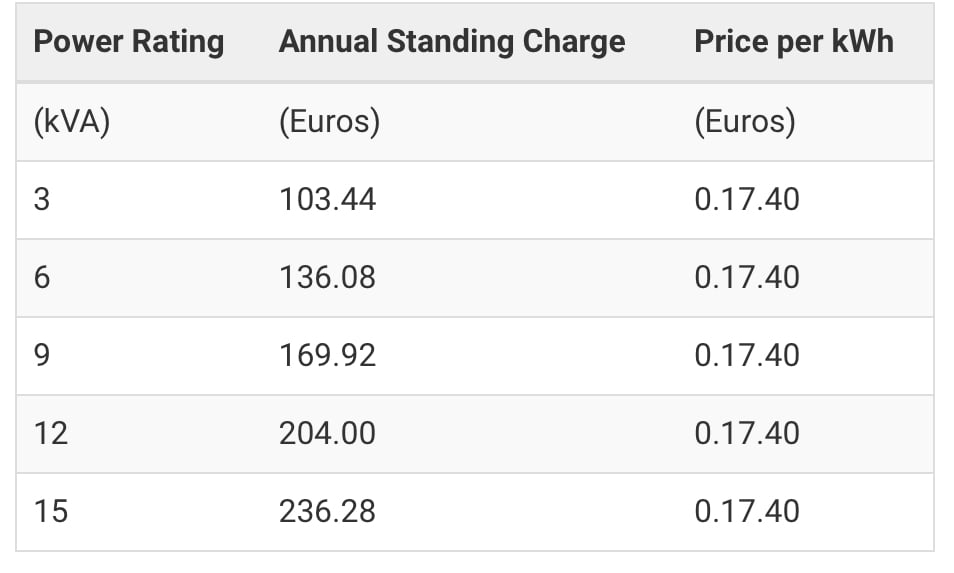
And the French model: (note the standing charge increases as the power limit increases but the unit price remains the same)
2
![[Deleted User]](https://us-noi.v-cdn.net/6031891/uploads/defaultavatar/nFA7H6UNOO0N5.jpg)






Confirm your email address to Create Threads and Reply

Categories
- All Categories
- 354K Banking & Borrowing
- 254.3K Reduce Debt & Boost Income
- 455.2K Spending & Discounts
- 247K Work, Benefits & Business
- 603.6K Mortgages, Homes & Bills
- 178.3K Life & Family
- 261.1K Travel & Transport
- 1.5M Hobbies & Leisure
- 16.1K Discuss & Feedback
- 37.7K Read-Only Boards