We’d like to remind Forumites to please avoid political debate on the Forum.
This is to keep it a safe and useful space for MoneySaving discussions. Threads that are – or become – political in nature may be removed in line with the Forum’s rules. Thank you for your understanding.
📨 Have you signed up to the Forum's new Email Digest yet? Get a selection of trending threads sent straight to your inbox daily, weekly or monthly!
The Forum now has a brand new text editor, adding a bunch of handy features to use when creating posts. Read more in our how-to guide
Underfloor Heating Setting
Comments
-
Thank you, I think to a large extent you're both right, I was misremembering so thanks for calling that out.
Thats said; you probably do want your flow to be 65 or thereabouts to reduce the risk of Legionnaires' disease because you want your hot water to reach this temp, if your flow is 50 degrees your hot water will never be greater than 50 degrees. Also, if you do reduce your flow then you need to make sure your hot water thermostat in the tank is set lower than the flow temp, otherwise the boiler will be cycling which isn't efficient or good for it. (None of this applies to a combi)
I'm not sure it's strictly true to say the lower you put the temp the more efficient it becomes because you definitely need a fair temperature differential between the flow and return and from a practical stand point; you also need to make sure that the flow into the furtherest radiator is sufficiently warm.
Like any system there will be an efficiency sweet spot and I suspect it will depend on the system and flow/return differential and like I say I think you're both right it can be lower; but I also think it needs to be balanced against health (to the extent you're worried about Legionnaires' disease).
Good discussion!
0 -
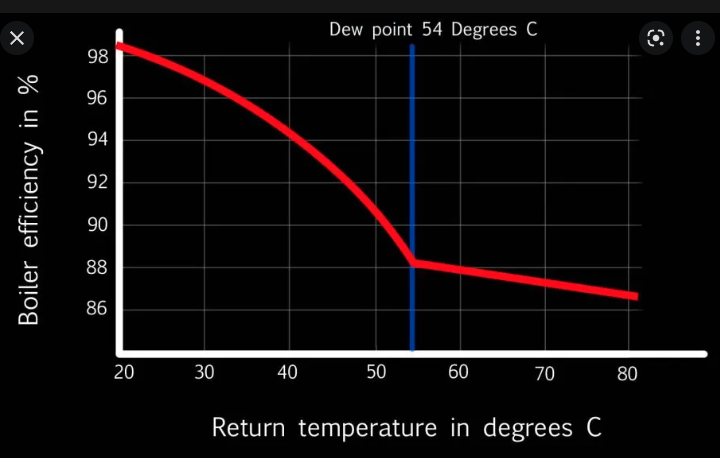
It is true that a lower return temp has better efficiency condensing wise, but its also true that the lower the flow temp, the lower the watts a radiator will emit, and therefore the slower the house will heat up. There should be a 20c difference between flow and return.Most radiator headline wattage output is still quoted at a flow temp of 75c, with a delta of 20c, this means that a boiler will never condense, as this would be 55c. So as the post above says, there is a sweet spot to be found with boiler flow, condensing efficiency, radiator balancing and comfort.
 0
0 -
Olly_J said:There should be a 20c difference between flow and return.I'd like to see a citation for this claim, and an explantion of why a temperature difference of 20C is better than 15C, 10C or 5C.N. Hampshire, he/him. Octopus Intelligent Go elec & Tracker gas / Vodafone BB / iD mobile. Ripple Kirk Hill Coop member.Ofgem cap table, Ofgem cap explainer. Economy 7 cap explainer. Gas vs E7 vs peak elec heating costs, Best kettle!
2.72kWp PV facing SSW installed Jan 2012. 11 x 247w panels, 3.6kw inverter. 35 MWh generated, long-term average 2.6 Os.0 -
There is no fundamental reason why a 20 C temperature difference is better but under certain circumstances you might struggle to achieve a temperature difference that is a lot less.QrizB said:Olly_J said:There should be a 20c difference between flow and return.I'd like to see a citation for this claim, and an explantion of why a temperature difference of 20C is better than 15C, 10C or 5C.
Heat pumps generally aim for a temperature difference of 5 C. This is because with a heat pump you want to use a low output water temperature and a small temperature differential maximises the average radiator temperature and hence the radiator output. To achieve a small temperature differential you need a higher water flow rate, which might not be achievable with micro-bore piping.Reed0 -
One of the reasons for a delta of 20c that is often quoted in condensing boiler manuals is to stop boiler short cycling, where the burner fires, usually at maximum output for a few seconds and reaches the set flow temp, either before it can modulate down, or cannot modulate down enough, so it will then cut out, and a minute or two later start back up once the temp decreases, which is short cycling and can lower boiler lifespan, as well as being less efficient. Conversely having a flow differential too high, above 25c will also lead to cut outs.Essentially that 20C delta is simply the result in how much heat is being emitted from your radiators during the circulation of the water, if it is too low, it means not enough heat was transferred to the rads i.e. not enough time to transfer heat, the radiators are not balanced or undersized, oversized boiler, or the pump is too fast. Too high a delta return is the reverse problem.Obviously the same principles probably don't apply to heat pumps as the above post saysHalf decent article herewww.theintergasshop.co.uk/content/187-why-your-new-gas-boiler-isnt-efficient
0 -
Olly_J said:Half decent article here
www.theintergasshop.co.uk/content/187-why-your-new-gas-boiler-isnt-efficientThat article says that a 20C differential is to allow lower flow speeds, which seems a bit back-to-front.Condensing boilers are typically designed to a ΔT of 20°C. This means the water flow rate through the heating system is much slower, pump sizing can be smaller, and pipework can be smaller verses a boiler built pre-2005. Having less flow rate allows the water to stay in radiators longer to exchange the energy the boiler has put into the system.Lower flow results in higher differential temperatures, I agree, but this is just a way to get the return temp down to 50C. If your flow temp is 55C you only need a 5C differential to get a return temp of 50C.I'm going to drop this now, it's almost entirely unrelated to the OP's original question of how to set their underfloor heating.N. Hampshire, he/him. Octopus Intelligent Go elec & Tracker gas / Vodafone BB / iD mobile. Ripple Kirk Hill Coop member.Ofgem cap table, Ofgem cap explainer. Economy 7 cap explainer. Gas vs E7 vs peak elec heating costs, Best kettle!
2.72kWp PV facing SSW installed Jan 2012. 11 x 247w panels, 3.6kw inverter. 35 MWh generated, long-term average 2.6 Os.0 -
Lower flow speed = more time for heat transfer from water to radiator, cooler water goes back to the boiler return.If you had a 5c differential, that means that your radiators are only putting out enough watts to dissipate that 5c, meaning your house will heat up more slowly than if you were set to dissipate 20c. That's why you want to water to stay in the radiator for enough time for that to happen, the rad valves need to be balanced to restrict the flow speed enough for that to happen. It also means your boiler will cut out frequently as it will exceed the flow temp setting each time the burner ignites, as the boiler is measuring flow and return to ensure they stay within its set tolerance range.0
-
Olly_J said:If you had a 5c differential, that means that your radiators are only putting out enough watts to dissipate that 5c, meaning your house will heat up more slowly than if you were set to dissipate 20c. That's why you want to water to stay in the radiator for enough time for that to happen, the rad valves need to be balanced to restrict the flow speed enough for that to happen. It also means your boiler will cut out frequently as it will exceed the flow temp setting each time the burner ignites, as the boiler is measuring flow and return to ensure they stay within its set tolerance range.I said I was out but I feel obliged to state that none of that is true, and it should be self-evident to you that it isn't.N. Hampshire, he/him. Octopus Intelligent Go elec & Tracker gas / Vodafone BB / iD mobile. Ripple Kirk Hill Coop member.Ofgem cap table, Ofgem cap explainer. Economy 7 cap explainer. Gas vs E7 vs peak elec heating costs, Best kettle!
2.72kWp PV facing SSW installed Jan 2012. 11 x 247w panels, 3.6kw inverter. 35 MWh generated, long-term average 2.6 Os.0 -
The time it takes for heat to transfer from one medium to another is proportional to the temperature difference between them (called deltaT),. If you reduce the temperature of a radiator then you reduce the temperature difference between it and the surrounding air and it will therefore take longer to heat the same space unless you increase the radiator size to compensate.
The same goes for underfloor heating which generally runs at much lower temperatures than radiators or around 27-30 degrees which means that the delta T is only about 10 degrees or less (room 20, floor at 30 = deltaT 10) so you need to run it for a lot longer although generally the floor area is much larger than the area of a radiator and the dissipation is usually quoted i watts/m2 at a certain flow/return temp. Have a shufti here for a bit more info - Underfloor Heating: Pros and Cons, Plus How Much it Costs | Homebuilding
This shows the relation ship between u/f output v flow temp, pipe diameter and spacing - Underfloor Heating Heat Output Tables - Trading Depot | Trading Depot
This graph show the derating factors that apply to radiators based on a delta T of 50 degrees (ie a room temp of 20 degrees and a rad temp of 70 degrees (80 in and 60 out)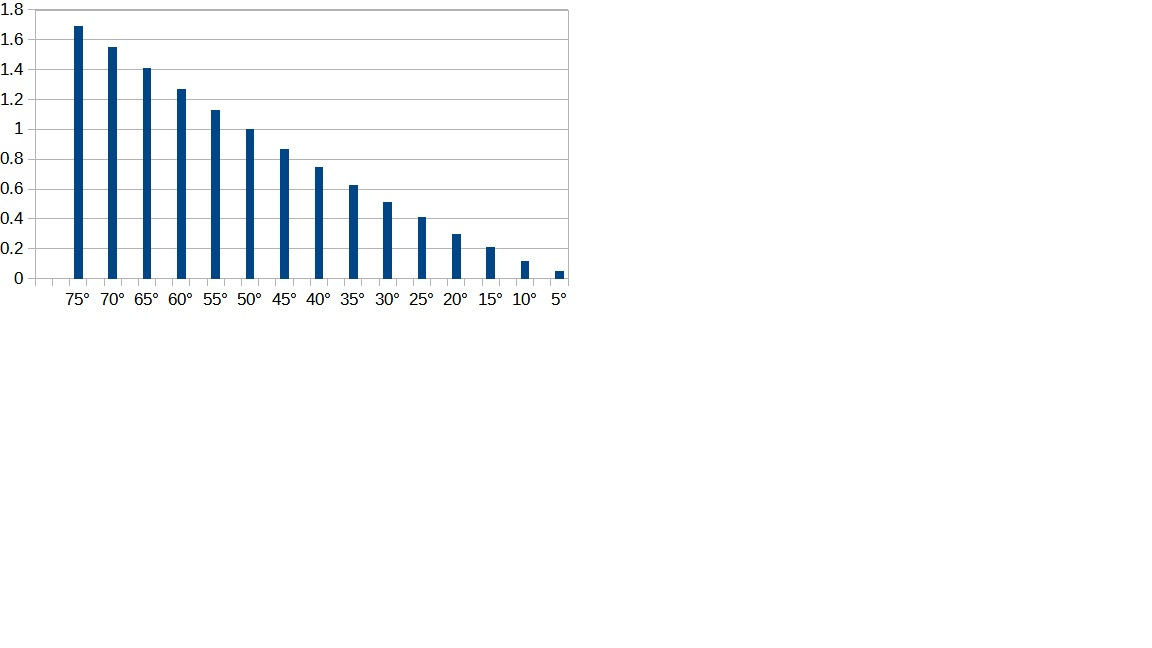 Never under estimate the power of stupid people in large numbers0










Confirm your email address to Create Threads and Reply

Categories
- All Categories
- 353.5K Banking & Borrowing
- 254.1K Reduce Debt & Boost Income
- 455K Spending & Discounts
- 246.5K Work, Benefits & Business
- 602.9K Mortgages, Homes & Bills
- 178K Life & Family
- 260.5K Travel & Transport
- 1.5M Hobbies & Leisure
- 16K Discuss & Feedback
- 37.7K Read-Only Boards