We’d like to remind Forumites to please avoid political debate on the Forum.
This is to keep it a safe and useful space for MoneySaving discussions. Threads that are – or become – political in nature may be removed in line with the Forum’s rules. Thank you for your understanding.
📨 Have you signed up to the Forum's new Email Digest yet? Get a selection of trending threads sent straight to your inbox daily, weekly or monthly!
The Forum now has a brand new text editor, adding a bunch of handy features to use when creating posts. Read more in our how-to guide
Starmer cap freeze £10bn shortfall ?
Comments
-
Just do the sums for the 14 billion from the £400 grant they earmarked for their plan. Either we have suddenly 35 million households instead of 28.1 million, or it is only £ 11.2 that is available to be used.Effician said:It does make you wonder who checks their costings before announcing to the country their plans, to be a serious contender for gov't you at least need the sums to add up to be considered credible.The problem with speculative sensationalist & misleading claims is that it often hurts the people it's aimed at helping.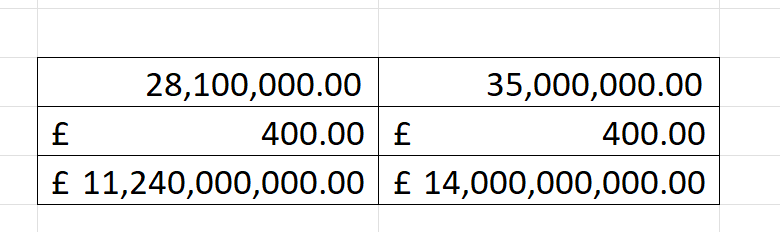
2 -
If prices fall & presume there will be some restriction on new suppliers entering the market offering lower rates[Deleted User] said:When energy prices fall, suppliers would not pass on the savings. These would be used to repay the loan.
0 -
That would essentially be a massive increase of the £200-loan-not-loan scheme (which later turned into a £400 grant) that was incredibly unpopular. Hard to see this gaining much traction with a new PM, they will want a win for their first policies, not something that has proven unpopular - especially among Conservative voters - just a few months ago.[Deleted User] said:There is a more robust plan on the table where Government money is not directly involved. Centrica (BG) and Octopus have suggested that prices should be frozen at the present Ofgem Cap for 2 years. The suppliers would take out a commercial loan - underwritten by Government - which suppliers would draw on to recover lost income.When energy prices fall, suppliers would not pass on the savings. These would be used to repay the loan.
In my opinion, this could prove to be popular with politicians as it involves no public money. It would have an impact inflation which a 6 month Cap wouldn’t. Moreover, it would enable Government to provide extra support to the vulnerable; to the care sector; to small businesses all of whom are badly impacted by high energy prices/inflation. The plan was discussed at the Ministerial meeting last week.
So far, neither PM candidate has come up with any plan which - as the Army would put it - would withstand the first contact with the enemy.2 -
Energy industry suggests price-fixing scheme that involves them charging more for longer. It would also mean that they can raise the behind-the-scenes price without the public having to pay it immediately, presumably they're hoping this means that they face less scrutiny.Hopefully that suggestion is treated with the contempt it deserves.0
-
Lets look at a very basic example how this could work.
Lets say next year the average cap will be 4000, they freeze at 2000. so they need to borrow £2000 for the famous average user. 2024 will be better, cap is down to 3000, they only need to borrow another 1000. £3000 owed now. 2025 even better we are back at £2000, no further loan, nothing paid back. From 2026 the cap is down to £1500, they start to pay back. For the next 6 years if nothing happens to the cap!
Who is going to pay the interest?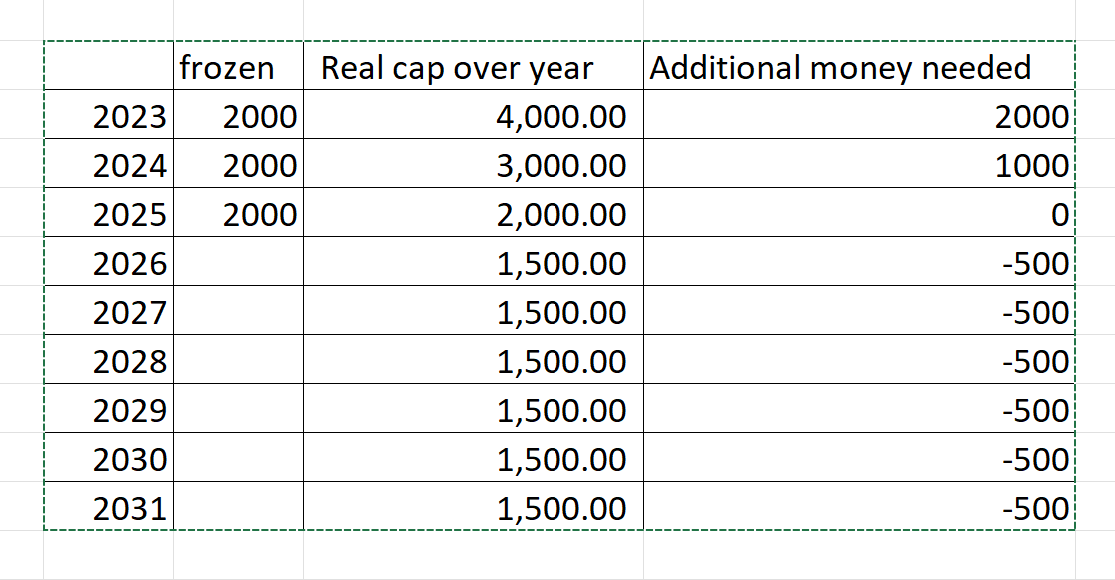
And how likely is it that the cap would stay the same and would not increase slowly again.
And what happens if the cap never comes back down to below £2000 so we can begin to pay back?
2 -
pochase said:Lets look at a very basic example how this could work.
Lets say next year the average cap will be 4000, they freeze at 2000. so they need to borrow £2000 for the famous average user. 2024 will be better, cap is down to 3000, they only need to borrow another 1000. £3000 owed now. 2025 even better we are back at £2000, no further loan, nothing paid back. From 2026 the cap is down to £1500, they start to pay back. For the next 6 years if nothing happens to the cap!
Who is going to pay the interest?
And how likely is it that the cap would stay the same and would not increase slowly again.
And what happens if the cap never comes back down to below £2000 so we can begin to pay back?
This scenario would hand a big advantage to the true green energy suppliers that are not beholding to the cap when prices do fall.
0 -
I think it was rushed out as soon as Starmer got back from his holidays so that Labour could keep running with their attack of "look we have a plan and the Tories don't", whilst ignoring the fact that the Conservatives original cost of living plan is already in motion (albeit it is based on a lower predicted cap and will need tweaking when the new PM is crowned.)Effician said:It does make you wonder who checks their costings before announcing to the country their plans, to be a serious contender for gov't you at least need the sums to add up to be considered credible.The problem with speculative sensationalist & misleading claims is that it often hurts the people it's aimed at helping.5 -
You forgot the words 'fully costed'I think it was rushed out as soon as Starmer got back from his holidays so that Labour could keep running with their attack of "look we have a plan and the Tories don't", whilst ignoring the fact that the Conservatives original cost of living plan is already in motion (albeit it is based on a lower predicted cap and will need tweaking when the new PM is crowned.) 0
0 -
Starmer can promise free gas & electricity to everyone if he wants, he’s in no position to deliver so it makes no difference what he comes up with2
-
I think everyone expects energy prices to increase over time, if someone said to me to day that in 10 years the cap will be £4000 then I would not be shocked, I would hope that by that time I was earning alot more than today and those on pensions / benefits have also seen annual increases.pochase said:Lets look at a very basic example how this could work.
Lets say next year the average cap will be 4000, they freeze at 2000. so they need to borrow £2000 for the famous average user. 2024 will be better, cap is down to 3000, they only need to borrow another 1000. £3000 owed now. 2025 even better we are back at £2000, no further loan, nothing paid back. From 2026 the cap is down to £1500, they start to pay back. For the next 6 years if nothing happens to the cap!
Who is going to pay the interest?
And how likely is it that the cap would stay the same and would not increase slowly again.
And what happens if the cap never comes back down to below £2000 so we can begin to pay back?
It's the rate that prices have increased in such a short time that has been the problem, but we could have a situation where energy does get cheaper and the cap still increases to pay back the loan.0








Confirm your email address to Create Threads and Reply

Categories
- All Categories
- 354K Banking & Borrowing
- 254.3K Reduce Debt & Boost Income
- 455.2K Spending & Discounts
- 247K Work, Benefits & Business
- 603.6K Mortgages, Homes & Bills
- 178.3K Life & Family
- 261.1K Travel & Transport
- 1.5M Hobbies & Leisure
- 16.1K Discuss & Feedback
- 37.7K Read-Only Boards