We’d like to remind Forumites to please avoid political debate on the Forum.
This is to keep it a safe and useful space for MoneySaving discussions. Threads that are – or become – political in nature may be removed in line with the Forum’s rules. Thank you for your understanding.
📨 Have you signed up to the Forum's new Email Digest yet? Get a selection of trending threads sent straight to your inbox daily, weekly or monthly!
Ditching gas, going electric immersion only, a wee project
Comments
-
Excellent news Solar buddy!Not sure how you fitting a control valve makes the flooring/room warmer though. I would expect it to prevent over heating....unless you now have it on for longer?Your extra destrat presumable makes for better heat transfer from immersion to water.What's the next project for when you are not wizzing around on your electric wheels? Starting a new thread? We all need a new challange. Maybe converting an ICE machine into an EV?1
-
"One saving grace us that the house consumption should [ is assumed to] not run at max all the time"Heedtheadvice said:Qyburn said:
If that's referring to my post, 100A is rating of the fuse itself, as removed/refitted during one of the meter swaps.Heedtheadvice said:It should be noted that the fuse holder is often labelled 100A as that is it's capability. The actual fuse historically could often be 60A .....so the actual rating needs fuse inspection.Not at all. Just a general comment for anyone reading the thread.It would be very easy to see the label and make, to my mind, a reasonable layman's interpretation ( but incorrectly) that it was showing the fitted fuse rating!I also agree with micheals that modern consumption trend means that we will be more frequently running at [property supply current]max or greater than fuse current rating..and hence another need to get the grid supply upgraded. One saving grace us that the house consumption should [ is assumed to] not run at max all the time and calculations have always relied upon an assumed diversification.It would help in this respect if things like dishwashers and washing machines were not started at the same time. They draw high current levels intermittently particularly during their cycles at the early stages and especially for dishwashers latterly whilst drying. Staggered starting helps diversification.Edits: main points within [] brackets for better clarification.
Not sure about that! When bi directional EV charging kicks off next year you'll find cars charging at 12kWs for 5 off peak hours then immediately swapping to discharging for 10 hours, if not longer due to natural export from solar panels. Big changes needed..0 -
Qyburn said:We have a 100A fuse in the cutout, but we're served by a 16kVA transformer (data plate also says 64A so I'm not sure if the supply is 64A or 66).The rating plate will assume it's been tapped to 250V, as 250 x 64 = 16000. That way, if it's feeding a long overhead wire to the house, there's a good chance of getting at least 230V with lots of electrics turned on in the house.The supply in the UK used to be 240V ±6%. So they wanted to keep it between 227 and 253 across all loads.In reality, pole pig transformers can be overloaded quite a lot for short periods, especially in winter when they are less likely to overheat.
If it sticks, force it.
If it breaks, well it wasn't working right anyway.1 -
Solarchaser said:A wee update.
Since fitting the ufh thermostatic valve, wife is definitely happier with heat level in the house.
Last week was between 5C and -5C pretty much all week, so was a good test of the system, and I was delighted to have a situation where the wife said they house was bloody roasting and so we have reduced the 20.5C thermostat setting to 19.5C.
With the addition of the sunamp for the showers, im now able to run the heating system down as far as 40C, as it is still keeping up with demand, but the sunamp can supply the showers with 65C.
This has given me another 10kwh of useable heat from the same size of tank, as I previously had to keep above 50C or the showers would be not skin scaldingly hot for the females of the house.
It did however highlight a problem I hadn't foreseen.
I've always known the smaller tank had a stratification issue, and so when it tells me it's really hot, it really only means the top 2/3rds are hot.
For this reason id installed a pump between the two tanks to circulate water once the main tank got up to temperature.
However I found out last week that the main tank was not getting up to temperature until about 20 mins before the end of my off peak electricity, and so when it ran the destratification it mixed both tanks but without the ability to continue heating.
So instead I've set the Eddi to control the pump like a heater and have it come on for 15 mins 3 times during the heating cycle, and so far (just under a week) it's working very well.
So i think after 3 years of messing about... I may just have reached the point of it coming out of project phase, and just working. 🤞🤞🤞
Well done SC a great project and all credit to you for sticking with it during all the ups and downs. It's kept me pleasantly entertained through out and have nothing but great respect for arriving at completion.East coast, lat 51.97. 8.26kw SSE, 23° pitch + 0.59kw WSW vertical. Nissan Leaf plus Zappi charger and 2 x ASHP's. Givenergy 8.2 & 9.5 kWh batts, 2 x 3 kW ac inverters. Indra V2H . CoCharger Host, Interest in Ripple Energy & Abundance.1 -
I previously (last year) Replaced a gate valve that I was using to blend the central heating water, with a thermostatic valve to give a consistent amount of heat.Heedtheadvice said:Excellent news Solar buddy!Not sure how you fitting a control valve makes the flooring/room warmer though. I would expect it to prevent over heating....unless you now have it on for longer?Your extra destrat presumable makes for better heat transfer from immersion to water.What's the next project for when you are not wizzing around on your electric wheels? Starting a new thread? We all need a new challange. Maybe converting an ICE machine into an EV?
I used a hot water valve to do it, but the hot water valve topped out about 50C which meant thermal transfer to the radiators was ending up around 45C radiators (iirc) which in the depths of winter just wasn't enough of a temperature delta to heat the house.
Around a month ago I replaced that with an under floor heating valve which has a maximum of 60c, and my good lady tested the radiator until she was happy that they were giving enough heat, which ended around 56C according to the valve.
The extra destrat does exactly that.
This was two weeks ago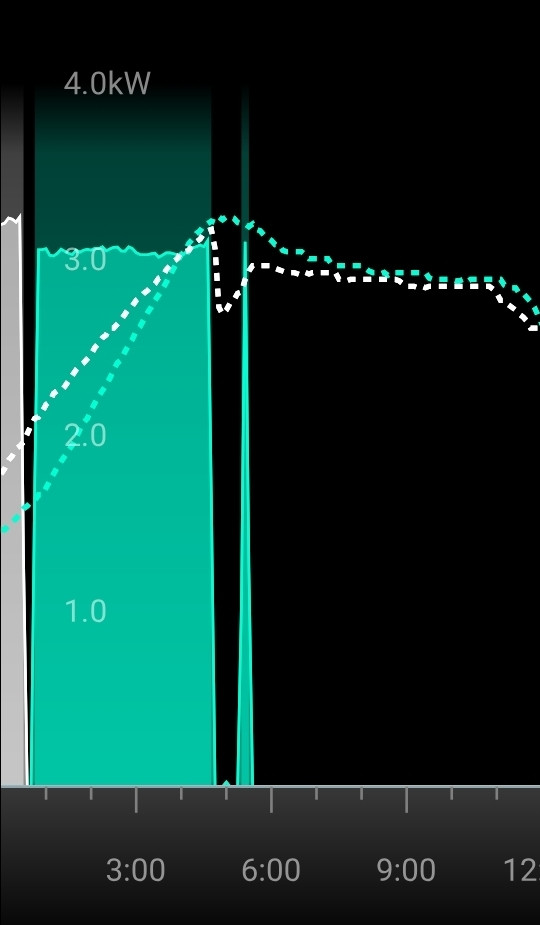
You can see at 5am the destrat happens and the second tank (white) drops significantly straight away, and the 1st tank in green continues to drop over the course of a couple of hours.
When you compare to yesterday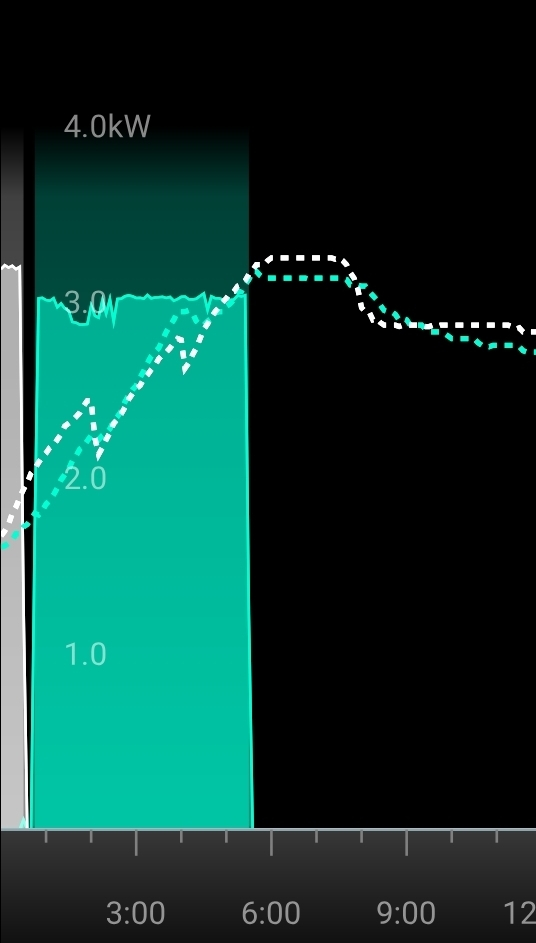
You can see the 1st destrat at 2am, another at 4am, and there is a 3rd at 5am which makes very little difference assumably because it's well mixed, and the difference here is that the heat is up at 85C until the heating kicks in at 7:30 instead of dropping away.
The next challenge... oh man, I just wanna chill and enjoy doing nothing.
Yeah, no it's actually what you suggest.
I'm going to put my track car back on the road for a couple of years, and in those couple of years I'll prepare for the conversion which will indeed be coming, I need to replace both sills and a few other bits n bobs, so seems a good point in time to make those sills a little deeper so they can accommodate battery packs.
The good thing about the heating project is that in the last 3 years the second hand car battery market has plummeted and so the 20k i was looking at spending 3 years ago is more like 6k on batteries now.
Not sure about a project thread though, I think this one has just served to show I started out with expectations based on false assumptions, made alot of the wrong choices and made myself look and feel very silly doing it, (i got caught out by thermosyphon on 3 seperate occasions, thats just embarrassing) not to mention the cost and pain.
The thermostatic valves cost about £50 each, but changing and bending all the pipes etc must have been 4-5 days crawling around under the house, and at least the same cost again in pipes, fittings, solder and gas.
Hopefully in a year or so I'll have forgotten all of that and be daft enough to do something else 😂
West central Scotland
4kw sse since 2014 and 6.6kw wsw / ene split since 2019
24kwh leaf, 75Kwh Tesla and Lux 3600 with 60Kwh storage1 -
Great info there and actual data to prove how the changes have made an improvement.I would say you deserve a rest for a few days till your other half comes up with an idea to stop you feeling bored!!I think you do yourself a disservice. Most would not tackle such a project ( me included ) and you must have gone through a big learning process, successfully.Congrats.1
-
pensionpawn said:
"One saving grace us that the house consumption should [ is assumed to] not run at max all the time"Heedtheadvice said:Qyburn said:
If that's referring to my post, 100A is rating of the fuse itself, as removed/refitted during one of the meter swaps.Heedtheadvice said:It should be noted that the fuse holder is often labelled 100A as that is it's capability. The actual fuse historically could often be 60A .....so the actual rating needs fuse inspection.Not at all. Just a general comment for anyone reading the thread.It would be very easy to see the label and make, to my mind, a reasonable layman's interpretation ( but incorrectly) that it was showing the fitted fuse rating!I also agree with micheals that modern consumption trend means that we will be more frequently running at [property supply current]max or greater than fuse current rating..and hence another need to get the grid supply upgraded. One saving grace us that the house consumption should [ is assumed to] not run at max all the time and calculations have always relied upon an assumed diversification.It would help in this respect if things like dishwashers and washing machines were not started at the same time. They draw high current levels intermittently particularly during their cycles at the early stages and especially for dishwashers latterly whilst drying. Staggered starting helps diversification.Edits: main points within [] brackets for better clarification.
Not sure about that! When bi directional EV charging kicks off next year you'll find cars charging at 12kWs for 5 off peak hours then immediately swapping to discharging for 10 hours, if not longer due to natural export from solar panels. Big changes needed..
Quite. A very valid point that the old assumptions about diversification are going to apply less and less on some properties grid power.1





Confirm your email address to Create Threads and Reply

Categories
- All Categories
- 355.6K Banking & Borrowing
- 254.8K Reduce Debt & Boost Income
- 456.1K Spending & Discounts
- 248.2K Work, Benefits & Business
- 605.8K Mortgages, Homes & Bills
- 179K Life & Family
- 263.5K Travel & Transport
- 1.5M Hobbies & Leisure
- 16.1K Discuss & Feedback
- 37.7K Read-Only Boards