We’d like to remind Forumites to please avoid political debate on the Forum.
This is to keep it a safe and useful space for MoneySaving discussions. Threads that are – or become – political in nature may be removed in line with the Forum’s rules. Thank you for your understanding.
Price vs. Total Return on bond funds
Comments
-
Here we are talking about safe developed world government bonds. Other bonds behave differently.aroominyork said:JohnWinder said:Did you have some strategy in mind?Not a tactical trading one, No. My bonds are skewed towards corporate and I want to hold more gilts/govt. Options are index (either aggregate, eg Vanguard Global Bind Index, or govt eg IGLH) or an actively managed fund. Merian is mostly govt so might fit the bill; my question was based on mulling whether the recent price rise mostly i) is an indication that the manager has done well at predictably the global macro environment, ii) suggests the fund is overpriced (ie trading at a premium) and might re-set.Linton said:As @JohnWinder says, in an ideal world where interest rates are constant bond prices would remain constant and the total return would simply arise from the interest and reinvestment of the interest.Why is that ideal? Why shouldn’t people want fund managers to identify bonds which will rise in price? Should the bond market only be made up of index funds?
Safe bonds behave in a the same predictable way given the interest rate. Increasingly major individual country interest rates broadly move together as we live in a global market. There aren't bonds that will do well in the future vs bonds that wont. Neither are there bonds that have been overlooked or mispriced by the market. Everything there is to know about a bond is known by everyone in the market. The only thing unknown is the future economic environment and if you can predict that why would you focus on bonds?
Apart from those bonds held by broad bond funds, bonds are generally bought by institutions and companies so that their characteristics match liabilities. For example a pension scheme paying a deferred pension in 20 years time will want to hold a range of bonds with at least that time to maturity. The Wealth Preservation funds and some multi asset funds will choose bonds with an eye on short/medium term volatility - for example CGT moved into short dated US inflation linked bonds. IIRC it was invested in Australian bonds for some time in the past as Australia was less affected by global monetary problems than other countries because of its large exports of raw materials.
In any case as we have seen bonds that rise excessively in price will also fall excessively in price. There is no point in buying volatile low return bonds. If you want high volatility and high return buy equities.0 -
Why shouldn’t people want fund managers to identify bonds which will rise in price?
They may well, and even better if the longer term return can be ahead of the pack. But the manager would need to predict the future better than the competition, surely. If the manager thought the yen would rise against the AUD, she could get in first and buy Australian bonds anticipating that the Japanese investors would take advantage of the falling dollar and thus be even more attracted to the better yielding Australian bonds than they already are. Or if the manager thought Russia might default on its bonds, the manager could sell their Russian bonds before that happened. Similarly, if they saw a stock crash coming they might pile into safe government bonds before everyone else did.
Merian is mostly govt so might fit the bill; my question was based on mulling whether its recent price rise mostly i) is an indication that the manager has done well at predictably the global macro environment, ii) suggests the fund is overpriced (ie trading at a premium) and might re-set.This is where I think your thinking (or definitions) differ from other posters'. I'll take your word that Merian has price risen more than comparable funds, but it can't trade at a premium in the way that a closed end fund can (as it's an open fund, isn't it?), so it can only be priced at what its assets are worth or someone would step in to make a killing with arbitrage - or can't that happen with this OEIC? Thus, the managers must be doing something right - at 1.4%/year in fees.
0 -
I think we agree it comes down to whether a bond fund manager can read the macroeconomic environment and trade accordingly to a meaningful degree (although I don't know where you get 1.4% fees from, JW; the more expensive ones hover around 0.7%). Linton, although you generally seem interested in govt rather than corporate bonds, you might say such trading equates to investing in volatile low return bonds which is not much different from investing in equities. I'm not sure it's that black & white. Actively managed funds do not only decide whether Company (or Country) A's debt looks safer and better priced than Company B's debt; they also trade based on the macroeconomic environment and, when you read their reports, it is absolutely clear that underpins their strategy. Do the long term results of most active bond managers revert to the mean? - that is what I am trying to fathom.0
-
Merian's price has risen over other Strategic Bond funds in the past 5 years but let's look at 10 years:
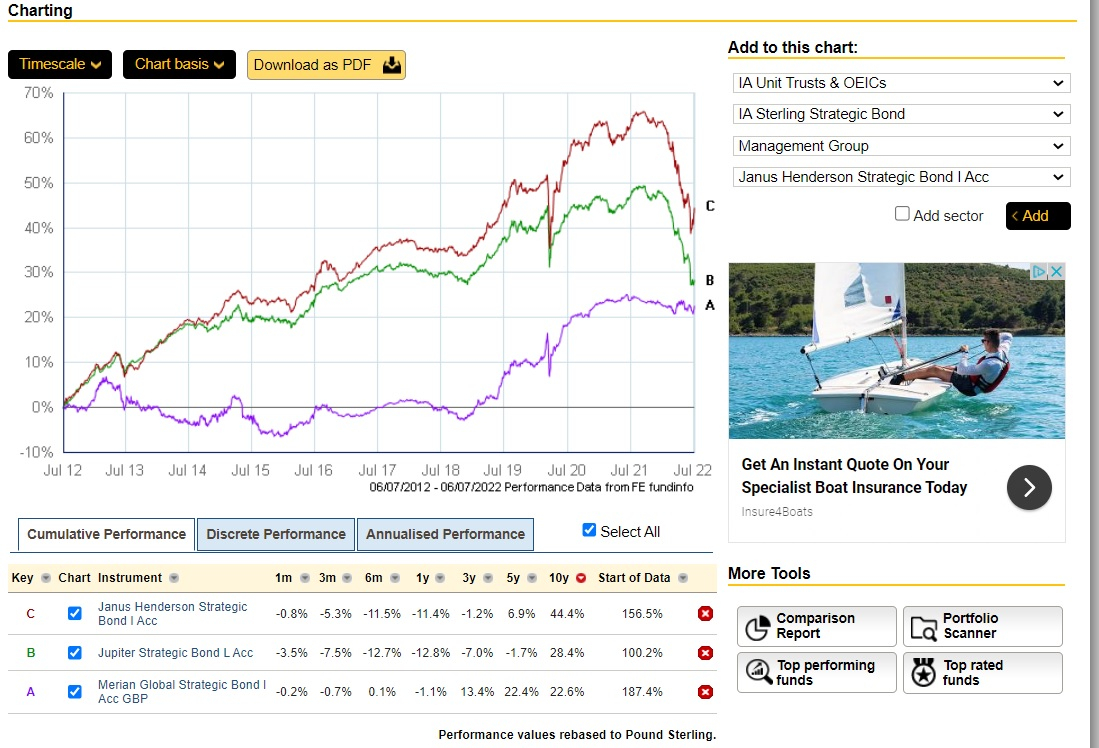
Clearly and simply Merian is a much more cautious fund. Over the first 7 years it managed to produce a 0% return, well below its competitors. So no evidence of unusually clever management unless you believe that in 2012 the manager foresaw what would happen 10 years later. Just as with equity funds you can choose your strategic bond fund on its risk level.
Note that all these funds are in the "Sterling Strategic Bond" sector and so could invest in a wide range of very different types of bond. For example Merian is 77% government bond whereas Janus Henderson is 28%.0 -
Come on Linton - you can do better than that. Why pick those two funds? Below is Merian against the sector, and since Merian's current manager started less than six years ago I am showing a five year view. I started by saying I was looking for more govt bonds (to balance my overweight corporates) so it's positioning might work for me.

0 -
Sure, if you are just working on a 5 year view then it would make sense to avoid excess risk. Personally, for short/medium term timeframes I use CGT. I am happy for the fund manager to choose appropriate bonds and other investments for the purpose.aroominyork said:Come on Linton - you can do better than that. Why pick those two funds? Below is Merian against the sector, and since Merian's current manager started less than six years ago I am showing a five year view. I started by saying I was looking for more govt bonds (to balance my overweight corporates) so it's positioning might work for me.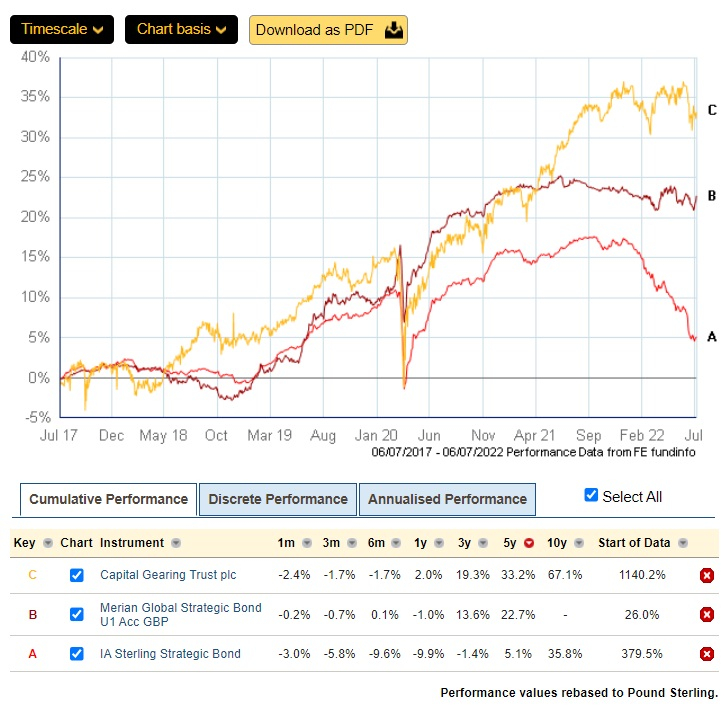
0 -
I am not looking for a five year investment but for a govt-heavy FI fund as part of my overall portfolio. I only showed five years because it coincides with the current manager's tenure.I am also a CGT fan but since it holds a good chunk of equities I would not compare it to a bond fund; the best comparison might be VLS40.0
-
https://www.jupiteram.com/uk/en/individual/product-page/merian-global-strategic-bond-fund-l-gbp-acc/aroominyork said:..I don't know where you get 1.4% fees from, JW; t……Do the long term results of most active bond managers revert to the mean? - that is what I am trying to fathom.
I think that’s where, but it reads 1.15/%, sorry for the mistake. Perhaps the ‘initial fee’ up to 4% muddled me. Some could swallow a 1.15%/yr fee without choking for an equity fund where you should get 6%/yr return; but for a bond fund that is more like 3%/yr which makes 1.15%/yr a bit less palatable.
No idea about mean reversion. Can’t recall having seen any data or read any well founded opinions. But isn’t it the same old story: they can’t all beat the market, so how do we identify the ones who will and will persistently?0 -
1.15% is the old dirty class. The clean class charges 0.65%. However I agree even that eats deep into likely returns from a bond fund, especially with trading costs on top. My two Royal London bond funds (Short Duration Credit and Short Duration Global Index Linked) charge 0.35% and 0.27% respectively, which feels much more comfortable.0
-
What duration bonds do you want? Which governments? Just UK , global, high or low risk, or perhaps all of the above chosen by the manager to achieve some stated objectives? What is your objective for your bond allocation? Different types of bond behave in different ways and are as diverse as equities. Though they have the advantage over equities of being easier to categorise.aroominyork said:I am not looking for a five year investment but for a govt-heavy FI fund as part of my overall portfolio. I only showed five years because it coincides with the current manager's tenure.I am also a CGT fan but since it holds a good chunk of equities I would not compare it to a bond fund; the best comparison might be VLS40.
A fund like CGT will choose very different bonds at different times to meet its goals. VLS40 has an arbitrary allocation which I would categorise as ballast. Its sole purpose is to stop the boat rocking too much. I believe that a significant allocation of your life savings is too important to use merely as ballast.1







Confirm your email address to Create Threads and Reply

Categories
- All Categories
- 354.7K Banking & Borrowing
- 254.5K Reduce Debt & Boost Income
- 455.5K Spending & Discounts
- 247.5K Work, Benefits & Business
- 604.4K Mortgages, Homes & Bills
- 178.6K Life & Family
- 262K Travel & Transport
- 1.5M Hobbies & Leisure
- 16.1K Discuss & Feedback
- 37.7K Read-Only Boards