We’d like to remind Forumites to please avoid political debate on the Forum.
This is to keep it a safe and useful space for MoneySaving discussions. Threads that are – or become – political in nature may be removed in line with the Forum’s rules. Thank you for your understanding.
📨 Have you signed up to the Forum's new Email Digest yet? Get a selection of trending threads sent straight to your inbox daily, weekly or monthly!
The Forum now has a brand new text editor, adding a bunch of handy features to use when creating posts. Read more in our how-to guide
Link between commercial REIT value and the company share value

jake_jones99
Posts: 258 Forumite



I am comparing two types of investment. First we have supermarket stock (ASDA, Tesco etc. - or an index tracking them). Second, we have the Real-Estate Investment Trusts (REITs) with a focus on commercial properties (such as Supermarket Income REIT). Clearly, if supermarkets do well, then they pay the rent on time and the corresponding REIT will also do well (that's the explanation I found so far). I've got 3 questions and would be very thankful for any insight:
1. If someone would like to bet on supermarkets doing well, would it make sense to go for REITs or supermarkets themselves?
2. Is the link between the REIT value and business performance that strong? (i.e., are rent defaults for big corporations so often and thus significant?)
3. Wouldn't the rent be "blind" to the success of the business, or would it go up/down depending on it?
1. If someone would like to bet on supermarkets doing well, would it make sense to go for REITs or supermarkets themselves?
2. Is the link between the REIT value and business performance that strong? (i.e., are rent defaults for big corporations so often and thus significant?)
3. Wouldn't the rent be "blind" to the success of the business, or would it go up/down depending on it?
0
Comments
-
1. Why do you have to choose? Buy both, but a Reit could be less volatile as it's more of a credit play than on how well a business trades.jake_jones99 said:I am comparing two types of investment. First we have supermarket stock (ASDA, Tesco etc. - or an index tracking them). Second, we have the Real-Estate Investment Trusts (REITs) with a focus on commercial properties (such as Supermarket Income REIT). Clearly, if supermarkets do well, then they pay the rent on time and the corresponding REIT will also do well (that's the explanation I found so far). I've got 3 questions and would be very thankful for any insight:
1. If someone would like to bet on supermarkets doing well, would it make sense to go for REITs or supermarkets themselves?
2. Is the link between the REIT value and business performance that strong? (i.e., are rent defaults for big corporations so often and thus significant?)
3. Wouldn't the rent be "blind" to the success of the business, or would it go up/down depending on it?
2. It will be a consideration, but a supermarket wouldn't have to default for it to affect a Reit e.g., there could be a programme of store closures. Recently warehouse related Reits took a knock on worries that Amazon is looking to scale back its number of warehouses.
3. Linked to concerns over a company's ability to pay and expectations for its or its sector's expansion/contraction. Another factor with property companies is the value of their properties. If property values plummet then their NAVs and concomitantly their shares prices will likely fall, too.
You might be aware of it but a popular pure play on this at the moment is Supermarket Reit, LSE:SUPR, but you're a bit late to the game as last I checked it's trading well over NAV, 130p vs. 113p NAV at the end of December 2021.
There are other things to think about, too, e.g., how leveraged they are, what it costs to service and the other company analysis related things.2 -
Thanks for the reply. So in your Amazon example is it fair to say you simply own a part of a warehouse buy buying a REIT? Then what happens if Amazon scales down and sells the warehouse? Do you own a smaller percentage of the remaining warehouses? Because if someone else buys the warehouse it will likely keep generating rent. I guess I get confused here because it seems it's not 100% property (it's closely linked to the company), but also not 100% company stock.wmb194 said:
1. Why do you have to choose? Buy both, but a Reit could be less volatile as it's more of a credit play than on how well a business trades.jake_jones99 said:I am comparing two types of investment. First we have supermarket stock (ASDA, Tesco etc. - or an index tracking them). Second, we have the Real-Estate Investment Trusts (REITs) with a focus on commercial properties (such as Supermarket Income REIT). Clearly, if supermarkets do well, then they pay the rent on time and the corresponding REIT will also do well (that's the explanation I found so far). I've got 3 questions and would be very thankful for any insight:
1. If someone would like to bet on supermarkets doing well, would it make sense to go for REITs or supermarkets themselves?
2. Is the link between the REIT value and business performance that strong? (i.e., are rent defaults for big corporations so often and thus significant?)
3. Wouldn't the rent be "blind" to the success of the business, or would it go up/down depending on it?
2. It will be a consideration, but a supermarket wouldn't have to default for it to affect a Reit e.g., there could be a programme of store closures. Recently warehouse related Reits took a knock on worries that Amazon is looking to scale back its number of warehouses.
3. Linked to concerns over a company's ability to pay and expectations for its or its sector's expansion/contraction. Another factor with property companies is the value of their properties. If property values plummet then their NAVs and concomitantly their shares prices will likely fall, too.
You might be aware of it but a popular pure play on this at the moment is Supermarket Reit, LSE:SUPR, but you're a bit late to the game as last I checked it's trading well over NAV, 130p vs. 113p NAV at the end of December 2021.
There are other things to think about, too, e.g., how leveraged they are, what it costs to service and the other company analysis related things.
Yes, LSE:SUPR is one of the REITs I'm watching. Indeed it's trading over NAV, but if you look at a wider time frame, it is not much farther from NAV than in 2021 overall (see below). I am not invested here, I consider other REITs and funds too, I am still getting the grips on how to asses these things, then I plan on investing over a longer time period (5-10 years).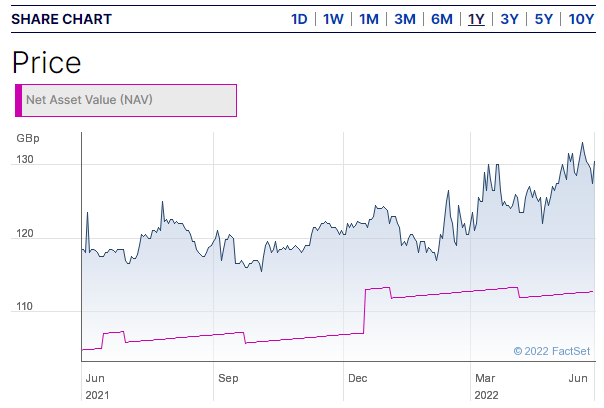
0 -
You own a share in a company that then owns assets and has to comply with certain laws as it has formed itself as a Real Estate Investment Trust. The same as any other company, you own a share of the future cashflows to the company, not any particular nut or bolt of anything it owns.jake_jones99 said:
Thanks for the reply. So in your Amazon example is it fair to say you simply own a part of a warehouse buy buying a REIT? Then what happens if Amazon scales down and sells the warehouse? Do you own a smaller percentage of the remaining warehouses? Because if someone else buys the warehouse it will likely keep generating rent. I guess I get confused here because it seems it's not 100% property (it's closely linked to the company), but also not 100% company stock.wmb194 said:
1. Why do you have to choose? Buy both, but a Reit could be less volatile as it's more of a credit play than on how well a business trades.jake_jones99 said:I am comparing two types of investment. First we have supermarket stock (ASDA, Tesco etc. - or an index tracking them). Second, we have the Real-Estate Investment Trusts (REITs) with a focus on commercial properties (such as Supermarket Income REIT). Clearly, if supermarkets do well, then they pay the rent on time and the corresponding REIT will also do well (that's the explanation I found so far). I've got 3 questions and would be very thankful for any insight:
1. If someone would like to bet on supermarkets doing well, would it make sense to go for REITs or supermarkets themselves?
2. Is the link between the REIT value and business performance that strong? (i.e., are rent defaults for big corporations so often and thus significant?)
3. Wouldn't the rent be "blind" to the success of the business, or would it go up/down depending on it?
2. It will be a consideration, but a supermarket wouldn't have to default for it to affect a Reit e.g., there could be a programme of store closures. Recently warehouse related Reits took a knock on worries that Amazon is looking to scale back its number of warehouses.
3. Linked to concerns over a company's ability to pay and expectations for its or its sector's expansion/contraction. Another factor with property companies is the value of their properties. If property values plummet then their NAVs and concomitantly their shares prices will likely fall, too.
You might be aware of it but a popular pure play on this at the moment is Supermarket Reit, LSE:SUPR, but you're a bit late to the game as last I checked it's trading well over NAV, 130p vs. 113p NAV at the end of December 2021.
There are other things to think about, too, e.g., how leveraged they are, what it costs to service and the other company analysis related things.
Yes, LSE:SUPR is one of the REITs I'm watching. Indeed it's trading over NAV, but if you look at a wider time frame, it is not much farther from NAV than in 2021 overall (see below). I am not invested here, I consider other REITs and funds too, I am still getting the grips on how to asses these things, then I plan on investing over a longer time period (5-10 years).In this example, Amazon wouldn't sell the warehouse, it would just cease to rent it and the Reit would continue to own it. The issue would be whether it could then find another renter, sell it and for what price, whether it could obtain the same level of rent, the same terms e.g., inflation linked and so on.I guess you've come across the AIC's website and its data tables? E.g., for 'commercial property' ITs: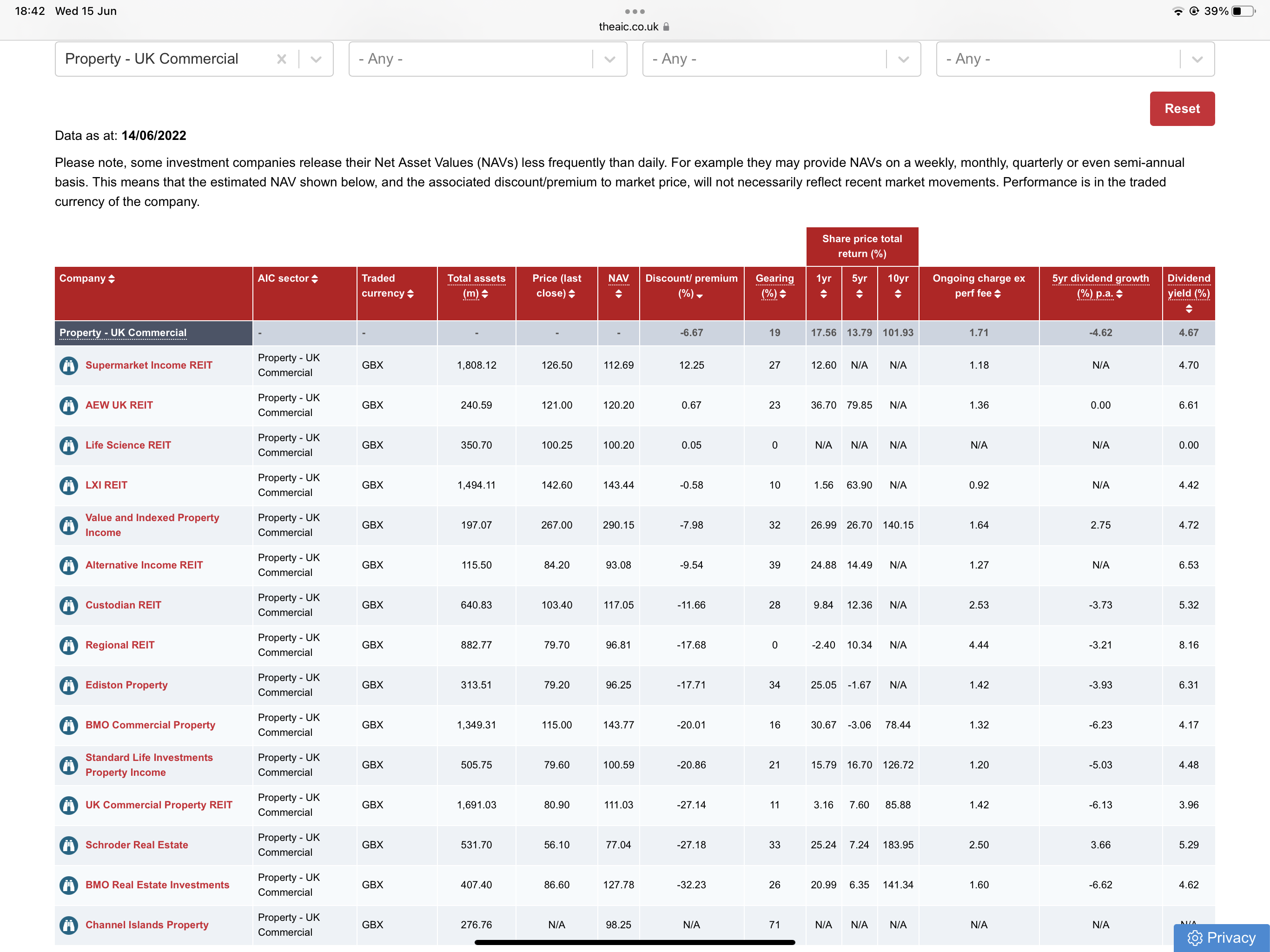
https://www.theaic.co.uk/aic/find-compare-investment-companies?sec=PUC&sortid=DiscFairCum&desc=true1 -
I get it, it's an intermediary between the company and the property. So if they need to change who rents it, it will likely be a gap leading to rent loss (as it happens for residential property). Thanks for the explanation.wmb194 said:
You own a share in a company that then owns assets and has to comply with certain laws as it has formed itself as a Real Estate Investment Trust. The same as any other company, you own a share of the future cashflows to the company, not any particular nut or bolt of anything it owns.jake_jones99 said:
Thanks for the reply. So in your Amazon example is it fair to say you simply own a part of a warehouse buy buying a REIT? Then what happens if Amazon scales down and sells the warehouse? Do you own a smaller percentage of the remaining warehouses? Because if someone else buys the warehouse it will likely keep generating rent. I guess I get confused here because it seems it's not 100% property (it's closely linked to the company), but also not 100% company stock.wmb194 said:
1. Why do you have to choose? Buy both, but a Reit could be less volatile as it's more of a credit play than on how well a business trades.jake_jones99 said:I am comparing two types of investment. First we have supermarket stock (ASDA, Tesco etc. - or an index tracking them). Second, we have the Real-Estate Investment Trusts (REITs) with a focus on commercial properties (such as Supermarket Income REIT). Clearly, if supermarkets do well, then they pay the rent on time and the corresponding REIT will also do well (that's the explanation I found so far). I've got 3 questions and would be very thankful for any insight:
1. If someone would like to bet on supermarkets doing well, would it make sense to go for REITs or supermarkets themselves?
2. Is the link between the REIT value and business performance that strong? (i.e., are rent defaults for big corporations so often and thus significant?)
3. Wouldn't the rent be "blind" to the success of the business, or would it go up/down depending on it?
2. It will be a consideration, but a supermarket wouldn't have to default for it to affect a Reit e.g., there could be a programme of store closures. Recently warehouse related Reits took a knock on worries that Amazon is looking to scale back its number of warehouses.
3. Linked to concerns over a company's ability to pay and expectations for its or its sector's expansion/contraction. Another factor with property companies is the value of their properties. If property values plummet then their NAVs and concomitantly their shares prices will likely fall, too.
You might be aware of it but a popular pure play on this at the moment is Supermarket Reit, LSE:SUPR, but you're a bit late to the game as last I checked it's trading well over NAV, 130p vs. 113p NAV at the end of December 2021.
There are other things to think about, too, e.g., how leveraged they are, what it costs to service and the other company analysis related things.
Yes, LSE:SUPR is one of the REITs I'm watching. Indeed it's trading over NAV, but if you look at a wider time frame, it is not much farther from NAV than in 2021 overall (see below). I am not invested here, I consider other REITs and funds too, I am still getting the grips on how to asses these things, then I plan on investing over a longer time period (5-10 years).In this example, Amazon wouldn't sell the warehouse, it would just cease to rent it and the Reit would continue to own it. The issue would be whether it could then find another renter, sell it and for what price, whether it could obtain the same level of rent, the same terms e.g., inflation linked and so on.I guess you've come across the AIC's website and its data tables? E.g., for 'commercial property' ITs:
https://www.theaic.co.uk/aic/find-compare-investment-companies?sec=PUC&sortid=DiscFairCum&desc=true
Also, I wasn't aware of the website thanks for sharing, it looks pretty up-to-date and complete so I will study it in more detail!0 -
Hi, thanks again for the link I've been studying the investments there and I have two quick questions:wmb194 said:
You own a share in a company that then owns assets and has to comply with certain laws as it has formed itself as a Real Estate Investment Trust. The same as any other company, you own a share of the future cashflows to the company, not any particular nut or bolt of anything it owns.jake_jones99 said:
Thanks for the reply. So in your Amazon example is it fair to say you simply own a part of a warehouse buy buying a REIT? Then what happens if Amazon scales down and sells the warehouse? Do you own a smaller percentage of the remaining warehouses? Because if someone else buys the warehouse it will likely keep generating rent. I guess I get confused here because it seems it's not 100% property (it's closely linked to the company), but also not 100% company stock.wmb194 said:
1. Why do you have to choose? Buy both, but a Reit could be less volatile as it's more of a credit play than on how well a business trades.jake_jones99 said:I am comparing two types of investment. First we have supermarket stock (ASDA, Tesco etc. - or an index tracking them). Second, we have the Real-Estate Investment Trusts (REITs) with a focus on commercial properties (such as Supermarket Income REIT). Clearly, if supermarkets do well, then they pay the rent on time and the corresponding REIT will also do well (that's the explanation I found so far). I've got 3 questions and would be very thankful for any insight:
1. If someone would like to bet on supermarkets doing well, would it make sense to go for REITs or supermarkets themselves?
2. Is the link between the REIT value and business performance that strong? (i.e., are rent defaults for big corporations so often and thus significant?)
3. Wouldn't the rent be "blind" to the success of the business, or would it go up/down depending on it?
2. It will be a consideration, but a supermarket wouldn't have to default for it to affect a Reit e.g., there could be a programme of store closures. Recently warehouse related Reits took a knock on worries that Amazon is looking to scale back its number of warehouses.
3. Linked to concerns over a company's ability to pay and expectations for its or its sector's expansion/contraction. Another factor with property companies is the value of their properties. If property values plummet then their NAVs and concomitantly their shares prices will likely fall, too.
You might be aware of it but a popular pure play on this at the moment is Supermarket Reit, LSE:SUPR, but you're a bit late to the game as last I checked it's trading well over NAV, 130p vs. 113p NAV at the end of December 2021.
There are other things to think about, too, e.g., how leveraged they are, what it costs to service and the other company analysis related things.
Yes, LSE:SUPR is one of the REITs I'm watching. Indeed it's trading over NAV, but if you look at a wider time frame, it is not much farther from NAV than in 2021 overall (see below). I am not invested here, I consider other REITs and funds too, I am still getting the grips on how to asses these things, then I plan on investing over a longer time period (5-10 years).In this example, Amazon wouldn't sell the warehouse, it would just cease to rent it and the Reit would continue to own it. The issue would be whether it could then find another renter, sell it and for what price, whether it could obtain the same level of rent, the same terms e.g., inflation linked and so on.I guess you've come across the AIC's website and its data tables? E.g., for 'commercial property' ITs:
https://www.theaic.co.uk/aic/find-compare-investment-companies?sec=PUC&sortid=DiscFairCum&desc=true
1. Are all trusts on the website you suggested REITs per se? Sometimes you can find it in the research section, but sometimes it's not very transparent. For example the "International Public Partnerships" fund is focused on infrastructure. I would assume it's not a REIT, but with somewhat similar characteristics? (i.e. closed-ended, 90% of income back to investors etc.)
2. On a different note, when the total return (TR) is announced on the website, I would assume fund charges are not considered (~1-2%). Would there be any other costs to include in the TR before jumping on board? (apart from the investment platform charges and taxes which I am aware of).
Thank you!
0 -
Published returns for investments are always after deduction of fund charges so when looking at performance you do not need to worry about them. As you say there will be other charges which you will need to deduct - eg dealing charges and platform charges.jake_jones99 said:
Hi, thanks again for the link I've been studying the investments there and I have two quick questions:wmb194 said:
You own a share in a company that then owns assets and has to comply with certain laws as it has formed itself as a Real Estate Investment Trust. The same as any other company, you own a share of the future cashflows to the company, not any particular nut or bolt of anything it owns.jake_jones99 said:
Thanks for the reply. So in your Amazon example is it fair to say you simply own a part of a warehouse buy buying a REIT? Then what happens if Amazon scales down and sells the warehouse? Do you own a smaller percentage of the remaining warehouses? Because if someone else buys the warehouse it will likely keep generating rent. I guess I get confused here because it seems it's not 100% property (it's closely linked to the company), but also not 100% company stock.wmb194 said:
1. Why do you have to choose? Buy both, but a Reit could be less volatile as it's more of a credit play than on how well a business trades.jake_jones99 said:I am comparing two types of investment. First we have supermarket stock (ASDA, Tesco etc. - or an index tracking them). Second, we have the Real-Estate Investment Trusts (REITs) with a focus on commercial properties (such as Supermarket Income REIT). Clearly, if supermarkets do well, then they pay the rent on time and the corresponding REIT will also do well (that's the explanation I found so far). I've got 3 questions and would be very thankful for any insight:
1. If someone would like to bet on supermarkets doing well, would it make sense to go for REITs or supermarkets themselves?
2. Is the link between the REIT value and business performance that strong? (i.e., are rent defaults for big corporations so often and thus significant?)
3. Wouldn't the rent be "blind" to the success of the business, or would it go up/down depending on it?
2. It will be a consideration, but a supermarket wouldn't have to default for it to affect a Reit e.g., there could be a programme of store closures. Recently warehouse related Reits took a knock on worries that Amazon is looking to scale back its number of warehouses.
3. Linked to concerns over a company's ability to pay and expectations for its or its sector's expansion/contraction. Another factor with property companies is the value of their properties. If property values plummet then their NAVs and concomitantly their shares prices will likely fall, too.
You might be aware of it but a popular pure play on this at the moment is Supermarket Reit, LSE:SUPR, but you're a bit late to the game as last I checked it's trading well over NAV, 130p vs. 113p NAV at the end of December 2021.
There are other things to think about, too, e.g., how leveraged they are, what it costs to service and the other company analysis related things.
Yes, LSE:SUPR is one of the REITs I'm watching. Indeed it's trading over NAV, but if you look at a wider time frame, it is not much farther from NAV than in 2021 overall (see below). I am not invested here, I consider other REITs and funds too, I am still getting the grips on how to asses these things, then I plan on investing over a longer time period (5-10 years).In this example, Amazon wouldn't sell the warehouse, it would just cease to rent it and the Reit would continue to own it. The issue would be whether it could then find another renter, sell it and for what price, whether it could obtain the same level of rent, the same terms e.g., inflation linked and so on.I guess you've come across the AIC's website and its data tables? E.g., for 'commercial property' ITs:
https://www.theaic.co.uk/aic/find-compare-investment-companies?sec=PUC&sortid=DiscFairCum&desc=true
1. Are all trusts on the website you suggested REITs per se? Sometimes you can find it in the research section, but sometimes it's not very transparent. For example the "International Public Partnerships" fund is focused on infrastructure. I would assume it's not a REIT, but with somewhat similar characteristics? (i.e. closed-ended, 90% of income back to investors etc.)
2. On a different note, when the total return (TR) is announced on the website, I would assume fund charges are not considered (~1-2%). Would there be any other costs to include in the TR before jumping on board? (apart from the investment platform charges and taxes which I am aware of).
Thank you!1 -
Supermarkets themselves, there is only a weak link between the fortunes of supermarkets and the fortunes of the companies that they rent their property from.jake_jones99 said:1. If someone would like to bet on supermarkets doing well, would it make sense to go for REITs or supermarkets themselves?
1 -
jake_jones99 said:I am comparing two types of investment. First we have supermarket stock (ASDA, Tesco etc. - or an index tracking them). Second, we have the Real-Estate Investment Trusts (REITs) with a focus on commercial properties (such as Supermarket Income REIT). Clearly, if supermarkets do well, then they pay the rent on time and the corresponding REIT will also do well (that's the explanation I found so far). I've got 3 questions and would be very thankful for any insight:
1. If someone would like to bet on supermarkets doing well, would it make sense to go for REITs or supermarkets themselves?
2. Is the link between the REIT value and business performance that strong? (i.e., are rent defaults for big corporations so often and thus significant?)
3. Wouldn't the rent be "blind" to the success of the business, or would it go up/down depending on it?1. If you think supermarkets will do well, you should buy their shares. The performance of the REIT are not correlated to the performance of their tenants.2. The NAV of a REIT is largely based on a cash flow basis, and assuming supply and demand are roughly in balance, it will be far more dependent on interest rates and inflation. Interest rates, as when rates rise and spreads widen, yields will need to increase to compensate the risks being taken which will put downward pressure on the NAV (and hence share price) unless they are able to raise rents. Inflation, because many REITs have rents that are index linked to inflation, although often with caps and collars. It is not uncommon to have upward only rent revisions linked to CPI or RPI, at a minimum of 1% and capped at 4%3. Largely it is unrelated. The business pays the rent which is likely linked to inflation. As the rent goes up, the tenant either absorbs it or passes it on to it's customers assuming they have sufficient pricing power to be able to do that. I suspect you have noticed most supermarkets are passing on costs to their customers at present rather than engaging in price wars to retain the last percentile of market share. If they can't afford to pay the rent and default, they get evicted and the REIT gets in new tenants. Having a large REIT with a well diversified range of tenants will help reduce risks of default. With supermarkets, it is unlikely Sainsbury's or Tesco will go bust. Tenants tend to pay their rent unless they are at risk of going under - for most people / businesses, the rent is the first thing that gets paid. Supermarkets are more likely to not pay suppliers than they are to not pay rent.REITs are generally considered to be a good source of inflation linked income. Picking a REIT that is trading at a good discount to NAV gives some protection to share price falls and also acts to enhance the yield.
Our green credentials: 12kW Samsung ASHP for heating, 7.2kWp Solar (South facing), Tesla Powerwall 3 (13.5kWh), Net exporter1 -
The website lists closed-ended companies. A REIT is a particular type of company governed by specific laws relating to, for instance, how it's taxed and how it distributes its income e.g., dividends from ordinary companies vs REITs that can pay a combination of Property Income Distributions (PIDs) and interest.jake_jones99 said:
1. Are all trusts on the website you suggested REITs per se? Sometimes you can find it in the research section, but sometimes it's not very transparent. For example the "International Public Partnerships" fund is focused on infrastructure. I would assume it's not a REIT, but with somewhat similar characteristics? (i.e. closed-ended, 90% of income back to investors etc.)wmb194 said:
You own a share in a company that then owns assets and has to comply with certain laws as it has formed itself as a Real Estate Investment Trust. The same as any other company, you own a share of the future cashflows to the company, not any particular nut or bolt of anything it owns.jake_jones99 said:
Thanks for the reply. So in your Amazon example is it fair to say you simply own a part of a warehouse buy buying a REIT? Then what happens if Amazon scales down and sells the warehouse? Do you own a smaller percentage of the remaining warehouses? Because if someone else buys the warehouse it will likely keep generating rent. I guess I get confused here because it seems it's not 100% property (it's closely linked to the company), but also not 100% company stock.wmb194 said:
1. Why do you have to choose? Buy both, but a Reit could be less volatile as it's more of a credit play than on how well a business trades.jake_jones99 said:I am comparing two types of investment. First we have supermarket stock (ASDA, Tesco etc. - or an index tracking them). Second, we have the Real-Estate Investment Trusts (REITs) with a focus on commercial properties (such as Supermarket Income REIT). Clearly, if supermarkets do well, then they pay the rent on time and the corresponding REIT will also do well (that's the explanation I found so far). I've got 3 questions and would be very thankful for any insight:
1. If someone would like to bet on supermarkets doing well, would it make sense to go for REITs or supermarkets themselves?
2. Is the link between the REIT value and business performance that strong? (i.e., are rent defaults for big corporations so often and thus significant?)
3. Wouldn't the rent be "blind" to the success of the business, or would it go up/down depending on it?
2. It will be a consideration, but a supermarket wouldn't have to default for it to affect a Reit e.g., there could be a programme of store closures. Recently warehouse related Reits took a knock on worries that Amazon is looking to scale back its number of warehouses.
3. Linked to concerns over a company's ability to pay and expectations for its or its sector's expansion/contraction. Another factor with property companies is the value of their properties. If property values plummet then their NAVs and concomitantly their shares prices will likely fall, too.
You might be aware of it but a popular pure play on this at the moment is Supermarket Reit, LSE:SUPR, but you're a bit late to the game as last I checked it's trading well over NAV, 130p vs. 113p NAV at the end of December 2021.
There are other things to think about, too, e.g., how leveraged they are, what it costs to service and the other company analysis related things.
Yes, LSE:SUPR is one of the REITs I'm watching. Indeed it's trading over NAV, but if you look at a wider time frame, it is not much farther from NAV than in 2021 overall (see below). I am not invested here, I consider other REITs and funds too, I am still getting the grips on how to asses these things, then I plan on investing over a longer time period (5-10 years).In this example, Amazon wouldn't sell the warehouse, it would just cease to rent it and the Reit would continue to own it. The issue would be whether it could then find another renter, sell it and for what price, whether it could obtain the same level of rent, the same terms e.g., inflation linked and so on.I guess you've come across the AIC's website and its data tables? E.g., for 'commercial property' ITs:
https://www.theaic.co.uk/aic/find-compare-investment-companies?sec=PUC&sortid=DiscFairCum&desc=trueA company investing in property doesn't have to be a REIT and some closed-ended companies listed in London are domiciled abroad so becoming a REIT might not even be an option or one that makes sense. As per your example, INPP is domiciled abroad (Guernsey).1 -
Clearly when the NAV increases it would automatically lead to a drop in discount as it happened recently with UK Commercial Property REIT, whose discount is getting comparable with past periods of economic crises. My question is, if anyone would be able to clarify, how can one explain what caused the change in NAV? What should we look for in the research phase? Purchases of new property? Increase in real estate value? These would give additional clues to evaluate the REIT before jumping on board with an attractive discount. Any insight would be appreciated, thanks in advance!

0









Confirm your email address to Create Threads and Reply

Categories
- All Categories
- 354.2K Banking & Borrowing
- 254.4K Reduce Debt & Boost Income
- 455.3K Spending & Discounts
- 247.2K Work, Benefits & Business
- 603.8K Mortgages, Homes & Bills
- 178.4K Life & Family
- 261.4K Travel & Transport
- 1.5M Hobbies & Leisure
- 16.1K Discuss & Feedback
- 37.7K Read-Only Boards