We’d like to remind Forumites to please avoid political debate on the Forum.
This is to keep it a safe and useful space for MoneySaving discussions. Threads that are – or become – political in nature may be removed in line with the Forum’s rules. Thank you for your understanding.
📨 Have you signed up to the Forum's new Email Digest yet? Get a selection of trending threads sent straight to your inbox daily, weekly or monthly!
The Forum now has a brand new text editor, adding a bunch of handy features to use when creating posts. Read more in our how-to guide
Link between commercial REIT value and the company share value
Comments
-
You don't have to guess, just read the company's RNS announcements:jake_jones99 said:Clearly when the NAV increases it would automatically lead to a drop in discount as it happened recently with UK Commercial Property REIT, whose discount is getting comparable with past periods of economic crises. My question is, if anyone would be able to clarify, how can one explain what caused the change in NAV? What should we look for in the research phase? Purchases of new property? Increase in real estate value? These would give additional clues to evaluate the REIT before jumping on board with an attractive discount. Any insight would be appreciated, thanks in advance!
- Valuation increases across all asset classes led to 7.9% growth in the like-for-like portfolio to £1.67 billion, net of capital expenditure, with the 64% industrial weighting driving outperformance against the 4.4% uplift in the MSCI monthly index over the quarter.
An increase in the NAV doesn't always lead to an 'automatic' widening of a discount or narrowing of a premium as it just depends on how the market reacts to the announcement. In this case at the current time the market is worrying about the prospect of a recession and that the valuations of industrial property has hit a peak ie. it doesn't think that the stated NAV will hold true. NAVs are just an attempt at a good guess anyway so you shouldn't take them a gospel.1 -
wmb194 -- Thank you for the reply and explanation, that makes perfect sense.
I would be thankful to hear some opinions from everyone on the risk factor of two potential investment venues:
1. infrastructure closed-ended trusts
2. index funds
I will share some opinions and I wouldn't mind at all if you contradicted me fully (with some arguments). From what I read so far, infrastructure would hold better during a recession because the very high value assets are primarily accessible to large companies and would fluctuate less than real estate. Looking at the past performance, it looks like infrastructure tends to recover very fast from dips (faster than index funds). However, they would be sole companies compared to an index fund, that gives exposure to a whole sector without requiring going through company balance sheets. Given that infrastructure is known to hold well in a recession, is it (in your view) riskier or less risky compared to an index fund? (i.e. FTSE, S&P 500 etc)
Thanks!0 -
Index funds are a kind of workhorse/ part of the basic structure of many portfolios, whilst infrastructure funds would be more of a diversifier. You may have heard of the 'core and satellite' style of portfolio management.
Index funds would be in the core, and infrastructure in the satellite part.
I have one infrastructure IT ( up 6% in the last 12 months ) and one infrastructure OEIC, which holds a variety of infrastructure IT's and funds ( up 5% in the last 12 months)0 -
If someone might be considering adding property to diversify a portfolio I would probably be opting for a property fund that is itself diversified, rather than one just investing in warehouses or just supermarkets and so on. There are a few that do this. One that is good value at the moment, if we accede that a wide discount of price to NAV is an indicator of value, particularly where for that fund historically it has been narrower or even at a premium, might be Balanced Commercial Property Trust (BCPT). I've added this to my list of funds as it is very diversified covering many areas of commercial property.
0 -
Hi, there's a bit of a mixture in my head on the types of companies and I would be really grateful for a clarification. On the one hand there are the classical corporations such as Tesco, Tesla etc., on the other hand there are funds and investment trusts. I am sorry in advance for potentially not using the right terms in my explanation below.wmb194 said:
The website lists closed-ended companies. A REIT is a particular type of company governed by specific laws relating to, for instance, how it's taxed and how it distributes its income e.g., dividends from ordinary companies vs REITs that can pay a combination of Property Income Distributions (PIDs) and interest.jake_jones99 said:
1. Are all trusts on the website you suggested REITs per se? Sometimes you can find it in the research section, but sometimes it's not very transparent. For example the "International Public Partnerships" fund is focused on infrastructure. I would assume it's not a REIT, but with somewhat similar characteristics? (i.e. closed-ended, 90% of income back to investors etc.)wmb194 said:
You own a share in a company that then owns assets and has to comply with certain laws as it has formed itself as a Real Estate Investment Trust. The same as any other company, you own a share of the future cashflows to the company, not any particular nut or bolt of anything it owns.jake_jones99 said:
Thanks for the reply. So in your Amazon example is it fair to say you simply own a part of a warehouse buy buying a REIT? Then what happens if Amazon scales down and sells the warehouse? Do you own a smaller percentage of the remaining warehouses? Because if someone else buys the warehouse it will likely keep generating rent. I guess I get confused here because it seems it's not 100% property (it's closely linked to the company), but also not 100% company stock.wmb194 said:
1. Why do you have to choose? Buy both, but a Reit could be less volatile as it's more of a credit play than on how well a business trades.jake_jones99 said:I am comparing two types of investment. First we have supermarket stock (ASDA, Tesco etc. - or an index tracking them). Second, we have the Real-Estate Investment Trusts (REITs) with a focus on commercial properties (such as Supermarket Income REIT). Clearly, if supermarkets do well, then they pay the rent on time and the corresponding REIT will also do well (that's the explanation I found so far). I've got 3 questions and would be very thankful for any insight:
1. If someone would like to bet on supermarkets doing well, would it make sense to go for REITs or supermarkets themselves?
2. Is the link between the REIT value and business performance that strong? (i.e., are rent defaults for big corporations so often and thus significant?)
3. Wouldn't the rent be "blind" to the success of the business, or would it go up/down depending on it?
2. It will be a consideration, but a supermarket wouldn't have to default for it to affect a Reit e.g., there could be a programme of store closures. Recently warehouse related Reits took a knock on worries that Amazon is looking to scale back its number of warehouses.
3. Linked to concerns over a company's ability to pay and expectations for its or its sector's expansion/contraction. Another factor with property companies is the value of their properties. If property values plummet then their NAVs and concomitantly their shares prices will likely fall, too.
You might be aware of it but a popular pure play on this at the moment is Supermarket Reit, LSE:SUPR, but you're a bit late to the game as last I checked it's trading well over NAV, 130p vs. 113p NAV at the end of December 2021.
There are other things to think about, too, e.g., how leveraged they are, what it costs to service and the other company analysis related things.
Yes, LSE:SUPR is one of the REITs I'm watching. Indeed it's trading over NAV, but if you look at a wider time frame, it is not much farther from NAV than in 2021 overall (see below). I am not invested here, I consider other REITs and funds too, I am still getting the grips on how to asses these things, then I plan on investing over a longer time period (5-10 years).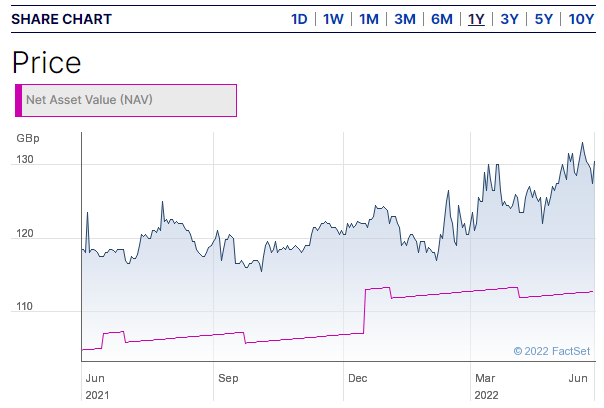 In this example, Amazon wouldn't sell the warehouse, it would just cease to rent it and the Reit would continue to own it. The issue would be whether it could then find another renter, sell it and for what price, whether it could obtain the same level of rent, the same terms e.g., inflation linked and so on.I guess you've come across the AIC's website and its data tables? E.g., for 'commercial property' ITs: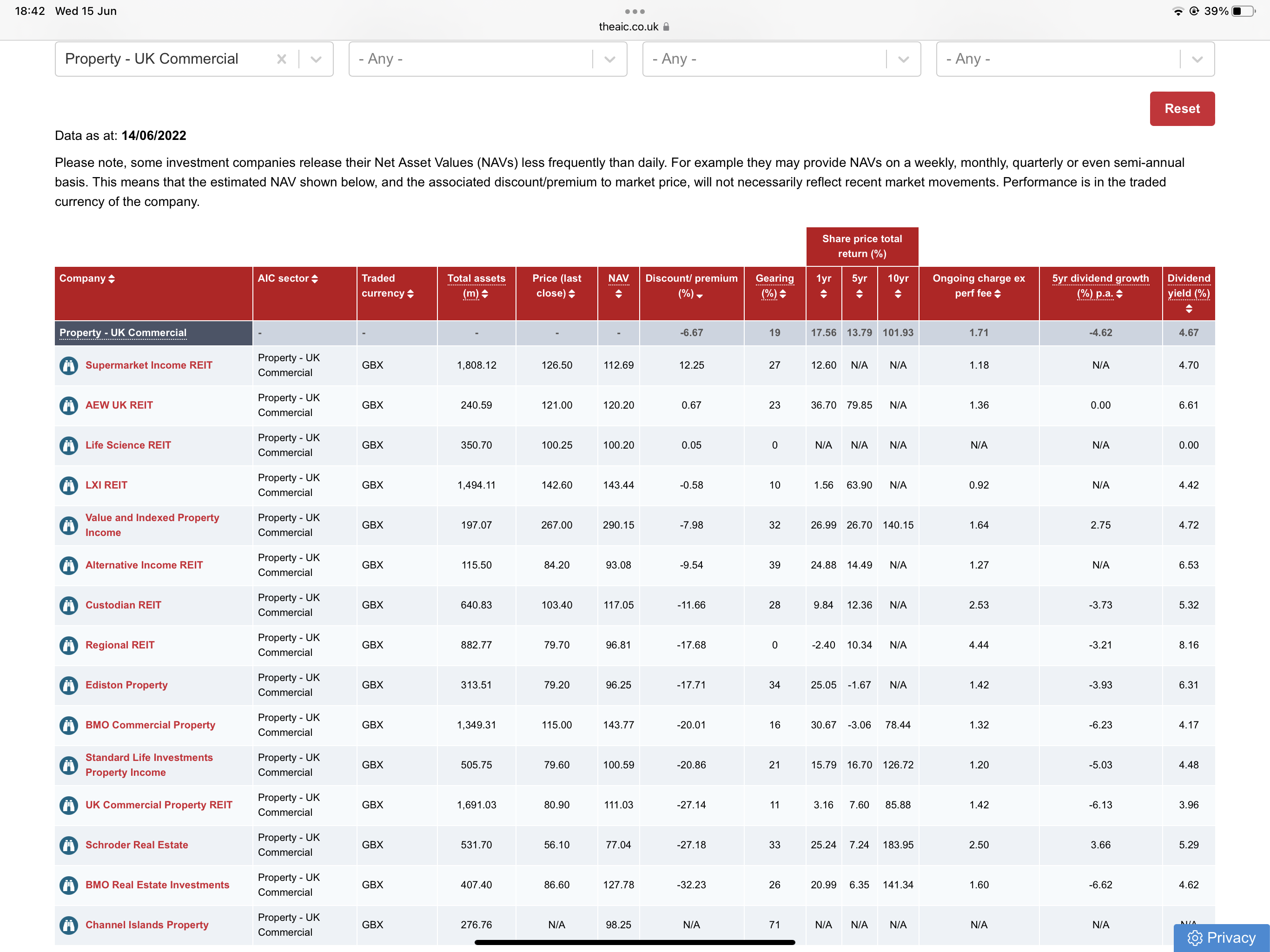
https://www.theaic.co.uk/aic/find-compare-investment-companies?sec=PUC&sortid=DiscFairCum&desc=trueA company investing in property doesn't have to be a REIT and some closed-ended companies listed in London are domiciled abroad so becoming a REIT might not even be an option or one that makes sense. As per your example, INPP is domiciled abroad (Guernsey).
I was previously invested in passive index funds, where your money essentially gets split proportionally between a number of companies. If you invest in, e.g., FTSE 100, then you essentially own a tiny proportion of each of the 100 companies that make the index. An active fund still owns shares in a large number of companies only the manager changes the constituent companies according to an investment strategy.
Now I will formulate my question. The AIC (www.theaic.co.uk) consists of investment companies. I am very much confused by this term, as I don't understand if they are more like a passive/active funds or more like corporations. I would assume most of them are trusts, but I am still improving my understanding of the term. To specify, I am not interested in formal definitions (of which are plenty on Investopedia but didn't clear my confusion), but rather a more intuitive/comparative approach. Would an passive/active fund be an investment company? A company such as "UK commercial property REIT", or "International Public Partnerships" does not own shares in different companies like a fund, but interacts with a large number of them by charging them rent.
I guess what I am trying to find out with all these questions is if the level of risk for going onboard with an investment company (such as a REIT or other trusts) would be similar to that of an active/passive fund, where if a number of companies go bust you're still left with a big chunk of your investment. Could the trust itself go bust, or it's very unlikely?
Sorry for the long post and I hope you managed to get an idea about my confusion.0 -
An investment company is listed on the stockmarket and is a corporation. It's just that some choose to qualify to follow different rules and become a REIT, and ordinary Investment Trust and so on. You can Google what these differences are and read the legislation.Like any company they can own many different types of assets if they wish/are allowed e.g., there are some investment trusts which own shares in stockmarket listed companies but also unlisted companies and they can borrow money. As with any fund, including unit trusts/OEICs, the risk boils down to what they own but with the conventional trusts that own shares in many different listed companies in a number of different sectors it's unlikely you'll lose everything. If they find themselves badly underperforming they tend to get wound up, with the remaining assets sold and distributed to the shareholders.You need to be careful of REITs as some have a lot of leverage so could see issues with rising interest rates, if their properties fell in value a long way and/or they fell vacant they could have cashflow issues, breach loan to value covenants and so on.
It feels to me that you shouldn't be investing in any of these investment companies as you clearly aren't grasping what they are.1 -
There's a weekly podcast called "Money Makers" that talks about what's going on in the listed investment company world and it might give you a feel for what these companies are and the issues and opportunities they face. It has its own website but it's also available on iTunes, Spotify and Soundcloud.
https://money-makers.co/2022/07/17/money-makers-podcast-16-jul-2022/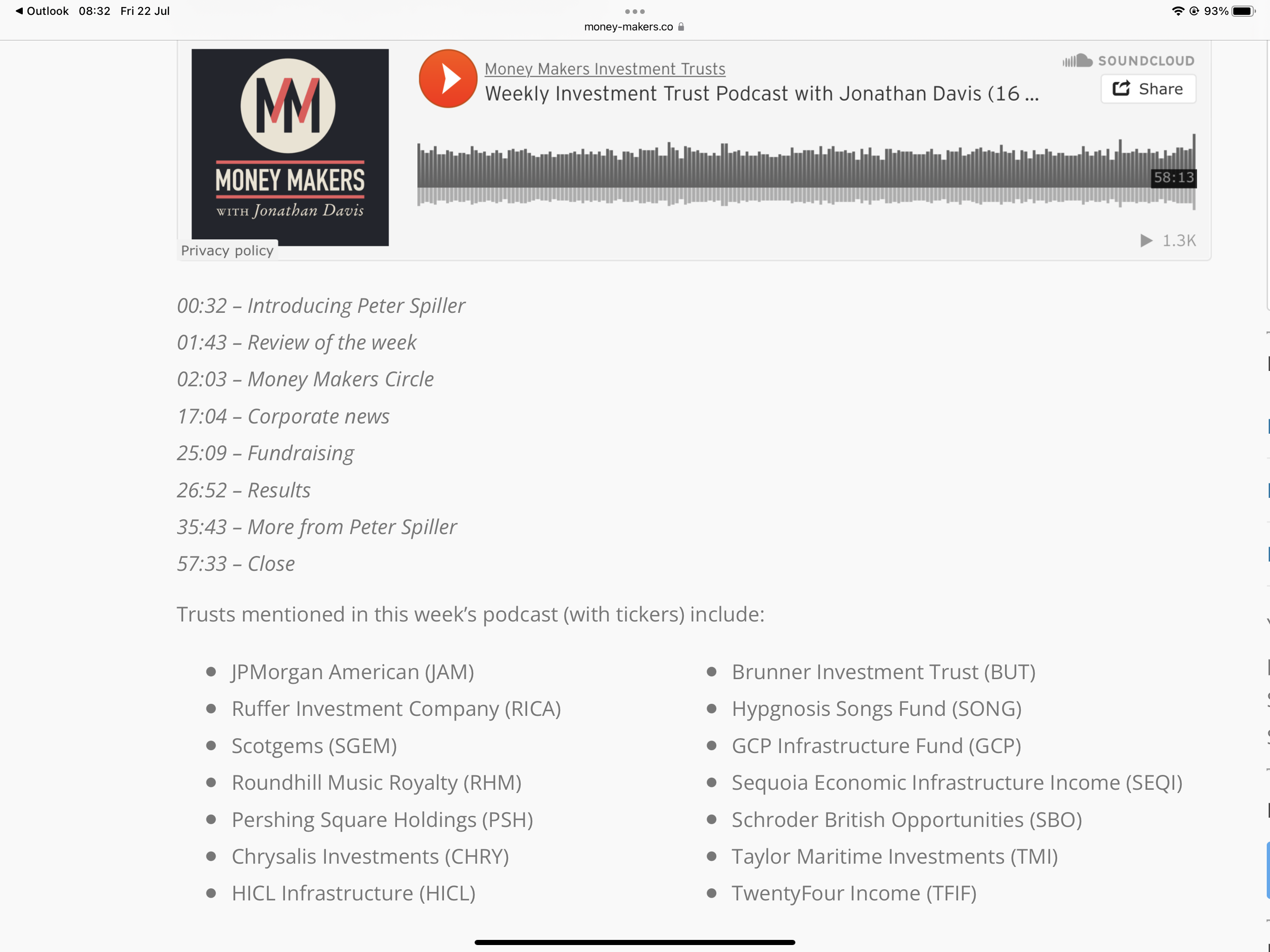
1 -
wmb194 said:An investment company is listed on the stockmarket and is a corporation. It's just that some choose to qualify to follow different rules and become a REIT, and ordinary Investment Trust and so on. You can Google what these differences are and read the legislation.Like any company they can own many different types of assets if they wish/are allowed e.g., there are some investment trusts which own shares in stockmarket listed companies but also unlisted companies and they can borrow money. As with any fund, including unit trusts/OEICs, the risk boils down to what they own but with the conventional trusts that own shares in many different listed companies in a number of different sectors it's unlikely you'll lose everything. If they find themselves badly underperforming they tend to get wound up, with the remaining assets sold and distributed to the shareholders.You need to be careful of REITs as some have a lot of leverage so could see issues with rising interest rates, if their properties fell in value a long way and/or they fell vacant they could have cashflow issues, breach loan to value covenants and so on.
It feels to me that you shouldn't be investing in any of these investment companies as you clearly aren't grasping what they are.
Thank you for the reply. My previous post was quite confusing, as I was mixing up financial terms. Guided by your explanation but also my research I am able to formulate much better what my idea was. I am making a comparison between investment trusts (ITs) and other investment companies (ETFs, OEICs).
The ETFs containing a large variation of assets are achieving market average in a particular sector. For ETFs the share price is coupled to the NAV via a redemption mechanism. Therefore, the ETF price wouldn't change significantly with:
1) the investor sentiment towards that particular ETF
2) human errors within the ETF management (maybe no errors are even possible given it's usually an algorithm doing most work)
These two conditions give me some peace of mind that my portfolio performance is not coupled to the performance of a specific company.
After researching better the investment companies I noticed that for closed-ended ones such as ITs the price tends to go much farther from the NAV compared to ETFs or OEICs. So even though the IT could have lots of different shares in its portfolio contributing to its NAV (achieving a "market average"), it would also have its own price that can go far from the NAV.
Just to give an example,
Shares in Supermarket Income tumble 6% after broker downgrades popular real estate investment trust from ‘hold’ to ‘reduce’, expressing concern at its high valuation.
The REIT dropped hugely in price in one day simply because a broker said something (irrespective if it's correct or not). This wouldn't happen with an ETF where the price is coupled to its NAV. So, to formulate my question much more clearly than before, could someone argue generally that an IT is more "risky" than an OEIC or ETF (considering they own similar assets)? Here, by "risky" I mean less volatility and more certainty. Indeed, as a worst case scenario, shareholders would get the "shareholder's equity" distributed to them, but that is typically considerably smaller than the share price and even NAV.
I did make a note of your previous comments on debt. Indeed with rising interest rates this will be at some point significant. That's why I am looking in particular at the ones with 0% gearing.
Regarding investing in them - no I will not before I am convinced they are the right thing for me. That is why I am asking these questions and greatly appreciate your reply!
0 -
Thank you, it's interesting to listen to Peter Spiller and how he thinks we'll end up with fewer ITs trading closer to NAV. I hope he's right.wmb194 said:There's a weekly podcast called "Money Makers" that talks about what's going on in the listed investment company world and it might give you a feel for what these companies are and the issues and opportunities they face. It has its own website but it's also available on iTunes, Spotify and Soundcloud.
https://money-makers.co/2022/07/17/money-makers-podcast-16-jul-2022/0 -
I like to buy things at a discount, but if you'd prefer to pay more for the same assets then that's up to you. If the aim is to hold and hope it shouldn't be a big worry but it is a quirk and feature of closed ended investment companies. There are ITs that historically trade closer to NAV than others but a 10% discount is usually quite common. They tend to move towards and away depending on how the market's feeling i.e. tighter discounts when it's bullish and wider when it's bearish. ETFs and ITs investing in the stockmarket aren't competing in quite the same space anyway i.e. passive vs active.jake_jones99 said:wmb194 said:An investment company is listed on the stockmarket and is a corporation. It's just that some choose to qualify to follow different rules and become a REIT, and ordinary Investment Trust and so on. You can Google what these differences are and read the legislation.Like any company they can own many different types of assets if they wish/are allowed e.g., there are some investment trusts which own shares in stockmarket listed companies but also unlisted companies and they can borrow money. As with any fund, including unit trusts/OEICs, the risk boils down to what they own but with the conventional trusts that own shares in many different listed companies in a number of different sectors it's unlikely you'll lose everything. If they find themselves badly underperforming they tend to get wound up, with the remaining assets sold and distributed to the shareholders.You need to be careful of REITs as some have a lot of leverage so could see issues with rising interest rates, if their properties fell in value a long way and/or they fell vacant they could have cashflow issues, breach loan to value covenants and so on.
It feels to me that you shouldn't be investing in any of these investment companies as you clearly aren't grasping what they are.
Thank you for the reply. My previous post was quite confusing, as I was mixing up financial terms. Guided by your explanation but also my research I am able to formulate much better what my idea was. I am making a comparison between investment trusts (ITs) and other investment companies (ETFs, OEICs).
The ETFs containing a large variation of assets are achieving market average in a particular sector. For ETFs the share price is coupled to the NAV via a redemption mechanism. Therefore, the ETF price wouldn't change significantly with:
1) the investor sentiment towards that particular ETF
2) human errors within the ETF management (maybe no errors are even possible given it's usually an algorithm doing most work)
These two conditions give me some peace of mind that my portfolio performance is not coupled to the performance of a specific company.
After researching better the investment companies I noticed that for closed-ended ones such as ITs the price tends to go much farther from the NAV compared to ETFs or OEICs. So even though the IT could have lots of different shares in its portfolio contributing to its NAV (achieving a "market average"), it would also have its own price that can go far from the NAV.
Just to give an example,
Shares in Supermarket Income tumble 6% after broker downgrades popular real estate investment trust from ‘hold’ to ‘reduce’, expressing concern at its high valuation.
The REIT dropped hugely in price in one day simply because a broker said something (irrespective if it's correct or not). This wouldn't happen with an ETF where the price is coupled to its NAV. So, to formulate my question much more clearly than before, could someone argue generally that an IT is more "risky" than an OEIC or ETF (considering they own similar assets)? Here, by "risky" I mean less volatility and more certainty. Indeed, as a worst case scenario, shareholders would get the "shareholder's equity" distributed to them, but that is typically considerably smaller than the share price and even NAV.
I did make a note of your previous comments on debt. Indeed with rising interest rates this will be at some point significant. That's why I am looking in particular at the ones with 0% gearing.
Regarding investing in them - no I will not before I am convinced they are the right thing for me. That is why I am asking these questions and greatly appreciate your reply!Supermarket Income REIT plc (SUPR) has been a very fashionable sector/IT to invest in and it was trading at a big premium to NAV. As with many companies, it's often good to sell or avoid them when they're on big premiums* or when the market has become very or unrealistically bullish on them so this doesn't come as a surprise to me.Further, can you find an ETF that directly owns supermarkets and rents them to Sainsbury's, Tesco, Waitrose, Morrisons, Aldi and M&S? I seriously doubt it but you can find ETFs which *include* SUPR: it's a member of the FTSE250. In this instance you're comparing apples to oranges. REITs are property management companies. As opposed to the ETFs, ITs, OEICs and other funds that invest in a range of stockmarket listed shares, you'll see that it's an operating business. If you look at its annual report you'll see what I mean.There are still some property OEICs but they have issues around how they're valued plus liquidity issues relating to redemptions that CEICs, which includes Reits, don't have, so they're slowly disappearing as they fall out of favour.
Btw, it's never all or nothing. Your choice is not between one and the other. You can own ITs, REITs and ETFs. I do.
*Wind and solar aka renewables ITs are others to watch out for at the moment.1











Confirm your email address to Create Threads and Reply

Categories
- All Categories
- 354.5K Banking & Borrowing
- 254.4K Reduce Debt & Boost Income
- 455.5K Spending & Discounts
- 247.4K Work, Benefits & Business
- 604.2K Mortgages, Homes & Bills
- 178.5K Life & Family
- 261.7K Travel & Transport
- 1.5M Hobbies & Leisure
- 16.1K Discuss & Feedback
- 37.7K Read-Only Boards