We’d like to remind Forumites to please avoid political debate on the Forum.
This is to keep it a safe and useful space for MoneySaving discussions. Threads that are – or become – political in nature may be removed in line with the Forum’s rules. Thank you for your understanding.
📨 Have you signed up to the Forum's new Email Digest yet? Get a selection of trending threads sent straight to your inbox daily, weekly or monthly!
The Forum now has a brand new text editor, adding a bunch of handy features to use when creating posts. Read more in our how-to guide
Wall crack

FreeBear
Posts: 18,359 Forumite




Solid brick wall, chipped off the top layer of pebble dash, and revealed this crack. The base coat of render appears to be a hard cement based coating, and has a number of fine cracks at random angles & places (due to shrinkage ?) - This all dates from around 1928/9.
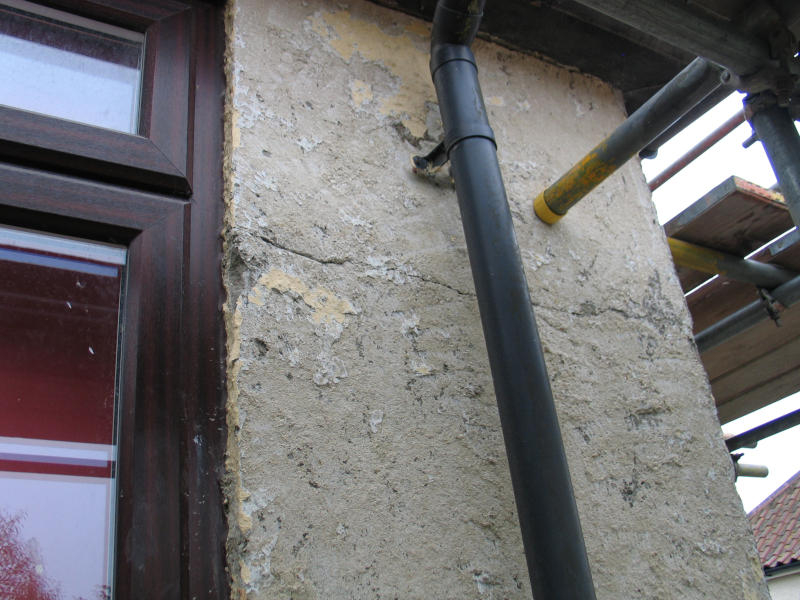
Comments/thoughts ?
Any language construct that forces such insanity in this case should be abandoned without regrets. –
Erik Aronesty, 2014
Treasure the moments that you have. Savour them for as long as you can for they will never come back again.
Erik Aronesty, 2014
Treasure the moments that you have. Savour them for as long as you can for they will never come back again.
0
Comments
-
The crack could be in the mortar joint as well. Probably nothing serious.
Horizontal cracks in render are sometimes a sulphate attack expanding the joint a bit. Could be a rusty frame cramp.
Occasionally with a hip roof pressure on the corner moves the brickwork a bit, but it's usually the top course that goes.
Might be worth cutting out a bit of render to see the joint.0 -
I'll be grinding out this, and other cracks, so will take a look. Doesn't appear to be any ironwork in the wall apart from a couple of cut clasp nails used to fix a downpipe clip. Sulphate attack would surely be random patches & cause blisters rather than straight cracks ?Will post more pics once I've attacked it with the grinderAny language construct that forces such insanity in this case should be abandoned without regrets. –
Erik Aronesty, 2014
Treasure the moments that you have. Savour them for as long as you can for they will never come back again.0 -
I'd say that is where the renderer stopped for a cup of tea.0
-
It can cause cracks like that in the render, as the bed joints in the brickwork expand. It's more likely when a wall is rendered, but can happen on face brickwork.FreeBear said:Sulphate attack would surely be random patches & cause blisters rather than straight cracks
Most common where the wall is exposed to driving rain. Causes chimney stacks to bend as one side of the stack gets bigger bed joints.1 -
Lime mortar used between the bricks which I believe is immune to sulphate attack.
Any language construct that forces such insanity in this case should be abandoned without regrets. –
Erik Aronesty, 2014
Treasure the moments that you have. Savour them for as long as you can for they will never come back again.0 -
Less likely, but not totally immune. The period of your build often used lime mortar with a small amount of OPC gauged into the mix.
It could be pure lime, or gauged mortar, the 2 are very similar in appearance.
When you open up the crack you will have a better idea. Sulphate attacked joints are usually crumbling, and often are white.0 -
Opened up a small section of the crack. Right on top of a mortar joint.The mortar between the bricks is a sandy colour and friable (like all the mortar in this building). Loading from the hip causing a slip in the mortar bed sounds like the most reasonable explanation.Any language construct that forces such insanity in this case should be abandoned without regrets. –
Erik Aronesty, 2014
Treasure the moments that you have. Savour them for as long as you can for they will never come back again.0 -
There is quite a load on the plate in the corner of a hip roof. A Dragon piece or tie was often put in to help with this issue.
It probably won't go any further.0






Confirm your email address to Create Threads and Reply

Categories
- All Categories
- 354.3K Banking & Borrowing
- 254.4K Reduce Debt & Boost Income
- 455.4K Spending & Discounts
- 247.3K Work, Benefits & Business
- 604K Mortgages, Homes & Bills
- 178.4K Life & Family
- 261.5K Travel & Transport
- 1.5M Hobbies & Leisure
- 16K Discuss & Feedback
- 37.7K Read-Only Boards