We’d like to remind Forumites to please avoid political debate on the Forum.
This is to keep it a safe and useful space for MoneySaving discussions. Threads that are – or become – political in nature may be removed in line with the Forum’s rules. Thank you for your understanding.
📨 Have you signed up to the Forum's new Email Digest yet? Get a selection of trending threads sent straight to your inbox daily, weekly or monthly!
Help with maths around Energy increases



Hi. I'm with British Gas on the standard variable rate (price cap). I noticed on the newsletter about a fixed I could change to called May23v1. I checked but it doesn't seem to be there anymore. But there are some on there. The Jul23v1 has better rates than the May23v1, on the newsletter it said that the May23v1 was a 26% rise (so worth changing too as below 30%).
This is the maths I've worked out..... Please can someone just check and make sure that's right and I'm not barking up the wrong tree? I've averaged all the increases as some are obviously higher than others so I'm guessing that's right. Thanks in advance.
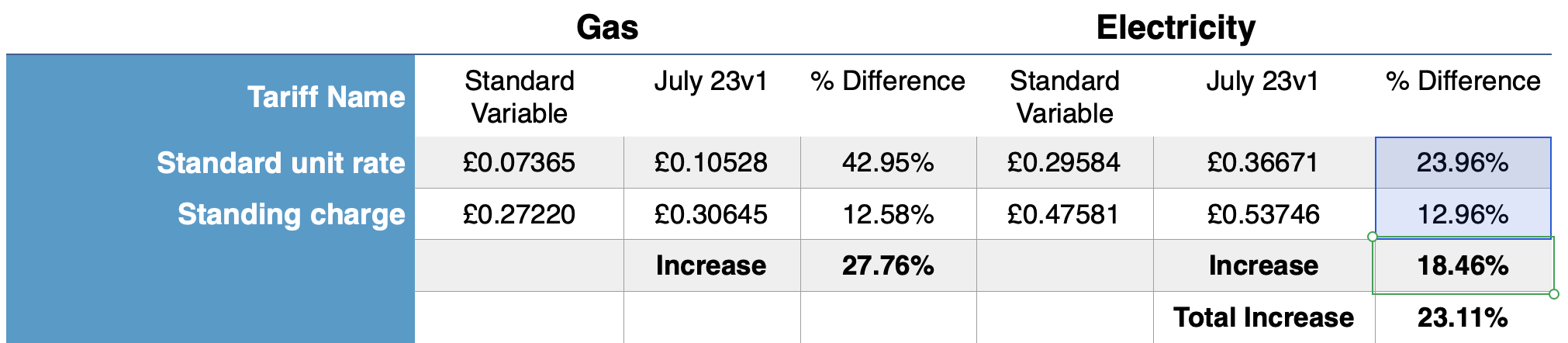
This is the maths I've worked out..... Please can someone just check and make sure that's right and I'm not barking up the wrong tree? I've averaged all the increases as some are obviously higher than others so I'm guessing that's right. Thanks in advance.
0
Comments
-
While you have calculated all the single increase percentage, your problem lies with just taking the average of them without taking into account the percentage of the annual cost.
For example you have a 12% increase for gas standing charge and a 43% increase for gas and you see it at an average increase of 27.76%.
The total increase for the standing charge would be £12.50, but the increase for just 1000KWh gas is already £31.63.
The only way you can calculate it is by using your usage of the last 12 months and do a cost calculation for gas, electricity and both standing charges for the SVT and the offered fixed and than calculate the increase percentage. This will not even take into account that you will be paying the fixed rate already for the next 4 months, nor that you will not be paying the April 2023 CAP SVT rates for two months.0 -
It would be right if you only use one kWh Elec and gas. Remember the standing charge is just once a day but you use multiple kWh of elec and gas per day so take the SC out of your table to get the realistic price increase.0
-
Even without the standing charges it still would not work, or only if you use exactly the same number of KWh of gas and electricity.Mstty said:It would be right if you only use one kWh Elec and gas. Remember the standing charge is just once a day but you use multiple kWh of elec and gas per day so take the SC out of your table to get the realistic price increase.
You cannot just add the percentage for electricity and gas and divide it by 2.0 -
I find it gives a good indication.
I actually have a spreadsheet for it all but didn't want to over complicate things for the OP👍
They could of course multiply their existing rate and new rate by 2900 kWh Elec and 12000 kWh gas and add in the years worth of SC to give a clearer picture as some are doing on the site to give a representative percentile difference.
So many ways to cut this up someone will always have another way.0



Confirm your email address to Create Threads and Reply

Categories
- All Categories
- 355.6K Banking & Borrowing
- 254.8K Reduce Debt & Boost Income
- 456.1K Spending & Discounts
- 248.2K Work, Benefits & Business
- 605.7K Mortgages, Homes & Bills
- 179K Life & Family
- 263.5K Travel & Transport
- 1.5M Hobbies & Leisure
- 16.1K Discuss & Feedback
- 37.7K Read-Only Boards