We’d like to remind Forumites to please avoid political debate on the Forum.
This is to keep it a safe and useful space for MoneySaving discussions. Threads that are – or become – political in nature may be removed in line with the Forum’s rules. Thank you for your understanding.
📨 Have you signed up to the Forum's new Email Digest yet? Get a selection of trending threads sent straight to your inbox daily, weekly or monthly!
The Forum now has a brand new text editor, adding a bunch of handy features to use when creating posts. Read more in our how-to guide
Energy firms face 3 week deadline in review of direct debit hikes
Comments
-
With respect - rubbish. New supplier data collectors have access to the historical usage data for your property - whether they bother to use or not is another matter.prowla said:In my case I've shifted from a failed provider and I think it's acceptable for there to be a settling-in period for payment amounts to stabilise.In my case my new provider recommended a new payment amount and I went with it; I'll take stock and see if it's right.The thing which isn't right, though, is allowing the vendors to engage in profiteering.Raising the cap to allow price increases (of course they are going to raise prices right up to the cap) whilst the cartel of companies are posting record profits cannot sit squarely with the role of a regulator having a duty to the public.The idea too that standing charges have to be increased to pay for something which isn't part of the standing service is just plain skulduggery.I SoLR’d to EDF almost one year to the day from when my SMETS2 gas meter was fitted. A simple 11.22 times the meter reading came to 7771kWh/year. I provided EDF with this estimate. My first bill from EDF showed an estimated annual usage of c.11700kWh/year. I switched to Octopus and my first gas bill 3 weeks later showed an annual estimate of 7800kWh/year. It is easy to determine which supplier was using historical data.1 -
Saying something is rubbish is hardly "with respect"; in fact, it's quite bad mannered.[Deleted User] said:
With respect - rubbish. New supplier data collectors have access to the historical usage data for your property - whether they bother to use or not is another matter.prowla said:In my case I've shifted from a failed provider and I think it's acceptable for there to be a settling-in period for payment amounts to stabilise.In my case my new provider recommended a new payment amount and I went with it; I'll take stock and see if it's right.The thing which isn't right, though, is allowing the vendors to engage in profiteering.Raising the cap to allow price increases (of course they are going to raise prices right up to the cap) whilst the cartel of companies are posting record profits cannot sit squarely with the role of a regulator having a duty to the public.The idea too that standing charges have to be increased to pay for something which isn't part of the standing service is just plain skulduggery.I SoLR’d to EDF almost one year to the day from when my SMETS2 gas meter was fitted. A simple 11.22 times the meter reading came to 7771kWh/year. I provided EDF with this estimate. My first bill from EDF showed an estimated annual usage of c.11700kWh/year. I switched to Octopus and my first gas bill 3 weeks later showed an annual estimate of 7800kWh/year. It is easy to determine which supplier was using historical data.
1 -
Where exactly do you get the idea that all the suppliers are making record profits? Can you maybe link a few balance sheets showing the profits? And we are talking here the supply sector of a company, if Shell for example makes profits in other sectors that does not count as record profit in supplying energy to the end user.prowla said:In my case I've shifted from a failed provider and I think it's acceptable for there to be a settling-in period for payment amounts to stabilise.In my case my new provider recommended a new payment amount and I went with it; I'll take stock and see if it's right.The thing which isn't right, though, is allowing the vendors to engage in profiteering.Raising the cap to allow price increases (of course they are going to raise prices right up to the cap) whilst the cartel of companies are posting record profits cannot sit squarely with the role of a regulator having a duty to the public.The idea too that standing charges have to be increased to pay for something which isn't part of the standing service is just plain skulduggery.
Has your "failed" supplier and the other 30 companies that bust just made so much profit that they just cashed out and did not want to deal with the business any longer and are just going to spend their profit?
1 -
I am sorry if you are offended but there is so much wrong with your post. For example, cartels are illegal under Competition Law, with horrendous fines if there is a proven case (up to 10% of an undertaking's worldwide turnover in the last financial year).Saying something is rubbish is hardly "with respect"; in fact, it's quite bad mannered.Personally, I very much doubt that any energy supplier is profiteering at the moment. Wholesalers possibly but not suppliers. Octopus, for example, posted recently that the last few months had cost them well over £100M.All energy costs - whether they are direct or indirect - are borne by the consumer . The cost of the warm home discount; consumer credit protection; solar FITs; boiler grants et al are all included in the standing charge as are all the additional costs of failed suppliers. Remember SoLRs had to pay for the energy that they had to buy in to ensure continuity of supply which under the previous Cap they had to supply at below cost.
The debatable point is whether green taxes should be dropped (ie, switched to taxation) or switched from electricity to gas. In my view, the latter is the more likely option but that would put up the standing charge for gas.1 -
pochase said:
Where exactly do you get the idea that all the suppliers are making record profits? Can you maybe link a few balance sheets showing the profits? And we are talking here the supply sector of a company, if Shell for example makes profits in other sectors that does not count as record profit in supplying energy to the end user.prowla said:In my case I've shifted from a failed provider and I think it's acceptable for there to be a settling-in period for payment amounts to stabilise.In my case my new provider recommended a new payment amount and I went with it; I'll take stock and see if it's right.The thing which isn't right, though, is allowing the vendors to engage in profiteering.Raising the cap to allow price increases (of course they are going to raise prices right up to the cap) whilst the cartel of companies are posting record profits cannot sit squarely with the role of a regulator having a duty to the public.The idea too that standing charges have to be increased to pay for something which isn't part of the standing service is just plain skulduggery.
Has your "failed" supplier and the other 30 companies that bust just made so much profit that they just cashed out and did not want to deal with the business any longer and are just going to spend their profit?Well, my company is Shell, which has just posted record profits, ref. https://www.chroniclelive.co.uk/news/world-news/shell-bp-reveal-record-profit-23870805, along with others; a quick google search gave this link covering the big-six: https://www.independent.co.uk/news/uk/home-news/energy-bills-eon-british-gas-sse-scottish-power-b2013421.html, so exactly where is exactly there.As for the use of the quoted word "failed", I'd say that a company going bust is a pretty sure sign of its having failed; whilst it may be true that there was a bit of cashing in there, it was pretty obvious that their business model was unsustainable when prices went up and they had to buy at higher than their break-even level. Even if all of the money taken out was repaid, they'd not have lasted much longer. So yes, "failed" is the correct word.0 -
Shell profits will be due to crude oil price rises, not selling energy to a few thousand UK homes on a price cap.1
-
Regarding Shell - That is exactly what I wroteprowla said:pochase said:
Where exactly do you get the idea that all the suppliers are making record profits? Can you maybe link a few balance sheets showing the profits? And we are talking here the supply sector of a company, if Shell for example makes profits in other sectors that does not count as record profit in supplying energy to the end user.prowla said:In my case I've shifted from a failed provider and I think it's acceptable for there to be a settling-in period for payment amounts to stabilise.In my case my new provider recommended a new payment amount and I went with it; I'll take stock and see if it's right.The thing which isn't right, though, is allowing the vendors to engage in profiteering.Raising the cap to allow price increases (of course they are going to raise prices right up to the cap) whilst the cartel of companies are posting record profits cannot sit squarely with the role of a regulator having a duty to the public.The idea too that standing charges have to be increased to pay for something which isn't part of the standing service is just plain skulduggery.
Has your "failed" supplier and the other 30 companies that bust just made so much profit that they just cashed out and did not want to deal with the business any longer and are just going to spend their profit?Well, my company is Shell, which has just posted record profits, ref. https://www.chroniclelive.co.uk/news/world-news/shell-bp-reveal-record-profit-23870805, along with others; a quick google search gave this link covering the big-six: https://www.independent.co.uk/news/uk/home-news/energy-bills-eon-british-gas-sse-scottish-power-b2013421.html, so exactly where is exactly there.As for the use of the quoted word "failed", I'd say that a company going bust is a pretty sure sign of its having failed; whilst it may be true that there was a bit of cashing in there, it was pretty obvious that their business model was unsustainable when prices went up and they had to buy at higher than their break-even level. Even if all of the money taken out was repaid, they'd not have lasted much longer. So yes, "failed" is the correct word.
"And we are talking here the supply sector of a company, if Shell for example makes profits in other sectors that does not count as record profit in supplying energy to the end user".
The utility sector of Shell made an operating loss of £83.6 million in 2020.
https://www.shellenergy.co.uk/blog/post/customer-update-latest-financial-results
The article in the Independent states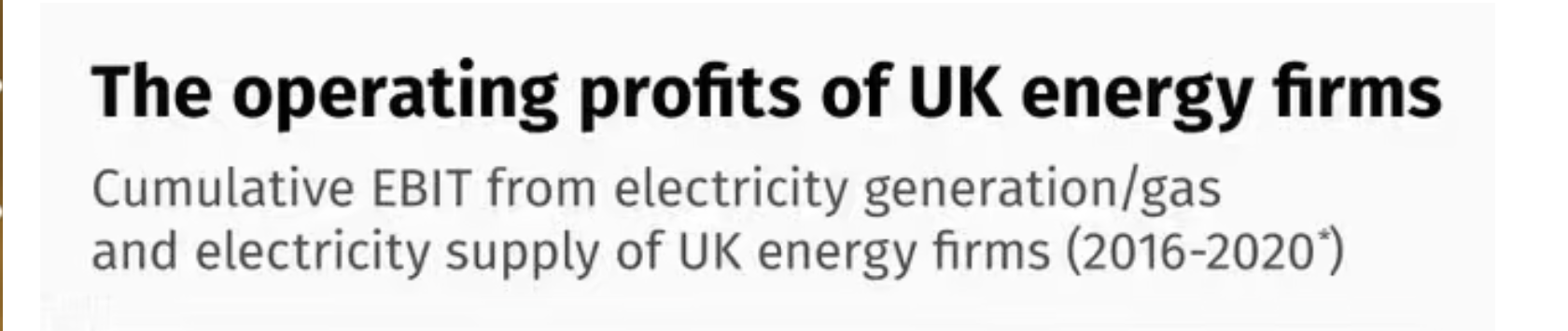
As we all know the problems started in 2021, so where do profits in 2016 to 2020 show that the companies still make profits?0 -
Dolor said:
I am sorry if you are offended but there is so much wrong with your post. For example, cartels are illegal under Competition Law, with horrendous fines if there is a proven case (up to 10% of an undertaking's worldwide turnover in the last financial year).Saying something is rubbish is hardly "with respect"; in fact, it's quite bad mannered.Personally, I very much doubt that any energy supplier is profiteering at the moment. Wholesalers possibly but not suppliers. Octopus, for example, posted recently that the last few months had cost them well over £100M.All energy costs - whether they are direct or indirect - are borne by the consumer . The cost of the warm home discount; consumer credit protection; solar FITs; boiler grants et al are all included in the standing charge as are all the additional costs of failed suppliers. Remember SoLRs had to pay for the energy that they had to buy in to ensure continuity of supply which under the previous Cap they had to supply at below cost.
The debatable point is whether green taxes should be dropped (ie, switched to taxation) or switched from electricity to gas. In my view, the latter is the more likely option but that would put up the standing charge for gas.When you say there is "so much wrong" with my post, the first bit was clearly stated as "I think that..." and said how I would deal with the requested increase in payment; that's my opinion and my choice, and so is not "rubbish".On to the other bits where there is "so much wrong" with my post...Regarding the word cartel, which seems to have struck a nerve; well, some might say that it is curious that prices are suspiciously similar across various companies, but of course they wouldn't possibly consider any for of collusion whatsoever (perish the thought!); and heck, if the prices are set globally and happen to increase their profits, then their hands are tied and who are they to argue?As for cartels proper, OPEC is a cartel which sets the price of oil, but it is not subject to UK law.In profiteering I gave two links in the above post showing the energy companies making huge profits.On to the standing charges - why should they be used to pay for the failed suppliers? It's effectively a stealth tax."So much wrong"? Hmmm....It'd be more courteous to say you disagree with things rather than say that they are "rubbish" and there is "so much wrong" with them; especially where items are clearly stated as opinions and personal ways of dealing with the situation.
0 -
prowla said:... some might say that it is curious that prices are suspiciously similar across various companies,Some might say that, particularly the uninformed or those being deliberately provocative.Others would point out that while single-rate variable tariffs are broadly similar, following the Ofgem cap, variable E7 tariffs do differ somewhat between suppliers and fixed-rate tariffs are all over the shop.N. Hampshire, he/him. Octopus Intelligent Go elec & Tracker gas / Vodafone BB / iD mobile. Kirk Hill Co-op member.Ofgem cap table, Ofgem cap explainer. Economy 7 cap explainer. Gas vs E7 vs peak elec heating costs, Best kettle!
2.72kWp PV facing SSW installed Jan 2012. 11 x 247w panels, 3.6kw inverter. 35 MWh generated, long-term average 2.6 Os.2 -
Sorry but I agree , we are living in GB and nearly in a recession ? Sorry but I suggest these company bosses maybe take a paycut ? maybe your one of them...suprise , horror 🙀 Britain is a very privileged country but companies want to maintain their profits regardless .......we all have to cut back then so should the people at the top. There are a few people on here who would make prime politicians ......I don't vote so no bias whatsoever.pochase said:
Where exactly do you get the idea that all the suppliers are making record profits? Can you maybe link a few balance sheets showing the profits? And we are talking here the supply sector of a company, if Shell for example makes profits in other sectors that does not count as record profit in supplying energy to the end user.prowla said:In my case I've shifted from a failed provider and I think it's acceptable for there to be a settling-in period for payment amounts to stabilise.In my case my new provider recommended a new payment amount and I went with it; I'll take stock and see if it's right.The thing which isn't right, though, is allowing the vendors to engage in profiteering.Raising the cap to allow price increases (of course they are going to raise prices right up to the cap) whilst the cartel of companies are posting record profits cannot sit squarely with the role of a regulator having a duty to the public.The idea too that standing charges have to be increased to pay for something which isn't part of the standing service is just plain skulduggery.
Has your "failed" supplier and the other 30 companies that bust just made so much profit that they just cashed out and did not want to deal with the business any longer and are just going to spend their profit?0
![[Deleted User]](https://us-noi.v-cdn.net/6031891/uploads/defaultavatar/nFA7H6UNOO0N5.jpg)







Confirm your email address to Create Threads and Reply

Categories
- All Categories
- 354.6K Banking & Borrowing
- 254.5K Reduce Debt & Boost Income
- 455.5K Spending & Discounts
- 247.5K Work, Benefits & Business
- 604.4K Mortgages, Homes & Bills
- 178.6K Life & Family
- 262K Travel & Transport
- 1.5M Hobbies & Leisure
- 16.1K Discuss & Feedback
- 37.7K Read-Only Boards