We’d like to remind Forumites to please avoid political debate on the Forum.
This is to keep it a safe and useful space for MoneySaving discussions. Threads that are – or become – political in nature may be removed in line with the Forum’s rules. Thank you for your understanding.
📨 Have you signed up to the Forum's new Email Digest yet? Get a selection of trending threads sent straight to your inbox daily, weekly or monthly!
The Forum now has a brand new text editor, adding a bunch of handy features to use when creating posts. Read more in our how-to guide
Research going nowhere!
Comments
-
As long as you recognize the higher risk and volatility of small companies you would expect something like the FTSE 250 to outperform the FTSE 100 over the long term, as it has historically. No need to buy and sell or play the valuation game.GeoffTF said:
An all market tracker is a little more diversified than a large and medium cap tracker, but that is not going to make much difference to the outcome. You can overweight the small companies. That will be profitable if you know more than the market and manage to buy the smaller companies when they are undervalued and sell them when they are overvalued. The problem is that you almost certainly do not know more than the market. Active fund managers do not have more than chance success here either.Prism said:
They won't make much difference in an equity tracker but they would in an active smaller companies fund. You don't need smaller companies but it can help to be more diversified.GeoffTF said:
For practical purposes, yes. The very small equities are typically sampled in an all cap tracker. The tiny equities are not going to make much difference anyway. There is not going to be much difference between an all cap tracker and a large and medium cap tracker. The whole point of global tracker is that it includes everything at its market weight. It does not matter what does well, because you own everything. "Do not look for the needle in the haystack. Buy the haystack." as Jack Bogle used to say.ColdIron said:
Are you sure about that?GeoffTF said:A global equity tracker includes every equity except unquoted investments, or equities that are not investable at all. You do not need anything else.0 -
Companies pay for a premium listing on the markets. They also agree to far higher regulatory standards. Fevertree the well known drinks mixer brand is listed on AIM and is capitalised at around £2 billion. Hardly a small company.tebbins said:Malthusian said:GeoffTF said:An all market tracker is a little more diversified than a large and medium cap tracker, but that is not going to make much difference to the outcome. You can overweight the small companies. That will be profitable if you know more than the market and manage to buy the smaller companies when they are undervalued and sell them when they are overvalued. The problem is that you almost certainly do not know more than the market. Active fund managers do not have more than chance success here either.No, it will be more profitable if smaller companies are more risky than the global market and come with a higher risk premium, which they are and do.A portfolio consisting of global equity tracker + smaller companies fund would be expected to outperform 100% global equity tracker if held for the long term. There is no need to switch in and out of the smaller companies fund to achieve that.Smaller companies funds are one of the few areas where there is good evidence and good reason to believe that fund managers can outperform the market. They often outperform small cap indices because the small-cap end of the market is full of scams, obvious no-hopers, vanity projects and companies trying to drill for oil in Surrey. Over the last 24 years, the total return of the FTSE AIM All Share was 17.3%, i.e. literally nothing. The total return of the average IA UK Smaller Companies Fund was 575% over the same period.However the OP has shown no appetite for dialling up the risk in pursuit of higher returns, so your original post was correct, he doesn't need one of those.
A lot of the reason for inferior performance of small cap indices is that they include everything, some of which would never appear in a "mainstream" index,
1 -
We seem to have a terminology problem here. In global terms, the FTSE 100 is large and medium cap, whereas the FTSE 250 is small cap, and anything smaller is micro-cap.tebbins said:
Historically yes, but there is no magic that makes small companies perform better over long periods simply because they are small, it is a historic observation, now widely known and arguably more efficient markets these days may have reduced the future potential. That said, the SPIVA scorecards for UK small cap management are very promising.Malthusian said:GeoffTF said:An all market tracker is a little more diversified than a large and medium cap tracker, but that is not going to make much difference to the outcome. You can overweight the small companies. That will be profitable if you know more than the market and manage to buy the smaller companies when they are undervalued and sell them when they are overvalued. The problem is that you almost certainly do not know more than the market. Active fund managers do not have more than chance success here either.No, it will be more profitable if smaller companies are more risky than the global market and come with a higher risk premium, which they are and do.A portfolio consisting of global equity tracker + smaller companies fund would be expected to outperform 100% global equity tracker if held for the long term. There is no need to switch in and out of the smaller companies fund to achieve that.Smaller companies funds are one of the few areas where there is good evidence and good reason to believe that fund managers can outperform the market. They often outperform small cap indices because the small-cap end of the market is full of scams, obvious no-hopers, vanity projects and companies trying to drill for oil in Surrey. Over the last 24 years, the total return of the FTSE AIM All Share was 17.3%, i.e. literally nothing. The total return of the average IA UK Smaller Companies Fund was 575% over the same period.However the OP has shown no appetite for dialling up the risk in pursuit of higher returns, so your original post was correct, he doesn't need one of those.
A lot of the reason for inferior performance of small cap indices is that they include everything, some of which would never appear in a "mainstream" index, and the FTSE small cap especially is dominated by expensive investment trusts of debatable, varying quality. Fundamentally, a good company bought at or below a fair price is a good company bought at or below fair price, and a good fund manager is a good fund manager. UK small cap is a space where local knowledge and local market access that foreign capital may lack can come into play much more than higher up the market cap/fund size scale, where liquidity becomes a material issue. Index funds are not yet a big player, actively managed funds and institutional investors are also relatively smaller players - a lot more market cap is held by individuals/founders/management etc who tend to be less concerned with price discovery.
Even though the risk and volatility of such a fund may be greater on its own, UK mid and small cap, though still equity, tends to be less correlated with UK large cap and global equity - I worked out a few years ago the FTSE 250/FTSE 100 correlation was around 0.8. Adding a (UK) small cap fund *may* reduce overall portfolio volatility, though very slightly.
There do not appear to be any trackers for the FTSE Russell small cap index that are available to retail investors in the UK. There are MSCI small cap trackers (e.g. from Vanguard), but that index tracks larger companies than the FTSE Russell small cap. Nonetheless FTSE all cap trackers should track FTSE Russell large, medium and small cap, i.e. FTSE 350 sized companies in UK terms.
As far as UK small cap is concerned, the FTSE 250 has not done badly. The main problem with chasing small cap is if too many people do it, the prices become inflated and performance from there on is poor. It is a self defeating strategy. All the more so for micro-caps.0 -
I do not want the income version of funds as the accumulation version is easier and cheaper (platform charges £5 per trade) within my isa. But would choose the income version if I had a general account for easy tax declaration ? of dividends.tebbins said:
So you're looking for a global growth equity fund, bearing in mind that growth has been doing very well since the GFC and what does well over such a long period is unlikely to be able to maintain superior returns over the next decade or so.mears1 said:
About 20-30%. This is to invest and leave for a long term. Would like to achieve growth, not an income. Have come across some infrastructure funds but the charges are high. Alternative energy, insulation etc, must show some growth too, if there was a passive fund for this, that would be ideal. The press has suggestions for some funds that are not so affected by inflation, but put off by their past performance which have been quite low (despite higher charges) compared to trackers (although, this is not indicative, but still a factor to consider)tebbins said:So you're looking for some suggestions for actively managed funds to occupy what % of the portfolio, and why? I.e. what has led you to this decision?
A good global equity tracker is about as diversified as it gets in the world of equities. However if you're seeking something 'different' that is still equity but less correlated, UK mid and small cap funds, infrastructure and real estate funds are popular additions I can think of of the top of my head. UK mid and small cap equity tends to be less correlated with UK large cap and global equity, than UK large cap and global equity are correlated with each other.
What is your objective with this money, what are you hoping to achieve with it?
Why do you not want an income? You could go for zero dividend stocks like Berkshire Hathaway (which still pays substantial buybacks), and for example the allegedly high growth S&P500 actually pays out a higher combined dividend + buybacks yield and has a higher payout ratio than the allegedly low growth/high yield/high payout FTSE 100. Historically most of the real total return from global equity came from dividends, not growth.
You can still use accumulation units, e.g. Legal & General have a global infrastructure index fund that has an accumulation version.
Commodities are impossible to track in the conventional sense.
Thank you for your suggestions, I will enjoy researching them. When you mention the S&P 500 ,are you referring to any particular fund egShares S&P 500 Growth ETF IVW SPDR® Portfolio S&P 500 Growth ETF SPYG Vanguard S&P 500 Growth ETF(VOOG)
Is infrastructure negatively affected if there is a downturn ie. reduced major building projects? In 2008, many architects and engineers were made redundant.0 -
A few points to break down.
1. Company size is obviously an objective fact, however there are many ways to measure it. Index funds use market cap, but revenue, employee count, customer count, operating earnings, (free) cashflow, gross assets, net assets, enterprise value, are all also valid measures of size and scale. For example the owner of this website employs less than 1,000 people and is in the FTSE 250, Capita employs over 60,000 as in the FTSE Small cap. The mega/large/mid/small/micro cap criteria set by FTSE Russell or other data providers are not fixed or authoritative, more helpful descriptors. Obviously for most countries outside the US, that country's own size guidelines will be smaller than the US or global figures. Some names from the bottom of the FTSE 100 are even mentioned at the top of Vanguard's Global Small Cap Index Fund.
2. FTSE 250 outperformance has occured mostly/entirely since the .com bubble -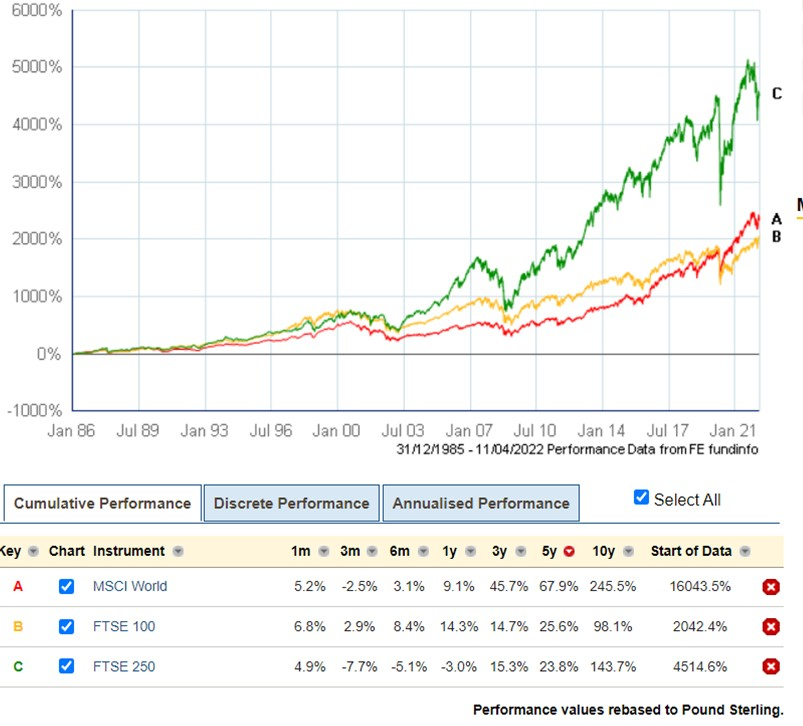
3. Most of the FTSE 250's outperformance over that period, is not explained by the superior returns of its constituents -Date Index Total Return Index Market Cap (£mn) 12/10/1992 2,400 831.38 98,000 31/03/2022 21,160.07 17,212.6 376,829 Total return 8.82x 20.70x 3.85x Annualised 7.66% 10.82% 4.67%
Sources for data: "25 yers of the FTSE 250 infographic", investing.com, yahoo finance
Implied geometric average yield = 2.94%
Index grows faster than market cap by 2.85%
This 2.85% difference is probably mostly down to the profit on the many deletions the FTSE 250 goes through as a huting ground for acquisitions, and to a lesser extent, the mechanical advatnage of churn with the FTSE 100. Promoted stocks tend to rally and demoted stocks tend to fall, potentially realising a small mechanical profit for the index. I also think the 250 has an advantage in that it sits in between the 'testing grounds' of the Small cap - more new entrants start on AIM and in the Small cap than IPO straight into the 250, and failures can be sold into the Smallcap rather than held until liquidation - and the 'post growth/size trap' of the 100. The sector diversity, lower liquidity and lower interest of price discovering analysts, 'home advantage' of being a more domestically focused (read 'insulated') index, low weight of cyclicals, presence of many highly specialised firms operating arguably with more monopoly-like moats than some of nthe 100 giants, you an go down this rabbbit hole all day.
4. Other research to do with the UK mid/small caps volatility, correllation with UK large cap and explanations for the "small premium" i.e. the additional return of small caps includes -
https://papers.ssrn.com/sol3/papers.cfm?abstract_id=4033932 - key takeaways include the moderate positive daily and monthly correllation between the FTSE Small/250 and 100, and their 2% size premium estimate.
https://onlinelibrary.wiley.com/doi/abs/10.1111/j.1468-5957.2006.00635.x - explains the differing volatility as partly due to large caps being traded more efficiently, with new information incporporated sooner, before 'spilling over' into smaller cap prices.
1 -
When I mentioned S&P 500 I refer to the index those funds track, and I think the three funds you mention are only available in the US. In the UK we have VUSA, plenty other US-tracking index funds available.mears1 said:
I do not want the income version of funds as the accumulation version is easier and cheaper (platform charges £5 per trade) within my isa. But would choose the income version if I had a general account for easy tax declaration ? of dividends.tebbins said:
So you're looking for a global growth equity fund, bearing in mind that growth has been doing very well since the GFC and what does well over such a long period is unlikely to be able to maintain superior returns over the next decade or so.mears1 said:
About 20-30%. This is to invest and leave for a long term. Would like to achieve growth, not an income. Have come across some infrastructure funds but the charges are high. Alternative energy, insulation etc, must show some growth too, if there was a passive fund for this, that would be ideal. The press has suggestions for some funds that are not so affected by inflation, but put off by their past performance which have been quite low (despite higher charges) compared to trackers (although, this is not indicative, but still a factor to consider)tebbins said:So you're looking for some suggestions for actively managed funds to occupy what % of the portfolio, and why? I.e. what has led you to this decision?
A good global equity tracker is about as diversified as it gets in the world of equities. However if you're seeking something 'different' that is still equity but less correlated, UK mid and small cap funds, infrastructure and real estate funds are popular additions I can think of of the top of my head. UK mid and small cap equity tends to be less correlated with UK large cap and global equity, than UK large cap and global equity are correlated with each other.
What is your objective with this money, what are you hoping to achieve with it?
Why do you not want an income? You could go for zero dividend stocks like Berkshire Hathaway (which still pays substantial buybacks), and for example the allegedly high growth S&P500 actually pays out a higher combined dividend + buybacks yield and has a higher payout ratio than the allegedly low growth/high yield/high payout FTSE 100. Historically most of the real total return from global equity came from dividends, not growth.
You can still use accumulation units, e.g. Legal & General have a global infrastructure index fund that has an accumulation version.
Commodities are impossible to track in the conventional sense.
Thank you for your suggestions, I will enjoy researching them. When you mention the S&P 500 ,are you referring to any particular fund egShares S&P 500 Growth ETF IVW SPDR® Portfolio S&P 500 Growth ETF SPYG Vanguard S&P 500 Growth ETF(VOOG)
Is infrastructure negatively affected if there is a downturn ie. reduced major building projects? In 2008, many architects and engineers were made redundant.
Everything can always be negatively affected by anything at any time, infrastructure is sometimes seen as a safe haven, but ultimately it's impossible to own an equity whose price or earnings are will be unnaffected by what goes in the world. L&G Global Infrastructure Index Fund for instance is essentially electricity generators, gas distribution networks, utility companies and railways.
0 -
mears1 said:I do not want the income version of funds as the accumulation version is easier and cheaper (platform charges £5 per trade) within my isa. But would choose the income version if I had a general account for easy tax declaration ? of dividends.The platform should send you an annual tax voucher detailing all dividend and interest income, whether accumulation or income units.1
-
The L&G Global Infrastructure Index Fund is interesting, as it is only 0.3% in charges. The low charge is that because it has only been launched since 2019 and that it is a tracker? Other funds in the 1A infrastructure sector have much higher charges eg VT Both the Global listed Infrastructure I Acc and M& G Global listed infrastructure I ACC are 70%. Presumably, it's because they are managed funds?tebbins said:
When I mentioned S&P 500 I refer to the index those funds track, and I think the three funds you mention are only available in the US. In the UK we have VUSA, plenty other US-tracking index funds available.mears1 said:
I do not want the income version of funds as the accumulation version is easier and cheaper (platform charges £5 per trade) within my isa. But would choose the income version if I had a general account for easy tax declaration ? of dividends.tebbins said:
So you're looking for a global growth equity fund, bearing in mind that growth has been doing very well since the GFC and what does well over such a long period is unlikely to be able to maintain superior returns over the next decade or so.mears1 said:
About 20-30%. This is to invest and leave for a long term. Would like to achieve growth, not an income. Have come across some infrastructure funds but the charges are high. Alternative energy, insulation etc, must show some growth too, if there was a passive fund for this, that would be ideal. The press has suggestions for some funds that are not so affected by inflation, but put off by their past performance which have been quite low (despite higher charges) compared to trackers (although, this is not indicative, but still a factor to consider)tebbins said:So you're looking for some suggestions for actively managed funds to occupy what % of the portfolio, and why? I.e. what has led you to this decision?
A good global equity tracker is about as diversified as it gets in the world of equities. However if you're seeking something 'different' that is still equity but less correlated, UK mid and small cap funds, infrastructure and real estate funds are popular additions I can think of of the top of my head. UK mid and small cap equity tends to be less correlated with UK large cap and global equity, than UK large cap and global equity are correlated with each other.
What is your objective with this money, what are you hoping to achieve with it?
Why do you not want an income? You could go for zero dividend stocks like Berkshire Hathaway (which still pays substantial buybacks), and for example the allegedly high growth S&P500 actually pays out a higher combined dividend + buybacks yield and has a higher payout ratio than the allegedly low growth/high yield/high payout FTSE 100. Historically most of the real total return from global equity came from dividends, not growth.
You can still use accumulation units, e.g. Legal & General have a global infrastructure index fund that has an accumulation version.
Commodities are impossible to track in the conventional sense.
Thank you for your suggestions, I will enjoy researching them. When you mention the S&P 500 ,are you referring to any particular fund egShares S&P 500 Growth ETF IVW SPDR® Portfolio S&P 500 Growth ETF SPYG Vanguard S&P 500 Growth ETF(VOOG)
Is infrastructure negatively affected if there is a downturn ie. reduced major building projects? In 2008, many architects and engineers were made redundant.
Everything can always be negatively affected by anything at any time, infrastructure is sometimes seen as a safe haven, but ultimately it's impossible to own an equity whose price or earnings are will be unnaffected by what goes in the world. L&G Global Infrastructure Index Fund for instance is essentially electricity generators, gas distribution networks, utility companies and railways.
Is the L&G Global Infrastructure Index Fund, the only tracker available in the infrastructure sector?0 -
The offset to paying low fees is performing your own research. ( Access to time saving information comes at a cost. i.e. subscriptions) . Take a look at the performance of INRG ~ (ISHARES II PLC GLOBAL CLEAN ENERGY UCITS ETF). A classic example of herd investing. With investors piling in as it was the latest fad doing the rounds, particularly on social media. Money flow drives markets. With a concentrated portfolio of just 30 shares at the time. The share prices of a group of companies rose to excessive levels. A series of events burst the ballon and brought everything crashing back to earth. The ETF has been subsequently expanded to emcompass around a 100 companies in an attempt to dilute the concentration.
Approach investing with a neutral mindset. Don't get hung up on fees alone. There's pro's and con's to every investment choice. If you haven't identifed the negatives. Then your research isn't complete.2












Confirm your email address to Create Threads and Reply

Categories
- All Categories
- 354K Banking & Borrowing
- 254.3K Reduce Debt & Boost Income
- 455.3K Spending & Discounts
- 247.1K Work, Benefits & Business
- 603.7K Mortgages, Homes & Bills
- 178.3K Life & Family
- 261.2K Travel & Transport
- 1.5M Hobbies & Leisure
- 16.1K Discuss & Feedback
- 37.7K Read-Only Boards