We’d like to remind Forumites to please avoid political debate on the Forum.
This is to keep it a safe and useful space for MoneySaving discussions. Threads that are – or become – political in nature may be removed in line with the Forum’s rules. Thank you for your understanding.
📨 Have you signed up to the Forum's new Email Digest yet? Get a selection of trending threads sent straight to your inbox daily, weekly or monthly!
The Forum now has a brand new text editor, adding a bunch of handy features to use when creating posts. Read more in our how-to guide
why rads are setup like this?

Dale_UK
Posts: 24 Forumite



does anyone know why the thermostatic value is set up at the top? for some reason all the radiators are like this in my home, it looks ugly, wondered if there was a real reason this was done?
Also looking at replacing the rad, suggestions welcome, victorian terraced (fireplaces missing), but coving and ceiling rose intact.
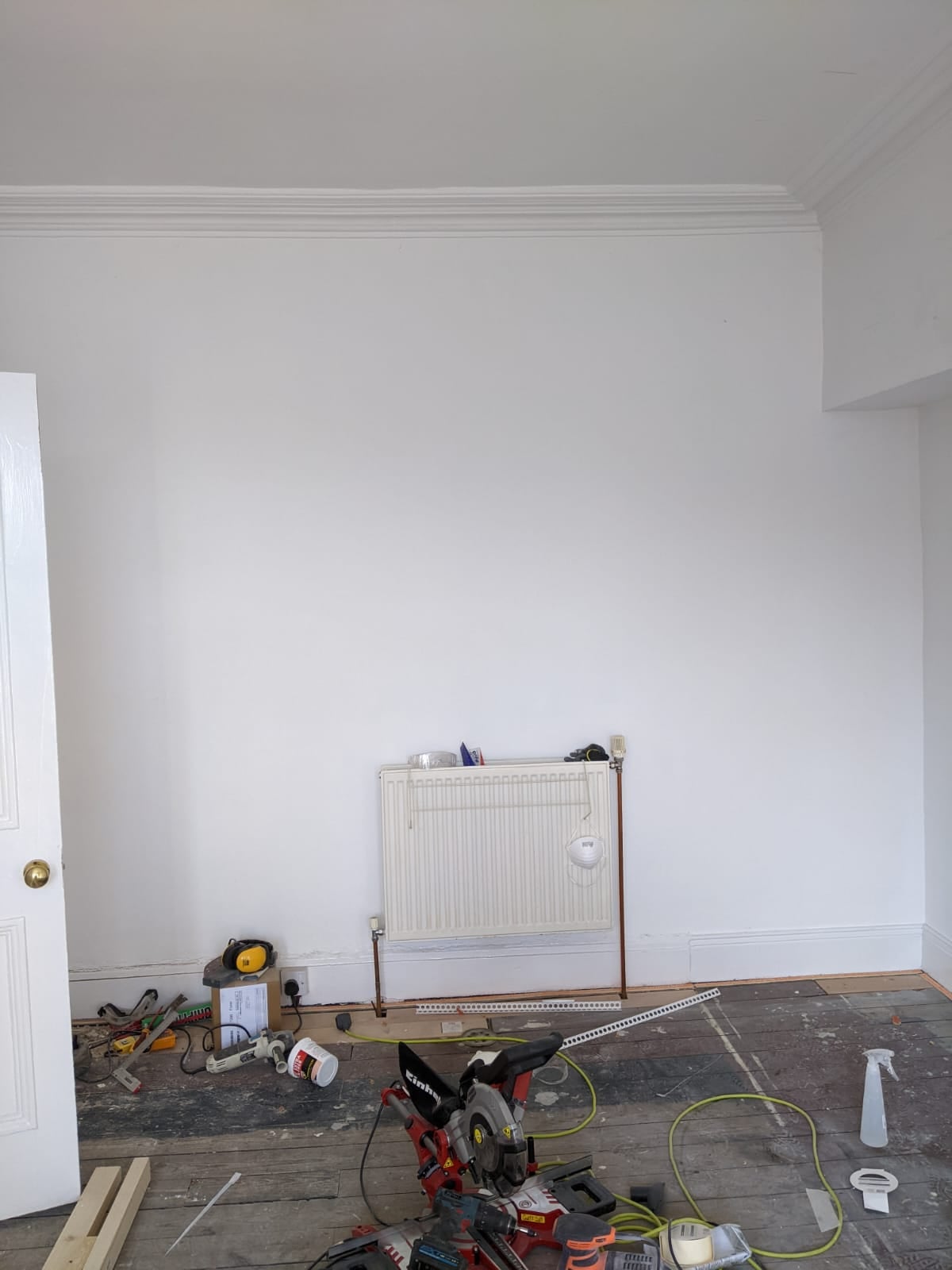
Also looking at replacing the rad, suggestions welcome, victorian terraced (fireplaces missing), but coving and ceiling rose intact.
0
Comments
-
That's the most 'efficient' setup - ie the rad works at its maximum output. But, yes, it's completely unnecessary, and looks 'orrible.When you replace the rads, just fit the valves at the bottom in the conventional way.BUT, try your best to fit 'oversized' rads since you are going to the effort of replacing them. Ie, try and choose outputs which are a good (I dunno) 20%? higher than what the room 'conventionally' needs.The reason for this is, you should be able to run your boiler (and any future heat replacement unit) at a cooler temp which means it'll be more efficient - fully condensing.What flooring are you putting down? If it's going to be covered, then it'll be easy to lift that floorboard along the wall to reposition the tails pipes, so don't feel restricted about where the new rad can go. Clearly old-style 'cast' rads will look great, but they'd also need to have the right heat output.And, before you lay a floor covering, seal around the perimeter under the skirtings, and between the 'boards if needed (or lay lining 'paper' over it instead) in order to reduce drafts.0
-
Why on earth would someone do that.....I've never seen that sort of set up before0
-
grandadgolfer said: Why on earth would someone do that.....I've never seen that sort of set up beforeSeen it done on a number of installations - The usual reason given is one of efficiency.The cutting of the floorboards around the pipes is, erm, brutal... It doesn't take much effort to mark and cut holes neatly.Any language construct that forces such insanity in this case should be abandoned without regrets. –
Erik Aronesty, 2014
Treasure the moments that you have. Savour them for as long as you can for they will never come back again.1 -
In theory it's more efficient as you are pumping hot watier straight to the top of the radiator before forcing it down through the radiator and out of the bottom.
Most modern panel radiators don't hold much water which makes it pointless these days. A modern panel radiator heats up fully in minutes if fed from the bottom.
There may be an argument to lay out the pipes this way on tall column radiators as they can take a little while to heat when fed from the bottom. I'd rather wait an extra 10 minutes though than have pipes fed to the top of the radiator. Can you imagine a "modern" plumber running pipes like that - they'd be run in plastic with push fit joints in them 0
0 -
FreeBear said:grandadgolfer said: Why on earth would someone do that.....I've never seen that sort of set up beforeSeen it done on a number of installations - The usual reason given is one of efficiency.The cutting of the floorboards around the pipes is, erm, brutal... It doesn't take much effort to mark and cut holes neatly.Quite common in commercial property (and schools) where function is more important than appearance.Also in domestic settings it was once quite common to have the return valve at the top on gravity systems - but it doesn't look likely that is the case in the OP's setup.0
-
Could the previous occupant have been disabled or a wheelchair user? TRV at the top might make it easier to adjust.
2 -
You could imagine the TRV getting into on-off cycles because it is going to be more influenced by the radiator temp than the general air temperature. Do not like.0
-
You are correct, the proper way with that connection is to have the sensor head to the side.coffeehound said:You could imagine the TRV getting into on-off cycles because it is going to be more influenced by the radiator temp than the general air temperature. Do not like.
TBOE is the best way of connecting radiators for output. Depending upon radiator & available connections there are other ways of acheiving the same effect (e.g. an internal pipe) & also neater ways of connecting if doing it from scratch..
Having the valve at waist height saves bending down & is easier to read so tends to be good for nursing homes, sheltered housing etc.
2











Confirm your email address to Create Threads and Reply

Categories
- All Categories
- 354.3K Banking & Borrowing
- 254.4K Reduce Debt & Boost Income
- 455.4K Spending & Discounts
- 247.3K Work, Benefits & Business
- 604K Mortgages, Homes & Bills
- 178.4K Life & Family
- 261.5K Travel & Transport
- 1.5M Hobbies & Leisure
- 16K Discuss & Feedback
- 37.7K Read-Only Boards