We’d like to remind Forumites to please avoid political debate on the Forum.
This is to keep it a safe and useful space for MoneySaving discussions. Threads that are – or become – political in nature may be removed in line with the Forum’s rules. Thank you for your understanding.
📨 Have you signed up to the Forum's new Email Digest yet? Get a selection of trending threads sent straight to your inbox daily, weekly or monthly!
The Forum now has a brand new text editor, adding a bunch of handy features to use when creating posts. Read more in our how-to guide
Stud wall support issue

Gavin83
Posts: 8,757 Forumite



Hi all. In my continuing DIY house renovation saga I’ve hit a fairly major issue and wanted some advice. So I’m currently starting an ensuite renovation which was taken back to brick. The house is 30 years old, the ensuite has chipboard subfloors and was originally carpeted so the chipboard isn’t in great condition. My plan was to replace it all with ply and ultimately finish it with LVT flooring.
So the issue at hand. There’s a stud wall between the ensuite and the bedroom. I somewhat naively assumed this wall would be on a joist but it’s not. From the little bit I’ve taken out I don’t think there’s anything other than the chipboard supporting the wall. Picture below:
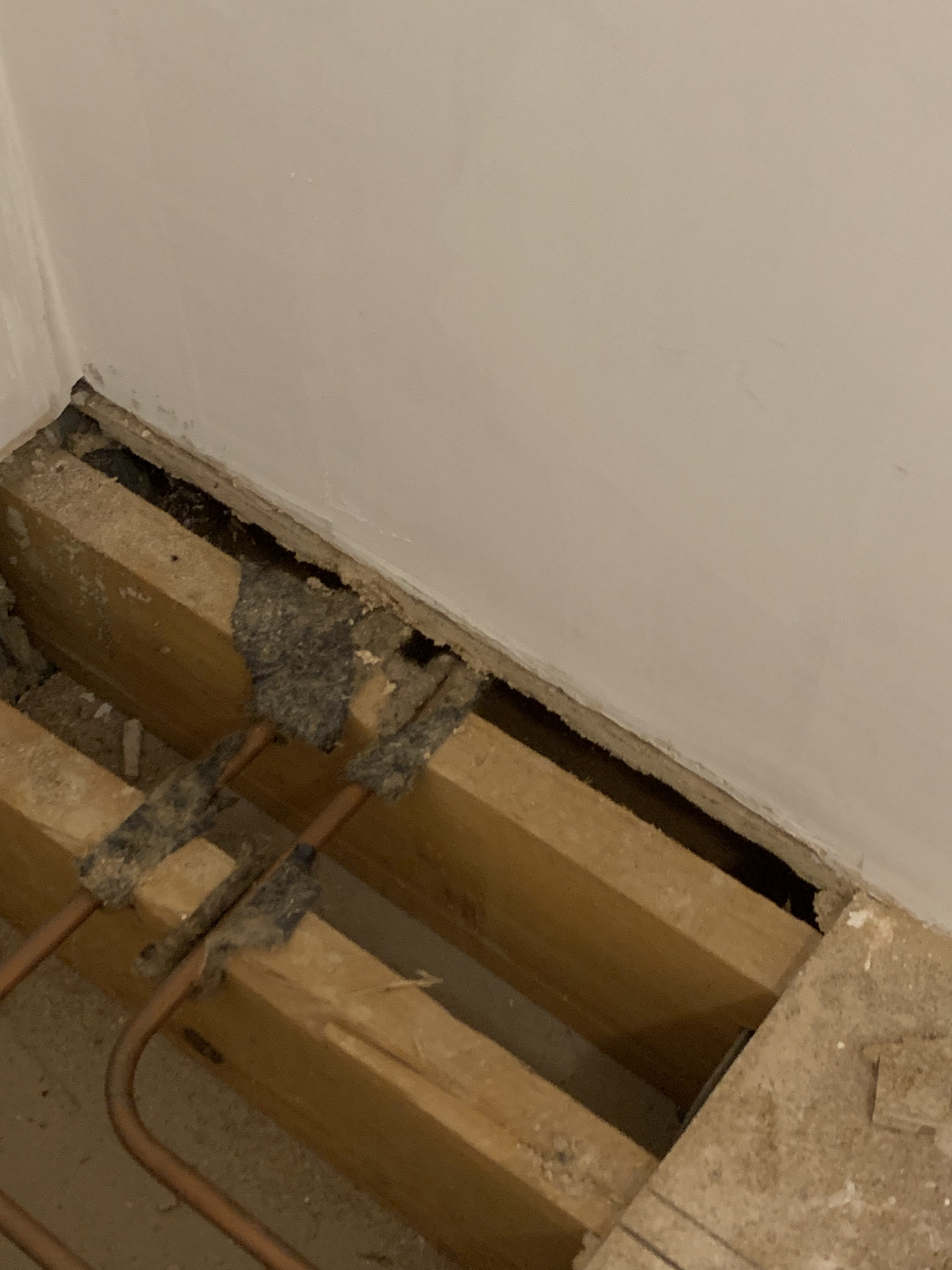
So the issue at hand. There’s a stud wall between the ensuite and the bedroom. I somewhat naively assumed this wall would be on a joist but it’s not. From the little bit I’ve taken out I don’t think there’s anything other than the chipboard supporting the wall. Picture below:
Just so you’re aware there’s another joist just beyond that wall. Also they’ll be nothing major attached to that wall. Only thing of note will be a towel rail.
So what do I do about this? Appreciate just having a wall hanging unsupported isn’t an option so which of the following options do I take:
1) Take out less chipboard than I was planning to. It’ll still be weakened though, it’s fairly knackered and it doesn’t seem a great base for LVT, even with overboarding.
2) Open up the ceiling below and sling some noggins in between the joists from underneath. Luckily the ceiling below still needs plastering so it’s not a massive inconvenience.
3) Somehow try and slide a piece of ply underneath, although that wall sole plate is screwed to the chipboard and I can’t help but feel this’ll be a nightmare.
4) Something else?
One last thing, removing that wall really isn’t an option.
Thanks for the help!
1) Take out less chipboard than I was planning to. It’ll still be weakened though, it’s fairly knackered and it doesn’t seem a great base for LVT, even with overboarding.
2) Open up the ceiling below and sling some noggins in between the joists from underneath. Luckily the ceiling below still needs plastering so it’s not a massive inconvenience.
3) Somehow try and slide a piece of ply underneath, although that wall sole plate is screwed to the chipboard and I can’t help but feel this’ll be a nightmare.
4) Something else?
One last thing, removing that wall really isn’t an option.
Thanks for the help!
0
Comments
-
I think noggins is the only solution that will give adequate support to both the wall and the flooring.It's the correct solution so if it isn't too much extra hassle because of the ceiling, it's what I'd choose to do.New builds. They put the floors down before the internal walls.Everything that is supposed to be in heaven is already here on earth.
1 -
Gavin, do you understand what is required noggin-wise?Ideally, you'll also need access to the underfloor on the other side of the wall. I say 'ideally', but there may be no option.If that access gap - between the last joist and the wall - was big enough to slip a noggin in there - 3x2 or larger - then in theory you could cut noggins to virtually the lengths they need to be to almost (ie, leave some 'play') reach the next joist on the other side of the wall, slip them under there, hold it up against the underside of the floor, and someone screws a few times through the floor on the other side into this noggin to secure it tightly against the underside of the floor. The noggins should now be (a) tight up against the underside of that wall, and (b) spanning under them. Then a couple of large screws skewed through the side of the joist on your side, and into the ends/end-side of the noggins.Really, the joists on both sides should be exposed, and the noggins cut to fit tightly betwixt them, before being screwed through to each joist, but the above method would save you having to rip up the floor on the other side.Another method would be to cut strips of either chipboard or ply, say 6" wide, and slip them under the wall through that gap, with a nice bead of polyurethane glue along the top. Skew-screw through the barely-exposed part of that remaining floor under the wall and into these strips, with the strip positioned to be butting as close to that visible joist as possible. Then, once your new flooring goes down, you screw down along the edge of the new flooring and into these strips (avoiding pipes and wires, of course...) What you will have hopefully effectively done is to rejoin the old floor that's under the wall to the new floor in the bathroom, using this glued-and-screwed strip to span the join.1
-
Bendy, the OP said they can do the noggins from underneath in point 2.The second option is a bodge.Everything that is supposed to be in heaven is already here on earth.
4 -
Doozergirl said:Bendy, the OP said they can do the noggins from underneath in point 2.The second option is a bodge.I agree on both points.The only problem is if the joist under/the other side of the wall is very close to the visible one (it looks like the other joist can just be seen in the picture).Even with access from below it will be a PITA to cut and fit noggings with such narrow joist spacings. But it is the correct way of doing the job and the only one that will give a safe and adequate solution (without taking the wall down).2
-
Thanks all. You've confirmed what I was thinking in regards to a solution. The ceiling below is easily accessible and needed plastering later this year anyway so I can take a strip out and then just board it back up once I'm done. A little more work than I was anticipating but isn't everything when it comes to renovations!
Space is my biggest problem. There isn't much room between that joist and the next one on the other side of the wall (maybe 150mm or so) and while I guess in theory I could screw it in from the opposite side as you can see in the photo there isn't exactly much room that side either. I'll work it out as I go along though.
Appreciate floors generally go down first in new builds but it still annoys me they built 2 joists close to each other but didn't bother to put either of them under the wall!1 -
Ah, cool - access from below is ideal.You can skew-screw the noggins to each joist from below and side. And then one through the ends via the joists if needed.
0 -
I'd suggest using joist hangers - https://www.screwfix.com/c/building-doors/builders-metalwork/cat850192#category=cat850224 - Spreads the load a bit better and gives a neater job.
Any language construct that forces such insanity in this case should be abandoned without regrets. –
Erik Aronesty, 2014
Treasure the moments that you have. Savour them for as long as you can for they will never come back again.1




Confirm your email address to Create Threads and Reply

Categories
- All Categories
- 354.8K Banking & Borrowing
- 254.5K Reduce Debt & Boost Income
- 455.6K Spending & Discounts
- 247.6K Work, Benefits & Business
- 604.5K Mortgages, Homes & Bills
- 178.6K Life & Family
- 262.1K Travel & Transport
- 1.5M Hobbies & Leisure
- 16.1K Discuss & Feedback
- 37.7K Read-Only Boards