We’d like to remind Forumites to please avoid political debate on the Forum.
This is to keep it a safe and useful space for MoneySaving discussions. Threads that are – or become – political in nature may be removed in line with the Forum’s rules. Thank you for your understanding.
📨 Have you signed up to the Forum's new Email Digest yet? Get a selection of trending threads sent straight to your inbox daily, weekly or monthly!
The Forum now has a brand new text editor, adding a bunch of handy features to use when creating posts. Read more in our how-to guide
F-Rated Energy property, grants to improve the house?

FlatFour
Posts: 126 Forumite




Hi all,
Hoping I can get some guidance and advice here...
Recently bought our Housing Association home after an excessive time - just shy of three years, thanks to mistakes on the (prior) Landlords part - but it's done now. Finally.
One of the last things we got, actually days after the purchase was complete, was the energy report. The Landlord (a housing association) seemed very hesitant to provide this, having been sat on it for several months based on the dates on the document. And we found out why, the property was rated F after the energy survey was completed. Which is pretty bad. We expected it'd not be great, the house has always been difficult to keep warm, but the housing association really didn't listen to us. They just wanted to fit that heat-pump based heating system (refused) replacing the old (1980's!) storage heaters (rubbish, not used), which would be even more useless in a poorly-insulated house.
Based on this particularly poor energy rating, we had hoped to be able to apply for some sort of grant for help getting that rating improved and the home warmer / easier to heat, lowering energy use. We only have electric here, no gas, which is not an option in this area. We know there's insufficient (by current standards) roof insulation - one of the points raised in the report which downgraded the rating - as well as other issues. Doing some research, we found mention of such schemes on the gov.uk website, which pointed us towards contacting our energy provider (EON) so we went down that route.
Initially, all seemed good, we spoke to EON who referred our details on to a third-party company that would "call us next week to arrange an appointment" then "come out and evaluate the property" and "make suggestions of what needed doing " (it's on the energy report anyway) and "guide us through the process". This all sounded perfect, exactly what we needed.
However, that's not how it played out. We had no call from this third party company, so ended up chasing them ourselves. The "service" they provide, as described by EON, was nothing of the sort. Really, it's almost funny. Upon calling them they tried to be helpful, genuinely so I believe, but all they did was go on Google and start looking up what we could do. And what did they tell us we could do? Contact our energy provider! Yup, back to where we started in the first place *sigh*
So, after all that fun, I thought I'd come here and ask if anyone has experience going through this process. The house has been under-insulated for years, something we'd reported time and time again. From poor insulation in the roof, to poorly fitting doors, leading to draughts. Don't get me wrong, the core of the house is pretty solid, just the neglect / cheap-skating by the Housing Association mean it's very sub-par verses where it should be in 2022. What I think the house needs to make the most difference (80 / 20 rule) is modern-standard insulation in the roof - actually in the eves, not in the floor of the loft, and new doors, or at least someone knowledgeable to inspect and refit / seal them. That would then allow a modern electric radiator system to keep the house comfortable. All of this costs money though and bills have gone up lately, so any help would be welcome, and it looks like we qualify based on various factors such as household income etc.
We're aware that grants exist to help out in such situations, however, we seem to be getting stuck in a loop when going through the suggested process to get help and guidance on this subject. I further understand that, to a degree, some of these grants might be regional. For the record, we're near Oxford.
It'd be great if someone who has experience with this process can provide some guidance. Going through our energy provider, as suggested by gov.uk, hasn't yielded results.
Cheers.
0
Comments
-
FlatFour said: What I think the house needs to make the most difference (80 / 20 rule) is modern-standard insulation in the roof - actually in the eves, not in the floor of the loftUnless you are converting the loft space into a habitable room, stuffing insulation between the eves is not the way to go. You end up heating an unused space that should be well ventilated. Filling the space between the ceiling joists (loft floor) with 100mm of fibreglass and then a further 200mm laid at 90 degrees is the best way to go. This insulates the room below and maximises the heat retained within the habitable space.Please, don't have spray foam applied in the roof space - It will devalue your home and promote rot in the roof timbers.Plugging the draughts will also pay huge dividends. For doors/windows, it may be as simple as replacing any rubber seals and adjusting the hinges. If you have suspended timber floors, go round the perimeter of each room and fill any gap between floorboards & skirting. Foam draught excluder tape is ideal for this.Long term, you may well want to look at replacing the doors & windows - No grants available for this, so don't get sucked in by any bull from the likes of Anglian, Zenith, Safestyle, etc - If they tell you grants are available, you can be certain that it is just a marketing con (they tried pulling that little scam with me).Any language construct that forces such insanity in this case should be abandoned without regrets. –
Erik Aronesty, 2014
Treasure the moments that you have. Savour them for as long as you can for they will never come back again.1 -
Thanks for the reply @FreeBear, I appreciate you taking the time.It appears that the companies that do these reviews now frown on "normal" loft floor insulation - we have this, but it's a bit thin, plus there's a floor (raised) up there currently - in favour of doing the eves. Just what they say and the energy rating was explicitly marked down due to the lack of this eves insulation, even though there is regular loft floor insulation. We do find that this space gets very cold in the winter and very hot in the summer, which translates to the upstairs temps following that. I suspect the loft floor insulation is pretty poor, it's also ancient, plus it's uneven and certainly no more than 10cm or so at best. We do want this space to be able to be used more, hence the flooring, but hope to expand on this.Note: the floor in the loft currently isn't solid, just boards with large gaps in between. It was done just to allow moving around up there with ease, rather than being a "proper" floor. Ultimately, I'd like to improve this, perhaps pull it up, refresh the current loft floor insulation with modern stuff, then put a better (again, raised) floor down that's more solid.Would never touch spray foam, but thanks for the reminder. Was considering rolls of insulation or perhaps the polystyrene-like stuff that gets cut to shape. Need to do more research myself, as we thought we were getting help with all this stuff.Draughts is something we certainly want to get sorted, both in the loft space and elsewhere. In the loft there are some tears - which they'd never fix - in the roof lining (the black layer between the roof tiles and roof timbers - which will need to be patched. Plus there are odd "missing bricks" between us and next door (semi) that need work. I need to have a good poke around up there again sometime and take pictures of things.Regarding windows, the landlord did insist on replacing them about five years ago now. However, they were inferior quality to the prior ones and have poor shut fit, if you get what I mean. Plus the cowboys who installed them actually caused major structural damage to the house removing the old ones...using sledge hammers to smash them out. *sigh* that was a nightmare, but all structural repairs got done...eventually.What we were mainly looking for a grant to help with was getting the basic levels of insulation done. Windows and doors would be separate, though I hope they can just be inspected so they actually fit / shut properly and actually create and air-right seal.If anyone else has any information on any grants available, it would be much appreciated. We'll likely try to get things that need doing done regardless, but a grant would potentially speed things up. I want next winter to be a warmer winter inside this house.0
-
I don't think you've understood this properly. As FreeBear has said, you want the loft to be cold in the winter - that means your expensive heat is not being wasted in this space. The loft needs to be cold and properly ventilated, and with proper insulation in the ceiling between this and the first floor rooms. There is not such a thing as concentrating on eaves insulation.FlatFour said:It appears that the companies that do these reviews now frown on "normal" loft floor insulation - we have this, but it's a bit thin, plus there's a floor (raised) up there currently - in favour of doing the eves. Just what they say and the energy rating was explicitly marked down due to the lack of this eves insulation, even though there is regular loft floor insulation. We do find that this space gets very cold in the winter and very hot in the summer, which translates to the upstairs temps following that.You don't mention what year the house was built? Insulation for walls might also be needed to get energy usage down. Table below showing just how quickly this has improved over the years.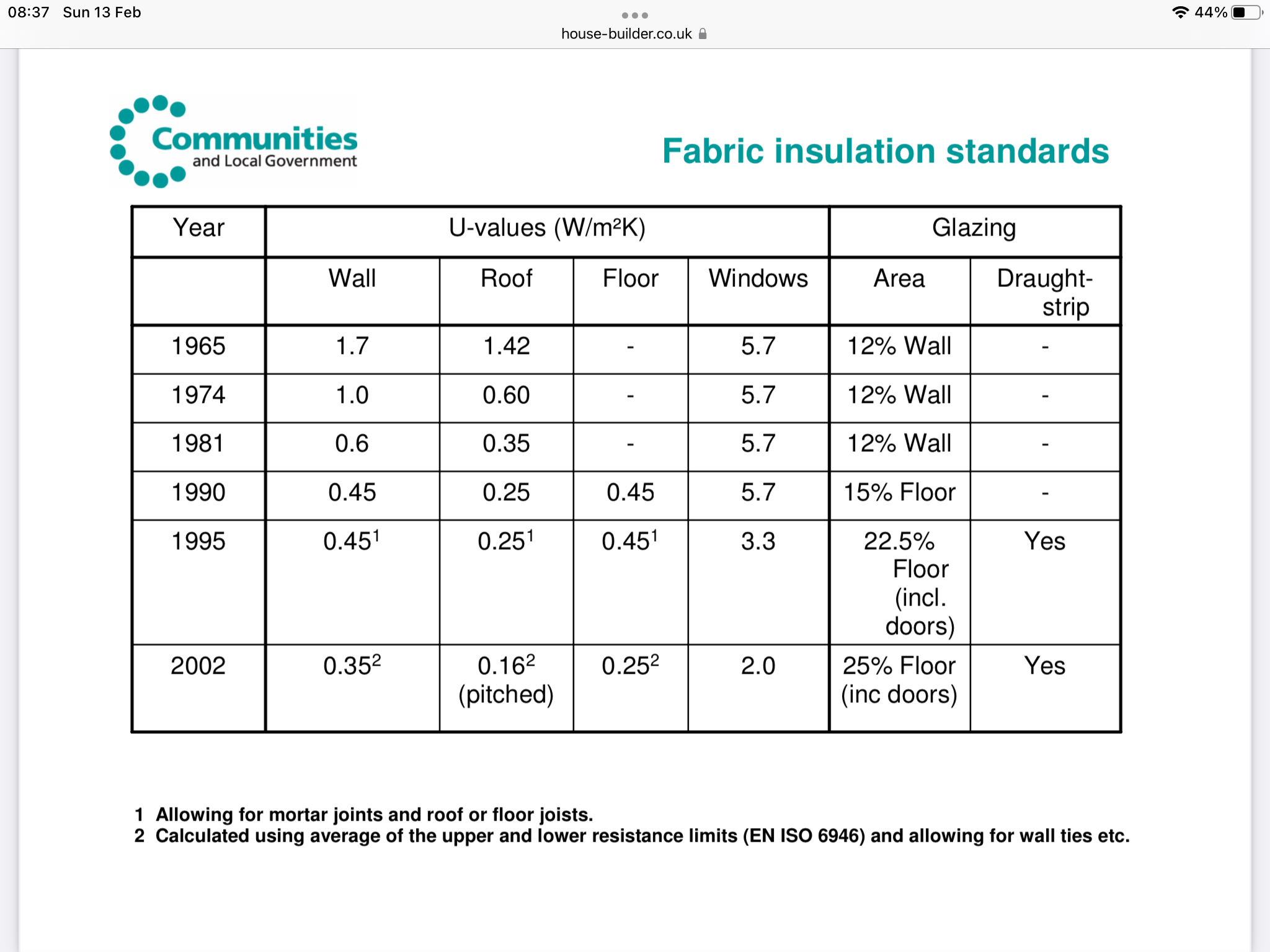 2
2 -
The target u-values changed in 2010 and are due to change yet again in June 2022*. But it is worth noting that there are two sets of figures. One set for new builds, and another for refurbishment of existing buildings - It is the latter set that should be used as the minimum target to aim for if technically feasible. For a typical loft, there is no technical reason not to aim even higher.ComicGeek said: You don't mention what year the house was built? Insulation for walls might also be needed to get energy usage down. Table below showing just how quickly this has improved over the years.*) New requirements can be found here - https://assets.publishing.service.gov.uk/government/uploads/system/uploads/attachment_data/file/1045920/ADL1.pdf (p26 for refurbishment targets).
Any language construct that forces such insanity in this case should be abandoned without regrets. –
Erik Aronesty, 2014
Treasure the moments that you have. Savour them for as long as you can for they will never come back again.1 -
Thanks for the additional replies, I'll try to do some more reading.Hmm, what you're saying does line up with my original thinking, it's just the Energy Report seems to place more emphasis on insulation in the eves.Ultimately though, the current loft floor insulation is near useless. If heating is not currently on, then upstairs temperatures basically match what's in the loft, be it cold in winter or excessively hot in the summer. Basically, if an upstairs room is heated, any heat is rapidly lost when the heater is turned off. Current loft insulation - I cannot recall when it was installed, likely 20+ years ago - is awful. Additionally, when the raised floor was put in, we were told the insulation being compressed somewhat would be just fine - I don't think that is the case. They appear to have used cheap insulation that needs to be VERY thick to work, not better quality stuff that works well despite being thinner. It needs replacing.I think we need to pull up the floor - it should just unscrew - remove the existing rubbish insulation, and replace it with modern good stuff. Then we can replace the floor with something better.I will try to have the read thought that document, it's all a bit out of my area of expertise as I've never had to deal with stuff like this before.See, here's the thing. We were told we'd get help and guidance to make our home warmer and more energy efficient. That's not happened, despite going through the required steps. We filled out an online form again the other day, just in case the first one didn't work for some reason. We didn't get the usual email confirmation you'd expect when filling out such an online form, so thought something might have gone wrong. Still no confirmation the second time either.I fully acknowledge I know nothing about this sort of stuff, hence the need to guidance.0
-
When I did my loft insulation a decade ago (1951 bungalow, which had nothing useful, just a about 50 bin bags worth of of polystyrene chips that took multiple weekends of scooping out) the target was 275mm of the fibreglass stuff, so I did 100mm between the rafters and 175mm at right angles on top of that. Made a big difference to how warm the house was in winter and to gas consumption. Big job though, being a bungalow there's a lot more loft area for the same habitable space compared to a house. Fortunately Wickes were doing 3 for the price of 2 on loft insulation rolls at the time.
I have some old wardrobe doors to walk on which barely compress it unless my weight is on them and I don't store heavy stuff up there, again to avoid compressing the insulation.
Proud member of the wokerati, though I don't eat tofu.Home is where my books are.Solar PV 5.2kWp system, SE facing, >1% shading, installed March 2019.Mortgage free July 20231 -
1
-
If you are looking for help with the costs that is going to take some time to apply for and in the mean time you are paying to heat fresh air so I'd look to do something easy to temporarily fix this while you are looking and applying.Loft insulation is cheap enough and easy to put down. Leave the eaves clear for ventilation to the roof. The company that did mine didn't bother with taking up the previous thin insulation and I had no trouble with that.There is a black mastic claulking type stuff available that should deal with tears in the roof lining.Draughts from doors? What sort? Wood or double glazed type?Is there wall insulation?If you want a good electric heating system the way to go here. I've been told by locals in the same situation, is the new storage heaters which a couple of people have told me are really good at heat and so much cheaper to run. Now you may need help with the cost of installation if you can get it but while waitng for a grant if poss, you could investigate and see if replacements for the old ones would be reasonable with the set up you have.As for grants here's one - sometime you have to pay to view but it's not much and you have a lot to do/saveThe government advice - just beware, it's limited and needs checkingand of courseJust be very careful.I found a link that said 'government-grants. co.uk. Nothing to do with the government, All government sites end 'gov.
I can rise and shine - just not at the same time!
viral kindness .....kindness is contageous pass it on
The only normal people you know are the ones you don’t know very well
1 -
Twixty3 said:Hi,Really sorry, meant to respond sooner but lots going on here.Thanks to this link we managed to secure grants for both heating and insulation improvements. The heating is done, with the grant helping greatly, even though it didn't cover the full cost. We just went for regular, efficient electric radiators in the end that much better fitted our use case. Storage heaters, even though much improved, were simply not on the cards after researching them. Even though we've had some chilly weather, we've not actually used any of them yet. Might be ok until Winter at this rate.The insulation is going to be fully covered by a grant through the National Energy Foundation. We've had a further survey done and the cavity wall insulation is intact and in good condition, it's just the loft insulation that's below spec and patchy. The HA really didn't do a good job here with the insulation piled thick in some places - not laid properly, literally just thrown in a corner - and totally absent in others. There's even a roll they didn't even bother to take out of the packaging just thrown in the back there.Regarding loft insulation, all was set to proceed tomorrow, but we have an issue with the company commissioned by the NEF to do the work, now insisting on doing extra work - I go into details about that in this thread:
https://forums.moneysavingexpert.com/discussion/6348289/loft-insulation-grant-company-moving-the-goalposts/p1?new=1In essence though they're insisting they now have to fit a "Positive Input Ventilation System" in the loft in order to carry out the work. That's not what was agreed and it's explicitly not what the grant is there to cover. We researched this, as I'd never heard of it before, and it's not appropriate for this property as we do not suffer from the excessive damp issues it's designed to prevent. The only parts that do get occasional dampness are the uninsulated sloped bits of the upstairs ceiling as mentioned - something the new insulation was promised to prevent.
I'm hopeful things will go smoothly tomorrow, but it adds to the stress when they try to change the plan at the last moment like this.@twopenny - you mention leaving the eves free of insulation to aid ventilation, yet the advice from the survey was the exact opposite. It's these areas that are currently not insulated, leading to the cold spots on the sloped edges of the ceilings in several upstairs rooms.Thanks again for all the replies, it's much appreciated. We just have the loft insulation to go now, so hopefully that goes smoohly.
0 -
Hi FF. If the PIVS is being supplied free, then perhaps just suck it up and allow it; it's your choice whether to turn it on.
So the 'eaves' referred to are sloping ceilings? Yes, these were often left without insulation, and were also often THE most cold parts of the ceiling as the loft ventilation drafts flew up there from the outside. Icy...
What sort of insulation are they adding here? Could you afford to lose a couple of inches from the INSIDE space on these slopes? If they instead hope to slip insulation down the back of these slopes, it won't be as effective (unless done supremely well), and 'could' risk blocking off the essential ventilation from there - so worth having a look when it's done.
So you're going for instant heaters - turned on as required? Surely that is the single most costly form of energy?0











Confirm your email address to Create Threads and Reply

Categories
- All Categories
- 354.6K Banking & Borrowing
- 254.5K Reduce Debt & Boost Income
- 455.5K Spending & Discounts
- 247.5K Work, Benefits & Business
- 604.3K Mortgages, Homes & Bills
- 178.6K Life & Family
- 261.9K Travel & Transport
- 1.5M Hobbies & Leisure
- 16.1K Discuss & Feedback
- 37.7K Read-Only Boards