We’d like to remind Forumites to please avoid political debate on the Forum.
This is to keep it a safe and useful space for MoneySaving discussions. Threads that are – or become – political in nature may be removed in line with the Forum’s rules. Thank you for your understanding.
UKPPO Claim Form
Comments
-
Send it to yourself as well. That way, if they claim they never received it you will be able to prove it was a problem with their email system.
It wouldn't be the first time a PPC has said they didn't receive something, yet will swear black is white that they sent something to you that you did not receive.I married my cousin. I had to...I don't have a sister. All my screwdrivers are cordless."You're Safety Is My Primary Concern Dear" - Laks1
 -
Hi all,
I received a court date (17th October) which leaves me to submit my witness statement by the 3rd. Unfortunately I had some health challenges so was unable to complete this sooner, but gave it a good stab today. Any feedback would be much appreciated.
Thanks very much in advance for any help
Background and sequence of events
3. On xx/xx/xxxx (date redacted), I took my grandmother to do some shopping at multiple stores in Wembley Stadium Retail Park. My grandmother is a disabled person (see Exhibit XX-01 of proof of her disability, by way of a disabled blue badge permit) and struggles to walk long distances. She also requires additional space around the car to enter and exit the vehicle, hence requiring parking close to shops in a bay large enough for her to manoeuvre.
4. Upon arrival at the Stadium Retail Park, it was observed that there was a sign whilst arriving in the car park but due to driving in and cars moving constantly, it was not possible to stop on the entrance road and read the sign and this was not legible whilst in a moving vehicle, especially as the sign was on the left-hand side of the kerb.
5. It was a busy time on a busy day and hence I was unable to find a disabled parking spot immediately. It took me 10 minutes before I was able to find a vacant disabled spot. There were also no signs immediately next to the disabled parking space. This meant having to walk to the nearest sign in order to read the terms and conditions for parking. By the time I parked, read the signs and accepted the terms, it was approximately 15 minutes from the time I entered the car park.
6. Because of the disability that my grandmother has, it takes her extra time to enter and exit the vehicle and no provision was made by the claimant to take this into consideration. This shows blatant disregard and discrimination for disabled persons with protected characteristics.
7. Given that it is difficult for my grandmother to walk, she does not go out very often and when she does, she likes to complete her shopping from various places in one trip, and hence anticipated to make full use of the 90 minutes parking that was allowed at the car park.
8. In addition, due to the busy day in the retail park, it took a few minutes to get out of the car park too.
9. Taking into account the time taken to actually park the car, read the signs, allowing for the disabled passenger to get in and out of the car, I believe that the time the car actually spent parked in the car park was comfortably within the 90 minute time frame that the car park allows for, not even taking into account a 10 grace period which should have been allowed for by the claimant.
10. No provision was made to understand when the car was actually parked by the claimant. In the case of 3JD08399 ParkingEye v Ms X (Altrincham 17/03/2014), where the defendant spent 31 minutes waiting to park, the judge ruled against ParkingEye saying the ANPR data recorded time in the car park and not the time parked.
11. Instead, I received a PCN and was asked to pay a penalty charge. This is not because the car was parked longer than the car park allows, but because I parked the car later than the Claimant acknowledges, compared to the time the ANPR captures the car entering and leaving the car park.
12. After receiving the PCN, I appealed just after 21 days of receiving the letter but received a response from the claimant that it was too late to appeal. This again does not give defendants a reasonable time frame between receiving a letter (a few days after being issued and sent via second class post) and drafting an appeal for it to be considered appropriately.
Abuse of process - the quantum
13. The Claimant has added a sum disingenuously described as 'damages/admin' or 'debt collection costs'. The amount stated as per the sign in the car park was originally £100, however the claimant subsequently claimed for £160 which was then over time inflated to £266.67. The added £166.67 constitutes more than double recovery and the court is invited to find the quantum claimed is false and an abuse of process - see Exhibit XX-03 - transcript of the Approved judgment in Britannia Parking v Crosby (Southampton Court 11.11.19). That case was not appealed and the decision stands.
14. Whilst it is known that another case that was struck out on the same basis was appealed to Salisbury Court (the Semark-Jullien case), the parking industry did not get any finding one way or the other about the illegality of adding the same costs twice. The Appeal Judge merely pointed out that he felt that insufficient information was known about the Semark-Jullien facts of the case (the Defendant had not engaged with the process and no evidence was in play, unlike in the Crosby case) and so the Judge listed it for a hearing and felt that case (alone) should not have been summarily struck out due to a lack of any facts and evidence.
15. The Judge at Salisbury correctly identified as an aside, that costs were not added in the Beavis case. That is because this had already been addressed in ParkingEye's earlier claim, the pre-Beavis High Court (endorsed by the Court of Appeal) case ParkingEye v Somerfield (ref para 419): <link redacted>
''It seems to me that, in the present case, it would be difficult for ParkingEye to justify, as against any motorist, a claim for payment of the enhanced sum of £135 if the motorist took the point that the additional £60 over and above the original figure of £75 constituted a penalty. It might be possible for ParkingEye to show that the additional administrative costs involved were substantial, though I very much doubt whether they would be able to justify this very large increase on that basis. On the face of it, it seems to me that the predominant contractual function of this additional payment must have been to deter the motorist from breaking his contractual obligation to pay the basic charge of £75 within the time specified, rather than to compensate ParkingEye for late payment. Applying the formula adopted by Colman J. in the Lordsvale case, therefore, the additional £60 would appear to be penal in nature; and it is well established that, in those circumstances, it cannot be recovered, though the other party would have at least a theoretical right to damages for breach of the primary obligation.''
16. This stopped ParkingEye from using that business model again, particularly because HHJ Hegarty had found them to have committed the 'tort of deceit' by their debt demands. So, the Beavis case only considered an £85 parking charge but was clear at paras 98, 193 and 198 that the rationale of that inflated sum (well over any possible loss/damages) was precisely because it included (the Judges held, three times) 'all the costs of the operation'. It is an abuse of process to add sums that were not incurred. Costs must already be included in the parking charge rationale if a parking operator wishes to base their model on the ParkingEye v Beavis case and not a damages/loss model. This Claimant can't have both.
17. This Claimant knew or should have known, that by adding £166.67 in costs over and above the purpose of the 'parking charge' to the global sum claimed is unrecoverable, due to the POFA at 4(5), the Beavis case paras 98, 193 and 198 (see Exhibit XX-02), the earlier ParkingEye Ltd v Somerfield High Court case and the Consumer Rights Act 2015 ('CRA') Sch 2, paras 6, 10 and 14. All of those seem to be breached in my case and the claim is pleaded on an incorrect premise with a complete lack of any legitimate interest.
18. Not drawing onerous terms to the attention of a consumer breaches Lord Denning's 'red hand rule' and in addition the global sum on the particulars of claim is unfair under the CRA. Consumer notices are never exempt from the test of fairness and the court has a duty under s71 of the CRA to consider the terms and the signs to identify the breaches of the CRA. Not only is the added vague sum not stated on the notices at all but the official CMA guidance to the CRA covers this and makes it clear that words like 'indemnity' are objectionable in themselves and any term trying to allow a trader to recover costs twice would (of course) be void, even if the added sum was on the signs.
19. In a very recent case, District Judge Taylor, dismissed a case from BWLegal that included a false amount of £60 (Claim number is F0DP201T District Judge Taylor Southampton Court, 10th June 2019).
"The claim contains a substantial charge additional to the parking charge which it is alleged the defendant contracted to pay, This additional charge is not recoverable under the protection of freedoms act 2012, Schedule 4 not with reference to the judgement in parking eye v Beavis. It is an abuse of process from the claimant to issue a knowingly inflated claim for an additional sum which it is not entitled to recover,
This order has been made by the court of its own initiative without a hearing pursuant to CPR Rule 3.3(4) of the civil procedure rules 1998"
Another case was also struck out for the same reason (Case # F0DP163T Judge was DJ Grand)”
The additional charge is not recoverable under POFA 2012.
CPR 44.11 - further costs
20. I am appending with this bundle, a fully detailed costs assessment (see Exhibit XX-04) which also covers my proportionate but unavoidable further costs and I invite the court to consider making an award to include these, pursuant to the court's powers in relation to misconduct (CPR 44.11). In support of that argument, I remind the court that I appealed and engaged with the Claimant early on and they were very much aware of the circumstances that led to this claim. Not only could this claim have been avoided but the Claimant has no cause of action but it is also vexatious to pursue an inflated sum that includes double recovery.
My fixed witness costs - ref PD 27, 7.3(1) and CPR 27.14
21. As a litigant-in-person I have had to learn relevant law from the ground up and spent a considerable time researching the law online, processing and preparing my defence plus this witness statement. I ask for my fixed witness costs. I am advised that costs on the Small Claims track are governed by rule 27.14 of the CPR and (unless a finding of 'wholly unreasonable conduct' is made against the Claimant) the Court may not order a party to pay another party’s costs, except fixed costs such as witness expenses which a party has reasonably incurred in travelling to and from the hearing (including fares and/or parking fees) plus the court may award a set amount allowable for loss of earnings or loss of leave.
22. The fixed sum for loss of earnings/loss of leave apply to any hearing format and are fixed costs at PD 27, 7.3(1)
''The amounts which a party may be ordered to pay under rule 27.14(3)(c) (loss of earnings)... are: (1) for the loss of earnings or loss of leave of each party or witness due to attending a hearing ... a sum not exceeding £95 per day for each person.''
0 -
Remove 19 because a case that mirrored that case was appealed/overturned, so claims are no longer struck out. We no longer use the Southampton case.
Instead, copy the stuff in the WS on the thread by @aphex007 because that reflects the position in 2022, as things stand.PRIVATE 'PCN'? DON'T PAY BUT DON'T IGNORE IT (except N.Ireland).
CLICK at the top or bottom of any page where it says:
Home»Motoring»Parking Tickets Fines & Parking - read the NEWBIES THREAD2 -
Thanks @Coupon-mad for the help. I have reviewed and incorporated the points from aphex007's WS. I've also added a few other points earlier. Appreciate a further review on this please.
Few questions:
- I have taken images from Google Maps for Exhibits 02/03 (July 2017 ones, which are the most relevant given the event of this PCN was on Oct 2018). Is that okay to use as evidence given I don't have my own photos from the time?
- Is point 12 a valid argument? If so, is there anything else I need to add?
- You mentioned to scrap point 19 from my previous attempt. Is the logic + transcript in point 14 from Southampton for Britannia Parking v Crosby in Nov 2019 still okay to use?
Thanks once again!Background and sequence of events
3. On xx/xx/xxxx, I took my grandmother to do some shopping at multiple stores in Wembley Stadium Retail Park. My grandmother is a disabled person (see Exhibit XX-01 of proof of her disability, by way of a disabled blue badge permit) and struggles to walk long distances. She also requires additional space around the car to enter and exit the vehicle, hence requiring parking close to shops in a bay large enough for her to manoeuvre around the vehicle.
4. Upon arrival at the Stadium Retail Park, it was observed that there was a sign whilst arriving in the car park (see Exhibit XX-02) but due to driving in and cars moving constantly, it was not possible to stop on the entrance road and read the sign and this was not legible whilst in a moving vehicle, especially as the sign was on the left-hand side of the kerb.
5. It was a busy time on a busy day and hence I was unable to find a disabled parking spot immediately. It took me 10 minutes before I was able to find a vacant disabled spot. There were also no signs immediately next to the disabled parking space (see Exhibit XX-03). This meant having to walk to the nearest sign in order to read the terms and conditions for parking. By the time I parked, read the signs and accepted the terms, it was approximately 15 minutes from the time I entered the car park.
6. Because of the disability that my grandmother has, it takes her extra time to enter and exit the vehicle, as well as procure her walking aids from the boot. No provision was made by the claimant to take this into consideration. This shows blatant disregard and discrimination for disabled persons with protected characteristics. This is contradictory to the IPC code of practice (see Exhibit XX-04) where reasonable adjustments should be made for disabled persons as per the Equality Act 2010.
7. Given my grandmother’s walking difficulties, she does not go out very often and when she does, she likes to complete her shopping from various shops in one trip as much as possible, and hence anticipated to make full use of the 90 minutes parking that was allowed at the car park.
8. In addition, due to the busy day in the retail park and the queue to exit the site, it took a few minutes to get out of the car park too.
9. Taking into account the time taken to actually park the car, read the signs, allowing for the disabled passenger to get in and out of the car, I believe that the time the car actually spent parked in the car park was comfortably within the 90 minute time frame that the car park allows for, not even taking into account a 10 grace period which should have been allowed for by the claimant.
10. No provision was made to understand when the car was actually parked by the claimant. In the case of 3JD08399 ParkingEye v Ms X (Altrincham 17/03/2014), where the defendant spent 31 minutes waiting to park, the judge ruled against ParkingEye saying the ANPR data recorded time in the car park and not the time parked.
11. Instead, I received a Parking Charge Notice (PCN) and was asked to pay this penalty charge. This is not because the car was parked longer than the car park allows, but because I parked the car later than the Claimant acknowledges, compared to the time the ANPR captures the car entering and leaving the car park.
Lack of ADR
12. After receiving the PCN, I appealed just after 21 days of receiving the letter which I understood to be within relevant time frames. In the penalty charge notice sent by the claimant, there are various references to dates (14 days allowed to get a reduced charge of £60 instead of the full £100 charge, 21 days mentioned once under the appeal section, and 28 days mentioned multiple times including twice within the appeals section) which I found very confusing – see Exhibit XX-05. Instead, I received a response from the claimant that it was too late to appeal. Aside from the confusion around the dates, this again does not give defendants a reasonable time frame between receiving a letter (a few days after being issued and sent via second class post) and drafting an appeal for it to be considered appropriately.
13. I further aver the Claimant failed to offer a genuinely independent Alternative Dispute Resolution (ADR). The Appeals Annex in the new Code shows that genuine disputes such as this - even if the facts were narrowed later - would have seen the charge cancelled, had a fair ADR existed. Whether or not a person engaged with it, the Claimant's consumer blame culture and reliance upon the industry's own 'appeals service' should not sway the court into a belief that an independent and fair ADR was ever on offer. The rival Trade Bodies' time-limited and opaque 'appeals' services fail to properly consider facts or rules of law and would have rejected almost any dispute.
Abuse of process - the quantum
14. The Claimant continues to pursue a hugely disproportionate fixed sum (routinely added per PCN) despite knowing that this is now banned. They have added a sum described as 'damages/admin' or 'debt collection costs'. The amount stated as per the sign in the car park was originally £100, however the claimant subsequently claimed for £160 which was then over time inflated to £266.67. The added £166.67 constitutes more than double recovery and it is denied that the quantum sought is recoverable (authorities: two well-known ParkingEye cases where modern penalty law rationale was applied). Attention is drawn to paras 98, 100, 193, 198 of ParkingEye Ltd v Beavis [2015] UKSC67. Also ParkingEye Ltd v Somerfield Stores Ltd ChD [2011] EWHC 4023(QB) where the parking charge was £75, discounted to £37.50 for prompt payment. Whilst £75 was reasonable, HHJ Hegarty (sitting at the High Court; later ratified by the CoA) held in paras 419-428 that unspecified 'admin costs' inflating it to £135 'would appear to be penal', i.e. unrecoverable. The court is invited to find the quantum claimed is false and an abuse of process - see Exhibit XX-06 - transcript of the Approved judgment in Britannia Parking v Crosby (Southampton Court 11.11.19). That case was not appealed and the decision stands.
15. My stance regarding this punitive add-on is now underpinned by the Government, who have now stated that attempts to gild the lily by adding 'debt recovery costs' were 'extorting money'. The Department for Levelling Up, Housing and Communities ('DLUHC') published in February 2022, a statutory Code of Practice, found here: https://www.gov.uk/government/publications/private-parking-code-of-practice.
16. Whilst it is known that the rogue parking industry have just filed Judicial Reviews and have delayed the new Code of Practice (as per paragraph 15), the Government is pressing ahead and has conceded to undertake a final Public Consultation and Impact Assessment, as the latter was missing from their rationale. Going by the damning words of the Minister, and the fact that two consultations and an industry and consumer represented Steering Group have already informed the DLUHC's decision over the past two years, I believe there is no reason to think the Government's view will significantly change about adding unconscionable costs that were not incurred and which merely exist as a mechanism to enhance already-doubled parking charges, to fuel the roboclaim race to court and to side-step the £50 legal fees cap set in the Small Claims Track.
17. Adding debt recovery/costs/damages/fees (however described) onto a parking charge is now banned. In a section called 'Escalation of costs' the incoming statutory Code of Practice says: "The parking operator must not levy additional costs over and above the level of a parking charge or parking tariff as originally issued."
18. This particular Claimant's legal team routinely continues to pursue a sum on top of each PCN, despite indisputably knowing that these are banned costs. The claim is exaggerated by inclusion of a false, wholly disproportionate and unincurred 'damages' enhancement of £60 upon which the Claimant seems to have also added interest at 8% calculated from the date of parking. Clearly an abuse of the court process.
19. The Code's Ministerial Foreword is unequivocal about abusive existing cases such as the present claim: "Private firms issue roughly 22,000 parking tickets every day, often adopting a labyrinthine system of misleading and confusing signage, opaque appeals services, aggressive debt collection and unreasonable fees designed to extort money from motorists."
20. The DLUHC consulted for over two years and considered evidence from a wide range of stakeholders. Almost a fifth of all respondents to the 2021 Technical Consultation called for false fees to be scrapped altogether; this despite the parking industry flooding both public consultations, some even masquerading as consumers. The DLUHC saw through this and in a published Response (also in February 2022), they identified that some respondents were 'parking firms posing as motorists'. Genuine consumer replies pointed out that successful debt recovery does not trigger court proceedings and the debt recovery/robo-claim law firms operate on a 'no win, no fee' basis, and are effectively Trade Body Board member colleagues passing motorists' data around electronically and seeking to inflate the sum of the parking charge, which in itself is already sufficiently enhanced.
21. This Claimant has not incurred any additional costs (not even for reminder letters) because the full parking charge itself more than covers what the Supreme Court in Beavis called a 'letter chain' business model that generates a healthy profit. The Judge at Salisbury correctly identified as an aside, that costs were not added in the Beavis case. That is because this had already been addressed in ParkingEye's earlier claim, the pre-Beavis High Court (endorsed by the Court of Appeal) case ParkingEye v Somerfield (ref para 419): https://www.bailii.org/ew/cases/EWHC/QB/2011/4023.html
''It seems to me that, in the present case, it would be difficult for ParkingEye to justify, as against any motorist, a claim for payment of the enhanced sum of £135 if the motorist took the point that the additional £60 over and above the original figure of £75 constituted a penalty. It might be possible for ParkingEye to show that the additional administrative costs involved were substantial, though I very much doubt whether they would be able to justify this very large increase on that basis. On the face of it, it seems to me that the predominant contractual function of this additional payment must have been to deter the motorist from breaking his contractual obligation to pay the basic charge of £75 within the time specified, rather than to compensate ParkingEye for late payment. Applying the formula adopted by Colman J. in the Lordsvale case, therefore, the additional £60 would appear to be penal in nature; and it is well established that, in those circumstances, it cannot be recovered, though the other party would have at least a theoretical right to damages for breach of the primary obligation.''
22. This stopped ParkingEye from using that business model again, particularly because HHJ Hegarty had found them to have committed the 'tort of deceit' by their debt demands. So, the Beavis case only considered an £85 parking charge but was clear at paras 98, 193 and 198 that the rationale of that inflated sum (well over any possible loss/damages) was precisely because it included (the Judges held, three times) 'all the costs of the operation'. It is an abuse of process to add sums that were not incurred. Costs must already be included in the parking charge rationale if a parking operator wishes to base their model on the ParkingEye v Beavis case and not a damages/loss model. This Claimant can't have both.
23. This Claimant knew or should have known, that by adding £166.67 in costs over and above the purpose of the 'parking charge' to the global sum claimed is unrecoverable, due to the POFA at 4(5), the Beavis case paras 98, 193 and 198 (see Exhibit XX-07), the earlier ParkingEye Ltd v Somerfield High Court case and the Consumer Rights Act 2015 ('CRA') Sch 2, paras 6, 10 and 14. All of those seem to be breached in my case and the claim is pleaded on an incorrect premise with a complete lack of any legitimate interest.
24. Not drawing onerous terms to the attention of a consumer breaches Lord Denning's 'red hand rule' and in addition the global sum on the particulars of claim is unfair under the CRA. Consumer notices are never exempt from the test of fairness and the court has a duty under s71 of the CRA to consider the terms and the signs to identify the breaches of the CRA. Not only is the added vague sum not stated on the notices at all but the official CMA guidance to the CRA covers this and makes it clear that words like 'indemnity' are objectionable in themselves and any term trying to allow a trader to recover costs twice would (of course) be void, even if the added sum was on the signs.
25. The driver did not agree to pay a parking charge, let alone unknown costs, which were not quantified in prominent text on the signage. It comes too late when purported debt recovery fees are only quantified after the event. These are now banned costs which the Claimant has neither paid nor incurred. Introducing the purported 'costs' add-on in later debt demands is a moneymaking exercise to extract a high fixed sum from weaker motorists and came far too late. I did not agree to it.
26. Whilst the new Code and Act is not retrospective, it was enacted due to the failure of the self-serving BPA & IPC Codes of Practice. The Minister is indisputably talking about existing (not future) cases when declaring that 'recovery' fees were 'designed to extort money'. A clear steer for the Courts.
27. This overrides mistakes made in the appeal cases that the parking industry try to rely upon (Britannia v Semark-Jullien, One Parking Solution v Wilshaw, Vehicle Control Services v Ward and Vehicle Control Services v Percy). Far from being persuasive, regrettably these one-sided appeals were findings by Circuit Judges who appeared to be inexperienced in the nuances of private parking law and were led in one direction by Counsel for parking firms, and the litigant-in-person consumers lacked the wherewithal to appeal further.
28. It is pertinent to note that the Britannia v Semark-Jullien appeal judgment by HHJ Parkes criticised the District Judges at Southampton, for apparently not having enough evidence to conclude that Britannia 'knew' that their added costs were abusive (unincurred, unpaid and unjustified). Unbeknown to HHJ Parkes, of course all District Judges deal with template, generic evidence and arguments from parking operators every week, and BPA member firms including Britannia, certainly had been told this by Judges up and down the Country for many years. And the decision and words used by the DLUHC show that DJ Grand and DJ Taylor were right all along. As was HHJ Jackson in Excel v Wilkinson (not appealed - see Exhibit xx-16) where she went into great detail about this abuse.
29. The Semark-Jullien case is now unreliable going forward and is fully distinguished now that the Government has at last stepped in and exposed and published the truth. This Claimant indisputably has knowledge (and always had knowledge) that they have not paid a penny in debt recovery costs, nor incurred any additional costs that the £100 parking charge is not designed to more than cover. The abuse is now clearly established and a new judgment re-stating this position, in the light of the damning words in the Foreword and the Explanatory Document published alongside the Code of Practice and stating (for the avoidance of doubt) the knowledge that District Judges have from years of experience of seeing these template enhanced claims and telling this Claimant to stop bringing exaggerated parking claims to court, would be welcomed to bring much-needed clarity for consumers and Judges across England and Wales.
30. In case this Claimant tries to rely upon those old cases, significant errors were made. Evidence - including unclear signage and Codes of Practice - was either ignored, even when in evidence at both hearings (Wilshaw, where the Judge was also oblivious to regulatory DVLA KADOE rules requiring landowner authority) or the judgment referred to the wrong rules, with one Judge seeking out the inapplicable BPA Code after the hearing and using it erroneously (Percy). In Ward, a few seconds' emergency stop out of the control of the driver, was inexplicably aligned with Beavis. The learned Judges were led in one direction by Counsel for parking firms, and were not in possession of the same level of facts and evidence as the DLUHC.
CPR 44.11 - further costs
20. I am appending with this bundle, a fully detailed costs assessment (see Exhibit XX-08) which also covers my proportionate but unavoidable further costs and I invite the court to consider making an award to include these, pursuant to the court's powers in relation to misconduct (CPR 44.11). In support of that argument, I remind the court that I appealed and engaged with the Claimant early on and they were very much aware of the circumstances that led to this claim. Not only could this claim have been avoided but the Claimant has no cause of action but it is also vexatious to pursue an inflated sum that includes more than double recovery.
My fixed witness costs - ref PD 27, 7.3(1) and CPR 27.14
21. As a litigant-in-person I have had to learn relevant law from the ground up and spent a considerable time researching the law online, processing and preparing my defence plus this witness statement. I ask for my fixed witness costs. I am advised that costs on the Small Claims track are governed by rule 27.14 of the CPR and (unless a finding of 'wholly unreasonable conduct' is made against the Claimant) the Court may not order a party to pay another party’s costs, except fixed costs such as witness expenses which a party has reasonably incurred in travelling to and from the hearing (including fares and/or parking fees) plus the court may award a set amount allowable for loss of earnings or loss of leave.
22. The fixed sum for loss of earnings/loss of leave apply to any hearing format and are fixed costs at PD 27, 7.3(1)
''The amounts which a party may be ordered to pay under rule 27.14(3)(c) (loss of earnings)... are: (1) for the loss of earnings or loss of leave of each party or witness due to attending a hearing ... a sum not exceeding £95 per day for each person.''
0 -
In the penalty charge notice sent by the claimant ...........Did they actually call it that? surely it is a Parking Charge Notice?2
-
Only when issued by a council or the police.pryder said:
- I've heard PCNs also referred to as penalty charge notices..Le_Kirk said:In the penalty charge notice sent by the claimant ...........Did they actually call it that? surely it is a Parking Charge Notice?
An unregulated parking company simply cannot use that word.
From their trade association's Code of Practice...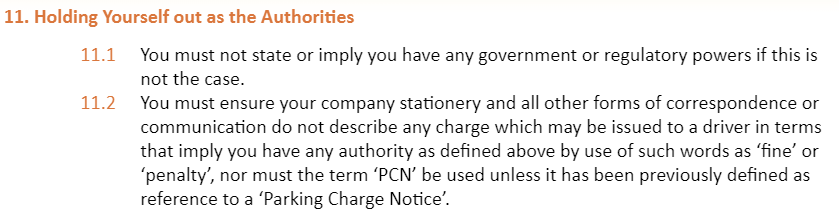
2 -
Thanks for clarifying - I had no idea! I'll make sure to amend in the WSKeithP said:
Only when issued by a council or the police.pryder said:
- I've heard PCNs also referred to as penalty charge notices..Le_Kirk said:In the penalty charge notice sent by the claimant ...........Did they actually call it that? surely it is a Parking Charge Notice?
An unregulated parking company simply cannot use that word.
From their trade association's Code of Practice...0 -
Some observations:-"10. No provision was made to understand when the car was actually parked by the claimant."Perhaps amend slightly to - "No provision was made by the claimant to understand when the car was actually parked."Para 11 - ".... but because I parked the car later than the Claimant acknowledges,...." - not sure if that makes sense.Paras 14 & 23 - "The added £166.67 constitutes more than double recovery...." does that include Court/sols fees?2
-
Thanks for the feedback @1505grandad1505grandad said:Some observations:-"10. No provision was made to understand when the car was actually parked by the claimant."Perhaps amend slightly to - "No provision was made by the claimant to understand when the car was actually parked."Para 11 - ".... but because I parked the car later than the Claimant acknowledges,...." - not sure if that makes sense.Paras 14 & 23 - "The added £166.67 constitutes more than double recovery...." does that include Court/sols fees?
First point - yes makes sense. I will amend.
Para 11 makes sense to me but as it may not be clear to everyone, I will have a think how to re-word.
Paras 14/23: Yes it does - I have a breakdown somewhere. Will find the bwlegal letters and post their breakdown but I'm pretty sure it was recovery costs, inflation, solicitor fees amongst that figure. Should I not be quoting the full figure?0









Confirm your email address to Create Threads and Reply

Categories
- All Categories
- 354.4K Banking & Borrowing
- 254.4K Reduce Debt & Boost Income
- 455.4K Spending & Discounts
- 247.3K Work, Benefits & Business
- 604K Mortgages, Homes & Bills
- 178.4K Life & Family
- 261.5K Travel & Transport
- 1.5M Hobbies & Leisure
- 16K Discuss & Feedback
- 37.7K Read-Only Boards