We’d like to remind Forumites to please avoid political debate on the Forum.
This is to keep it a safe and useful space for MoneySaving discussions. Threads that are – or become – political in nature may be removed in line with the Forum’s rules. Thank you for your understanding.
📨 Have you signed up to the Forum's new Email Digest yet? Get a selection of trending threads sent straight to your inbox daily, weekly or monthly!
The Forum now has a brand new text editor, adding a bunch of handy features to use when creating posts. Read more in our how-to guide
Plumbers and Heating - Should I leave the TRV off one Radiator in the house?
Comments
-
Yes. Smart TRVs on all rads would be the ultimate setup! It is like having numerous 'zones' - one for each rad!sho_me_da_money said:Further to my last comment, I learned something interesting about the Smart TRVs I have installed.
When I set Bedroom 1s Smart TRV to 21 degrees, it sends and instruction to the boiler, turns it on and starts getting hot. All other radiators in the house stay cold and only Bedroom 1 gets hot until 21 degrees is hit.
This begs a fundamental question for me:
If the entire house i.e. all radiators are configured with a smart TRV, what the heck is a Thermostat unit needed for? I literally see no reason for it as you can set schedules time/temp settings per TRV and every TRV is capable of calling the boiler to turn on.
Any thoughts?
Bear in mind that all the other rads stayed cold just because these rooms were already warm enough, so their manual TRVs had the rads shut off. If the other rads had manual valves or TRVs that were 'open' and waiting for the boiler to be timed to come on, then they TOO would have heated up when that bedroom 'smart' TRV told the boiler to fire up.0 -
Assuming the house is empty during the daytime, drop the temperature down to 16°C or 17°C, and maybe only go to 19°C in the morning. Night time, cut it back to 17°C and you shouldn't get much condensation on your windows. 16°C is a bit too low for my taste. Bedrooms, you can afford to drop the morning/evening temps down to 18°C unless you have smalls that are doing schoolwork & stuff.sho_me_da_money said: I have no idea about schedules and optimal temperatures for the house but I have configured the following temps and timings of the house.
06:00 - 09:30 - 20 degrees
09:30 - 17:00 - 19 degrees
17:00 - 22:00 - 20 degrees
22:00 - 06:00 - 18 degrees
.....rinse and repeat each day
Any language construct that forces such insanity in this case should be abandoned without regrets. –
Erik Aronesty, 2014
Treasure the moments that you have. Savour them for as long as you can for they will never come back again.1 -
Good to hear but has the system been balanced out and does the unknown branded lump of a vertical heat emitter actually now comfortably heat that room ?
So many people are trying to reduce their gas consumption, which is good Choose Stabila !0
 -
This is literally a pic of the current temps 2 mins ago.
The numbers with a clear white background (and not black) represent the detected temp by the thermostat or the TRV.
The numbers with a black background (and not white) represent the temps I have set in the schedule.
The temp outside is 6.3C
That means my house will rarely ever need to heat up as the temps seems to be firm around 19 degrees. Damn did I ever need radiators. LMAO.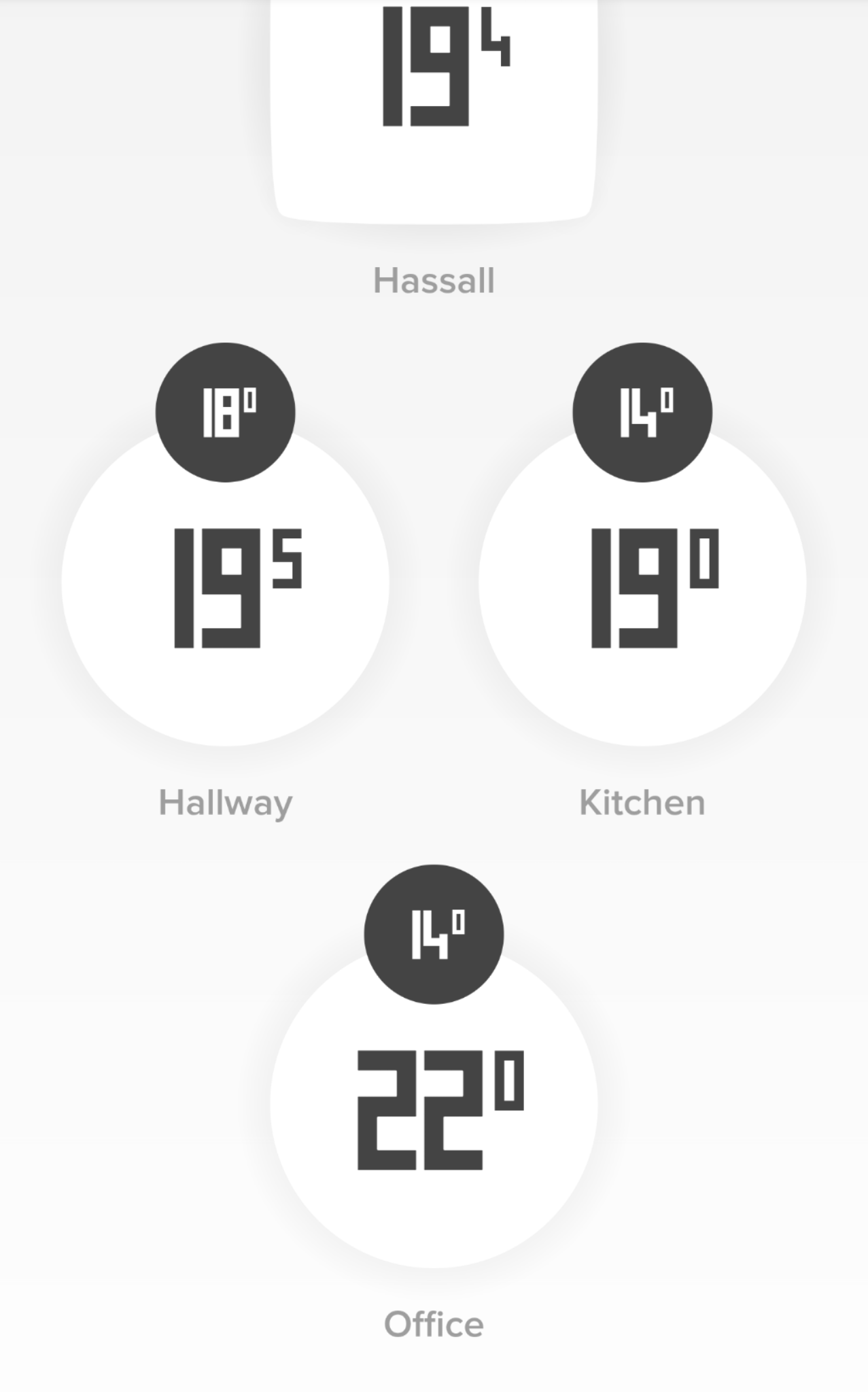
0 -
The thermostat should never be in the hallway, but in the room you spend most time in, on an internal wall.
1 -
I've decided to place the thermostat in the living room and install the Netatmo Smart Radiator TRVs everywhere else. Why? Because the living room is one of those vertical Anthracite models that would look HORRIBLE with white Netatmo TRV.aoleks said:The thermostat should never be in the hallway, but in the room you spend most time in, on an internal wall.
All other Radiators in the house are white and look aesthically better with the smart TRV.
Worked out nicely.
System is NOT balanced yet until the final two rads are installed next week.
Curiously - how much do you think it costs (roughly) to
1. Replace a radiator from one model to another type (small to large) with adjusted pipework in the exact position that the previous rad was in?
2. Replace a radiator from one model to another type (small to large) with adjusted pipework in the different position (about a meter away on the same wall) to where the previous rad was in?
3. Replace a radiator from horizontal to vertical, with pipework manipulated to come from the wall/plaster as opposed to up from the floorboards and in a different position (about a meter or two away on the same wall) to where the previous rad was in?
I think I paid about £800 for the labour for all 5 Rads. I provided the radiators and TRVS. The guy did everything else and supplied the things like copper piping and sleeving etc.0 -
These temps are coming from somewhere. It ain't magicked out of thin air. It's either solar warming, or the result of the rads having been on, and the temp flows between rooms (only if each room's doors are firmly shut will these temps remain constantish in each room). Also, if the bedrooms are upstairs, that's where most of the downstairs heat will end up.sho_me_da_money said:This is literally a pic of the current temps 2 mins ago.
The numbers with a clear white background (and not black) represent the detected temp by the thermostat or the TRV.
The numbers with a black background (and not white) represent the temps I have set in the schedule.
The temp outside is 6.3C
That means my house will rarely ever need to heat up as the temps seems to be firm around 19 degrees. Damn did I ever need radiators. LMAO.
But, smart TRVs seem to me to be the ultimate control system.0 -
This is peasy bread'n'butter work for a plumber.sho_me_da_money said:
Curiously - how much do you think it costs (roughly) to
1. Replace a radiator from one model to another type (small to large) with adjusted pipework in the exact position that the previous rad was in?
2. Replace a radiator from one model to another type (small to large) with adjusted pipework in the different position (about a meter away on the same wall) to where the previous rad was in?
3. Replace a radiator from horizontal to vertical, with pipework manipulated to come from the wall/plaster as opposed to up from the floorboards and in a different position (about a meter or two away on the same wall) to where the previous rad was in?
I think I paid about £800 for the labour for all 5 Rads. I provided the radiators and TRVS. The guy did everything else and supplied the things like copper piping and sleeving etc.
The likely most time-consuming part will be draining and refilling the system.
How long would each rad then take to do? I don't know, but surely under an hour each? And there's actually little difference in the work required between these three jobs, although vertical columns rads are a pita to mount.
The 'small' adjustment usually required to the pipework around a slightly-different rad change is every bit - often more - as annoying as shifting it to a new place a metre away. So, unless the pipe runs need to be hidden under floors or in walls, then fitting a new rad a metre away is a doddle, and I'd prefer such a job than trying to 'tweak' the bends around a 2" adjustment.
How long did these 5 rads take? Surely a comfy <day? So, nice money.
Seems a tad high based on what I think is involved, but not 'extortionate'. But I have nothing really to compare this with except DIY :-)0 -
sho_me_da_money said:
I've decided to place the thermostat in the living room and install the Netatmo Smart Radiator TRVs everywhere else. Why? Because the living room is one of those vertical Anthracite models that would look HORRIBLE with white Netatmo TRV.aoleks said:The thermostat should never be in the hallway, but in the room you spend most time in, on an internal wall.
All other Radiators in the house are white and look aesthically better with the smart TRV.
Just remember that this radiator (without a TRV) will then always heat up regardless of which other radiator is calling for heat. This would probably mean this room will overheat.2 -
Ooooh - a good point!fezster said:I've decided to place the thermostat in the living room and install the Netatmo Smart Radiator TRVs everywhere else. Why? Because the living room is one of those vertical Anthracite models that would look HORRIBLE with white Netatmo TRV.
All other Radiators in the house are white and look aesthically better with the smart TRV.
Just remember that this radiator (without a TRV) will then always heat up regardless of which other radiator is calling for heat. This would probably mean this room will overheat.
Yes, when any of these other TRVs 'call for heat', the boiler will come on and the pump run. Hot CH water will go in to any other rad with an 'open' control valve. The room stat in the sitting room will have no bearing on this.
Hard to think of an easy way to sort this, but a zone valve fitted to the supply pipe to that rad would do it, controlled by a remote wall stat just for that room. Would access to this pipe be possible?0












Confirm your email address to Create Threads and Reply

Categories
- All Categories
- 354.6K Banking & Borrowing
- 254.5K Reduce Debt & Boost Income
- 455.5K Spending & Discounts
- 247.5K Work, Benefits & Business
- 604.3K Mortgages, Homes & Bills
- 178.6K Life & Family
- 261.9K Travel & Transport
- 1.5M Hobbies & Leisure
- 16.1K Discuss & Feedback
- 37.7K Read-Only Boards