We’d like to remind Forumites to please avoid political debate on the Forum.
This is to keep it a safe and useful space for MoneySaving discussions. Threads that are – or become – political in nature may be removed in line with the Forum’s rules. Thank you for your understanding.
📨 Have you signed up to the Forum's new Email Digest yet? Get a selection of trending threads sent straight to your inbox daily, weekly or monthly!
The Forum now has a brand new text editor, adding a bunch of handy features to use when creating posts. Read more in our how-to guide
Floor !!!!!!-up - any way of salvaging?
Comments
-
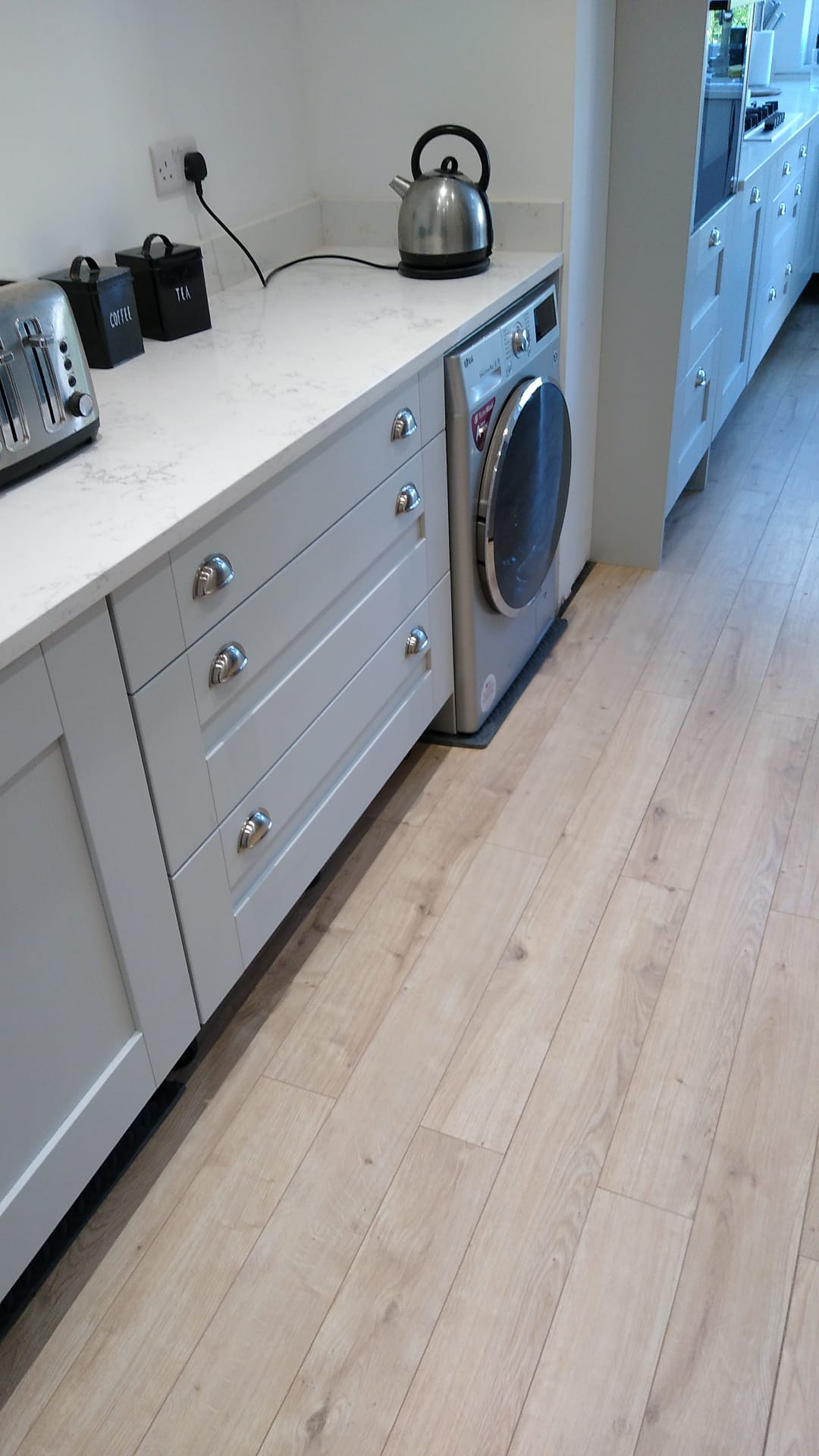
Here is a photo but doesn’t reflect the issue
 0
0 -
Well, in the photo the main problem I see is the unit behind the washing machine with two sides reaching the floor. However, I don't see why all the units in that part can't be removed temporary.It's impossible to see what sort of plinth and legs other units have.The only alternative that I can come up with is a surface grinder, but this depends on the sort of tiles under the laminate.


0 -
Oh that's a cool idea thank you! I don't think it can come up due to the quartz worktop it's glued down. I think that may be an old photo so the plinths aren't in yet. I'm not at the house so can't take live photos.0
-
So with the surface grinder, would that involve grinding the surface of the tiles then adding a screed?0
-
I own a 1927 built terrace.
It does sound like the original kitchen floor (the material under the quarry tiles) is at the end of its useful life, which is normal for a house of that age. Often the hardcore used was just whatever building waste was available i.e. of varying quality. Sometimes the hardcore was not compacted properly when the house was built, but then it starts compacting years later causing the concrete to start cracking and the floor to move. The only way to resolve this to replace the hardcore and flooring.
Also I would not have laminate or the damp proof membrane or any other plastic flooring on the old kitchen floor or over the wood floorboards at ground floor level. These original floorings need to allow moisture to evaporate through them otherwise you will get damp and, in the case of floorboards, woodworm because any moisture will become trapped under the plastic layer unable to evaporate away and will affect the materials beneath.
I would remove the floor coverings and find out what is going on under them. A trades person is going to need to do this anyway.
Read Haynes: The Victorian and Edwardian House Manual by Ian Alistair Rock to understand how these houses were built and designed and the common issues they have.0 -
Again, I haven't seen the tiles, but most likely this can be done without any screed added. All you need is to make the tiled surface as flat as possible without removing too much.
0 -
Sorry, I've just noticed something else. Was an internal wall in the old kitchen removed when the extension was done? Sometimes these walls were supported by the solid floor rather than had their own foundations. If so, the removal of this weight may have affected the floor too?0










Confirm your email address to Create Threads and Reply

Categories
- All Categories
- 354.5K Banking & Borrowing
- 254.4K Reduce Debt & Boost Income
- 455.4K Spending & Discounts
- 247.4K Work, Benefits & Business
- 604.2K Mortgages, Homes & Bills
- 178.5K Life & Family
- 261.7K Travel & Transport
- 1.5M Hobbies & Leisure
- 16.1K Discuss & Feedback
- 37.7K Read-Only Boards