We’d like to remind Forumites to please avoid political debate on the Forum.
This is to keep it a safe and useful space for MoneySaving discussions. Threads that are – or become – political in nature may be removed in line with the Forum’s rules. Thank you for your understanding.
PLEASE READ BEFORE POSTING: Hello Forumites! In order to help keep the Forum a useful, safe and friendly place for our users, discussions around non-MoneySaving matters are not permitted per the Forum rules. While we understand that mentioning house prices may sometimes be relevant to a user's specific MoneySaving situation, we ask that you please avoid veering into broad, general debates about the market, the economy and politics, as these can unfortunately lead to abusive or hateful behaviour. Threads that are found to have derailed into wider discussions may be removed. Users who repeatedly disregard this may have their Forum account banned. Please also avoid posting personally identifiable information, including links to your own online property listing which may reveal your address. Thank you for your understanding.
📨 Have you signed up to the Forum's new Email Digest yet? Get a selection of trending threads sent straight to your inbox daily, weekly or monthly!
The Forum now has a brand new text editor, adding a bunch of handy features to use when creating posts. Read more in our how-to guide
Concrete panel falling away above window
Comments
-
Let’s not get fixated about the legal niceties, anyway. I’m sure the op doesn’t want anyone to be hurt, so he needs a builder to make this safe ASAP. What is the quickest way to achieve that?No reliance should be placed on the above! Absolutely none, do you hear?1
-
ciderboy2009 said:
It might be if the OP has got Legal Protection as part of their policy.eddddy said:
But it's nothing to do with the insurers.
Some interesting non-sequitur comments and partial quoting.
Some posters are suggesting that there is an imminent a danger to life. Contacting your legal protection insurers about a potential claim some months into the future probably isn't a priority. Addressing the danger to life would be a priority.
1 -
By "making your own arrangements" I wasn't suggesting the OP had to personally shin up a ladder.JJR45 said:
Only if they are able to in decent time. By the sounds of it, the OP isn't. (recent stomach surgery).user1977 said:
Probably still quicker and cheaper to make your own arrangements for a temporary fix and/or protect the area below.JJR45 said:
I think in this case, the safety for pedestrians may outweigh the possible minor increase in premiums.user1977 said:
Though bear in mind that involving the insurer means (irrespective of whether they end up paying for it) they're likely to bump up your premium in future years for having made a claim.ProDave said:Contact your house insurance and tell them it is an emergency. Let them deal with it and decide who is liable.0 -
Regardless, a condition of insurance is that you tell them anyway.eddddy said:Gettingeven said:
Hi, yes, I contacted my home insurer via email yesterday.ProDave said:That is very seriously dangerous in that state.If that concrete panels falls out it would kill anyone it falls on. That area in front of the window should be fenced off and if it fall the window would likely go, so I would not be using that room.Contact your house insurance and tell them it is an emergency. Let them deal with it and decide who is liable.
TBH, that was probably a bad idea. It's best to check your policy to see if you're likely to be covered before contacting your insurer.
This won't be covered by your buildings insurance.
And your insurers might record this on the CUE database as an 'incident that may or may not have led to an insurance claim'. The CUE database is shared by all the main insurers.
So your own insurer might increase your premium at renewal as a result of you reporting this 'incident' even if you make no claim, and you might need to declare it if you what to change insurers - resulting in increased premiums.
A typical question when obtaining insurance quotes usually covers the following caveats;
"Have you or anyone at the property suffered any loss, damage, injury or liability whether insured or not?"0 -
Even if someone pushed it back and got a few folding wedges in it would help a bit as a tempary measure. Could be around 150 lb of brickwork ready to fall on someone.
I would say that to do a proper job it needs removing, inserting a lintel under the tray, and rebuilding the masonry with wall ties from the inner skin.2 -
I've never had to deal with a situation like this one - but rather than rebuilding the masonry would it be possible to part-fill the void with insulation, suitable boarding+mesh and then render over the top? Does it need to be rebuilt with masonry for any reason?stuart45 said:
I would say that to do a proper job it needs removing, inserting a lintel under the tray, and rebuilding the masonry with wall ties from the inner skin.
Just wondering whether using a lightweight infill would give the same external appearance without the need to fit a lintel. I'm assuming the arch is doing the structural work here?
4 -
That could well be an easier solution. My mind always seems to think in masonry terms instead of other methods.Section62 said:
I've never had to deal with a situation like this one - but rather than rebuilding the masonry would it be possible to part-fill the void with insulation, suitable boarding+mesh and then render over the top? Does it need to be rebuilt with masonry for any reason?stuart45 said:
I would say that to do a proper job it needs removing, inserting a lintel under the tray, and rebuilding the masonry with wall ties from the inner skin.
Just wondering whether using a lightweight infill would give the same external appearance without the need to fit a lintel. I'm assuming the arch is doing the structural work here?
2 -
FWIW I'd probably have done the same and replaced like-for-like. It was only that I started to get curious why the original infill was masonry that I wondered whether there was a technical reason why it had to be done that way?stuart45 said:
That could well be an easier solution. My mind always seems to think in masonry terms instead of other methods.
For the panel to fall out there was apparently no bonding, so did they use masonry in the original build just because they had bricks to hand and it was easier to do it like that? Wouldn't there be a fair bit of cutting and shaping to do though?
2 -
But will hold the OPs public liability, they would want to know if there is a potential liability issue. It is the correct thing to do, to inform them. If they have someone to come out and deal with it, bonus. If not they will advise the OP the best steps to take.GDB2222 said:
Quite the reverse, actually. The op goes on the record that he knows the situation is highly dangerous, but doesn’t do anything to fix it, apart from contacting his insurance company, which doesn’t generally fix things.JJR45 said:
Only if they are able to in decent time. By the sounds of it, the OP isn't. (recent stomach surgery). Protecting the area underneath with some cones should be possible though.user1977 said:
Probably still quicker and cheaper to make your own arrangements for a temporary fix and/or protect the area below.JJR45 said:
I think in this case, the safety for pedestrians may outweigh the possible minor increase in premiums.user1977 said:
Though bear in mind that involving the insurer means (irrespective of whether they end up paying for it) they're likely to bump up your premium in future years for having made a claim.ProDave said:Contact your house insurance and tell them it is an emergency. Let them deal with it and decide who is liable.
At least contacting the insurance avoids any claims of negligence if anything did happen.His excuse is that he’s in no fit state to fix it himself. Fair enough, but if he’s well enough to call his insurance company he’s also well enough to call a builder to make this safe.
Really, a friend or family could put out a bin or two to keep people out of the danger area.0 -
Normally the Tympanum is a decorative feature with a relieving arch over it. Often done with a decorative bond such as shown below. The masonry purists say that you shouldn't mix different materials in the same wall, as they move as different rates. Having wall ties on the inner skin is essential.Section62 said:
FWIW I'd probably have done the same and replaced like-for-like. It was only that I started to get curious why the original infill was masonry that I wondered whether there was a technical reason why it had to be done that way?stuart45 said:
That could well be an easier solution. My mind always seems to think in masonry terms instead of other methods.
For the panel to fall out there was apparently no bonding, so did they use masonry in the original build just because they had bricks to hand and it was easier to do it like that? Wouldn't there be a fair bit of cutting and shaping to do though?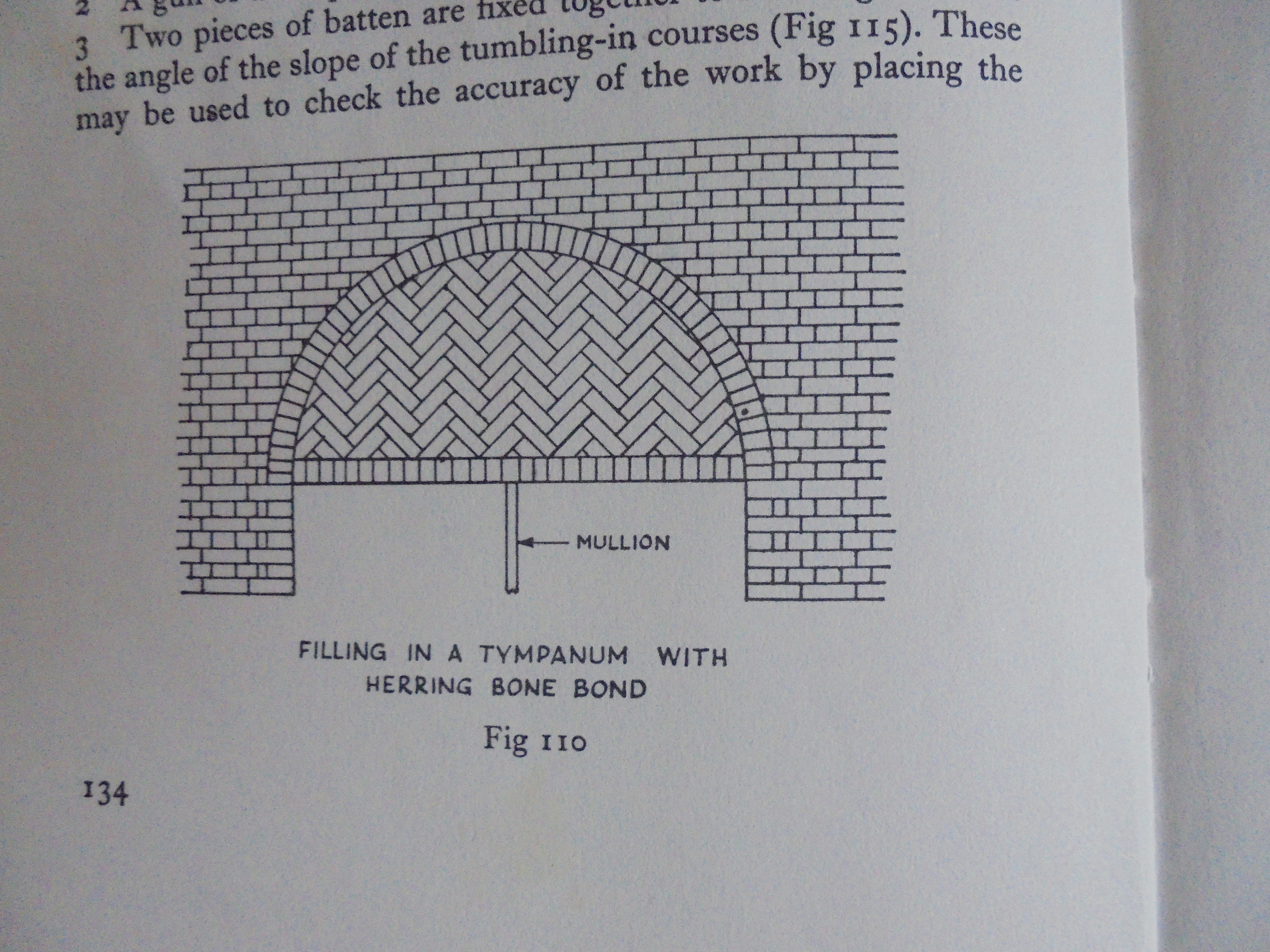 n th
n th
4












Confirm your email address to Create Threads and Reply

Categories
- All Categories
- 353.6K Banking & Borrowing
- 254.2K Reduce Debt & Boost Income
- 455.1K Spending & Discounts
- 246.7K Work, Benefits & Business
- 603.1K Mortgages, Homes & Bills
- 178.1K Life & Family
- 260.7K Travel & Transport
- 1.5M Hobbies & Leisure
- 16K Discuss & Feedback
- 37.7K Read-Only Boards