We’d like to remind Forumites to please avoid political debate on the Forum.
This is to keep it a safe and useful space for MoneySaving discussions. Threads that are – or become – political in nature may be removed in line with the Forum’s rules. Thank you for your understanding.
📨 Have you signed up to the Forum's new Email Digest yet? Get a selection of trending threads sent straight to your inbox daily, weekly or monthly!
The Forum now has a brand new text editor, adding a bunch of handy features to use when creating posts. Read more in our how-to guide
Put Rainy Day Fund into Premium Bonds?
Comments
-
it's all random tbh, you may or may not get the headline top rate, but enjoy the ride, it's just emergency funds for me and if I get extra, that's a bonus. Certainly beats alot of the low interest savings account at this time"It is prudent when shopping for something important, not to limit yourself to Pound land/Estate Agents"
G_M/ Bowlhead99 RIP0 -
No worries - I wasn't making any particular point beyond the obvious (which sometimes get lost - at least with me!) - the fact that the curves are broadly linear shows that the interest rate does not change with the number of bonds held. I think the real problem in interpreting this is that the shape of the distribution of amounts won is a) not Gaussian (so mean, median, and mode are not equal) and b) changes with the number of bonds held (in the sense that the peak is at zero for low number of bonds and non-zero for higher numbers)eskbanker said:
I may be missing the point you're making, but don't believe that anyone has ever disputed the common sense fact that "the more bonds held the greater the winnings will tend to be" (in absolute terms), but the earlier poster was apparently under the impression that more bonds gave greater winnings in percentage terms, whereas your most recent graph clearly shows (broadly) linear progression, as expected, rather than curves. Personally I prefer your first graph!OldScientist said:
Although the lines are stepped (at £25 pound intervals), the more bonds held the greater the winnings will tend to be.
For example, 20000 bonds held for 1 year (note these results in this post, unlike the earlier ones, are from a Monte Carlo approach so are not exact solutions, but are good enough approximations - I don't want to run the exact code again for the 10 or more hours it takes to extract this info) so has the following distribution of winnings (effective interest rate, mean~1.0%, median~0.9%, mode~0.8%)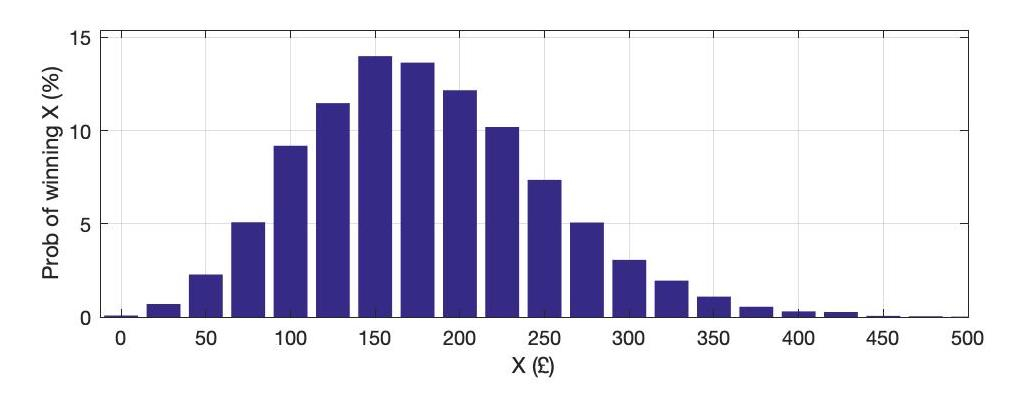
While 2000 bonds held for 1 year looks like the following (effective interest rate, mean=1.0%, median=1.25%, mode=0%)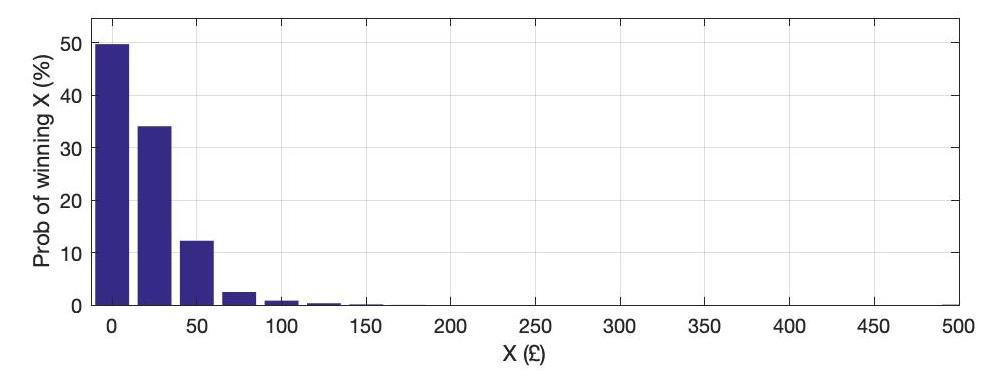
Just a few less bonds held would drop the median to 0% (i.e. the first column would be over 50%) for a tiny change in the actual probability of winning.
0








Confirm your email address to Create Threads and Reply

Categories
- All Categories
- 354.2K Banking & Borrowing
- 254.4K Reduce Debt & Boost Income
- 455.3K Spending & Discounts
- 247.2K Work, Benefits & Business
- 603.8K Mortgages, Homes & Bills
- 178.4K Life & Family
- 261.4K Travel & Transport
- 1.5M Hobbies & Leisure
- 16.1K Discuss & Feedback
- 37.7K Read-Only Boards