We’d like to remind Forumites to please avoid political debate on the Forum.
This is to keep it a safe and useful space for MoneySaving discussions. Threads that are – or become – political in nature may be removed in line with the Forum’s rules. Thank you for your understanding.
📨 Have you signed up to the Forum's new Email Digest yet? Get a selection of trending threads sent straight to your inbox daily, weekly or monthly!
The Forum now has a brand new text editor, adding a bunch of handy features to use when creating posts. Read more in our how-to guide
AMEX Letter
Comments
-
Thankfully never done capital modelling for credit cards and so may be totally wrong but would assume in some scenarios those that normally pay in full move to paying in installments but can afford to do so and therefore the higher interest rate starts to play a part... I could be wrong and the assumption is immutable, that no matter what happens and non-interest payers would never become interest payers.MoJoeGo said:
That would certainly make sense in the context of reducing limits. But I'm not sure how raising rates, for a card whose user base would not typically be paying interest, would have any material impact on Amex's reg cap requirements.Sandtree said:
Not really when you remember that banks, insurers etc have to model disaster scenarios to calculate how much capital they are required to hold to ensure events don't cause them to go bust. Even if it has no impact on you in normal scenarios that isnt to say it won't reduce the capital they need to hold against certain risks.MoJoeGo said:It's a bit of an odd one isn't it.0 -
I have a paypal credit account that had a limit of 3650 last march, when i logged in all of a sudden the limit was reduced to 2650 which was the balance, immidiately rang paypal and asked the reason for it and they said it was because I wasent "using" the rest of the available credit so they felt I didnt need it and decided to reduce it.MoJoeGo said:
That would certainly make sense in the context of reducing limits. But I'm not sure how raising rates, for a card whose user base would not typically be paying interest, would have any material impact on Amex's reg cap requirements.Sandtree said:
Not really when you remember that banks, insurers etc have to model disaster scenarios to calculate how much capital they are required to hold to ensure events don't cause them to go bust. Even if it has no impact on you in normal scenarios that isnt to say it won't reduce the capital they need to hold against certain risks.MoJoeGo said:It's a bit of an odd one isn't it.
I dont know about anyone else but surely not maxing out your credit accounts to the limit is a good thing and would suggest a lesser risk ?
The recent credit limit cuts with barclaycard suggest a knee jerk reaction by the lenders in order to reel in residual capital, rather than anything to do with the customer concerned being a "risk"as such, the only thing which would suggest a customer being a lending risk is if they have defaults, missed payments ect with the provider concerned or with other lenders.0 -
Financial hardship and responsible lending rules are very much a focus for banks as instructed by the FCADeleted_User said:
I have a paypal credit account that had a limit of 3650 last march, when i logged in all of a sudden the limit was reduced to 2650 which was the balance, immidiately rang paypal and asked the reason for it and they said it was because I wasent "using" the rest of the available credit so they felt I didnt need it and decided to reduce it.MoJoeGo said:
That would certainly make sense in the context of reducing limits. But I'm not sure how raising rates, for a card whose user base would not typically be paying interest, would have any material impact on Amex's reg cap requirements.Sandtree said:
Not really when you remember that banks, insurers etc have to model disaster scenarios to calculate how much capital they are required to hold to ensure events don't cause them to go bust. Even if it has no impact on you in normal scenarios that isnt to say it won't reduce the capital they need to hold against certain risks.MoJoeGo said:It's a bit of an odd one isn't it.
I dont know about anyone else but surely not maxing out your credit accounts to the limit is a good thing and would suggest a lesser risk ?
The recent credit limit cuts with barclaycard suggest a knee jerk reaction by the lenders in order to reel in residual capital, rather than anything to do with the customer concerned being a "risk"as such, the only thing which would suggest a customer being a lending risk is if they have defaults, missed payments ect with the provider concerned or with other lenders.
If you were carrying a balance rather than paying it off it's logical for them to stop you spending more to avoid running up more debt0 -
If that was the case then banks simply wouldnt lend anyone money, that would make lending unprofitable.Deleted_User said:
Financial hardship and responsible lending rules are very much a focus for banks as instructed by the FCADeleted_User said:
I have a paypal credit account that had a limit of 3650 last march, when i logged in all of a sudden the limit was reduced to 2650 which was the balance, immidiately rang paypal and asked the reason for it and they said it was because I wasent "using" the rest of the available credit so they felt I didnt need it and decided to reduce it.MoJoeGo said:
That would certainly make sense in the context of reducing limits. But I'm not sure how raising rates, for a card whose user base would not typically be paying interest, would have any material impact on Amex's reg cap requirements.Sandtree said:
Not really when you remember that banks, insurers etc have to model disaster scenarios to calculate how much capital they are required to hold to ensure events don't cause them to go bust. Even if it has no impact on you in normal scenarios that isnt to say it won't reduce the capital they need to hold against certain risks.MoJoeGo said:It's a bit of an odd one isn't it.
I dont know about anyone else but surely not maxing out your credit accounts to the limit is a good thing and would suggest a lesser risk ?
The recent credit limit cuts with barclaycard suggest a knee jerk reaction by the lenders in order to reel in residual capital, rather than anything to do with the customer concerned being a "risk"as such, the only thing which would suggest a customer being a lending risk is if they have defaults, missed payments ect with the provider concerned or with other lenders.
If you were carrying a balance rather than paying it off it's logical for them to stop you spending more to avoid running up more debt
Someone who pays in full every month is not profitable, the whole intention is that they dont.
0 -
If that were the case please explain the American Express Blue Card? Its a charge card so has to be paid off in full each month and it has no annual fee https://www.americanexpress.com/uk/charge-cards/basic-cardDeleted_User said:
Someone who pays in full every month is not profitable, the whole intention is that they dont.
Its a fiction that its not profitable to have customers paying off the balance in full each month... its just more profitable if they let it roll over.0 -
I think you missed the point, the other poster suggested that a customers credit limit would be reduced on a non amex facility because they didnt pay it in full, thats not even remotely realistic.Sandtree said:
If that were the case please explain the American Express Blue Card? Its a charge card so has to be paid off in full each month and it has no annual fee https://www.americanexpress.com/uk/charge-cards/basic-cardDeleted_User said:
Someone who pays in full every month is not profitable, the whole intention is that they dont.
Its a fiction that its not profitable to have customers paying off the balance in full each month... its just more profitable if they let it roll over.
Anyway in general I believe that lenders should only reduce credit limits if there is solid evidence of financial mismanagement for example late payments, missed payments ect, doing so willy nilly because the computer has decided that person "may" become a problem can have serious consequences, for example if someone unexpectedly has their overdraft pulled from under their feet, they may not be able to feed themselves of their children and then be placed in financial hardship as a result, and their credit score ruined if direct debits bounce.
The whole point of reducing credit limits should be to protect the consumer from excess unaffordable borrowing if they cannot meet exsisting commitments, if they can then reducing credit facilities is not justified and im some cases can actually make the problem worse.
Someone who has temporary financial difficulties may need to borrow more to tide themselves over until they can get back on top of things, if that person does not have any previous history of defaulting on credit agreements then its very unlikely that they will on any new ones they take out, so its fundimentally wrong that some credit risk system decides to naughty step them as a result.0 -
jay1804 said:Deleted_User said:Just received this strange letter from amex this morning saying that they are increasing my interest rate following an "account review"
Not really that bothered as its paid in full each month anyway and would use my amex green charge card more, but I've never seen this happen, I know what interest rate you are given depends on your credit score at time of application but I've never heard of it changing in regards to risk reviews as such, in fact it makes me giggle as I've never carried a statement balance over on any of my amex cards
My suspicion is that they have done this on alot of customers and they are trying to sneak an interest rate rise in across the board via the back door, but again its probably not going to be something that affects most of their customers as people usually only use amex cards for associated points and rewards.
It's nothing to worry about, i've just received my statement and there is a notice about a rate change.
A interest rate increase should bother anyone with an AmEx, as you should be clearing in FULL, to maximise cashback/rewards.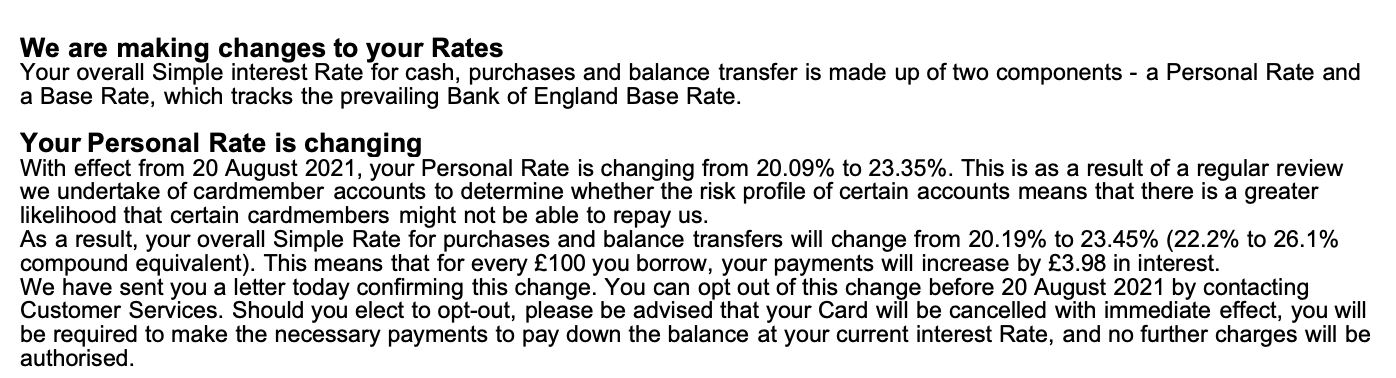
I received the same notification on my 3rd June statement followed by a letter in the post dated the same day, similar to the one received by @Deleted_User.
I always pay the balance in full, by direct debit, so I can’t see it being a problem.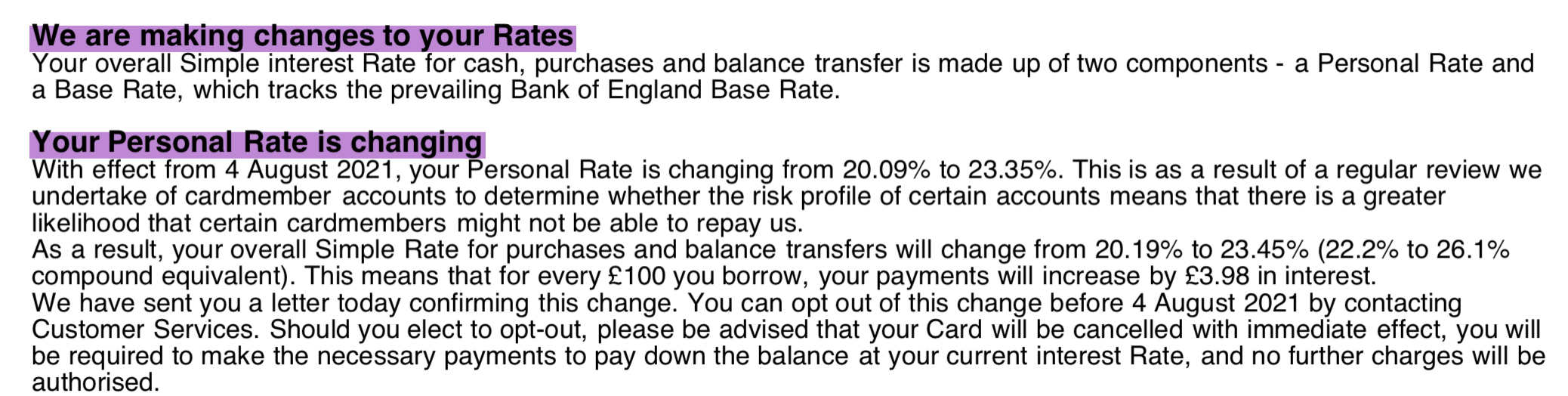
0 -
And your first point I didn't have an issue with or comment hence didn't quote it… just you then went on to repeat the urban myth that paying in full each month is unprofitable.Deleted_User said:
I think you missed the point, the other poster suggested that a customers credit limit would be reduced on a non amex facility because they didnt pay it in full, thats not even remotely realistic.Sandtree said:
If that were the case please explain the American Express Blue Card? Its a charge card so has to be paid off in full each month and it has no annual fee https://www.americanexpress.com/uk/charge-cards/basic-cardDeleted_User said:
Someone who pays in full every month is not profitable, the whole intention is that they dont.
Its a fiction that its not profitable to have customers paying off the balance in full each month... its just more profitable if they let it roll over.
Anyway in general I believe that lenders should only reduce credit limits if there is solid evidence of financial mismanagement for example late payments, missed payments ect, doing so willy nilly because the computer has decided that person "may" become a problem can have serious consequences, for example if someone unexpectedly has their overdraft pulled from under their feet, they may not be able to feed themselves of their children and then be placed in financial hardship as a result, and their credit score ruined if direct debits bounce.
The whole point of reducing credit limits should be to protect the consumer from excess unaffordable borrowing if they cannot meet exsisting commitments, if they can then reducing credit facilities is not justified and im some cases can actually make the problem worse.
The problem is that you are complaining about the wrong people… its the FCA that is driving this whole "persistent debt", affordable lending things etc. Its similar with the FCA now saying renewal of insurance cannot be higher than new business price… all designed to protect the vulnerable minority but consequently negatively impacts others.
As to pulling a line of revolving credit causing someone to not to be able to afford to feed their children… that seems a perfect example of someone in financial difficulty even before the overdraft being cut1 -
No its not, financial difficulties can be temporary and hence why overdrafts are there, someone who has never used their overdrafts in the past all of a sudden gets the facility removed, could be put in a very unfair position.Sandtree said:
And your first point I didn't have an issue with or comment hence didn't quote it… just you then went on to repeat the urban myth that paying in full each month is unprofitable.Deleted_User said:
I think you missed the point, the other poster suggested that a customers credit limit would be reduced on a non amex facility because they didnt pay it in full, thats not even remotely realistic.Sandtree said:
If that were the case please explain the American Express Blue Card? Its a charge card so has to be paid off in full each month and it has no annual fee https://www.americanexpress.com/uk/charge-cards/basic-cardDeleted_User said:
Someone who pays in full every month is not profitable, the whole intention is that they dont.
Its a fiction that its not profitable to have customers paying off the balance in full each month... its just more profitable if they let it roll over.
Anyway in general I believe that lenders should only reduce credit limits if there is solid evidence of financial mismanagement for example late payments, missed payments ect, doing so willy nilly because the computer has decided that person "may" become a problem can have serious consequences, for example if someone unexpectedly has their overdraft pulled from under their feet, they may not be able to feed themselves of their children and then be placed in financial hardship as a result, and their credit score ruined if direct debits bounce.
The whole point of reducing credit limits should be to protect the consumer from excess unaffordable borrowing if they cannot meet exsisting commitments, if they can then reducing credit facilities is not justified and im some cases can actually make the problem worse.
The problem is that you are complaining about the wrong people… its the FCA that is driving this whole "persistent debt", affordable lending things etc. Its similar with the FCA now saying renewal of insurance cannot be higher than new business price… all designed to protect the vulnerable minority but consequently negatively impacts others.
As to pulling a line of revolving credit causing someone to not to be able to afford to feed their children… that seems a perfect example of someone in financial difficulty even before the overdraft being cut
Also people should not be deamonised by not paying in full each month. Not all of us have the luxury of having loads of spare cash.0 -
Article in Telegraph about this (sorry may be behind paywall)
0












Confirm your email address to Create Threads and Reply

Categories
- All Categories
- 354.4K Banking & Borrowing
- 254.4K Reduce Debt & Boost Income
- 455.4K Spending & Discounts
- 247.3K Work, Benefits & Business
- 604K Mortgages, Homes & Bills
- 178.4K Life & Family
- 261.5K Travel & Transport
- 1.5M Hobbies & Leisure
- 16K Discuss & Feedback
- 37.7K Read-Only Boards