We’d like to remind Forumites to please avoid political debate on the Forum.
This is to keep it a safe and useful space for MoneySaving discussions. Threads that are – or become – political in nature may be removed in line with the Forum’s rules. Thank you for your understanding.
📨 Have you signed up to the Forum's new Email Digest yet? Get a selection of trending threads sent straight to your inbox daily, weekly or monthly!
The Forum now has a brand new text editor, adding a bunch of handy features to use when creating posts. Read more in our how-to guide
Capital gains washing out the base cost on index funds to utilise the personal allowance every year
Comments
-
There are too many variables involved for anyone to be able to give a simple yes/no answer to questions like this. As above, nobody knows what the price movements will be next year, but it's not difficult to envisage a situation where accrued gains would exceed the threshold - this isn't a showstopper in that it would still be possible to crystallise enough of a gain to use up the allowance, but if you're determined to minimise CGT over many years then crystallising gains every tax year probably is where you want to be.NottinghamMan said:But would we sell to reset the base cost this Tax year, or cause this is so low, if we left a year, we could catch up easily next year?
Or do we need to do every year so this base cost is as high as possible in years to come?
However, bear in mind that there are usually buying or selling costs associated with each transaction, and you'd be out of the market for at least thirty days or perhaps holding a second choice fund, so you'd need to weigh up the costs versus the benefits.
Depends on what you mean by 'on a loss', but if the current price is higher than current (most recently-adjusted) base cost, then selling and rebuying would still increase the base cost, regardless of whether or not the value has increased or decreased since the previous year. .NottinghamMan said:And if on a loss one year, would u still sell to reset the base cost?0 -
Who knows, we've had good growth this year, so may not grow next year, but I may be adding to it another £150,000.Eco_Miser said:But would we sell to reset the base cost this Tax year, or cause this is so low, if we left a year, we could catch up easily next year?How much is it going to go up next year? If it will be less than £2600 you could wait till next year. (But the allowance might be less next year, and the tax rate higher).My crystal ball isn't working though. I'd sell now.
Yes good point, the allowances & rates may be changing.0 -
I mean if the whole funds had gone down say 7% from April 2021 to March 2022 when ready to reset again, would resetting not work then as the funds haven't gained anything.eskbanker said:There are too many variables involved for anyone to be able to give a simple yes/no answer to questions like this. As above, nobody knows what the price movements will be next year, but it's not difficult to envisage a situation where accrued gains would exceed the threshold - this isn't a showstopper in that it would still be possible to crystallise enough of a gain to use up the allowance, but if you're determined to minimise CGT over many years then crystallising gains every tax year probably is where you want to be.
However, bear in mind that there are usually buying or selling costs associated with each transaction, and you'd be out of the market for at least thirty days or perhaps holding a second choice fund, so you'd need to weigh up the costs versus the benefits.
Thanks,
Yes I have no idea how this formula would work over 10 years ie. if we add 100k each year, can we always reset & be in front, or is it anything added or growth over £12,300 u start to fall behind on the resetting base cost.
At todays rates, is it correct in saying that all we are saving is 10% of £12,300 every year-Saving this up for 10 years when start to sell the funds for good, so if £1230 saving up each year, if the market moves more than that in the 30 days, are we actually at a risk of losing this potential saving in funds going down?Thanks again for your words but if you're determined to minimise CGT over many years then crystallising gains every tax year probably is where you want to be.
More or less re-affirming my thoughts.
Vanguard have no fees for buying/selling which helps the process.
Yes I plan to switch from 60/40 to Target retirement 2025 which is 58% equity/42% bonds, which I hope should move similar ways for the 30 days.
Depends on what you mean by 'on a loss', but if the current price is higher than current (most recently-adjusted) base cost, then selling and rebuying would still increase the base cost, regardless of whether or not the value has increased or decreased since the previous year. .
0 -
Again, it isn't possible to generalise, but what you need to measure whenever considering a reset is current trading price versus your current base cost, not the trading price a year ago.NottinghamMan said:
I mean if the whole funds had gone down say 7% from April 2021 to March 2022 when ready to reset again, would resetting not work then as the funds haven't gained anything.eskbanker said:Depends on what you mean by 'on a loss', but if the current price is higher than current (most recently-adjusted) base cost, then selling and rebuying would still increase the base cost, regardless of whether or not the value has increased or decreased since the previous year. .
Why not just switch from LifeStrategy 60 Acc to Inc?NottinghamMan said:
Yes I plan to switch from 60/40 to Target retirement 2025 which is 58% equity/42% bonds, which I hope should move similar ways for the 30 days.0 -
I did something similar recently - i went round in circles and landed on the following principles that i will adhere to
- Don't try and get two precise - Trying to get to a few pence of the CGT threshold is too much headache. Work out your base costs, work out the sale cost and sell units to within a hundred quid or so, knowing also that the transaction costs will give you some extra buffer. For me at least, knowing i am 'well within' the CGT is better than a future headache if HMRC ask me to justify my numbers and i have slightly miscalculated.
- I will never buy Accumulation units outside an ISA again. It gave me a headache just thinking about it how to back these out to then work out the true CGT position. i actually didn't need to in the end, but i had cold sweats by that time
- buy something similar and live with it. I was selling HSBC Global Strategy. I immediately reinvested into Vanguard Life strategy with the closest corresponding risk profile. Too much faff managing 30 day rule imo
Just my thoughts!0 -
Yes, thanks for the idea, I did look for this, but on the UK platform, can't see the Inc, I believe USA version does have both. Unless anyone else knows different as I thought I'd seen in the past the Inc fund.eskbanker said:Again, it isn't possible to generalise, but what you need to measure whenever considering a reset is current trading price versus your current base cost, not the trading price a year ago.
Aah, so so the current trading price will always be higher than current base cost, so always going to be better to reset even if fund price has dropped that year. We don't know these answers unless someone tells us. What's simple to some isn't to others.
Why not just switch from LifeStrategy 60 Acc to Inc?
0 -
Thanks for your advice, glad to know I'm not the only one that's asking. I think & correct me if I'm wrong, this info isn't really common, as I'm guessing most people hasn't max'd their pensions & ISA's, so they don't get to this stage of having to re-base non tax-efficient funds.danm said:I did something similar recently - i went round in circles and landed on the following principles that i will adhere to
- Don't try and get two precise - Trying to get to a few pence of the CGT threshold is too much headache. Work out your base costs, work out the sale cost and sell units to within a hundred quid or so, knowing also that the transaction costs will give you some extra buffer. For me at least, knowing i am 'well within' the CGT is better than a future headache if HMRC ask me to justify my numbers and i have slightly miscalculated.
- I will never buy Accumulation units outside an ISA again. It gave me a headache just thinking about it how to back these out to then work out the true CGT position. i actually didn't need to in the end, but i had cold sweats by that time
- buy something similar and live with it. I was selling HSBC Global Strategy. I immediately reinvested into Vanguard Life strategy with the closest corresponding risk profile. Too much faff managing 30 day rule imo
Just my thoughts!
On your re-investing into another fund, I thought if leave in the other fund, does it not then get complicated next year when having to work out two re-base costs? I've only just sussed the first formula out which Eskbanker has greatly & I mean greatly explained to me in normal Joe Bloggs language I could understand. I'd imagine similar formula, but done a bit different adding this & that. As I think I'd like starting a separate fund, probably go one up to 64% equity & then next year would I just swap between the two?0 -
NottinghamMan said:
Yes, thanks for the idea, I did look for this, but on the UK platform, can't see the Inc, I believe USA version does have both. Unless anyone else knows different as I thought I'd seen in the past the Inc fund.eskbanker said:Again, it isn't possible to generalise, but what you need to measure whenever considering a reset is current trading price versus your current base cost, not the trading price a year ago.
Aah, so so the current trading price will always be higher than current base cost, so always going to be better to reset even if fund price has dropped that year. We don't know these answers unless someone tells us. What's simple to some isn't to others.
Why not just switch from LifeStrategy 60 Acc to Inc?Just looked on Vanguard's UK site and here it is: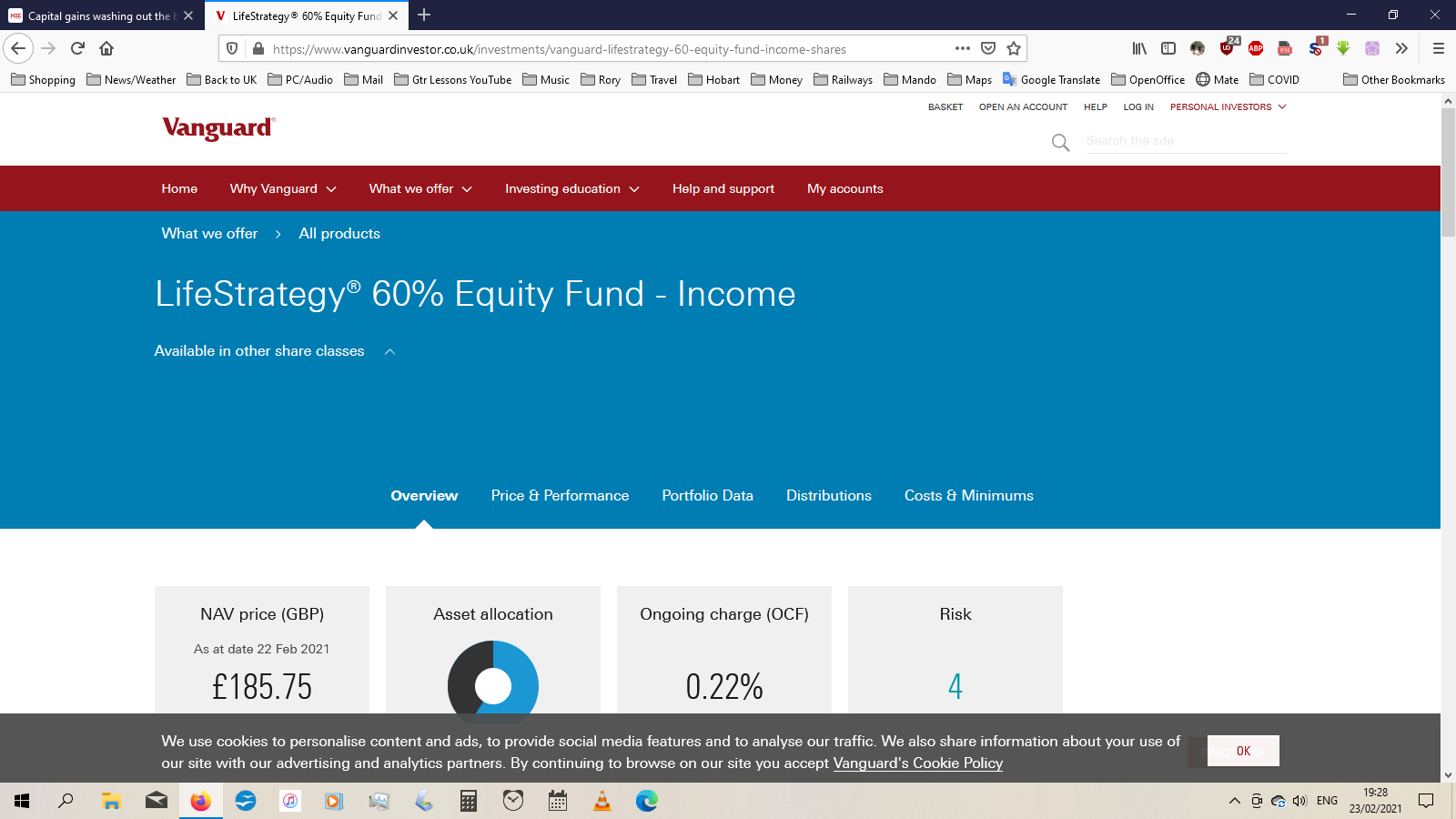 Under where it says LifeStrategy is a dropdown menu "Available in other share classes".0
 -
your base costs are independent. My purchase of Vanguard has done nothing to the base cost on my HSBC funds....NottinghamMan said:
Thanks for your advice, glad to know I'm not the only one that's asking. I think & correct me if I'm wrong, this info isn't really common, as I'm guessing most people hasn't max'd their pensions & ISA's, so they don't get to this stage of having to re-base non tax-efficient funds.danm said:I did something similar recently - i went round in circles and landed on the following principles that i will adhere to
- Don't try and get two precise - Trying to get to a few pence of the CGT threshold is too much headache. Work out your base costs, work out the sale cost and sell units to within a hundred quid or so, knowing also that the transaction costs will give you some extra buffer. For me at least, knowing i am 'well within' the CGT is better than a future headache if HMRC ask me to justify my numbers and i have slightly miscalculated.
- I will never buy Accumulation units outside an ISA again. It gave me a headache just thinking about it how to back these out to then work out the true CGT position. i actually didn't need to in the end, but i had cold sweats by that time
- buy something similar and live with it. I was selling HSBC Global Strategy. I immediately reinvested into Vanguard Life strategy with the closest corresponding risk profile. Too much faff managing 30 day rule imo
Just my thoughts!
On your re-investing into another fund, I thought if leave in the other fund, does it not then get complicated next year when having to work out two re-base costs? I've only just sussed the first formula out which Eskbanker has greatly & I mean greatly explained to me in normal Joe Bloggs language I could understand. I'd imagine similar formula, but done a bit different adding this & that. As I think I'd like starting a separate fund, probably go one up to 64% equity & then next year would I just swap between the two?
if anything (and i am by no means an expert) - it probably makes it simpler in the scenario where you wait 30 days and then reinvest back into the exact same fund; that will impact how you next work out your gain if only selling part of the holding.0 -
No, not always. If your wife sold her entire holding now and repurchased, then her new base cost will be the same as the Feb 2021 trading price if she doesn't buy any more units between now and next year's decision point, so a fall in trading price by Feb 2022 would affect that decision. However, resets that don't involve complete sale and repurchases, or further purchases during the year, could deliver a different outcome, so my point is that you have to work out each year whether or not to reset, based on the numbers at the time, using the right ones for that analysis.NottinghamMan said:
Aah, so so the current trading price will always be higher than current base cost, so always going to be better to reset even if fund price has dropped that year.eskbanker said:Again, it isn't possible to generalise, but what you need to measure whenever considering a reset is current trading price versus your current base cost, not the trading price a year ago?0











Confirm your email address to Create Threads and Reply

Categories
- All Categories
- 354.6K Banking & Borrowing
- 254.5K Reduce Debt & Boost Income
- 455.5K Spending & Discounts
- 247.5K Work, Benefits & Business
- 604.4K Mortgages, Homes & Bills
- 178.6K Life & Family
- 262K Travel & Transport
- 1.5M Hobbies & Leisure
- 16.1K Discuss & Feedback
- 37.7K Read-Only Boards