We’d like to remind Forumites to please avoid political debate on the Forum.
This is to keep it a safe and useful space for MoneySaving discussions. Threads that are – or become – political in nature may be removed in line with the Forum’s rules. Thank you for your understanding.
📨 Have you signed up to the Forum's new Email Digest yet? Get a selection of trending threads sent straight to your inbox daily, weekly or monthly!
The Forum now has a brand new text editor, adding a bunch of handy features to use when creating posts. Read more in our how-to guide
Going up or down with bond risk.
Comments
-
I notice that HICL and TRIG have not benefitted at all from the recent rise in the FTSE 250 , in fact the opposite in the latter case. I appreciate they are not typical of normal equities but seems a bit surprising they have not at least edged up with the positive overall market sentiment?bowlhead99 said:
Yes, infrastructure stuff (whether PPF projects or other type of company or operating asset) often combine some of the properties of bonds (long term stable cash generation which may be contractually backed by government or regulated in some way and perhaps linked to inflation) with equity/property upside potential (a productive asset has a market value linked to profitability, and may sit on a piece of owned real estate). Some infrastructure will be linked to economic activity levels and could be cyclical (e.g. ports and logistics, transport) while others not so much (e.g. water works, prisons, health sector). And the operating businesses held by an infrastructure fund are owned on a reasonably long-term, private-equity basis and their values aren't driven by short-term whims of the market looking at quarterly results, so may not be too volatile.Albermarle said:Possibly another non equity alternative are infrastructure funds as part of a wider portfolio.
So with a combination of equity-like returns and debt-like returns and exposure to cyclical and noncyclical, while not being too volatile, they can be a good diversifier for a portfolio - I hold HICL and INPP among other more specialist holdings. Of course, they have their own risks (e.g. utilities can be heavily regulated markets which can restrict sales pricing or impose costs, and the assets are often large capital projects so can be leveraged which provides a risk if things go wrong and it's expensive to refinance etc).
And the fact the assets might be valued on a 'discounted cash flow analysis' of very long term prospective future returns may lead to significant value changes if interest rates (and discount rates) change. If you think of an infrastructure project generating annual dividend cashflows as a 'bond proxy', then if prevailing interest rates change, the open market value of the company or project generating that annual cashflow per £ invested will get hammered down just like a bond price would get hammered.0 -
I appreciate that us as individuals may decide between bonds & cash held in a bank account based on relative returns / interest rates but I don't believe we can influence the price of bonds as we don't control enough cash to even register as a blip in global bond markets.MaxiRobriguez said:
The talk around a potential bond crash is because yields are low, and therefore any return of inflation and interest rate rises would result in a shift away from bonds as people move more money into standard bank accounts. That would reduce the price of the bonds as more sellers than buyers.ANGLICANPAT said:With all the talk of bonds overheating , not doing their balancing job, boiling over, about to crash etc , if I had been going to invest in the low end risk level of a global multi asset fund , sacrificing growth for preservation ( theoretically) since Im in my earlyish 70's --then should I be thinking about going up a risk level for a while, hence ditching a % of bonds , to help minimise my losses if bonds are likely to crash horribly , but hopefully not equities to the same degree at the same time?
I don't know what the stats are but I would have thought "retail" customers were no more than 5% of the global bond market.
The entities that have enough clout to influence bond prices are pension funds, sovereign wealth funds and the like dealing in numbers with a lot more zeroes than Joe Public.
These entities do not have the option of putting their billions in a Santander 123 account instead of bonds as a consequence of the Santander retail rate going up to 3-4-5%.
Apart from a small allocation in percentage terms I wouldn't expect many such institutions to hold much cash even if savings rates were a lot higher. There allocation to bonds will be driven by relative returns compared to other investment options and by there mandate e.g. pension fund aligning assets to liabilities.1 -
With regards to TRIG. Prices for renewable generated electricity have been falling for some time. Coupled with the fact that Orsted in the past week has issued a profit warning, due to lower wind speeds. Which will impact 2020/21 earnings figures. This is going to reflect across all the UK based wind based generators.Albermarle said:
I notice that HICL and TRIG have not benefitted at all from the recent rise in the FTSE 250 , in fact the opposite in the latter case. I appreciate they are not typical of normal equities but seems a bit surprising they have not at least edged up with the positive overall market sentiment?bowlhead99 said:
Yes, infrastructure stuff (whether PPF projects or other type of company or operating asset) often combine some of the properties of bonds (long term stable cash generation which may be contractually backed by government or regulated in some way and perhaps linked to inflation) with equity/property upside potential (a productive asset has a market value linked to profitability, and may sit on a piece of owned real estate). Some infrastructure will be linked to economic activity levels and could be cyclical (e.g. ports and logistics, transport) while others not so much (e.g. water works, prisons, health sector). And the operating businesses held by an infrastructure fund are owned on a reasonably long-term, private-equity basis and their values aren't driven by short-term whims of the market looking at quarterly results, so may not be too volatile.Albermarle said:Possibly another non equity alternative are infrastructure funds as part of a wider portfolio.
So with a combination of equity-like returns and debt-like returns and exposure to cyclical and noncyclical, while not being too volatile, they can be a good diversifier for a portfolio - I hold HICL and INPP among other more specialist holdings. Of course, they have their own risks (e.g. utilities can be heavily regulated markets which can restrict sales pricing or impose costs, and the assets are often large capital projects so can be leveraged which provides a risk if things go wrong and it's expensive to refinance etc).
And the fact the assets might be valued on a 'discounted cash flow analysis' of very long term prospective future returns may lead to significant value changes if interest rates (and discount rates) change. If you think of an infrastructure project generating annual dividend cashflows as a 'bond proxy', then if prevailing interest rates change, the open market value of the company or project generating that annual cashflow per £ invested will get hammered down just like a bond price would get hammered.
There's been a flow of new investments coming to the London market. No need to pay a premium for renewable power providers. Though dividends will be limited until the funds raised are invested. Scope for investing internationally as well in other forms of power generation than just wind. Wind not being as suitable in many areas around the globe.
1 -
None really . Our pension is more than enough to live on well , and its just a matter of what to do with surplus savings really .I make money decisions as OH isn't interested at all . We live fairly simply ,have got enough in cash put by , but I felt the need to 'tidy up' so the latest plan was for OH , to transfer the hotch potch of ISA equity funds he had to iweb, and have instead -probably a global assets fund he can just leave and add his isa to each year, and my question was about wondering which level to go for because of my query about bonds . For my own finances , Ive got some old poorly performing funds that Im going to replace with ones that interest me, that I think will do better, but nothing too risky . Overall its a matter of making things easier to manage, not paying out in charges more than necessary , and of just holding on to the capital we've got , and if my replacement funds increase the capital , that's great, but not essential . Thank you for everyones imput . Some interesting thoughts .Thrugelmir said:
How much risk do you actually need to expose yourself too? What's your personal objective? Equities are prone to far more volatility than bonds. Interest rates may only edge upwards very slowly.ANGLICANPAT said:since Im in my earlyish 70's --then should I be thinking about going up a risk level for a while, hence ditching a % of bonds , to help minimise my losses if bonds are likely to crash horribly , but hopefully not equities to the same degree at the same time?1 -
Albermarle said:
I notice that HICL and TRIG have not benefitted at all from the recent rise in the FTSE 250 , in fact the opposite in the latter case. I appreciate they are not typical of normal equities but seems a bit surprising they have not at least edged up with the positive overall market sentiment?This should not be a surprise, given as mentioned that an infrastructure fund such as HICL is not going to behave like an equity (its investees are private entities, the returns and valuations share some of the characteristics of bonds rather than equities etc.).Below is the 3 year chart for HICL vs the most common FTSE250 charts (dividends reinvested basis). You can see HICL did just fine, and there was no need for HICL to jump up in value massively with the 'returning sentiment' which made the FTSE 250 improve when vaccines were announced, because the valuations of their assets did not drop so heavily in the first place. Their value did not generally depend on the same things as other FTSE250 constituents such as (e.g.) Greggs (town centre lunches / fast food), WHSmith (highstreet / travel retail), Cineworld (entertainment venues), Watches of Switzerland (luxury retail) etc.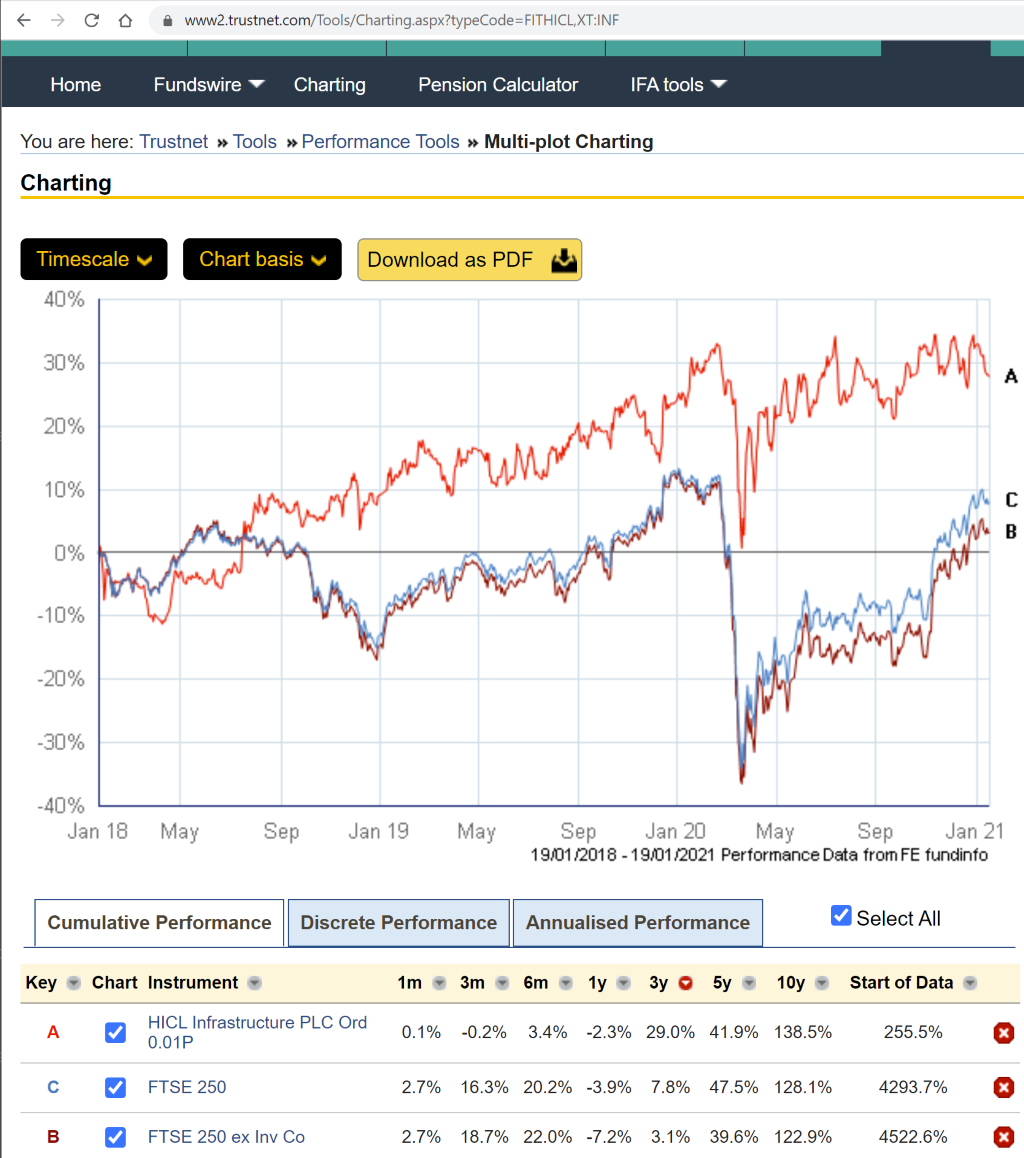
To zoom in on the last year - last March with the coronaviirus hitting markets you can see HICL only fell half as far as the fall in the FTSE250 at large. They did some decent damage limitation with investor letters explaining how their different types of holdings might be affected (e.g. a toll road would lose revenues with lack of traffic, but the HS1 rail connection had contractual revenue booked in advance so would only lose revenues after the first x months had elapsed, and some of their portfolio businesses' revenues aren't 'demand based' in the same way). The price bounced back to a premium to NAV relatively soon as investors sought safe havens, and they noted in one of their updates that, "Core infrastructure remains highly attractive to institutional investors seeking income, particularly during the current market turmoil, and this has benefited asset valuations".
If current valuations for infrastructure assets are supported by high demand from income-seekers then it clearly has exposure to interest rate changes, just like investment-grade bonds. However, clearly its characteristics are different from an equity tracker, so it will be a diversifier.
1 -
Thanks for the above, I realise this isn't my thread or anything so not wanting to muscle in but the above is really interesting. In my previous line of work (for about 16 years) we looked at Alt Assets so covered mostly PE but also INF, RE, NR etc and hedge funds of course. Good to see the charting too, I'll have a look how the above compares to the performance of some of the funds I've selected for my son's JISA.0
-
Okay so I had a little play - Fidelity World Index P vs HICL Infrastructure, and as suggested as defensive equities before by someone on here, Unilever. Here's my results. Question: When looking at indicies on here it seems odd that:
1. FTSE All World isn't available - only All Word - something
2. Why isn't MSCI World (or any MSCI indexes for that matter) present?
Anyhow, here's my results: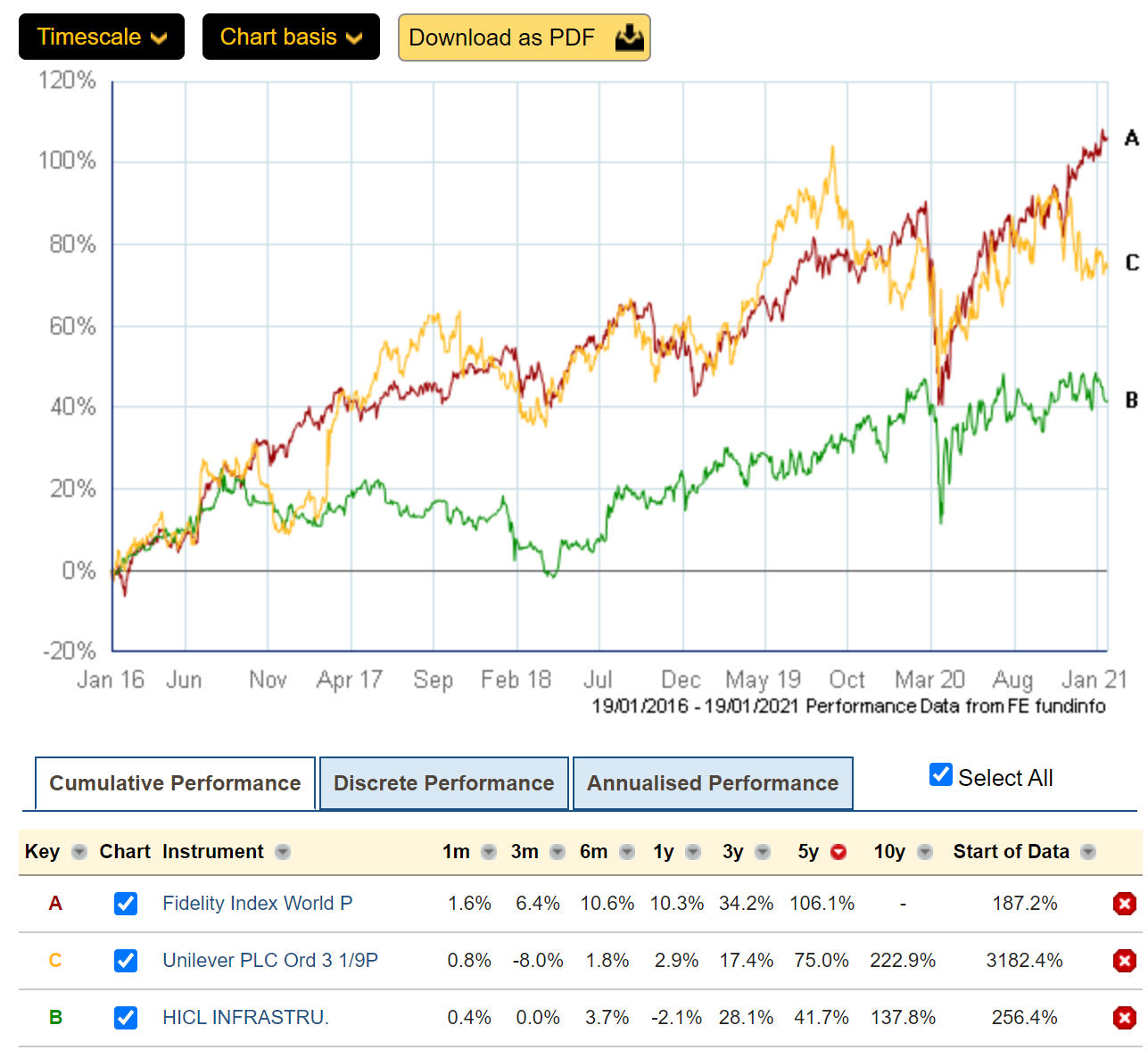
That makes me think, perhaps incorrectly, your portfolio would have done better if all was allocated to just the Fidelity fund (bear in mind I'm not looking to 10y since Fidelity doesn't have this data point).
I then just did 1 year.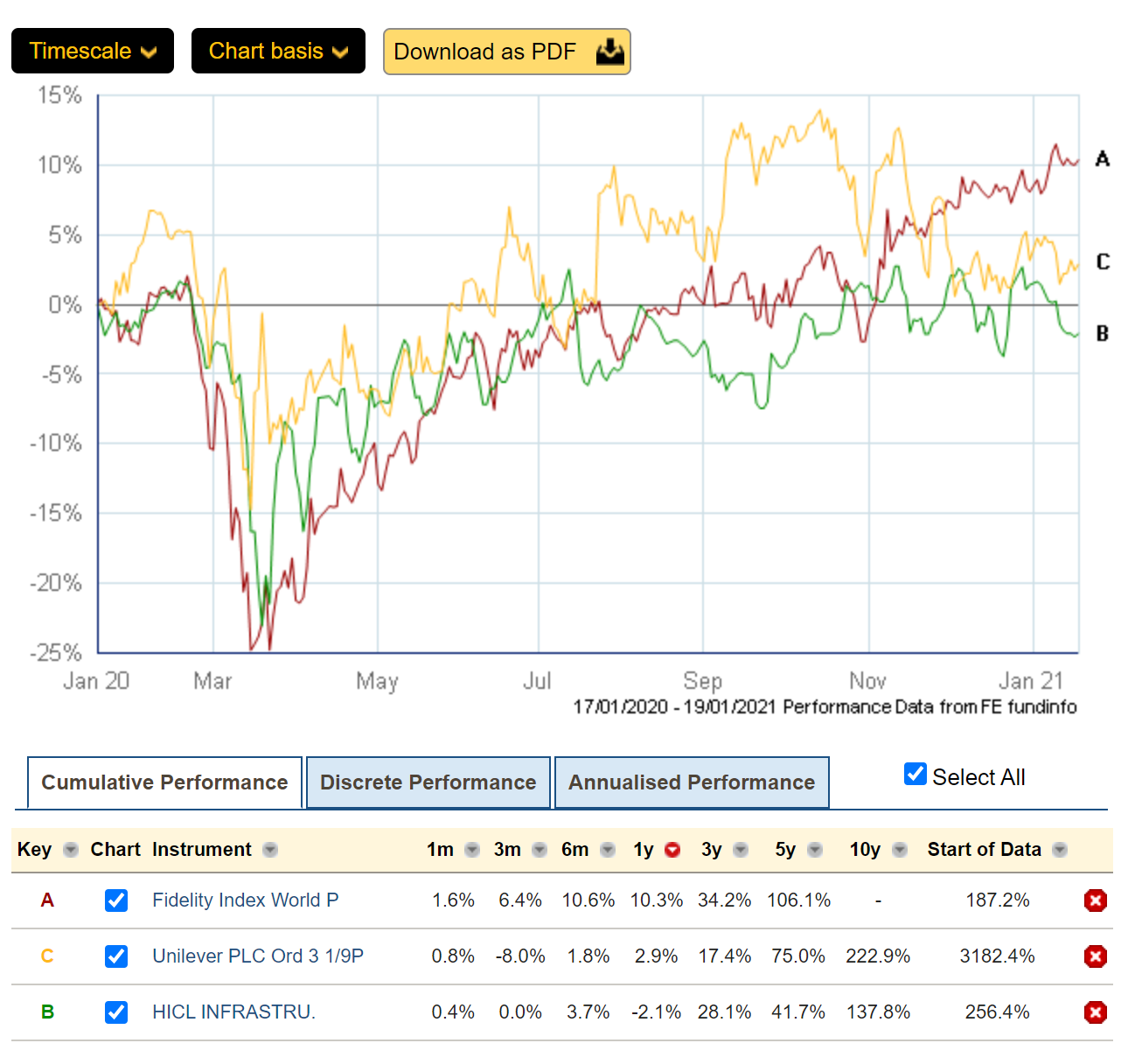
Which would suggest to me that the defensive equites like Unilever, would have broken the fall of Fidelity and equities in general if your portfolio held these. I'm not sure how to interpret the end position of Fidelity increasing from Nov? Perhaps because it's heavily US weighted and the election result triggered it?.
Volatility wise Fidelity was -25 to plus 11 or so. Unilever -15 to +14.
It's interesting but I don't think my narrative is 100% complete or correct!0 -
I don't know why the Trustnet Charting Tool doesn't have the FTSE All World index or haven't licensed the MSCI data but I just tend to use the FTSE World index when comparing performance as it's 'good enough' for most purposes of putting a global index on a graph. You could use an All-World fund/etf but that's not perfect either as there would be a small tracking error caused by fees, asset lending, optimal sampling, etc.ChilliBob said:Question: When looking at indicies on here it seems odd that:
1. FTSE All World isn't available - only All Word - something
2. Why isn't MSCI World (or any MSCI indexes for that matter) present?
Fidelity's global tracker almost certainly will be holding Unilever as part of it's underlying asset allocation but it will also be holding electric car makers, holiday companies, retail, etc which are more volatile than consumables like washing powder, tea bags and shower gel which people will go on buying anyway. There are some active funds that specialise in more defensive positions although each crash is different affecting different companies for example until recently people didn't consider tech stocks could be defensive after what happened 20 years ago. The danger is that known defensive shares can get overvalued due to high demand.ChilliBob said:Which would suggest to me that the defensive equites like Unilever, would have broken the fall of Fidelity and equities in general if your portfolio held these.
Vaccines giving hope of earnings recovery, signals from central banks, speculation, etc.ChilliBob said:I'm not sure how to interpret the end position of Fidelity increasing from Nov? Perhaps because it's heavily US weighted and the election result triggered it?.1 -
MSCI World isn't on the list as you say but I managed to find it a while ago as it came up on a comparison chart with a world tracker ETF. I have the following link bookmarked as it goes back decades . When you add Unilever to the MSCI chart you can see it has outperformed the index. Recent underperformance might be explained by future earnings growth which tends to drag a share price down if not up to expectations. There's also currency moves to take into account.
Chart Tool | Trustnet
Unilever PLC Ord 3 1/9P (Stock Code: ULVR) Fundamentals | Share price fundamentals | LSE Equities | Trustnet
Unilever (ULVR) | The Share Centre
One of the best sites for reference and charting etc.
Investing.com UK - Financial News, Shares, Quotes & Charts
0 -
Thanks Coastline and Alexland. It does make me think either defensive shares, or perhaps better still a defensive fund could be a good companion to a Global Equities tracker alongside various cash pools. I guess I still need to consider commodities, natural resources and real estate too though and see what they tend to do compared to global equities trackers. There didn't seem to be anything for gold/commodities on that charting tool, so I guess you'd need to choose a fund or etf specalising in it.
Given me a lot of thinking this thread 0
0







Confirm your email address to Create Threads and Reply

Categories
- All Categories
- 354.3K Banking & Borrowing
- 254.4K Reduce Debt & Boost Income
- 455.4K Spending & Discounts
- 247.3K Work, Benefits & Business
- 604K Mortgages, Homes & Bills
- 178.4K Life & Family
- 261.5K Travel & Transport
- 1.5M Hobbies & Leisure
- 16K Discuss & Feedback
- 37.7K Read-Only Boards