We’d like to remind Forumites to please avoid political debate on the Forum.
This is to keep it a safe and useful space for MoneySaving discussions. Threads that are – or become – political in nature may be removed in line with the Forum’s rules. Thank you for your understanding.
PLEASE READ BEFORE POSTING: Hello Forumites! In order to help keep the Forum a useful, safe and friendly place for our users, discussions around non-MoneySaving matters are not permitted per the Forum rules. While we understand that mentioning house prices may sometimes be relevant to a user's specific MoneySaving situation, we ask that you please avoid veering into broad, general debates about the market, the economy and politics, as these can unfortunately lead to abusive or hateful behaviour. Threads that are found to have derailed into wider discussions may be removed. Users who repeatedly disregard this may have their Forum account banned. Please also avoid posting personally identifiable information, including links to your own online property listing which may reveal your address. Thank you for your understanding.
📨 Have you signed up to the Forum's new Email Digest yet? Get a selection of trending threads sent straight to your inbox daily, weekly or monthly!
The Forum now has a brand new text editor, adding a bunch of handy features to use when creating posts. Read more in our how-to guide
Damp issue in potential house...

Nile_E_Coyote
Posts: 111 Forumite


Building survey picked up bits of damp but thought it was probably condensation related but isolated rising damp 'couldn't be totally discounted.'
Got a PCA company in and they diagnosed an alleged rising damp issue and recommended works involved a chemical damp proof injection. I'm aware that these are a waste of time which is pretty much what the first building surveyor said about damp.
The PCA also said it couldn't see evidence of a DPC but as its a 1930s it will be present in some form. I find it strange when the digital surveyor said he could see it in certain places.
Quite unsure how to proceed from here because I'm not filled with confidence.
Got a PCA company in and they diagnosed an alleged rising damp issue and recommended works involved a chemical damp proof injection. I'm aware that these are a waste of time which is pretty much what the first building surveyor said about damp.
The PCA also said it couldn't see evidence of a DPC but as its a 1930s it will be present in some form. I find it strange when the digital surveyor said he could see it in certain places.
Quite unsure how to proceed from here because I'm not filled with confidence.
0
Comments
-
Hahahahaha!No such thing as rising damp.PCA company just wants to charge lots of ££ for pointless chemcals. They gave you a free sales inspection survey?Find the source of the damp (if any) and resolve that instead.If you want help here, tell us where the damp is, how extensive, how diagnosed, what's the other side of the wall, etcand better still give us photos.3
-
This.greatcrested said:Hahahahaha!No such thing as rising damp.PCA company just wants to charge lots of ££ for pointless chemcals. They gave you a free sales inspection survey?Find the source of the damp (if any) and resolve that instead.If you want help here, tell us where the damp is, how extensive, how diagnosed, what's the other side of the wall, etcand better still give us photos.I despair.Everything that is supposed to be in heaven is already here on earth.
1 -
Don't have any real photos of the damp. The kitchen seems to have some old water drips but its fairly high up and the BS thought condensation. The other back room is seemingly where they've picked up the 'rising damp' though or maybe along the rear. Theyre sending the sketch over tomorrow (I will upload then). There is an external chimney breast at the back of the property near that location so I'm unsure if that is causing an issue. Other side of the wall is onto the back garden/patio.greatcrested said:Hahahahaha!No such thing as rising damp.PCA company just wants to charge lots of ££ for pointless chemcals. They gave you a free sales inspection survey?Find the source of the damp (if any) and resolve that instead.If you want help here, tell us where the damp is, how extensive, how diagnosed, what's the other side of the wall, etcand better still give us photos.
0 -
Impossible to respond. I'll leave dooergirl to come back and answer for the clarifications needed to give sensible advice.
1 -
😬 you gave the best advice initially.greatcrested said:Impossible to respond. I'll leave dooergirl to come back and answer for the clarifications needed to give sensible advice.
Their picture is only really going to help in context with some outdoor (and indoor) photos of the apparently affected areas with nice wide photos of walls, ground levels etc, but I don't trust these people at all as far as their 'solutions' go.
If the surveyor thought it was condensation, it probably is and almost certainly won't need anything luke that level of disruptive work.Everything that is supposed to be in heaven is already here on earth.
1 -
Nile_E_Coyote said: The other back room is seemingly where they've picked up the 'rising damp' though or maybe along the rear. ... There is an external chimney breast at the back of the property near that location so I'm unsure if that is causing an issue. Other side of the wall is onto the back garden/patio.Is the chimney in use ?If not, has it been thoroughly swept and fitted with a vented cap ?If the chimney is unused, unswept, and uncapped, rain will enter the pot, run down the inside and be absorbed by the soot. Over time, this damp will percolate down through the infill within the builder's opening and give the impression of "rising damp". Get the chimney swept, and light a fire to drive off the damp. Alternatively, clean out the builder's opening and install a log burner.As for the patio - Check to make sure it does not come all the way up to the external wall and is 150mm or so below the level of the DPC - With a 1930s property, there will be one. Probably just below any air bricks (worth checking to make sure they are clear). The DPC is likely to be a poured bitumastic layer that will be difficult to spot unless you know what to look for.If your foundations are anything like mine, they will be quite shallow, so getting a patio 150mm below the DPC may not be possible without exposing the footings.Any language construct that forces such insanity in this case should be abandoned without regrets. –
Erik Aronesty, 2014
Treasure the moments that you have. Savour them for as long as you can for they will never come back again.1 -
Don't really expect much feedback without pictures but safe to say I'm a tiny bit sceptical over the findings.
The alleged rising damp on the left seems to be the location of a window in a pretty ropey small offshoot. The one on the right has an external chimney on that area at the back.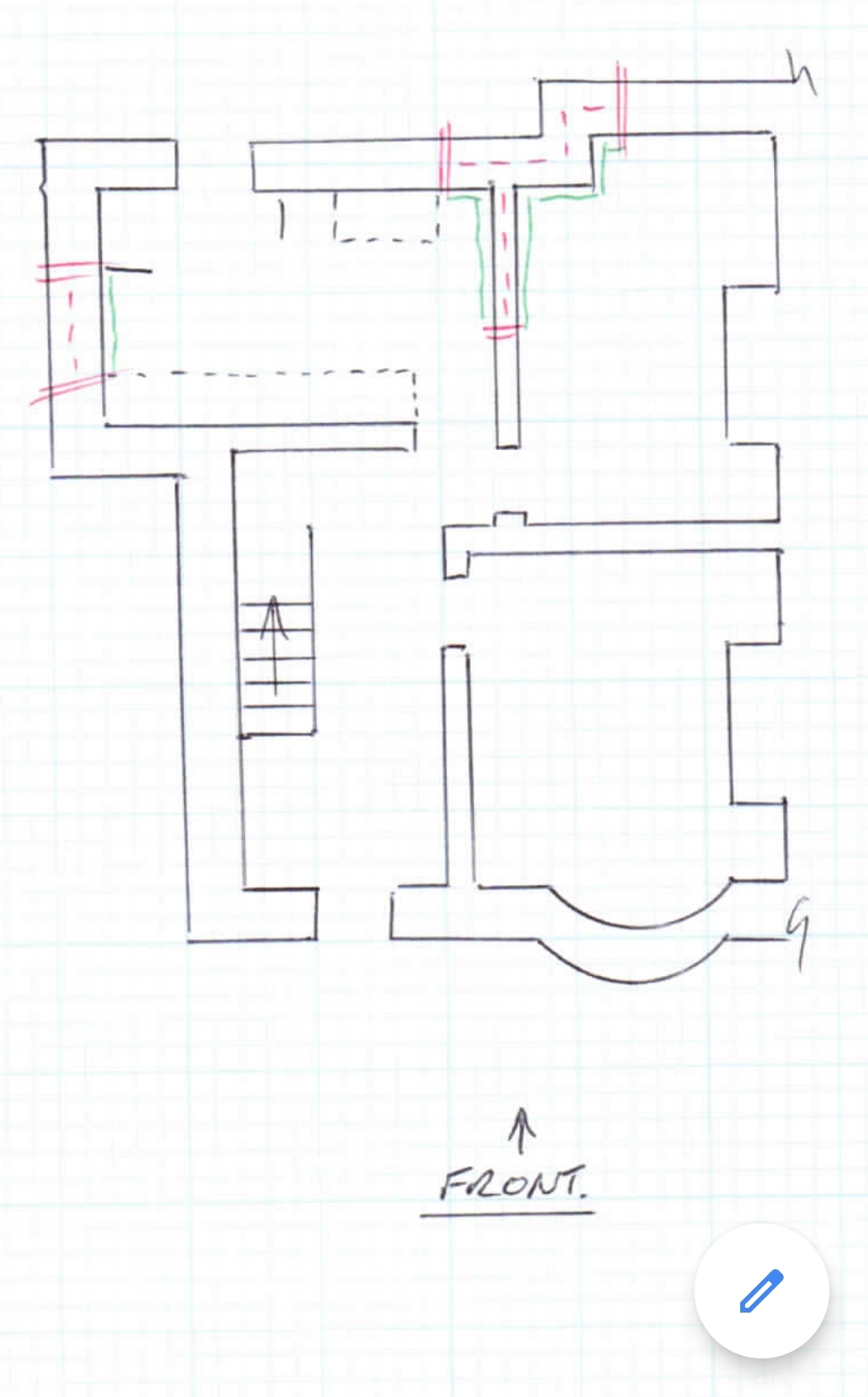
0 -
I haven't looked at the rear chimney too much. It doesn't have an opening or fire on the inside of the property. But seems to be a chimney going down the back of the house. I've noticed next door also has one but it is a couple of metres higher and has been presumably shortened.FreeBear said:Nile_E_Coyote said: The other back room is seemingly where they've picked up the 'rising damp' though or maybe along the rear. ... There is an external chimney breast at the back of the property near that location so I'm unsure if that is causing an issue. Other side of the wall is onto the back garden/patio.Is the chimney in use ?If not, has it been thoroughly swept and fitted with a vented cap ?If the chimney is unused, unswept, and uncapped, rain will enter the pot, run down the inside and be absorbed by the soot. Over time, this damp will percolate down through the infill within the builder's opening and give the impression of "rising damp". Get the chimney swept, and light a fire to drive off the damp. Alternatively, clean out the builder's opening and install a log burner.As for the patio - Check to make sure it does not come all the way up to the external wall and is 150mm or so below the level of the DPC - With a 1930s property, there will be one. Probably just below any air bricks (worth checking to make sure they are clear). The DPC is likely to be a poured bitumastic layer that will be difficult to spot unless you know what to look for.If your foundations are anything like mine, they will be quite shallow, so getting a patio 150mm below the DPC may not be possible without exposing the footings.0 -
Has your salesperson deigned to tell you *why* the damp exists and where it is coming from? How do they suggest actually stopping any ingress rather than masking it on the inside? Because that's all they're doing.It always comes from somewhere! Freebear has set you on the right path. If you need more help, then photos please. The ball point pen drawing doesn't help much, especially if they've missed off the chimney breast, which is probably the actual source of any issue on that side!Everything that is supposed to be in heaven is already here on earth.
0






Confirm your email address to Create Threads and Reply

Categories
- All Categories
- 354.3K Banking & Borrowing
- 254.4K Reduce Debt & Boost Income
- 455.4K Spending & Discounts
- 247.3K Work, Benefits & Business
- 603.9K Mortgages, Homes & Bills
- 178.4K Life & Family
- 261.5K Travel & Transport
- 1.5M Hobbies & Leisure
- 16.1K Discuss & Feedback
- 37.7K Read-Only Boards