We’d like to remind Forumites to please avoid political debate on the Forum.
This is to keep it a safe and useful space for MoneySaving discussions. Threads that are – or become – political in nature may be removed in line with the Forum’s rules. Thank you for your understanding.
PLEASE READ BEFORE POSTING: Hello Forumites! In order to help keep the Forum a useful, safe and friendly place for our users, discussions around non-MoneySaving matters are not permitted per the Forum rules. While we understand that mentioning house prices may sometimes be relevant to a user's specific MoneySaving situation, we ask that you please avoid veering into broad, general debates about the market, the economy and politics, as these can unfortunately lead to abusive or hateful behaviour. Threads that are found to have derailed into wider discussions may be removed. Users who repeatedly disregard this may have their Forum account banned. Please also avoid posting personally identifiable information, including links to your own online property listing which may reveal your address. Thank you for your understanding.
📨 Have you signed up to the Forum's new Email Digest yet? Get a selection of trending threads sent straight to your inbox daily, weekly or monthly!
The Forum now has a brand new text editor, adding a bunch of handy features to use when creating posts. Read more in our how-to guide
Buying a house with bad damp?
Comments
-
Smithy5000 said: You can check the foundation levels around the rooms that are suffering from the damp, if theyre higher the the dpc l (if there's any) then the walls will need to be tanked to stop the water ingress into the property.NO. Walls. Do. NOT. Need. Tanking.Slapping waterproof render/plaster on to walls just hides the problem for a few years. It does not cure it, and will end up costing even more to put right the damage in later years.Fix the problem at the source, and the damp will disappear.Any language construct that forces such insanity in this case should be abandoned without regrets. –
Erik Aronesty, 2014
Treasure the moments that you have. Savour them for as long as you can for they will never come back again.7 -
I don't think that has anything to do with render, given it's all on the chimney breast and around it. There's a lot of water coming in and so my very first port of call would be the roof and the flashing around the chimney breast.Photos of the outside of the wall would have been handy though.What evidence have they given you of the render being the problem? It doesn't make sense to me at all, looking at it being centred around a wall that has no render on the inside of it.Everything that is supposed to be in heaven is already here on earth.
2 -
The builder advised that he believed it was the render on the gable wall causing the issues, which the estate agent also mentioned. It’s only that one wall that is rendered, and I’m no expert but it looks very badly down and is clearly patched in places. Good point though about the chimney breast. To my knowledge the chimneys are blocked up.0
-
If water gets into cracks in render, it cannot evaporate and escape, so penetrates the wall causing damp inside.I have noidea why people put render on extermal walls. (well, OK, 'it looks good', but structurally....)0
-
They may well be blocked but the chimneys are still connected to the roof. If the flashing that protects the join between roof and chimney is split, there is no protection and the water will run down the face of the chimney breast inside, which looks a lot like what you have there. Because there is puddling on the ceiling, I would say that it is more of a leak on the inside than penetration through both the back and front walls of the breast.squishypengu said:The builder advised that he believed it was the render on the gable wall causing the issues, which the estate agent also mentioned. It’s only that one wall that is rendered, and I’m no expert but it looks very badly down and is clearly patched in places. Good point though about the chimney breast. To my knowledge the chimneys are blocked up.The render may well be shot, but I would expect the damp patches to correspond with the same areas outside.Everything that is supposed to be in heaven is already here on earth.
0 -
I'm talking about this area, if the lead has deteriorated. The back of the chimney here at the higher end would be most exposed as the water would run straight into the house down the part of chimney breast exposed inside. Your chimney probably isn't in the same position but the picture is better than nothing.
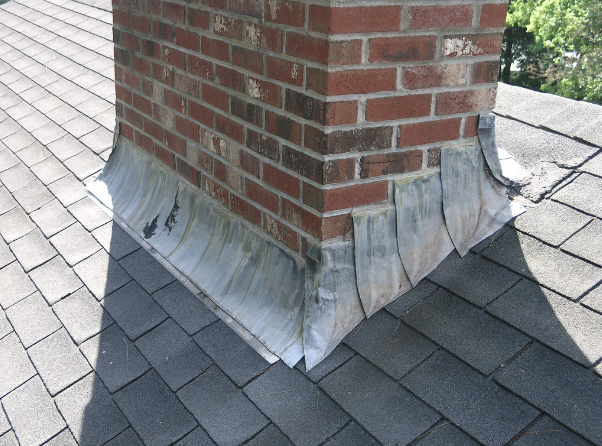 Even better would be you posting photos of the house outside!Everything that is supposed to be in heaven is already here on earth.
2 -
Thanks @Doozergirl that is very helpful!! I’ll chat to the builder about this. Unfortunately didn’t get any pictures outside0
-
The paving is at and probably over the DPC course in the side photo. It won't explain damp patches on the ceiling, but it can explain a significant amount at lower level. It needs to be taken back about a foot and the ground level around the wall taken down to at least 150mm below its present point against the render.Render also shouldn't touch the floor, it's going to act like a straw and breach the DPC even if the paving weren't against the wall. That needs cutting back up to DPC and a bell bead put on the bottom to prevent it dripping straight down the wall.The chimney stack isn't a problem as it doesn't exist but I would still want to get up in the loft and see whether the chimney breast is damp at that level. You can see the repair to the roof where it was taken away and the repair may not have been great. Real slate roofs don't like to be disturbed much.Everything that is supposed to be in heaven is already here on earth.
2 -
Thank you so much, this is so useful. The builder had also flagged the paving issue. We haven’t had a proper survey done yet but good to know we would need to look at the roof as a possible source. Thank you!!!Doozergirl said:The paving is at and probably over the DPC course in the side photo. It won't explain damp patches on the ceiling, but it can explain a significant amount at lower level. It needs to be taken back about a foot and the ground level around the wall taken down to at least 150mm below its present point against the render.Render also shouldn't touch the floor, it's going to act like a straw and breach the DPC even if the paving weren't against the wall. That needs cutting back up to DPC and a bell bead put on the bottom to prevent it dripping straight down the wall.The chimney stack isn't a problem as it doesn't exist but I would still want to get up in the loft and see whether the chimney breast is damp at that level. You can see the repair to the roof where it was taken away and the repair may not have been great. Real slate roofs don't like to be disturbed much.0 -
Look up 'French drain' that would helpDoozergirl said:The paving is at and probably over the DPC course in the side photo. It won't explain damp patches on the ceiling, but it can explain a significant amount at lower level. It needs to be taken back about a foot and the ground level around the wall taken down to at least 150mm below its present point against the render.Gather ye rosebuds while ye may0










Confirm your email address to Create Threads and Reply

Categories
- All Categories
- 354.4K Banking & Borrowing
- 254.4K Reduce Debt & Boost Income
- 455.4K Spending & Discounts
- 247.3K Work, Benefits & Business
- 604K Mortgages, Homes & Bills
- 178.4K Life & Family
- 261.5K Travel & Transport
- 1.5M Hobbies & Leisure
- 16K Discuss & Feedback
- 37.7K Read-Only Boards