We’d like to remind Forumites to please avoid political debate on the Forum.
This is to keep it a safe and useful space for MoneySaving discussions. Threads that are – or become – political in nature may be removed in line with the Forum’s rules. Thank you for your understanding.
📨 Have you signed up to the Forum's new Email Digest yet? Get a selection of trending threads sent straight to your inbox daily, weekly or monthly!
The Forum now has a brand new text editor, adding a bunch of handy features to use when creating posts. Read more in our how-to guide
Finding a way forward

LouSmith11
Posts: 2 Newbie

I wonder if anyone can help with a long running saga I am looking for some advice about.
We removed our bath upstairs to install a shower several years ago. We have been through two installations that both leaked and for various reasons we couldn’t get anyone back to sort it.
On the third occasion we thought we do things properly I went to a reputable bathroom showroom, someone came out to see the job to price up, I discussed the main issue as I saw it, that my partner and I are quite big, lumptons as we say! Clearly this needed to be taken into account. But he saw us and I was open about acknowledging this, embarrassing though it was at the time.
The shower was installed, we had to pay the plumber separately but he was arranged by the showroom.
After five months the shower tray developed a hair line crack and the sealant also cracked. The plumber came out and diagnosed it as a sub floor problem, that the joist is moving due to the weight and not something they are responsible for. Despite our efforts to use sealant tape on the tray a leak has continued and damaged our living room ceiling.
My argument is that if it was so easy to diagnose the joist as being the cause of the leak just by looking at the installed shower why could they not do that before they installed this one? The leak seems to be coming through in the same place in the living room. We have a photo we took of the flooring after the previous shower was removed, there are floor boards missing, they did use three sheets of ply under the shower tray but if it is not supported equally it may well cause an issue. There is also not much of a gradient for the waste pipe.
I guess what I am seeking is advice on is who can I approach who will give an objective view on where responsibility lies, currently the shop are either blaming the plumber or my weight, they have recently offered a replacement shower tray and waste when I showed them the photo of the floor pre installation, this was done “without prejudice”. The whole situation is awful, we have a shower that has to be used sparingly or it drips into the living room and unsightly stains on our living room ceiling which we can’t do anything about at the moment.
As I said it is a bit of a saga, thanks for reading and even more thanks if you can offer any advice.
0
Comments
-
In the circumstances, I think you should just crack on with getting it fixed. I think you'll have a hard time proving negligence on their part, especially since this is the third failed installation, which suggests an underlying problem. It could take many months, when surely your priority has to be to get a working bathroom again?
I'm afraid I agree with the showroom. It's not their job to be structural engineers. If there was something obvious they should have noticed, such as a missing or rotten joist, then fair enough, but you cant expect a bathroom fitter to be testing the structural integrity of your home before they install. It sounds to me as if you need a builder who can reinforce the joist or its fixings. I doubt that three installers have all made the same mistake - you have a fundamental problem underneath, perhaps caused or exacerbated by your weight. It's possible that the combined weight of a bath full of water plus a "lumpton", weakened the floor before the showers were fitted.1 -
But surely part of the installation work should be to inspect the area around the shower to ensure that the floor and supporting joists are suitable especially as the weight of the people who would be using the shower was specifically mentioned prior to making the contract.Aylesbury_Duck said:I'm afraid I agree with the showroom. It's not their job to be structural engineers. If there was something obvious they should have noticed, such as a missing or rotten joist, then fair enough, but you cant expect a bathroom fitter to be testing the structural integrity of your home before they install. It sounds to me as if you need a builder who can reinforce the joist or its fixings. I doubt that three installers have all made the same mistake - you have a fundamental problem underneath, perhaps caused or exacerbated by your weight. It's possible that the combined weight of a bath full of water plus a "lumpton", weakened the floor before the showers were fitted.
Consumer Rights Act 2015 (legislation.gov.uk)10 Goods to be fit for particular purpose
(1)Subsection (3) applies to a contract to supply goods if before the contract is made the consumer makes known to the trader (expressly or by implication) any particular purpose for which the consumer is contracting for the goods.
1 -
I suspect they did inspect and assess the areas as suitable, though. This installation failed a full five months after installation, so if there was anything they could have reasonably spotted at installation, surely it would have failed much sooner? It sounds to me as if there's an underlying structural problem with OP's house, perhaps a badly fitted or weakened joist. I presume if this ended up in a small claims court, would it be reasonable for the fitter to have done a full structural survey of the area in question, or just a good visual check of the state of the floor and supporting structure?1
-
Shower trays are usually rated for 250kg/40 stone, however that is on a solid/non-moving floor, they weaken considerably when flexed and especially when subjected to torsion. Even if that does not result in immediate failure it will over time, even with much lower weights. My suspicion is that under normal circumstances the shower tray might be fine, either lower weight or without the stress of being flexed due to issues with the joists, but added together this leads to premature failure.
You might want to get a builder with relevant experience in replacement joists to have a look, if the joists are damaged, or unsecured in some way then that could be the issue, they may also be able to recommend a load bearing structure which can be put in underneath, something that they do for heavy roll top enamel baths that spreads the load over multiple joists and provides a solid and stable platform.1 -
What sort of "inspection" do you expect them to make, other than any defects which were actually visible? I would say it's reasonable for bathroom installers to presume that the floor of an existing bathroom is going to be strong enough for continued use as a bathroom. Might be different if they were looking at a newly (and badly) converted loft or something.DiddyDavies said:
But surely part of the installation work should be to inspect the area around the shower to ensure that the floor and supporting joists are suitable especially as the weight of the people who would be using the shower was specifically mentioned prior to making the contract.Aylesbury_Duck said:I'm afraid I agree with the showroom. It's not their job to be structural engineers. If there was something obvious they should have noticed, such as a missing or rotten joist, then fair enough, but you cant expect a bathroom fitter to be testing the structural integrity of your home before they install. It sounds to me as if you need a builder who can reinforce the joist or its fixings. I doubt that three installers have all made the same mistake - you have a fundamental problem underneath, perhaps caused or exacerbated by your weight. It's possible that the combined weight of a bath full of water plus a "lumpton", weakened the floor before the showers were fitted.
2 -
If they couldn't make an inspection then at the very least I would expect them to state that an inspection is recommended by someone more knowledgeable prior to the fitment of the shower and make sure that this recommendation is written down and acknowledged before the installation begins.davidmcn said:What sort of "inspection" do you expect them to make, other than any defects which were actually visible? I would say it's reasonable for bathroom installers to presume that the floor of an existing bathroom is going to be strong enough for continued use as a bathroom. Might be different if they were looking at a newly (and badly) converted loft or something.
After all, the OP had made their concerns about their weight well known to the company concerned so they were aware of the loading that the shower would be put to.
The bathroom company are the professionals and it's up to them to ensure that the goods they supply are fit for the purpose for which they are bought and this still applies if there are any unusual requirement providing that these requirements are made known before the contract is concluded.1 -
LouSmith11 said:...My argument is that if it was so easy to diagnose the joist as being the cause of the leak just by looking at the installed shower why could they not do that before they installed this one? The leak seems to be coming through in the same place in the living room. We have a photo we took of the flooring after the previous shower was removed, there are floor boards missing, they did use three sheets of ply under the shower tray but if it is not supported equally it may well cause an issue. There is also not much of a gradient for the waste pipe....Surely it is not unreasonable to expect any competent bathroom fitter/installer to realise that if there are missing floorboards(!) where the shower was previously, then there is quite a serious problem to be addressed? ie properly investigated and remedied before going any further. I'd hardly consider three sheets of ply sufficient.
2 -
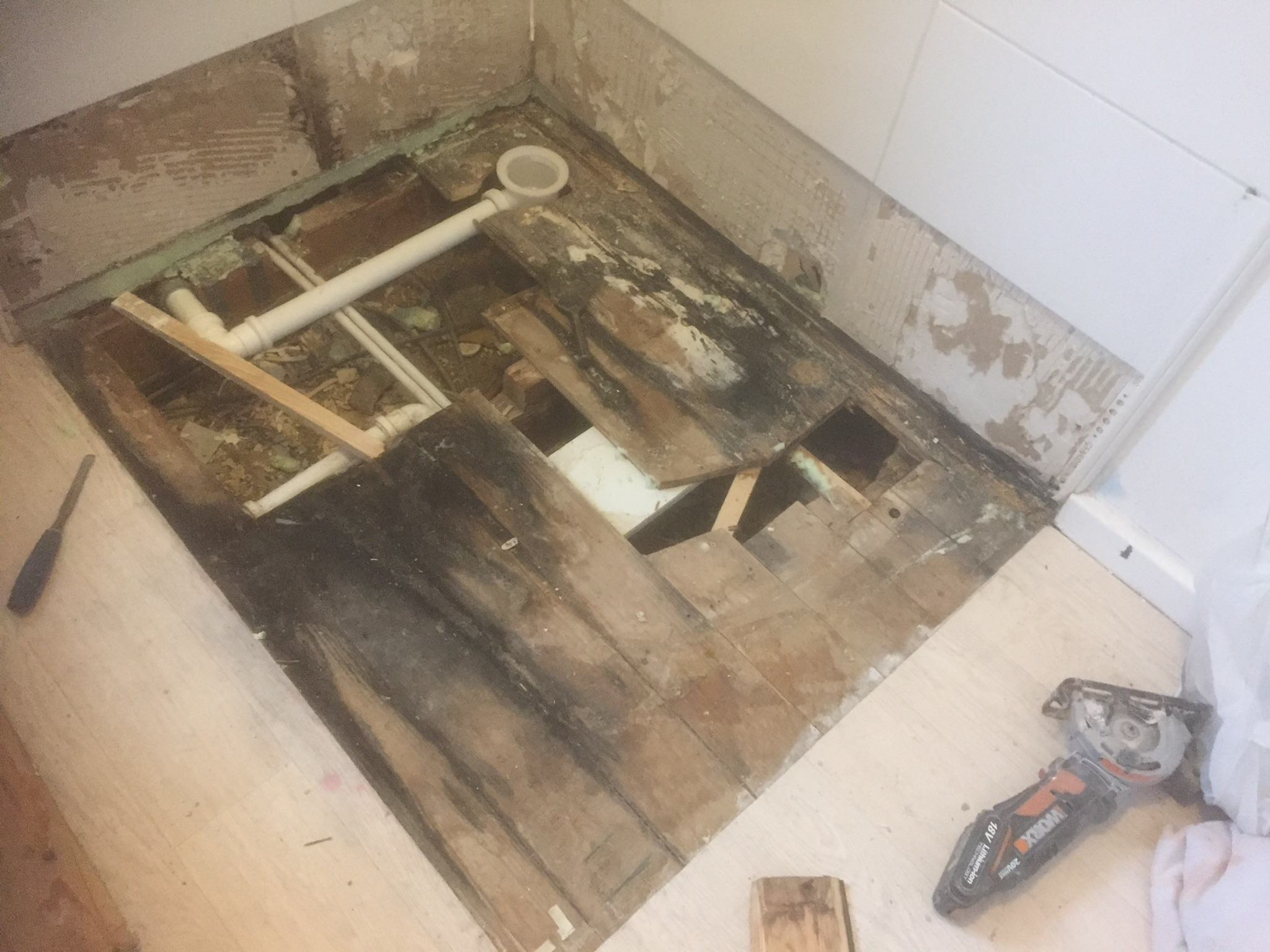 Thanks for the responses so far. This is what three sheets of marine ply was laid on. Thought a photo may be helpful.
0 -
There is quite a lot of damp and rot there, there are also logs of cuts through the two joists that I can see and a lot of the floor board is missing. Whilst the ply might help it is not going to solve the problem. I would suggest you get a builder who you trust to have a look at the joists and floor boards and get them to make sure they are structurally sound, especially with the amount of damp and rot visible on the floorboards.0
-
Having now seen the photo, I've changed my view. That's a total mess, and doesn't require a builder or structural engineer to say so. It's easy to see that the floorboards are damp and rotting and therefore reasonable to assume that the joists underneath might be affected. The two slim pieces of wood are telling, it looks as if they've been placed there as makeshift braces. The issue of your weight is immaterial - that flooring is not suitable for any installation, let alone for someone overweight.
The next decision is who to take action against. You say that the fitter was arranged through the showroom but that you paid them separately. Dig out your paperwork and find out exactly who your contract for installation was with. One final piece of advice: lose some weight. I don't mean that unkindly and also I don't say it with this situation in mind. We're in a pandemic where being overweight puts you at a disadvantage, even more than you are already at risk from illnesses associated with being overweight. Address your weight with the same attention and persistence that you need to for the bathroom problem! Good luck!1







Confirm your email address to Create Threads and Reply

Categories
- All Categories
- 353.6K Banking & Borrowing
- 254.2K Reduce Debt & Boost Income
- 455.1K Spending & Discounts
- 246.6K Work, Benefits & Business
- 603K Mortgages, Homes & Bills
- 178.1K Life & Family
- 260.7K Travel & Transport
- 1.5M Hobbies & Leisure
- 16K Discuss & Feedback
- 37.7K Read-Only Boards