We’d like to remind Forumites to please avoid political debate on the Forum.
This is to keep it a safe and useful space for MoneySaving discussions. Threads that are – or become – political in nature may be removed in line with the Forum’s rules. Thank you for your understanding.
📨 Have you signed up to the Forum's new Email Digest yet? Get a selection of trending threads sent straight to your inbox daily, weekly or monthly!
The Forum now has a brand new text editor, adding a bunch of handy features to use when creating posts. Read more in our how-to guide
Equity percentage in the deaccumulation phase
Comments
-
Deleted_User said:Just a note that these percentages don’t mean a lot unless you specify your family’s DB income. Including state pension and whatever other bits you may have. Thats part of your FI allocation.Indeed. We have a solid base of DB pensions plus state pension, but the DB pensions have inflation risk, as like most (nearly all?) DB pensions they are not fully inflation protected. The inflation increases are capped, partly at 3% and partly at 5%.I've just done some frightening analysis on the effect the inflation levels of previous decades would have on our DB pensions, after 10 years at 1970-1980 inflation rates, the DB pensions would be well under half their real value, a DB pension of £10,000 with an inflation cap of 5% would be worth £4300 in real terms after 10 years of 1970's inflation, and with a 3% cap only £3500. So somewhere in between for us, maybe £4000.I'm currently thinking foreign equities in the DC pensions/ISA are probably the best hedge against high UK inflation...but need to look into this more.Definitely something that needs considering for people with a possibly 30-40 year potential retirement horizon, a few years of high inflation (almost inevitable over a 30-40 year period) could halve the value of your DB pensions. Anyone got other strategies for this?3
-
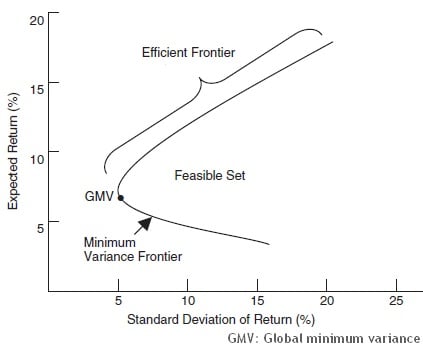
DairyQueen said:@Alexland: I didn't know that 80% was the optimum. I have variously read that it's 50/60/70. Are there any articles/sources that you could link? TIA.When mixing two asset types there is an optimum point for stability but most people would want to look at the efficient frontier range to achieve a better return within an acceptable range of volatility. Obviously the more equities you have the greater the long term return is expected but it gets to a point, which is a matter of judgement, where the extra return potential may not be worth the extra volatility. So in the example where your pot is much larger than you really need you might decide to go higher up the risk scale to say 80% while still keeping the remaining 15-20% reasonably accessible for spending during market lows as it would still be a lot of money and plenty in proportion to your spending needs.
 1
1 -
If stagflation were to return then we would all be in trouble. A very different world to the 70's.zagfles said:Deleted_User said:Just a note that these percentages don’t mean a lot unless you specify your family’s DB income. Including state pension and whatever other bits you may have. Thats part of your FI allocation.Definitely something that needs considering for people with a possibly 30-40 year potential retirement horizon, a few years of high inflation (almost inevitable over a 30-40 year period) could halve the value of your DB pensions. Anyone got other strategies for this?
0 -
Definitely something that needs considering for people with a possibly 30-40 year potential retirement horizon, a few years of high inflation (almost inevitable over a 30-40 year period) could halve the value of your DB pensions. Anyone got other strategies for this?To be honest I had never really thought about it , too many recent years of low inflation I suppose. It has not actually been above 5% for 29 years .
Now you have raised it , it is something else to think about . Although the DB will only represent about 25% once the SP's kick in and in the intervening handful of years , probably inflation will not rise that quickly .0 -
pip895 said:I have been running with an equity percentage of 60% although some of the funds I have in my "non equity portion" e.g. PNL contain equity so the actual equity percentage may be closer to 70%. What equity percentage are others using and do others allow this to change as the market changes - for instance I took a more aggressive position during the crash but have now sold equity to return close to the 60% mark now that markets have largely recovered.I didn't go into drawdown thinking that I must have a specific percentage in equity, instead I calculated on a fairly pessimistic basis how many £'s I'd need to have invested in globally diverse equities to (hopefully) comfortably cover the income that we'd want, the percentages then came from that. As we don't have a very expensive lifestyle there is enough cash left over to cover our income for multiple years should the need ever arise, and as I'm an avid follower of best savings rates the cash has been keeping up with CPI - though that will become more difficult if inflation take off and savings rates remain low.Our state pensions are some way away, but when we do start to get them (or if there is a humungous market crash that brings the VWRL yield closer to 4% rather than 2%) then I might think about using some of the cash we have to increase the amount in equities at that time, but until then the equity percentage will just go up and down as the markets go up and down rather than from me actively taking any decisions to increase equities.0
-
The worst thing is that higher inflation is unlikely to be constant and the lumpiness might cause some years in which it didn't hit the cap and other years in which it significantly exceeded the cap so at the end of the period the result is worse than assuming it was capped at the average yearly rate of high inflation.zagfles said:I've just done some frightening analysis on the effect the inflation levels of previous decades would have on our DB pensions, after 10 years at 1970-1980 inflation rates, the DB pensions would be well under half their real value, a DB pension of £10,000 with an inflation cap of 5% would be worth £4300 in real terms after 10 years of 1970's inflation, and with a 3% cap only £3500. So somewhere in between for us, maybe £4000.
0 -
Thrugelmir said:
If stagflation were to return then we would all be in trouble. A very different world to the 70's.zagfles said:Deleted_User said:Just a note that these percentages don’t mean a lot unless you specify your family’s DB income. Including state pension and whatever other bits you may have. Thats part of your FI allocation.Definitely something that needs considering for people with a possibly 30-40 year potential retirement horizon, a few years of high inflation (almost inevitable over a 30-40 year period) could halve the value of your DB pensions. Anyone got other strategies for this?I would tend to agree the future is unlikely to be similar to the past, but all modelling of investment returns, safe withdrawal rates etc seem to use historic data on equity/bonds returns & volatility etc and "back-test" the strategy over various periods in the past.Doing the same with capped DB pensions gives scary results... it's not just the 70's, even over the 1980's a capped DB pension would have lost 20-30% of its value (down to 71-83% of it's value)0 -
Depends which inflation measure you use - RPI was over 5% in 2011. And it was above 3% just 2 years ago. Pre-1997 service is usually capped at 3% increases.Albermarle said:Definitely something that needs considering for people with a possibly 30-40 year potential retirement horizon, a few years of high inflation (almost inevitable over a 30-40 year period) could halve the value of your DB pensions. Anyone got other strategies for this?To be honest I had never really thought about it , too many recent years of low inflation I suppose. It has not actually been above 5% for 29 years .
Now you have raised it , it is something else to think about . Although the DB will only represent about 25% once the SP's kick in and in the intervening handful of years , probably inflation will not rise that quickly .
0 -
I think that is a very good baseline for accumulation but its probably worth noting that due to two extended poor periods of returns in US equities the safe withdrawal rate drops just slightly when you go over 65% equities. Basically there are two time points that a 20% buffer of bonds wasn't enough without lowering withdrawals - which is obviously the right answer but something that not all want to consider. The UK markets have never created that effect but its probably because they have been a little less boom and bust than the US markets.Alexland said:DairyQueen said:@Alexland: I didn't know that 80% was the optimum. I have variously read that it's 50/60/70. Are there any articles/sources that you could link? TIA.When mixing two asset types there is an optimum point for stability but most people would want to look at the efficient frontier range to achieve a better return within an acceptable range of volatility. Obviously the more equities you have the greater the long term return is expected but it gets to a point, which is a matter of judgement, where the extra return potential may not be worth the extra volatility. So in the example where your pot is much larger than you really need you might decide to go higher up the risk scale to say 80% while still keeping the remaining 15-20% reasonably accessible for spending during market lows as it would still be a lot of money and plenty in proportion to your spending needs.0 -
Alexland said:
The worst thing is that higher inflation is unlikely to be constant and the lumpiness might cause some years in which it didn't hit the cap and other years in which it significantly exceeded the cap so at the end of the period the result is worse than assuming it was capped at the average yearly rate of high inflation.zagfles said:I've just done some frightening analysis on the effect the inflation levels of previous decades would have on our DB pensions, after 10 years at 1970-1980 inflation rates, the DB pensions would be well under half their real value, a DB pension of £10,000 with an inflation cap of 5% would be worth £4300 in real terms after 10 years of 1970's inflation, and with a 3% cap only £3500. So somewhere in between for us, maybe £4000.Indeed, I've accounted for that in my modelling. It's no use looking at the change in prices over a decade, you have to look at each individual year and apply the cap each year.A similar issue (in reverse) to the triple lock where if eg average earnings dip 10% this year and rise 10% next year the state pension will rise 2.5% then 10% even though earnings haven't increased over the 2 years!
0








Confirm your email address to Create Threads and Reply

Categories
- All Categories
- 354.2K Banking & Borrowing
- 254.3K Reduce Debt & Boost Income
- 455.3K Spending & Discounts
- 247.2K Work, Benefits & Business
- 603.8K Mortgages, Homes & Bills
- 178.4K Life & Family
- 261.3K Travel & Transport
- 1.5M Hobbies & Leisure
- 16.1K Discuss & Feedback
- 37.7K Read-Only Boards