We’d like to remind Forumites to please avoid political debate on the Forum.
This is to keep it a safe and useful space for MoneySaving discussions. Threads that are – or become – political in nature may be removed in line with the Forum’s rules. Thank you for your understanding.
Independent Financial Advisors
Comments
-
Pension Freedoms were a good time in the making, overseen by various committees of the great and the good. I don't find it plausible that they "forgot" to exclude DB pensions; it would have made the Act ideologically incoherent.Silvertabby said:
The Pension Freedoms were only ever intended to apply to DC schemes, at a time when poor value annuities seemed to be the only option for many.ZingPowZing said:
Maybe.NottinghamKnight said:I don't really understand the radically opposed opinions. I don't use an IFA but they may be valuable for some, the qualifications required aren't too onerous compared to most professions but then we have rampant grade inflation in all areas. Most professional services would be charged on he basis of a fixed fee for a defined scope of work, or at hourly rates to a budget estimate; percentage charging is fine for a rough idea but is now outdated for most professions including architects, engineers, solicitors, accountants etc Percentage figures, especially<1% look minor to many people, and certainly far less than say £200 an hour when presented to a client. Transactional advice would be good for may investors but the lack of certainty in income won't meet the financial requirements of most advisers, and it would appear to be rarely on offer from what is reported on the boards.
But what is your justification for your position that pension freedoms should never have been allowed, Nottinghamknight?
I expect the originators of Pension Freedoms never gave a thought to DB pension fund members because, hey, why on earth would a DB member want to change to DC?
The tabloids didn't help. The small print may have said that the new rules only applied to DC funds, but the headlines implied that everyone could get their hands on lots of lovely dosh. Now. Hence floods of calls to the LGPS (for one) from both deferred and current members, many of whom expected that 'their' money would just be paid into their bank accounts.
The rules re having to take financial advice weren't passed just to annoy those few who are perfectly capable of dealing with their own finances, they were passed to help safeguard those who are not.
https://www.gov.uk/government/collections/pension-schemes-bill-2014-to-2015#:~:text=The Pension Schemes Act sets,schemes and 'collective benefits'.
Which includes the text:- new safeguards to support individuals if they wish to transfer out of their existing Defined Benefit scheme to access the new flexibilities.
Awkward.0 -
Transparency - how did you get a figure of "easily £300k"? I ran a quick worksheet on the following assumptions:-
1. £30k starting salary at 30
2. 5% increase p.a.
3. 2% fee going into fund and 1/2% p.a.
4. 20% of income into pot
5. 2% growth after fees and 2.5% without any fees
6. At 65 £100k differenceOn point 3, an IFA cannot charge an initial fee beyond the first year So, they could charge 2% for 12 months but after that, the initial fee would be zero. Barely any providers have initial charges any more. On that scenario, a fee of around £500-£750 is likely. Taken fully in year one.
The best advice the IFA can give when someone is calling about market turbulence is “bug off”.But you wouldn't give them any advice on that follow up call as they are not paying you. Mrs Miggins used the method you prefer of transactional advice. So, the response to Mrs Miggins would be "I can tell you but it will cost you £x. However, if you dont pay, I won't tell you". Mrs Miggins then does exactly what that person did on another thread here from the other day and transfers it all to cash and it costs tens of thousands of pounds.
Is handholding a worthwhile service worth massive amounts of money?Its not just handholding.
You have no basis to say that the clients want this charging model.Yes we do. a) the model reflects what people want b) research time and again (including commissioned by the regulator) found that percentage was by far the most popular with consumers. c) hourly rates were the least popular with consumers.
So popular, they put clients money into platforms only accessible through advisors so its harder to just take over the portfolio you paid a fee to set up.IFA platforms can be cheaper than DIY platforms. Most DIY platforms don't accept intermediaries. Most IFA platforms will take instructions from a client if they dont have an adviser. Some cannot or they will increase their charge to cover the increased costs.
The clients don’t get to decide. At least not based on transparent information. If they were given options with clear illustrations of the impact the fees will have, it would be a different matter.You are not in this country. So, how can you say what disclosure is like in the UK? I suspect you are very out-of-date. Indeed, disclosure in the UK (and EU) has got so detailed and transparent that people can now suffer information overload. Ironically, I find the disclosures on the DIY side to be far less transparent. Just look at some fo the DIY platforms and the way they hide the TC & IC and only show the OCF. Or give a typical TC & IC rather than an actual.
Why do you believe a MIFIDII disclosure is not transparent?
I am an Independent Financial Adviser (IFA). The comments I make are just my opinion and are for discussion purposes only. They are not financial advice and you should not treat them as such. If you feel an area discussed may be relevant to you, then please seek advice from an Independent Financial Adviser local to you.2 -
My method of covering his costs by working an hour a week and putting that extra into the pension reduces the impact by 50%.Lets forget up front fees. If the advisor charges 1% and the funds he buys for you achieve the same return then you will end up with 1.705 million. Thats 434k less.
If the advisor charges 2% up front and 0.5% per year then you will end up with 1.891M. That’s 248k less.That’s the impact of advisor’s costs on your pot. Advisor gets less in his pocket. Firstly, there is the impact of compounding. Secondly, he has costs. Like insurance against you suing him because he screwed up. You need to cover the cost of him potentially being negligent, dumb, a bit of a crook or incompetent. So, not surprised the advisors are not living “high life”. Nor should they. To get qualified as an IFA you need to pass a 4 months course like this https://www.blackburn.ac.uk/course-details/EC683F/cii-diploma-in-regulated-financial-planning-modules-r01-r06. They are far, far less qualified than accountants. The focus of this course is on marketing and regulations. Those are not the things that are needed for wise investing. You can learn more by reading a few books by the best of the best. That’s your time though. Might well be worth more than 300k to you. Although frankly, you should read a couple of books anyway so you can understand his advice, evaluate it and make an informed decision.Him “checking on your portfolio” is a waste of time. What is it for? To rebalance? A multiasset fund does it for you for a fraction of the cost. To mess with your investments? That does more harm than good. If you are self employed and your income varies you still need to put away as much as you can whenever you can. Does that piece of info need an advisor? If your plans change... Well, thats something that shouldn’t happen often. And if it does, presumably you know how they changed.
Your £300k would apply to very few especially not me at 60 having rarely had ‘earned’ income above average and a few holes in my inputs!
There is a whole thread on rebalancing which seems in others opinions it isn’t quite as easy as you suggest.0 -
'Professional' advice to transfer may well have the norm in the early days. I remember the huge number of CETV requests we received from 'Pension Review Plan blah blah' companies, many of whom appeared to have jumped out of the woodwork post Pension Freedoms. Yes, these did wholeheartedly recommend transfers.ZingPowZing said:
Pension Freedoms were a good time in the making, overseen by various committees of the great and the good. I don't find it plausible that they "forgot" to exclude DB pensions; it would have made the Act ideologically incoherent.Silvertabby said:
The Pension Freedoms were only ever intended to apply to DC schemes, at a time when poor value annuities seemed to be the only option for many.ZingPowZing said:
Maybe.NottinghamKnight said:I don't really understand the radically opposed opinions. I don't use an IFA but they may be valuable for some, the qualifications required aren't too onerous compared to most professions but then we have rampant grade inflation in all areas. Most professional services would be charged on he basis of a fixed fee for a defined scope of work, or at hourly rates to a budget estimate; percentage charging is fine for a rough idea but is now outdated for most professions including architects, engineers, solicitors, accountants etc Percentage figures, especially<1% look minor to many people, and certainly far less than say £200 an hour when presented to a client. Transactional advice would be good for may investors but the lack of certainty in income won't meet the financial requirements of most advisers, and it would appear to be rarely on offer from what is reported on the boards.
But what is your justification for your position that pension freedoms should never have been allowed, Nottinghamknight?
I expect the originators of Pension Freedoms never gave a thought to DB pension fund members because, hey, why on earth would a DB member want to change to DC?
The tabloids didn't help. The small print may have said that the new rules only applied to DC funds, but the headlines implied that everyone could get their hands on lots of lovely dosh. Now. Hence floods of calls to the LGPS (for one) from both deferred and current members, many of whom expected that 'their' money would just be paid into their bank accounts.
The rules re having to take financial advice weren't passed just to annoy those few who are perfectly capable of dealing with their own finances, they were passed to help safeguard those who are not.
https://www.gov.uk/government/collections/pension-schemes-bill-2014-to-2015#:~:text=The Pension Schemes Act sets,schemes and 'collective benefits'.
Which includes the text:- new safeguards to support individuals if they wish to transfer out of their existing Defined Benefit scheme to access the new flexibilities.
Awkward.
On the other hand, when I received requests from what appeared to be a long- standing IFAs - particularly in the case of current scheme members, who would have had to opt out of the LGPS before the transfer could be carried out - I would ring the IFA to point out that we were a public sector final salary scheme etc. Almost without exception the IFA would say that they would never recommend that their client transferred out.
Since then, the rules for seeking financial advice have been strengthened, and many IFAs have ceased dealing with DB transfers because of the huge increase in the personal liability insurance premiums for doing so. I wonder why (tongue in cheek).1 -
I love these compound calcs as they are so powerful, but perspective is important. If you didn't buy a daily latte from Costa then over 30 years, at 8% growth, you would have £112k. Surely IFA financial advice is worth more than 4 times the value of a daily coffee?3
-
Unfortunately while an IFA would be able to mathematically say "this is the drag on performance that you get by incurring advice costs over the next couple of decades versus achieving the exact same gross performance without taking advice, for these various FCA-sanctioned potential rates of portfolio return, so that you can see how many year-2050 pounds it will have cost you to use my services and convert them back to today's prices", it will not necessarily equip customers with the information to know whether or not the advice is going to be of use to them.Deleted_User said:The clients don’t get to decide. At least not based on transparent information. If they were given options with clear illustrations of the impact the fees will have, it would be a different matter.
I mean, we can do the maths to say that £300k at 6.5% for three decades with no withdrawals is £1984k while £300k at 7% (because of no half a percent advice fee) is £2284k. Simply from 300 x 1.07^30 vs 300 x 1.065^30. So the convenient maths shows that the advice fees have cost £300k - what looks like literally 100% of the initial capital, which is a soundbite that would make many prospective investors recoil in horror, thinking what they could do with a sum of £300k in today's money (although more numerate customers would recognise that the £300k effect on the terminal value is not in today's money - but it does sounds like a lot).
Really it's like losing 13% of today's money and getting the full 7% return on about £261k instead of £300k to end up with the eventual £1984k - meaning the advice was like skimming £39k off today's pot. And £39k off your pot today sounds like a lot of money to pay for being guided on it. Obviously the impact is different and harder to model when the money is not just sitting there and left, but is added to or subtracted from, and if the customer was literally going to leave the money untouched for three decades it would not make a lot of sense to pay for any ongoing 'servicing' at all - so the simplest maths to prove on a cigarette packet is not going to be what gives the most meaningful insight, so my figures are only included to give a rough example.
Advisers are probably reluctant to illustrate the charges in that way unless it is a meaningful comparison. An analogy is how UK pension firms are forced by the FCA to give you an illustration of what size pot you might have in retirement and what amount of annual income it might buy you, in todays money, at that time, based on a load of assumptions which are not necessarily what will happen, and may lead you to think you are doing something right or wrong when the opposite could be true.
The reason that 'the drag from my ongoing servicing / advice fees will be £300k on your end pot or £39k on your starting pot' is not a very useful stat, is that it assumes that the customer choosing not to buy advice will end up with the exact same portfolio building blocks managed in a similarly appropriate way in the context of their tax allowances and personal circumstances to get the exact same gross performance each year, and it may be generous to assume that the typical prospective advisory customer will achieve that, even though many people using these forums might (because people here are more interested and engaged than the wider populace).
In that brave new world of transparent reporting, presumably the IFA would not be allowed to say, "here is what you get if the returns from my tax-efficient and competently-advised portfolio are 6.5% after advice cost, and here is the smaller amount that you will get with your 4% return from your 'making a pig's ear of it' portfolio, so the cost of my fee is actually negative £1.01 million in 2050 money, and the reason why I have assessed that your own realistic returns number is 4% rather than 2% or 7% is a consequence of a superficial review of the level of your understanding and a guesstimate of the amount of time and effort you would put into improving your comprehension or taking an interest in your portfolio and tax changes etc over the years and the number of poor judgements you might make about your capital if I were not there to steer you away from such actions..."
The anti-adviser crowd would have a field day if they heard that advisers were implying that taking ongoing servicing might be expected to result in better outcomes. So, the adviser would have to pretend against his better judgement that his advice wouldn't be expected to lead to any better outcome, and simply do the maths on what the customer would get if the customer convinced him to work for free, vs what the customer would get if paying his market rate for ongoing advice and servicing. One could imagine many customers thinking, "Well great, I'll just keep that £300k for myself then, as paying it doesn't lead to better outcomes, yoink" and then go away with their money and perhaps implement whatever they fancy (including whatever 'initial advice on a pounds per hour basis' they get), and never really follow up it up with any further guidance in future, and end some time later up with a portfolio that no longer really suits their needs and is perhaps in an obsolete product.
I presume your contention is that nobody needs ongoing 'servicing' so they can just buy a mixed asset fund and keep using it and they're done, and that most investors can identify which fund to use through their own research or textbooks (or simply buy one-off advice to find it).
But if we are to credit these 'prospective IFA customers' with the nous and comprehension and time and inclination to create their own ideal portfolio and maintain it on the optimum platform over the years, we should at least also be able to assume they can extrapolate a 0.5% annual servicing fee into the future without the IFA needing to do the maths for them. As fund performance and fund running costs and investment platform fees are typically described in percentage terms by the whole industry, a charging model of 0.x% a year for IFA service is convenient to adopt and would certainly help a customer understand the impact of such fees on performance if performance must be presumed to be the same with and without the fee. Perhaps a customer should not pretend that he is competent enough to build or buy his own investment solution and get the exact same result as the 'suitable' IFA portfolio plan, if he is unable to figure out for himself what the fee would turn into after some years of compounding. The calls for transparency (more transparent than telling you how much a fee costs as a percentage of your assets?) are therefore perhaps overdone.3 -
1. The Initial fee is charged in year one for a service. The ongoing fee is charged on the same amount of money in perpetuity whether the advisor is awake or not. He assumed its 0.5% but could be more.dunstonh said:Transparency - how did you get a figure of "easily £300k"? I ran a quick worksheet on the following assumptions:-
1. £30k starting salary at 30
2. 5% increase p.a.
3. 2% fee going into fund and 1/2% p.a.
4. 20% of income into pot
5. 2% growth after fees and 2.5% without any fees
6. At 65 £100k differenceOn point 3, an IFA cannot charge an initial fee beyond the first year So, they could charge 2% for 12 months but after that, the initial fee would be zero. Barely any providers have initial charges any more. On that scenario, a fee of around £500-£750 is likely. Taken fully in year one.
The best advice the IFA can give when someone is calling about market turbulence is “bug off”.But you wouldn't give them any advice on that follow up call as they are not paying you. Mrs Miggins used the method you prefer of transactional advice. So, the response to Mrs Miggins would be "I can tell you but it will cost you £x. However, if you dont pay, I won't tell you". Mrs Miggins then does exactly what that person did on another thread here from the other day and transfers it all to cash and it costs tens of thousands of pounds.
Is handholding a worthwhile service worth massive amounts of money?Its not just handholding.
You have no basis to say that the clients want this charging model.Yes we do. a) the model reflects what people want b) research time and again (including commissions by the regulator) fund that percentage was by far the most popular with consumers. c) hourly rates were the least popular with consumers.
So popular, they put clients money into platforms only accessible through advisors so its harder to just take over the portfolio you paid a fee to set up.IFA platforms can be cheaper than DIY platforms. Most DIY platforms don't accept intermediaries. Most IFA platforms will take instructions from a client if they dont have an adviser. Some cannot or they will increase their charge to cover the increased costs.
The clients don’t get to decide. At least not based on transparent information. If they were given options with clear illustrations of the impact the fees will have, it would be a different matter.You are not in this country. So, how can you say what disclosure is like in the UK? I suspect you are very out-of-date. Indeed, disclosure in the UK (and EU) has got so detailed and transparent that people can now suffer information overload. Ironically, I find the disclosures on the DIY side to be far less transparent. Just look at some fo the DIY platforms and the way they hide the TC & IC and only show the OCF. Or give a typical TC & IC rather than an actual.
Why do you believe a MIFIDII disclosure is not transparent?
2. If the people don’t understand the implications they can’t answer the question on the preferred charging model. Once upon a time everyone preferred really expensive funds with backloaded and hidden fees. As people get educated things change.3. DIY platforms don’t need to accept intermediaries. An advisor can advise. And the advice could be: “put your money into the cheapest DIY platform, buy a simple well diversified portfolio or fund, keep adding more money and sleep well”.4. You are right, I have not seen recent disclosures. You have. So can you help me? Can you provide an example of the disclosure illustrating the impact of ongoing IFA fees on the final value of the pot, similar to the examples provided above? Do the disclosure materials promote the value of simplicity?5. I opened a new SIPP less than 12 months ago. Everything was transparent. The Platform costs me less than 0.1% on a 130k fund. The charges do not increase with the pot. Charges are as advertised. Additional charges for moving money out, also advertised. I am not entirely happy with the selection of ETFs (why can’t I buy US domiciled ETFs?) but its not the providers fault. The ETFs themselves are very transparent, I know exactly whats in them today.0 -
There are lots of different methods for rebalancing. I use Larry Swidroe’s 5/25 rule. My spreadsheet sends me an email when I need to rebalance. An extremely rare event. Will it give me an advantage over a multiasset fund eith constant allocations? No idea. Maybe a bit. Maybe not. Its 6 and two 3s. Nothing compared to a 1% or a 0.5% annual charge. That gives you certainty. And not in a good way. Your decision, you are clearly informed and comfortable with it. I doubt many are informed.DT2001 said:
My method of covering his costs by working an hour a week and putting that extra into the pension reduces the impact by 50%.Lets forget up front fees. If the advisor charges 1% and the funds he buys for you achieve the same return then you will end up with 1.705 million. Thats 434k less.
If the advisor charges 2% up front and 0.5% per year then you will end up with 1.891M. That’s 248k less.That’s the impact of advisor’s costs on your pot. Advisor gets less in his pocket. Firstly, there is the impact of compounding. Secondly, he has costs. Like insurance against you suing him because he screwed up. You need to cover the cost of him potentially being negligent, dumb, a bit of a crook or incompetent. So, not surprised the advisors are not living “high life”. Nor should they. To get qualified as an IFA you need to pass a 4 months course like this https://www.blackburn.ac.uk/course-details/EC683F/cii-diploma-in-regulated-financial-planning-modules-r01-r06. They are far, far less qualified than accountants. The focus of this course is on marketing and regulations. Those are not the things that are needed for wise investing. You can learn more by reading a few books by the best of the best. That’s your time though. Might well be worth more than 300k to you. Although frankly, you should read a couple of books anyway so you can understand his advice, evaluate it and make an informed decision.Him “checking on your portfolio” is a waste of time. What is it for? To rebalance? A multiasset fund does it for you for a fraction of the cost. To mess with your investments? That does more harm than good. If you are self employed and your income varies you still need to put away as much as you can whenever you can. Does that piece of info need an advisor? If your plans change... Well, thats something that shouldn’t happen often. And if it does, presumably you know how they changed.
Your £300k would apply to very few especially not me at 60 having rarely had ‘earned’ income above average and a few holes in my inputs!
There is a whole thread on rebalancing which seems in others opinions it isn’t quite as easy as you suggest.0 -
Deleted_User said:The best advice the IFA can give when someone is calling about market turbulence is “bug off”.For a second before hitting "post" I thought I'd crossed the line from satire (tweaking what someone would say to comic effect) to strawman (putting words in someone's mouth that they'd never say). Shouldn't have worried."Bug off" has the same value as telling someone "just run faster" has in athletics coaching and "cheer up" has in grief counselling. Telling someone they should do something is not the same thing as helping them do it.1
-
3. DIY platforms don’t need to accept intermediaries. An advisor can advise. And the advice could be: “put your money into the cheapest DIY platform, buy a simple well diversified portfolio or fund, keep adding more money and sleep well”.Why would I want to do that? a) our portfolios have consistently outperformed multi-asset funds after charges. So, why would I want to put the client in something worse? b) the adviser fee would become VATable as it is no longer intermediary business. c) it prevents the adviser from complying with regulatory requirements as the DIY platforms do not meet the required standards that advice has to meet.4. You are right, I have not seen recent disclosures. You have. So can you help me? Can you provide an example of the disclosure illustrating the impact of ongoing IFA fees on the final value of the pot, similar to the examples provided above? Do the disclosure materials promote the value of simplicity?Ongoing charges are included in all charges disclosures. And since 1994, the effect of charges over the term (for retirement that would be selected retirement age) have been required to be included in the illustration. MIFDII made some changes to that and introduced IC & TC. So, now you get a breakdown showing platform charge, adviser charges, OCF/TER, TC & IC (IC sometimes being referred to as other). For life and pension investments, you get projections showing the impact of charges to a defined term. For ISAs or unwrapped you get a defined period that can vary with platforms/providers. Here is an example:
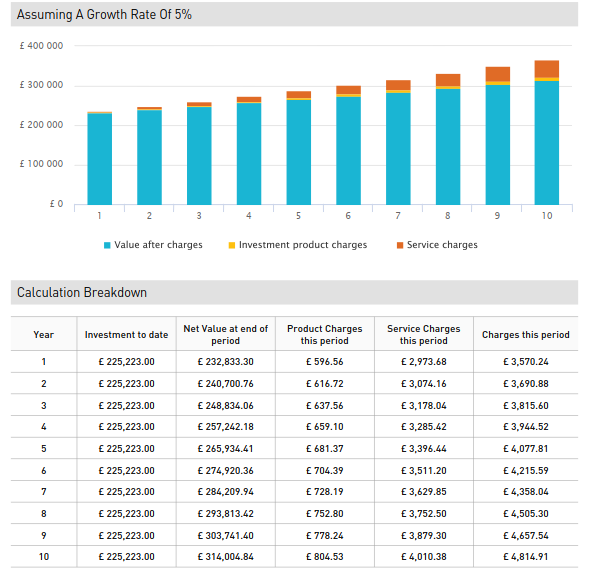
Promotion of simplicity should certainly not be included as that is a choice. A choice that may or may not be the right option for an individual. Options that are not suitable should not be promoted.5. I opened a new SIPP less than 12 months ago. Everything was transparent. The Platform costs me less than 0.1% on a 130k fund. The charges do not increase with the pot. Charges are as advertised. Additional charges for moving money out, also advertised. I am not entirely happy with the selection of ETFs (why can’t I buy US domiciled ETFs?) but its not the providers fault. The ETFs themselves are very transparent, I know exactly whats in them today.It cannot recall where you are but if its within the EU then it will be because many US-domiciled ETFs do not provide charges details that are compliant with the distribution within the EU. Some ETF providers have decided they dont want to do that. It could be that they think there isn't the market vs the cost. It may be that they are not as transparent as you think and the standards required would disclose something they dont want to disclose (TC & IC became embarrassing for some fund houses)
What you have done would be equally transparent in the UK. Whether the charges were fixed cost, percentage or other.
I am an Independent Financial Adviser (IFA). The comments I make are just my opinion and are for discussion purposes only. They are not financial advice and you should not treat them as such. If you feel an area discussed may be relevant to you, then please seek advice from an Independent Financial Adviser local to you.0
![[Deleted User]](https://us-noi.v-cdn.net/6031891/uploads/defaultavatar/nFA7H6UNOO0N5.jpg)












Confirm your email address to Create Threads and Reply

Categories
- All Categories
- 354.3K Banking & Borrowing
- 254.4K Reduce Debt & Boost Income
- 455.4K Spending & Discounts
- 247.3K Work, Benefits & Business
- 604K Mortgages, Homes & Bills
- 178.4K Life & Family
- 261.5K Travel & Transport
- 1.5M Hobbies & Leisure
- 16K Discuss & Feedback
- 37.7K Read-Only Boards