We’d like to remind Forumites to please avoid political debate on the Forum.
This is to keep it a safe and useful space for MoneySaving discussions. Threads that are – or become – political in nature may be removed in line with the Forum’s rules. Thank you for your understanding.
📨 Have you signed up to the Forum's new Email Digest yet? Get a selection of trending threads sent straight to your inbox daily, weekly or monthly!
The Forum now has a brand new text editor, adding a bunch of handy features to use when creating posts. Read more in our how-to guide
Stabilising a desk?

Rony
Posts: 160 Forumite



Hi,
I have bought a new desk, and whilst I love it, it is not the sturdiest. It's not too wobbly, just that I would like to have it sturdier. I'd give it a 6/10 for sturdiness. I have attached two images for your viewing.
So the desk is very stable width wise, but length wise when I move it with my hand, left and right, it does wobble and shake.
Are there any make shift ways I can stabilise my desk so that it is basically a boulder?
Thanks,
I have bought a new desk, and whilst I love it, it is not the sturdiest. It's not too wobbly, just that I would like to have it sturdier. I'd give it a 6/10 for sturdiness. I have attached two images for your viewing.
So the desk is very stable width wise, but length wise when I move it with my hand, left and right, it does wobble and shake.
Are there any make shift ways I can stabilise my desk so that it is basically a boulder?
Thanks,
0
Comments
-
Presuming ll the screws etc re tight, and presuming you'r not worried about it being seen, then a cross brace across the back might work0
-
Put a couple of shelf brackets on it at the back - they won't be particularly visible and are quite cheap - other sizes are available, the bigger you use the sturdier it will be.
https://www.diy.com/departments/white-steel-shelving-bracket-h-100mm-d-75mm/3663602764496_BQ.prd
0 -
@flashg67
Thanks for this. I think cross braces might be to visible for this design. Unless I can get a cross brace that fits right behind the rectangle partition board thing underneath, then it will be hidden.
@Paula_Smith
So do you mean put these brackets against the wall and the underneath of the desktop (not sure I fancy drilling into the wall!)? Or do you mean put those brackets near the back running along the underneath of the desktop and the inside of the side legs (so drill holes only affect the table)?
Thanks
0 -
That looks like nicely solid panels, so any sideways wobble is not likely down to side-panel 'flex'. So that leaves fractional movements in the fittings.
I presume wood dowels were used in the build? If so, dismantle it and redo using plenty of PVA in the dowel holes - both ends...0 -
Unfortunately they aren't wood dowels:
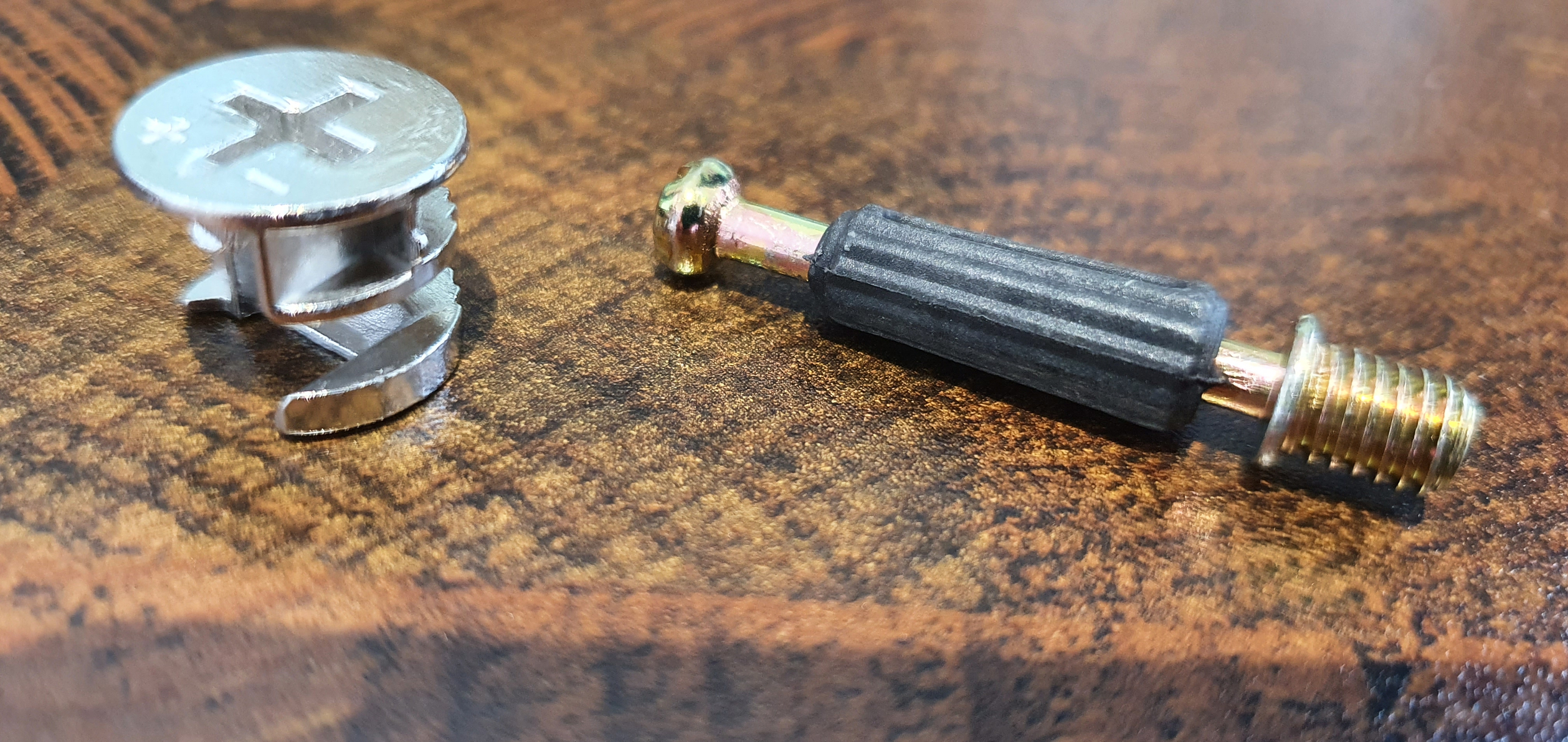 I do get a feeling it's the fractional movements as well. Like that metal silver thing doesn't really hold as well as conventional screws.
1 -
Check if the back board is securely fixed to the sides. You might need to glue it to the sides to get a truly strong connection between them. Also fix shelf angles between the top and sides as has been suggested.0
-
Ok thanks for this,0
-
I meant to put the brackets holding the sides to the top of the desk - at the back so they are hidden by the crossing stiffening section.0
-
Sorry - I didn't look at the instructions where it's clear there are no dowels.Rony said:Unfortunately they aren't wood dowels:I do get a feeling it's the fractional movements as well. Like that metal silver thing doesn't really hold as well as conventional screws.
These 'cam' fittings make sense, but they are only as firm as their precision allows. The cams - as I recall - have a slope so as to pull the 'pins' in tightly as you rotate them, but the slope then levels off so that there is a section where they just hold the pin in what is assumed to be the 'fully-pulled' position. Ie, there comes a point in the rotation where they actually stop pulling and reach a plateau to hold the pin so it doesn't slip. (If the cam simply continue to 'pull' all the way until the pin was tight, then the pin is left on a cam 'slope' where desk movement would just make it start to slip down again.)
You can feel this as you tighten the cams - do they start off 'loose' and then firm up as they start to pull in the pins? What happens then - do they keep getting firmer to turn until you are happy the fittings are tight? Or do they reach a point where they don't keep requiring more effort but 'plateau out?'
So, first thing is to check that these pins are fully screwed in tight and flush with the panels - if they are not, even by a fraction of a mm, the cams might be reaching the end of it's 'slope' (it's max pull) with the pin not fully tightened because it's fractionally too long.
Sometimes the boards bulge up around the pre-drilled holes when the pins are screwed in, and this effectively keeps them a mm too high - check yours. If needed, trim off any raised ridge and then pop a drop of PVA or Polyurethane glue in to the hole before replacing the pin firmly. Allow to set.
As a last resort, give the pin 'shafts' (these main fluted bits) a nice coating of poly glue (eg 'Gorilla Glue') before assembly - this will expand to fill the holes in the cam panels and should secure the fittings regardless of the cam's effectiveness.
Leave overnight to ensure full bonding.0






Confirm your email address to Create Threads and Reply

Categories
- All Categories
- 354.4K Banking & Borrowing
- 254.4K Reduce Debt & Boost Income
- 455.4K Spending & Discounts
- 247.3K Work, Benefits & Business
- 604K Mortgages, Homes & Bills
- 178.4K Life & Family
- 261.5K Travel & Transport
- 1.5M Hobbies & Leisure
- 16K Discuss & Feedback
- 37.7K Read-Only Boards