We’d like to remind Forumites to please avoid political debate on the Forum.
This is to keep it a safe and useful space for MoneySaving discussions. Threads that are – or become – political in nature may be removed in line with the Forum’s rules. Thank you for your understanding.
📨 Have you signed up to the Forum's new Email Digest yet? Get a selection of trending threads sent straight to your inbox daily, weekly or monthly!
The Forum now has a brand new text editor, adding a bunch of handy features to use when creating posts. Read more in our how-to guide
Is this allowed? (UK)
Comments
-
Exactly. My old supermarket contract was only 19 hours, often did anywhere up to 50, I only got paid at normal rate, not an enhanced rate. Only got extra pay if worked a BH.pramsay13 said:I'm not sure why you have a 40 hour working week in your head and think that you should get paid overtime above this.
The working week generally hasn't been 40 hours for many years.
You can work up to 48 hours weekly, and even more if you agree to it.
As long as you get paid for the hours you work, at the agreed rate, there is no issue.0 -
I'm not sure why posters (except chrisbur?) think that what the OP is querying is actually OK for his agency to do?AIUI, the OP is telling us that he is only paid for 40 hours per week, but that he is working more than that. I haven't bothered to work it out like chris bur has done, but it seems quite obvious to me that he is on average working more hours each week than he is on average being paid for (if he is only being paid 40 hours per week).Am I missing something obvious?(I'm not commenting on the overtime question - just that I think the OP ought to at least get paid for the hours they've actually worked).1
-
If anyone takes the time to project that pattern forward then over a 7 week period you get 5 lots of 6 day working and 1 lot of 5 day working. 35 times 8 hours = 280. 280 divided by 7 = 40. Its a 40 hour week.
What you have all missed is that there are two 3 day weekends in there. On the 7th week you get Sat off then you return to week one with Sun and Mon off. The same happens at the end of week six (Fri + Sat) then in week 7 you get Sunday off.
It's perfectly fair and legal.
Mind you, I've worked systems like this and they are a PITA. Having different days off each week is quite hard to get used too. I volunteered to do permanent weekends to get out of this sort of pattern as the stable shift pattern was more valuable to me than weekends off.
DarrenXbigman's guide to a happy life.
Eat properly
Sleep properly
Save some money0 -
This is not what the OP actually said was happening though. They advised "The shifts are 6 days on 2 days off at 8 hours a shift that rotate a day every week. " This suggests that it is a continuous pattern that repeats every 8 weeks rather than a pattern restarted after 7 weeks as you suggest.Xbigman said:If anyone takes the time to project that pattern forward then over a 7 week period you get 5 lots of 6 day working and 1 lot of 5 day working. 35 times 8 hours = 280. 280 divided by 7 = 40. Its a 40 hour week.
What you have all missed is that there are two 3 day weekends in there. On the 7th week you get Sat off then you return to week one with Sun and Mon off. The same happens at the end of week six (Fri + Sat) then in week 7 you get Sunday off.
It's perfectly fair and legal.
Mind you, I've worked systems like this and they are a PITA. Having different days off each week is quite hard to get used too. I volunteered to do permanent weekends to get out of this sort of pattern as the stable shift pattern was more valuable to me than weekends off.
Darren
Perhaps the OP will clarify which is the case.1 -
excuse me, but i didn't miss that. i had stated that the OP needs to average his hours over 17 weeks as that is the guidance on the government website for maximum number of hours working directive and so would be a good guide to follow. then if the answer is more than 40 hours, then come back.Xbigman said:If anyone takes the time to project that pattern forward then over a 7 week period you get 5 lots of 6 day working and 1 lot of 5 day working. 35 times 8 hours = 280. 280 divided by 7 = 40. Its a 40 hour week.
What you have all missed is that there are two 3 day weekends in there. On the 7th week you get Sat off then you return to week one with Sun and Mon off. The same happens at the end of week six (Fri + Sat) then in week 7 you get Sunday off.
It's perfectly fair and legal.
Mind you, I've worked systems like this and they are a PITA. Having different days off each week is quite hard to get used too. I volunteered to do permanent weekends to get out of this sort of pattern as the stable shift pattern was more valuable to me than weekends off.
Darren0 -
Just had a look at this system and cannot quite get my head around it.Xbigman said:If anyone takes the time to project that pattern forward then over a 7 week period you get 5 lots of 6 day working and 1 lot of 5 day working. 35 times 8 hours = 280. 280 divided by 7 = 40. Its a 40 hour week.
What you have all missed is that there are two 3 day weekends in there. On the 7th week you get Sat off then you return to week one with Sun and Mon off. The same happens at the end of week six (Fri + Sat) then in week 7 you get Sunday off.
If you do a 7 week pattern starting with Sun Mon as rest days and then you have 6 working days you get
Wk 2 Mon Tue rest days
Wk 3 Tue Wed rest days
Wk 4 Wed Thur rest days
Wk 5 Thur Fri rest days
Wk 6 Fri Sat rest days
Wk 7 Sat rest day end of 7 week rota.
Sun would be a rest day on an 8 week rota but this stops after 7 days and starts again with a repeat of these 7 weeks.
This pattern gives you 6 periods when 6 days are worked or 36 days all together not 35
You say "The same happens at the end of week six (Fri + Sat) then in week 7 you get Sunday off. " Why do you get Sunday off the pattern is that you get two days off then work 6 days so if you have Fri Sat off at the end of week 6 then you have to work Sun to Fri.1 -
This is the pattern that I have.
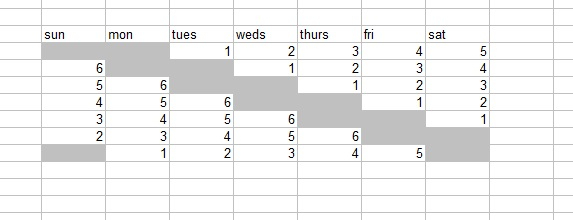
This is how a rotating pattern that advances one day a week works. The OP has assumed it is a linear pattern that would see them work that last Sat as well, but it won't be. Or if it is then its wrong.
The OP needs to put up the full shift pattern they are working to settle this. I suspect their agency may have only given them their shifts for October and a lot of assumptions have been made.
Incidentally, I spent 18 months on a colleague forum looking at shift patterns and this is a simple one.
Darren
Xbigman's guide to a happy life.
Eat properly
Sleep properly
Save some money2 -
We await details from the OP0
-
Xbigman said:This is the pattern that I have.
This is how a rotating pattern that advances one day a week works. The OP has assumed it is a linear pattern that would see them work that last Sat as well, but it won't be. Or if it is then its wrong.
The OP needs to put up the full shift pattern they are working to settle this. I suspect their agency may have only given them their shifts for October and a lot of assumptions have been made.
Incidentally, I spent 18 months on a colleague forum looking at shift patterns and this is a simple one.
DarrenOK - I understand what you are trying to say. Which I think is: that if what the OP is saying is correct, then he is being underpaid UNLESS there is an adjustment made at the end of (in your example) each seven week cycle. But he has not been told of this necessary adjustment, so he is unaware of it.That's fine, so the OP needs to go back to his agency armed with this information and ask when does he get the "additional" day or days off. (Having reviewed all the earlier replies to this post, I must say I'm surprised that the above one I've quoted is the first to give an answer to the OP that explains what he needs to know. Most posters have simply told the OP that they're wrong but with no explanation as to why or what questions he needs to ask his agency. My excuse is I'm not a rota expert!).But going back to the OP's eight day cycle, that cycle repeats after every eighth week, not every seventh week. So if the OP is meant to get an "extra day off" at the end of each cycle, how does that work with an eight day cycle that repeats after every eight weeks? If the OP only gets an extra day off at the end of each eight week repeat, they are still working more hours over the course of a year then they are getting paid. Or at least that's how it looks to me. (That question aimed at Xbigman).If I were the OP, and only knew what the OP has told us, I'd be concerned that I could easily not be getting paid correctly.Or perhaps I'm not seeing the pattern...EDIT: Based solely on what the OP has told us, and ignoring bank holidays and annual leave, they'd be working an additional 14 days over the course of a 52 week year, so they need to be getting back a day every 3.7 weeks.0 -
If the OP has an 8 week pattern then it's easy to repeat week 7 (the conventional mon - fri week). That's the only week you can repeat without throwing the days worked out of sync. It also makes sense as very few jobs require equal manning at weekends.But going back to the OP's eight day cycle, that cycle repeats after every eighth week, not every seventh week. So if the OP is meant to get an "extra day off" at the end of each cycle, how does that work with an eight day cycle that repeats after every eight weeks? If the OP only gets an extra day off at the end of each eight week repeat, they are still working more hours over the course of a year then they are getting paid. Or at least that's how it looks to me. (That question aimed at Xbigman).
Having said that we have no idea what other staff are working. Only the OP can get the answers. Fingers crossed they let us know the answer.
Darren.Xbigman's guide to a happy life.
Eat properly
Sleep properly
Save some money1
![[Deleted User]](https://us-noi.v-cdn.net/6031891/uploads/defaultavatar/nFA7H6UNOO0N5.jpg)



Confirm your email address to Create Threads and Reply

Categories
- All Categories
- 354.4K Banking & Borrowing
- 254.4K Reduce Debt & Boost Income
- 455.4K Spending & Discounts
- 247.3K Work, Benefits & Business
- 604K Mortgages, Homes & Bills
- 178.4K Life & Family
- 261.5K Travel & Transport
- 1.5M Hobbies & Leisure
- 16K Discuss & Feedback
- 37.7K Read-Only Boards