We’d like to remind Forumites to please avoid political debate on the Forum.
This is to keep it a safe and useful space for MoneySaving discussions. Threads that are – or become – political in nature may be removed in line with the Forum’s rules. Thank you for your understanding.
📨 Have you signed up to the Forum's new Email Digest yet? Get a selection of trending threads sent straight to your inbox daily, weekly or monthly!
The Forum now has a brand new text editor, adding a bunch of handy features to use when creating posts. Read more in our how-to guide
Lazy first time investor - 20 K in Vanguard S&P 500 ??
Comments
-
I don’t think he’s done yet. He wants re-elected. Could be wild.0
-
If we agree that these companies will probably do well over the next few years. Do you not think that the current investors , which include some of the top financial brains in the world , will have already worked that out and this future success is already reflected in the current share prices?dhjb said:While I dont know about the whole economy of America, I am betting on the companies included in the sp 500 and mainly MSFT, AAPL, AMZN, GOOGL AND FB which are 20 % of the sp 500 . Would you disagree that those 5 would under perform ? I dont think so .
2 -
The P/E Ratio for the S&P500 has a median of around 14-15. Its minimum was around 5. When the P/E ratio gets above 20, you generally get concerned that we are heading for stagnation or a drop. It isnt the only measure you can use as the P/E ratio can change without any stockmarket movement. However, it is an important consideration. Especially if you are not going to be invested for a whole cycle (which appears to be the case here).Amazon currently has P/E ratio of 115 (it was 83 in January). Ignoring all other factors, that is a scarily high ratio. If you didnt name the stock and were told its PE ratio was that high, you would be unlikely to buy it. If something goes wrong at Amazon, the scale of the fall in share price could be massive.As albermarle says above, the current share price is at this level because the current investors feel it is viable. They may be right. Or they could be in for a shock similar to 20 years ago.Tech has to keep going forward. If it stands still, it goes backwards. The big players today may not exist in the future. Disruptive technology companies in one period can be the victim of other disruptive technology companies in the next. IBM, has a PE ratio of just 12 currently. It was the big thing back in the day. Yahoo was as big as Facebook or Google are today worth priced with a worth of $125. It fell to $5 bn.What goes up high has further to fall.I am an Independent Financial Adviser (IFA). The comments I make are just my opinion and are for discussion purposes only. They are not financial advice and you should not treat them as such. If you feel an area discussed may be relevant to you, then please seek advice from an Independent Financial Adviser local to you.3
-
Come come Dunston you should know that's not strictly true, over the long term, for a share growing in price (and why hold it otherwise) Acc will slightly overperfom Inc as all your money is always invested whereas with income, it isn't.dunstonh said:Two different opinions on accumulation and income .Not really. I just gave my preference. Acc units works out the same as inc units reinvested.
0 -
good arguments , thanks . Maybe you are right , I will have a look at Global All Cap Acc Vanguard ?dunstonh said:The P/E Ratio for the S&P500 has a median of around 14-15. Its minimum was around 5. When the P/E ratio gets above 20, you generally get concerned that we are heading for stagnation or a drop. It isnt the only measure you can use as the P/E ratio can change without any stockmarket movement. However, it is an important consideration. Especially if you are not going to be invested for a whole cycle (which appears to be the case here).Amazon currently has P/E ratio of 115 (it was 83 in January). Ignoring all other factors, that is a scarily high ratio. If you didnt name the stock and were told its PE ratio was that high, you would be unlikely to buy it. If something goes wrong at Amazon, the scale of the fall in share price could be massive.As albermarle says above, the current share price is at this level because the current investors feel it is viable. They may be right. Or they could be in for a shock similar to 20 years ago.Tech has to keep going forward. If it stands still, it goes backwards. The big players today may not exist in the future. Disruptive technology companies in one period can be the victim of other disruptive technology companies in the next. IBM, has a PE ratio of just 12 currently. It was the big thing back in the day. Yahoo was as big as Facebook or Google are today worth priced with a worth of $125. It fell to $5 bn.What goes up high has further to fall.0 -
The share price will move haphazardly from day to day and if the annual total return achieved in 250 business days is something like 6% then one average day's price movement between receiving a dividend and redeploying it at the next dealing point will be a 250th of the 6% or, 0.024%, on the portion of your investment that the annual dividend represents.AnotherJoe said:
Come come Dunston you should know that's not strictly true, over the long term, for a share growing in price (and why hold it otherwise) Acc will slightly overperfom Inc as all your money is always invested whereas with income, it isn't.dunstonh said:Two different opinions on accumulation and income .Not really. I just gave my preference. Acc units works out the same as inc units reinvested.
And as the annual dividend being received and sitting idle for a day before going back in at the next dealing point is perhaps 3% of your overall investment (depending on yield profile, it may be less), we are talking about a drag of 3% of 0.024% which may work out to something like 0.00072% of your portfolio per year. Compounded for 20 years that shortfall is a cost of a seventh of a percent, which is less than a day's average daily fluctuation, after two decades.
So whether it is 'strictly true' that Acc units work out the same as Inc units reinvested - or it's a bare faced lie and it really makes a cumulative difference after doing it for twenty years, of half an afternoon's typical market fluctuation - may be splitting hairs. In practice, you won't get that exact 0.00072% drag on the dividend pay date, but some bigger number, which might be to your favour or your detriment depending on how the market moves that day, but a number that has ups and downs while averaging out to 0.00072% different in a year, is basically 'the same'.
If you're holding income shares or a distributing share class, then as soon as they go ex div you know you have a pending receipt so you can deploy that amount of cash into an investment opportunity, whether it's a re-investment into the same fund or a re-investment into a different fund within your portfolio which is most in need of topping up. The idea that it is grossly inefficient to have the odd bit of cash sitting around in a buffer (with the positive benefit of cash on hand to pay fees or to make more timely rebalances to keep the portfolio in line with its target allocations, and have better visibility of the cash ins and outs for tax tracking if an unwrapped account) is somewhat overblown.
So, I don't think that Dunstonh needs to be overly criticised for his habit ('obsession') of using inc funds in a broad portfolio, because while you note the difference is 'marginal', the margin is so wafer-thin as to be pretty meaningless over the long term.
While accepting of course that you are technically correct, and that technically correct is a good type of correct, I wouldn't be losing any sleep over it, because the income flows are not too troublesome to deal with and they have their uses.1 -
Does this mean that those companies have actually less potential for capital appreciation/share price increase? I mean, if they keep on doing well in the future, that's in line with today's expectation, so nothing really new. So question is, do they have to perform "amazingly well" in the future in order for their share price to keep on rising?Albermarle said:
If we agree that these companies will probably do well over the next few years. Do you not think that the current investors , which include some of the top financial brains in the world , will have already worked that out and this future success is already reflected in the current share prices?dhjb said:While I dont know about the whole economy of America, I am betting on the companies included in the sp 500 and mainly MSFT, AAPL, AMZN, GOOGL AND FB which are 20 % of the sp 500 . Would you disagree that those 5 would under perform ? I dont think so .0 -
AnotherJoe said:
Come come Dunston you should know that's not strictly true, over the long term, for a share growing in price (and why hold it otherwise) Acc will slightly overperfom Inc as all your money is always invested whereas with income, it isn't.dunstonh said:Two different opinions on accumulation and income .Not really. I just gave my preference. Acc units works out the same as inc units reinvested.
The Vanguard S&P tracker acc history is short so I picked another popular multi-asset fund with Acc units and Inc units reinvested.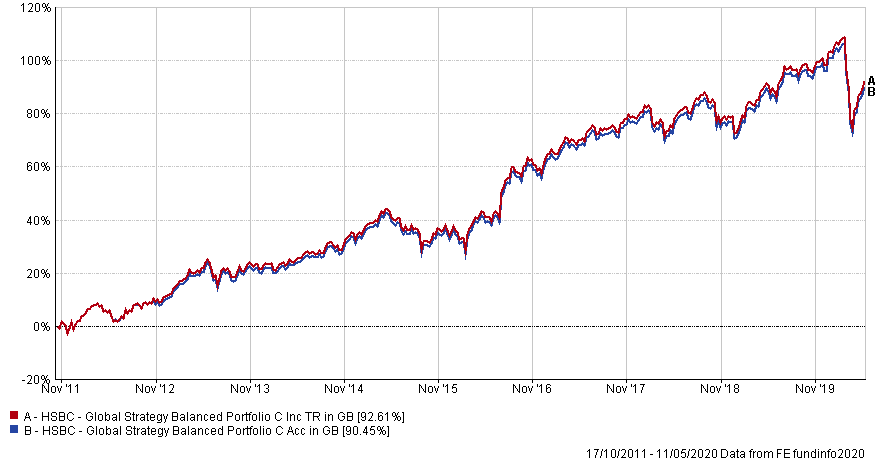 I am an Independent Financial Adviser (IFA). The comments I make are just my opinion and are for discussion purposes only. They are not financial advice and you should not treat them as such. If you feel an area discussed may be relevant to you, then please seek advice from an Independent Financial Adviser local to you.2
 -
To some extent yes . The share prices of companies are largely based on expectations of their future earnings .poto said:
Does this mean that those companies have actually less potential for capital appreciation/share price increase? I mean, if they keep on doing well in the future, that's in line with today's expectation, so nothing really new. So question is, do they have to perform "amazingly well" in the future in order for their share price to keep on rising?Albermarle said:
If we agree that these companies will probably do well over the next few years. Do you not think that the current investors , which include some of the top financial brains in the world , will have already worked that out and this future success is already reflected in the current share prices?dhjb said:While I dont know about the whole economy of America, I am betting on the companies included in the sp 500 and mainly MSFT, AAPL, AMZN, GOOGL AND FB which are 20 % of the sp 500 . Would you disagree that those 5 would under perform ? I dont think so .
If the big players in the market think that they will continue to do well , then this will be priced into the share price already.
On the other side also priced in will be the possibility that something unexpected happens that could affect a companies share price negatively.
1













Confirm your email address to Create Threads and Reply

Categories
- All Categories
- 354.6K Banking & Borrowing
- 254.5K Reduce Debt & Boost Income
- 455.5K Spending & Discounts
- 247.5K Work, Benefits & Business
- 604.3K Mortgages, Homes & Bills
- 178.5K Life & Family
- 261.9K Travel & Transport
- 1.5M Hobbies & Leisure
- 16.1K Discuss & Feedback
- 37.7K Read-Only Boards