We’d like to remind Forumites to please avoid political debate on the Forum.
This is to keep it a safe and useful space for MoneySaving discussions. Threads that are – or become – political in nature may be removed in line with the Forum’s rules. Thank you for your understanding.
📨 Have you signed up to the Forum's new Email Digest yet? Get a selection of trending threads sent straight to your inbox daily, weekly or monthly!
The Forum now has a brand new text editor, adding a bunch of handy features to use when creating posts. Read more in our how-to guide
Short duration bond funds
Comments
-
As you say, like many people she sees bricks and mortar as safer than venturing into the markets in her mid 50s. And in this case her Mum's house was next door so (assuming the tenants don't mind a neighbour landlord) it is easy to manage.I think a lot of people that do not read these forums or know about investments, would think that inheriting a property and renting it out, is less risky than selling it and investing the proceeds in an investment portfolio of equity and bonds. I'm not saying property is less risky, but I'm not surprised that the OP's friend thinks it is less risky. It may be that she knows the property market and is more comfortable being a landlord than managing an investment portfolio.
Here's a risk/return graph, though over-generous on the returns.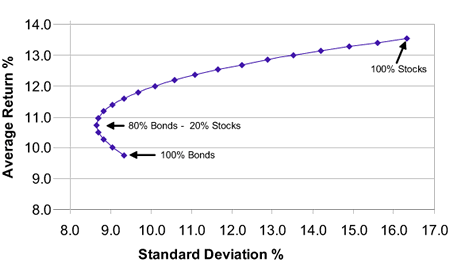 0
0 -
I think a lot of people that do not read these forums or know about investments, would think that inheriting a property and renting it out, is less risky than selling it and investing the proceeds in an investment portfolio of equity and bonds. I'm not saying property is less risky, but I'm not surprised that the OP's friend thinks it is less risky. It may be that she knows the property market and is more comfortable being a landlord than managing an investment portfolio.
Property was a great investment over the past twenty years so it's no surprise people who find it easier to understand the concept of property than equities and bonds pumped for something that also made them a lot of money.
But that's changed now. Property prices in and around the major urban areas are reaching price-to-salary ratio ceilings so the possibility of capital growth is slim, meaning investors need full confidence that the income element ticks over nicely, and there's the double whammy of additional tax implications now and the continued prospect of growing tenant rights. Not to mention additional stamp duty for new buyers.
The wider general public haven't yet acknowledged that property is no longer an easy investment. It takes time for wider opinion to change, but it will over the course of the next decade or so as amateur investors are forced out of the rental sector.0 -
MaxiRobriguez wrote: »A spike in inflation matched by central bank interest rate increases brings down the entire bond market.
The broader issues are more deeply rooted in declining global growth and debt levels. Availability of cheap money appears may have run it's course. There's a flight to bonds currently. With some $16 trillion's worth offering a negative yield. Fed may cut interest rates again in September.0 -
Thrugelmir wrote: »The broader issues are more deeply rooted in declining global growth and debt levels. Availability of cheap money appears may have run it's course. There's a flight to bonds currently. With some $16 trillion's worth offering a negative yield. Fed may cut interest rates again in September.
I suspect there is a limit about how far yields can go negative before investors go "no thanks" and I would suspect we're very close to it.
My take is that profits from investing in bonds requires a lot of things not to change. Limited equity growth, no inflation, trade barriers not going up etc. It's possible but there's too much complacency amongst too many people that bonds are simply "a safe investment class that yields slightly more than a bank account" - and I don't think that accurately assesses many downside risks.0 -
Short duration Government bond funds are most commonly employed because the risk of default is treated as zero, so these are overall lower risk than their longer dated counterparts.aroominyork wrote: »Masonic’s posts #6 and #22 are helpful in explaining the risk of maturing bonds defaulting i) in an economic downturn or ii) when interest rates rise and borrowers cannot afford the re-financing rates on offer. If that is correct, how might a short duration fund perform in those circumstances compared to a medium risk strategic bond fund such as Jupiter?
Looking at credit quality, Jupiter is 55% investment grade and RL is 69% investment grade. Is that materially relevant, for example indicating that RL purposefully selects companies that, as masonic said in post #6, will have relatively little time to limp along before the bond matures?
You're going to find it hard putting figures on it, but there are two aspects at play here when you start introducing credit risk:
- Going from high credit quality to lower credit quality will increase risk of default
- Going from long duration to short duration will reduce the extent to which capital values would fall in a rising interest rate environment.
Combining the two factors above (lower credit quality with shorter duration) will have different effects depending on the extent to which you go down either path. But clearly short duration bond funds are lower yielding than the equivalent long duration bond fund, so a "high yield" short duration bond fund with an equivalent yield to a long duration fund is likely to hold bonds of considerably higher credit risk.
The topic could be a good one for a PhD thesis.0 -
so a "high yield" short duration bond fund with an equivalent yield to a long duration fund is likely to hold bonds of considerably higher credit risk.
Not neccessarily. The higher running yield reflects the capital loss when held to redemption. The bond will be redeemed at nominal par value.
One needs to look inside the tin. Running yield will be far greater than duration yield. Something which is going to catch many out I fear.0 -
I agree you need to look inside the tin as the running yield will be greater than the duration yield. But capital values tend towards par gradually as the bond nears maturity, so if the longer duration fund is maintaining an average duration at a certain level and not holding to maturity, this effect may be diminished.Thrugelmir wrote: »Not neccessarily. The higher running yield reflects the capital loss when held to redemption. The bond will be redeemed at nominal par value.
One needs to look inside the tin. Running yield will be far greater than duration yield. Something which is going to catch many out I fear.0 -
Considered IBTS.L ? An ETF on UST Notes. Average duration 2 years.0
-
But capital values tend towards par gradually as the bond nears maturity,
Capital values will also price in accrued interest on a daily basis. Final redemption date is also the final payment date for the coupon (normally six monthly). In effect you'll be getting the interest you bought paid back to you, i.e. no gain.0 -
Yes, I was mainly considering the effect at the long duration end, but for ultra-short bonds there may be little if any reward, meaning any risk of default would not be adequately compensated.Thrugelmir wrote: »Capital values will also price in accrued interest on a daily basis. Final redemption date is also the final payment date for the coupon (normally six monthly). In effect you'll be getting the interest you bought paid back to you, i.e. no gain.0










Confirm your email address to Create Threads and Reply

Categories
- All Categories
- 354.1K Banking & Borrowing
- 254.3K Reduce Debt & Boost Income
- 455.3K Spending & Discounts
- 247.1K Work, Benefits & Business
- 603.7K Mortgages, Homes & Bills
- 178.3K Life & Family
- 261.2K Travel & Transport
- 1.5M Hobbies & Leisure
- 16.1K Discuss & Feedback
- 37.7K Read-Only Boards