We’d like to remind Forumites to please avoid political debate on the Forum.
This is to keep it a safe and useful space for MoneySaving discussions. Threads that are – or become – political in nature may be removed in line with the Forum’s rules. Thank you for your understanding.
📨 Have you signed up to the Forum's new Email Digest yet? Get a selection of trending threads sent straight to your inbox daily, weekly or monthly!
The Forum now has a brand new text editor, adding a bunch of handy features to use when creating posts. Read more in our how-to guide
Insulating 1 1/2 storey house

ChasingButterflies
Posts: 945 Forumite
Hi,
We are trying to insulate the roof of our house... the upper loft was a doddle however insulating the eaves (side loft) is causing a bit of a headache and I am looking for some advice...
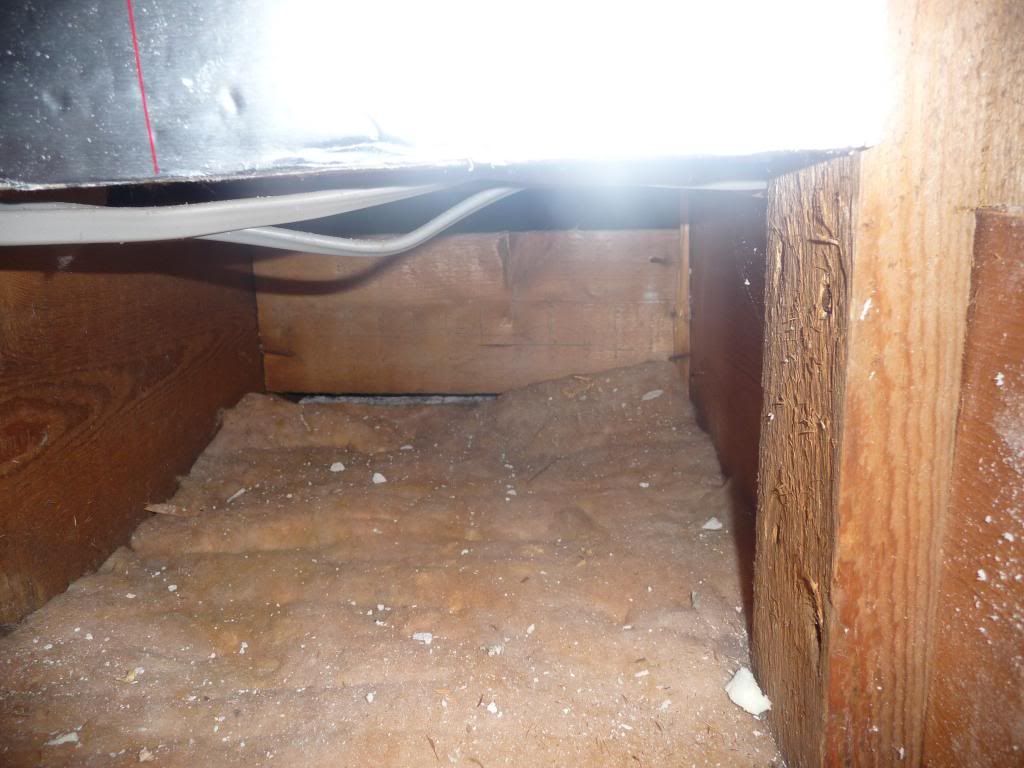
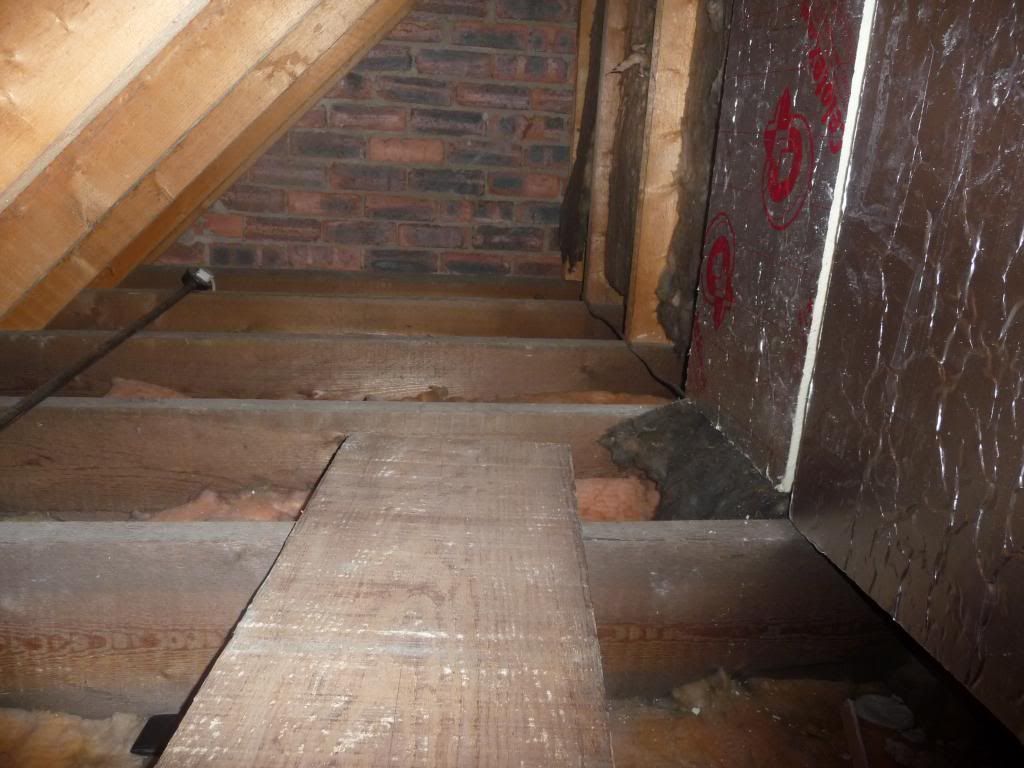
Where the walls of the 1st floor rooms meet the ceiling of the ground floor ceiling there is a gap so that the air from the soffits can circulate... However as the house is very cold I wondered if the area between the ceiling of ground floor/floor of the first floor needed to be ventilated in this way? Ideally I would like to block off this area with more rigid insulation to try and retain the heat within the main body of the building. However I do not want to cause a problem in the future. There is a link to a picture of what I am trying to describe below... I can't seem to attach a picture to the post properly - apologies.
http://i687.photobucket.com/albums/vv232/slate744/loft2013005.jpg
^ Picture of area I would like to block cold air flow to...
http://i687.photobucket.com/albums/vv232/slate744/loft2013004.jpg
^ Picture of section of area to be insulated
Many thanks in advance...
We are trying to insulate the roof of our house... the upper loft was a doddle however insulating the eaves (side loft) is causing a bit of a headache and I am looking for some advice...
Where the walls of the 1st floor rooms meet the ceiling of the ground floor ceiling there is a gap so that the air from the soffits can circulate... However as the house is very cold I wondered if the area between the ceiling of ground floor/floor of the first floor needed to be ventilated in this way? Ideally I would like to block off this area with more rigid insulation to try and retain the heat within the main body of the building. However I do not want to cause a problem in the future. There is a link to a picture of what I am trying to describe below... I can't seem to attach a picture to the post properly - apologies.
http://i687.photobucket.com/albums/vv232/slate744/loft2013005.jpg
^ Picture of area I would like to block cold air flow to...
http://i687.photobucket.com/albums/vv232/slate744/loft2013004.jpg
^ Picture of section of area to be insulated
Many thanks in advance...
0
Comments
-
I'm trying to understand here.... So you are feeling the cold somewhere up through the floor because the cold air is rushing int this side cavity and down the walls?
I have a house where the top floor houses 2 bedrooms which have sloping walls too. The builders placed pir boards down the side slope and the loft insulation goes right up to the edge. If you look down the slope you see these boards.
I'm struggling to figure out what you are trying to achieve unless you have a room in your actual loft?
Don't go overboard filling gaps with insulation. We haven't filled our cavities, they have insulating block. A family member has an identical house with a filled cavity, our bills are the practically the same, in fact I pay less as I use less electric but we have much lower levels of condensation. In fact none, not even in bathrooms. Yet they have water building up on their windows quite easily.
It taught me how important it is to have ventilation and let a house breath. And that the cavity fill really doesn't make a huge difference to your bills.0 -
I'm trying to understand here.... Thank you I know my post wasn't 100% clear
 So you are feeling the cold somewhere up through the floor because the cold air is rushing int this side cavity and down the walls? Yes the rooms are affected by cold coming through from the eaves and loft space into the bedrooms... I was also assuming that the cold air circulating from the loft space under the floor would also make the rooms colder.
I have a house where the top floor houses 2 bedrooms which have sloping walls too. The builders placed pir boards down the side slope I am attaching PIR boards to the walls (loft side) and the loft insulation goes right up to the edge. If you look down the slope you see these boards.
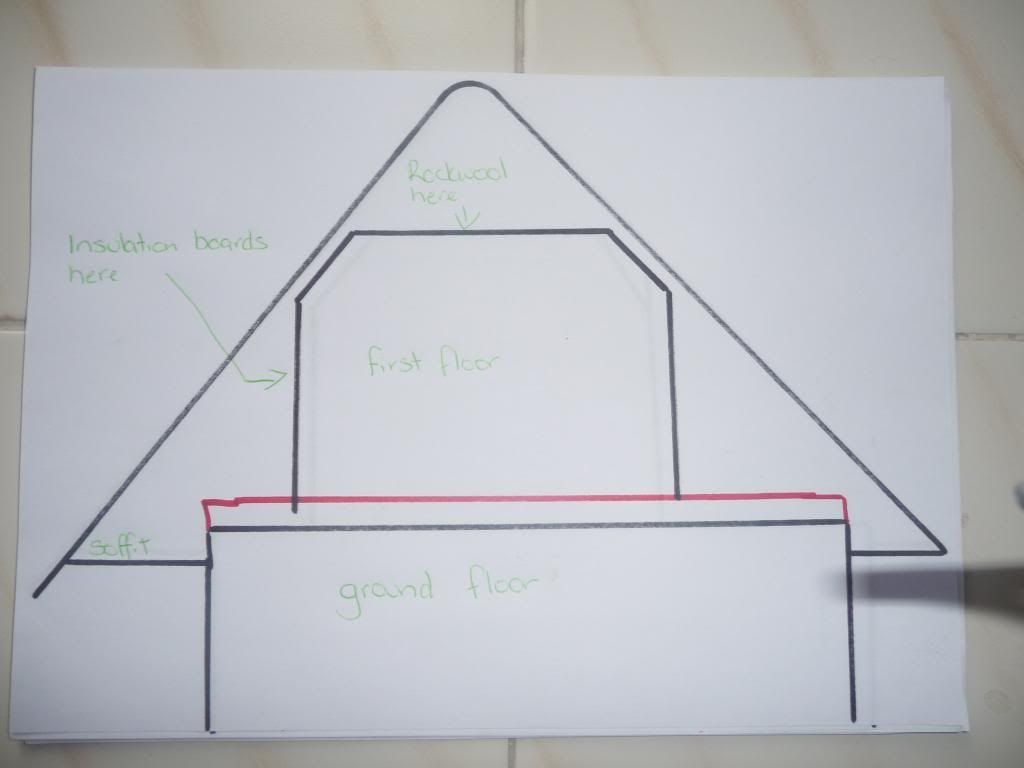
I'm struggling to figure out what you are trying to achieve unless you have a room in your actual loft? I have attached another diagram (hand drawn and not to scale I am afraid!)
http://i687.photobucket.com/albums/vv232/slate744/roofdiagram005.jpg
The area in red are the joists that go between the ground and first floor. Ideally I would like to put the PIR boards along the joists from the external ground floor wall to just under the internal wall. To stop the cold air flow I would need to double up boards. My question is does this area need to be ventilated? I think in a normal 2 storey house it wouldn't be and this is why I wonder if it needs to be here...
Don't go overboard filling gaps with insulation. We haven't filled our cavities, they have insulating block. A family member has an identical house with a filled cavity, our bills are the practically the same, in fact I pay less as I use less electric but we have much lower levels of condensation. In fact none, not even in bathrooms. Yet they have water building up on their windows quite easily.
It taught me how important it is to have ventilation and let a house breath. This is my main concern, I am trying to fix one issue I don't want to create another problem further down the line..And that the cavity fill really doesn't make a huge difference to your bills.
I have been searching for info on the net and I found this discussion here http://www.diynot.com/forums/viewtopic.php?t=20661 which seemed to suggest that as long as air can flow from the soffits up past the rooms in the loft space to the ridge that blocking the flow of air through the ground floor ceiling/first floor, floor is ok? Then again I am not sure I am reading it correctly
Apologies for not being clear I will blame living in a very cold house for giving me brain freeze! Thank you for taking the time to try and understand what I am asking and respond.
0 -
Oh i see now, diagrams clears things up
Underfloor insulation is a big no no on a ground floor in an older house like a 1930's house with wooden floors.
Upstairs it isn't so much of a problem because you don't get damp / water transfer from the ground.
Providing your loft space is ventilated i see no reason why you can't lay insulation under the floor of the upper room (i'm assuming in the red bit).
What you need to keep in mind is you will have electrical cables for lights / spots on the ground floor ceiling. You need to ensure these cables have the correct insulation and dont pack the insulation in there.
If you think you are getting air flow from the loft space going under the floor and rising up, you could just pack the ends with PIR board. Restricting airflow should improve matters and with correct undercarpet insulation and carpet i'm sure you shouldn't feel drafts.
Damp is usually caused by water transfer from the brick to the inner leaf. Keeping the cavity and roof space ventilated essentially the inner skin of the property, this should be sufficient. Insulating the inner core of the house should be ok. You do obviously get moisture inside a property so it would be good to get an additional opinion but i dont think insulating under those boards would be an issue providing the electrical cables aren't going to cause a fire hazard.0 -
Oh i see now, diagrams clears things up I had hoped it might help, pleased it did!
Underfloor insulation is a big no no on a ground floor in an older house like a 1930's house with wooden floors.
Upstairs it isn't so much of a problem because you don't get damp / water transfer from the ground.
Providing your loft space is ventilated i see no reason why you can't lay insulation under the floor of the upper room (i'm assuming in the red bit). Yes it is.
What you need to keep in mind is you will have electrical cables for lights / spots on the ground floor ceiling. You need to ensure these cables have the correct insulation and dont pack the insulation in there. Ok thank you, the other side of the house seems to have a lot more cables running through the loft (although most of them are running over the joists. I will take care in the other areas where they don't. There are only 3 spots in the area that I am insulating atm, I will perhaps leave that area for my husband to sort when he is feeling better
If you think you are getting air flow from the loft space going under the floor and rising up, you could just pack the ends with PIR board. I was going to try this to start with although DS is complaing about noise coming up from DD1 and DD2's rooms... Restricting airflow should improve matters and with correct undercarpet insulation and carpet i'm sure you shouldn't feel drafts. That was what I was hoping, the house is warm as long as the heating is on... as soon as it is off it gets cold very quickly. There are a few reasons for this which we are addressing i.e. steel crittle windows (temporary measure was to put up thermal lined curtains while we obtain planning to change them) Sediment in the radiators (probably a job for the weekend!) There are also holes all over the house which haven't been filled i.e. in the kitchen I think there was an appliance that needed to be vented to the outside wall, when it was removed they simply put a kitchen unit in front of it. It is taking us time to find and fix all these little "features"
Damp is usually caused by water transfer from the brick to the inner leaf. Keeping the cavity and roof space ventilated essentially the inner skin of the property, this should be sufficient. Insulating the inner core of the house should be ok. You do obviously get moisture inside a property so it would be good to get an additional opinion Do you have any idea who to ask? but i dont think insulating under those boards would be an issue providing the electrical cables aren't going to cause a fire hazard.
Thank you again for taking the time to look at my reply and respond.
Although our last house was the same style i.e lots of room in the "loft" it was newer and the owners had installed rockwool everywhere, under the floor etc. it was built in '94. I am fairly sure that the area I want to insulate here was at the last house, but I am doubting myself.
Current house was built in '75 in most places it has rockwool 1" thick going up to 4" where the previous owners converted an unused area of loft into some rooms around '89. All my kids sleep in the area where it is 1" thick. In the middle of the night their rooms are incredibly cold. This winter they have all had lingering colds are never normally ill - hence my paranoia about trying to keep the heat within the habitable space as our winter gas bill was quite scary, especially as nobody felt very warm!0




This discussion has been closed.
Confirm your email address to Create Threads and Reply

Categories
- All Categories
- 353.6K Banking & Borrowing
- 254.2K Reduce Debt & Boost Income
- 455.1K Spending & Discounts
- 246.7K Work, Benefits & Business
- 603.1K Mortgages, Homes & Bills
- 178.1K Life & Family
- 260.7K Travel & Transport
- 1.5M Hobbies & Leisure
- 16K Discuss & Feedback
- 37.7K Read-Only Boards