We’d like to remind Forumites to please avoid political debate on the Forum.
This is to keep it a safe and useful space for MoneySaving discussions. Threads that are – or become – political in nature may be removed in line with the Forum’s rules. Thank you for your understanding.
📨 Have you signed up to the Forum's new Email Digest yet? Get a selection of trending threads sent straight to your inbox daily, weekly or monthly!
Please help!!
Comments
-
If the heater has a thermostat and you hear a substantial mechanical click at the same time as the spark then believe it or not this is normal, especially as the heater ages and attracts dust.
In order to get those lovely £20 price tags, most Electric Heaters are made in Poland and China. To keep manufacturing costs low, high spec Triac switched solid state zero voltage thermostats have been abandoned in favour of cheap bi-metallic types, this is basically a piece of exposed metal with two contacts, when the metal heats as the room gets warmer, it eventually expands to the point where it parts company with its 'mate' breaking the circuit and switching off the heating element, when it cools down, it sinks back downwards and eventually reforms the contact, re-establishing the circuit and the element heats again. Its just an automatic heat senstive switch.
Since the two contacts are switching 230v at around 8 - 9 Amps (2kw heater), it creates a spark, and this is more obvious especially if the heater is getting old and the contacts are becoming pitted from the carbon created by many hundreds of previous 'sparks'.
If your spark is caused by the Thermostat then buying a new heater is probably just going to leave you with exactly the same problem in a few months of use, if its caused by bad wiring or a loose internal connection then it needs replacing.
If the heater is part of the internal furnisings of the property and came with it, then the LL should have it PAT tested or checked as part of their Electrical Safety Inspection.
Unfortunately Electric Heating is extremely expensive, and if the room is as poorly insulated and as large as you described then you will need a fairly substantial heater to produce the heat required to heat it adequately when the building is covered with snow and its freezing outside (ie now)
Guessing what kind and rating of heater you need is ludicrous. Work it out properly using the room size heat calculator and enter in your physical room dimensions. Use the 'KW' one on this site
Putting a single 2kw heater into a room in a badly insulated victorian era building with a cathedral high ceiling would be about as effective as taking an extension lead and trying to heat the back garden with it!. What if the physical room size would routinely need 6kw to heat it? do you really think a piddly little 2kw is going to do the job when / if we get the predicted -10c outside ???????
Still it looks pretty so that ok! they can sit and look at it......with their coats on - Geez do people here REALLY use heaters as ornaments?
Sounds like complete bollox to me, overnight off peak perhaps but I don't know any utility company who will be selling him 24/7 Electricity at 5.6p per unit, we use over 1/4 million KW/H at work, and even we pay over 9p per unit.
If he means that you get 5.6 units for your quid, then even at 17.8p per kw/h then he needs to shop around for a better deal for his tenants as it is possible to still get it for 12p - 13p per kw/h
Personally, my advice is that if you can't afford the bills for this property then once your minimum tenancy period is up, find another property which is better insulated and has gas central heating, its a stark fact that utilities are extremely expensive and the cost of them goes up by at least 20 - 30% every year.
The heater we have now is a 1.5kw and it is effective while it is on, but as soon as it is off the room turns freezing again! There is a massive draft by the window, which probably causes the damp too. So I'm hoping that if I get 2kw one with a thermastat, I can keep it on all night and the room will remain warm.
I think it is more likely that we are getting 5.6 units to the pound. Which I have now found out is quite expensive and I will need to look into it with my landlord!
We are already paying about £150 a quarter to pay the gas bills for the gas heaters in the other rooms! Although this is much cheaper than the electric heating. Is central heating a lot cheaper than this?
Having to move costs a lot of money too with all the fees you have to pay!0 -
electric on average is around 3 times more expensive than gas.
renting can be hard so if you word it good you could get your landlord to lower your meter rate to keep you in the flat, worth a try.0 -
Then this is a clear indication that it is not adequate for the room size and its natural heat loss through the building fabric, doors, windows etc, chances are that the internal thermostat is just sensing the residual heat from inside and around the heater and not at the other end of the room or even several feet away.The heater we have now is a 1.5kw and it is effective while it is on, but as soon as it is off the room turns freezing again!
If the room goes uncomfortably cold as soon as the heater turns off, then the room is clearly losing about the same amount of heat as you were inputting when the heater was heating.
1.5kw of loss requires 1.5kw of heat input just to maintain the current room temperature. Remove that 1.5kw worth of input and the room will still be losing 1.5kw of heat, meaning the room temperature rapidly drops close to or equal to that outside the building"Dont expect anybody else to support you, maybe you have a trust fund, maybe you have a wealthy spouse, but you never know when each one, might run out" - Mary Schmich0 -
Then this is a clear indication that it is not adequate for the room size and its natural heat loss, chances are the internal thermostat is just sensing the residual heat from inside and around the heater and not at the other end of the room or even several feet away.
If the room goes uncomfortably cold as soon as the heater turns off, then the room is clearly loosing about the same amount of heat as you were inputting when the heater was heating.
no, a room's heat retention has no bearing on the heater used, the OP could have the best heater in the world but if the walls are made out of paper the heat loss will be greater than a well insulated room.
If as the OP has said the heater heats up the room when on then it's a good heater, a heater when turned off does not heat (well a oil heater will be cooling down but you have paid for it to heat up in the first place so no benefit there) so why does that make the heater bad?0 -
Nothing to do with what is a 'good' heater - 1,5kw is 1.5kw whether it comes from a modern oil filled radiator or my Gran's 1950's bar fire, its whether its adequate for the room size and enough to build up a residual heat level. What is the point of having a heater with a thermostat if it has to run continuously.and immediately goes freezing cold when it does turn off?, they may as well just get a heater without a thermostat and burn 1.5 kw/h constantly.If as the OP has said the heater heats up the room when on then it's a good heater
When you visit a house, any house with gas central heating, care to note that an average sized living area will probably have two radiators or at least one large 6ft - 8ft double, this equals about 4kw - 5kw worth of total available heat output. They (heating engineers) generally specify that amount of heat in order to slowly heat the building fabric as well as replace the natural heat loss from the room, if the building fabric is heated then it retains the heat better, if it doesn't heat and remains cold, what you effectively have is a brick fridge!.
How exactly do you think that a single 1.5kw heater can magically do the same job as 4 - 5kw of heat from radiators fed from a modern combi boiler, in the equiv modern property fitted with gas central heating? bear in mind that in the case of the OP we are taking about a property which was built over 100 years ago and has a high ceiling and poor insulation at that.
Surely if a modern, ultra insulated property routinely requries 4kw+ output in its living area, then an older building will require more?
Or perhaps those engineers over the years have got it all wrong, and they should only be fitting a 1.2kw bathroom style radiator into the living rooms of new properties, as clearly 1.5kw is adequate to heat a very old, draughty one? so to follow your theory, less output should be needed for the modern insulation levels of today?, and we could all be saving a fortune.
If the room is losing 1.5kw+ worth of heat and immediately goes cold when the heat source switches off, then there is not the capacity available to actually heat the fabric of the building
Or maybe you also think that Gas Central Heating runs continuously and never switches off?
Like I said before, don't take my word for it, use as many of the hundreds of room size heat calculators available on the internet, enter the OP's room dimensions taking into consideration the high ceiling and the low level of insulation and see what it / they output. I would be surprised if it was only 1.5kw. I've just done my relatively small living room, and it came back at 2.8kw.
No smoke and mirrors, no pack drill......."Dont expect anybody else to support you, maybe you have a trust fund, maybe you have a wealthy spouse, but you never know when each one, might run out" - Mary Schmich0 -
Hot water bottle, electric blanket and lots of warm clothes. Buy thicker curtains, make draught excluders and line any existing curtains you're not replacing.0
-
Hot water bottle, electric blanket and lots of warm clothes. Buy thicker curtains, make draught excluders and line any existing curtains you're not replacing.
We have no curtain pole in our bedrooms, it's blinds only. We can't afford to buy them either. We do have an electric blanket, which is good but not good for getting ready in the morning 0
0 -
-
Nothing to do with what is a 'good' heater - 1,5kw is 1.5kw whether it comes from a modern oil filled radiator or my Gran's 1950's bar fire, its whether its adequate for the room size. What is the point of having a heater with a thermostat if it has to run continuously.and immediately goes freezing cold when it does turn off?.
When you visit a house with gas central heating, care to note that an average sized living area will have two radiators or at least one large 6ft - 8ft double, this equals about 4kw - 5kw worth of heat output. They generally specify that amount of heat in order to heat the building fabric as well as replace the heat loss from the room.
How exactly do you think a single 1.5kw heater can magically do the same job as 4 - 5kw of heat from radiators in the equiv modern property with gas central heating? and in a property which was built over 100 years ago and has a high ceiling and poor insulation at that.
Or perhaps those engineers have got it wrong, and they should only be fitting a 2kw bathroom style radiator into new properties, as clearly 1.5kw is adequate to heat a very old, draughty one?
If the room is losing 1.5kw+ worth of heat and imemdiately goes cold when the heat source switches off, then there is not the capacity to actually heat the fabric of the building
Or maybe you think that Gas Central Heating runs continuously and never switches off?
you're confusing yourself, once a heater is off it play no part in how the heat in the room is lost, if the heater is doing it's job by heating the room to the level wanted then it's a good heater.
If once the heater is turned off, and the room goes cold fast, that is to do with the insulation of the room not that the heater didn't heat the room well enough, or are you suggesting the heater needs to heat the room twice as much so when it turns off the room stays warmer for longer? that would be daft and expenses.
The problem you are describing is one of insulation not heating.0 -
Hi,
this'll give you an idea how your meter works, you'rs might be different, but same principle.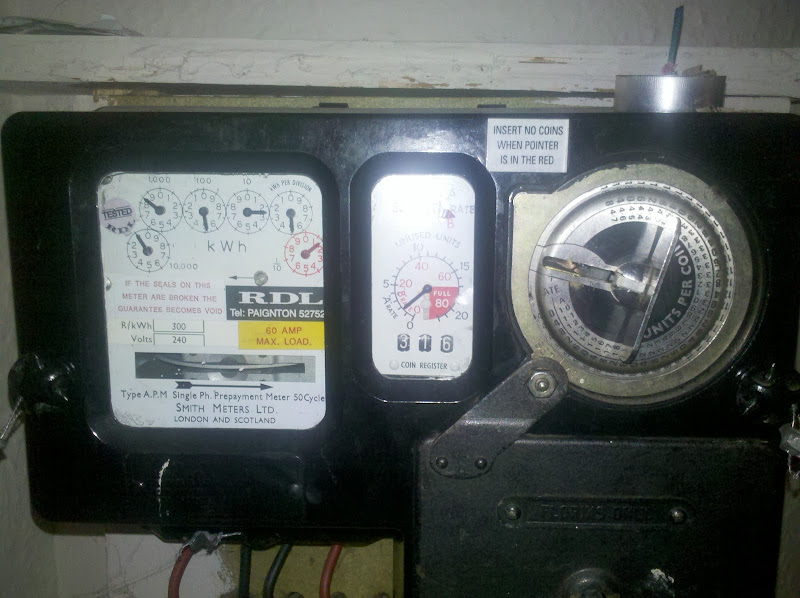

[FONT=Times New Roman, serif]
If you look at the small rectangular window in the middle, the three numbers at the bottom count the coins inserted, so should advance 1 with each coin inserted.[/FONT]
[FONT=Times New Roman, serif]The little pointer at the top indicates whether you are on A or B rate, this one is on B rate.[/FONT]
[FONT=Times New Roman, serif]On the second picture, where it says 'set at', it is set at 5.6 units per per coin on the B rate, so nearly 18p per unit.[/FONT]
[FONT=Times New Roman, serif]The pointer on the little dial should move with each coin inserted.[/FONT]0







This discussion has been closed.
Confirm your email address to Create Threads and Reply

Categories
- All Categories
- 355.6K Banking & Borrowing
- 254.8K Reduce Debt & Boost Income
- 456.1K Spending & Discounts
- 248.2K Work, Benefits & Business
- 605.7K Mortgages, Homes & Bills
- 179K Life & Family
- 263.5K Travel & Transport
- 1.5M Hobbies & Leisure
- 16.1K Discuss & Feedback
- 37.7K Read-Only Boards