We’d like to remind Forumites to please avoid political debate on the Forum.
This is to keep it a safe and useful space for MoneySaving discussions. Threads that are – or become – political in nature may be removed in line with the Forum’s rules. Thank you for your understanding.
Debate House Prices
In order to help keep the Forum a useful, safe and friendly place for our users, discussions around non MoneySaving matters are no longer permitted. This includes wider debates about general house prices, the economy and politics. As a result, we have taken the decision to keep this board permanently closed, but it remains viewable for users who may find some useful information in it. Thank you for your understanding.
📨 Have you signed up to the Forum's new Email Digest yet? Get a selection of trending threads sent straight to your inbox daily, weekly or monthly!
The Forum now has a brand new text editor, adding a bunch of handy features to use when creating posts. Read more in our how-to guide
Looks like the bank losses are stopping Goldman Sachs post $1.8bn 1st 1/4 profit.
Comments
-
Some basic maths about goldmansachs –
TARP bailout 10billion
Indirect funding via AIG bailout 13billion
Dec 08 loss (the missing month) 1 billion.
Profit jan feb march 09 1.8 billion
So net loss greater than 22.2 billion. Thats excluding preferential shares (costly arrangement) made to buffet etc. So any ‘profit’ is just playing with words and accounting.
http://en.wikipedia.org/wiki/Goldman_SachsOn December 4, 1928, it launched the Goldman Sachs Trading Corp. a closed-end fund with characteristics similar to that of a Ponzi scheme. The fund failed as a result of the Stock Market Crash of 1929, hurting the firm's reputation for several years afterward.[3] For this case and others like Blue Ridge Corporation [7] and Shenandoah Corporation [8] John Kenneth Galbraith wrote: The Autumn of 1929 was, pheraps, the first occasion when men succeeded on a large scale in swindling themselves.
Plus see what you can decipher of what i gathered from a few blogs.
What do you decipher from the Hedge Fund Market Neutral Index bottoming again.
Probably someone like generali, purch, STT etc can make more sense of this one and explain if possible in plain English so that the layperson like me can hopefully understand if stocks are in for a beating again.
http://3.bp.blogspot.com/_FM71j6-VkNE/Sd9NNJtdyXI/AAAAAAAABzA/xMYFjmuxE1s/s1600-h/HFRXEMN.jpg
and also this chart http://www.google.com/finance?q=NASDAQ:HSKAX
http://3.bp.blogspot.com/_FM71j6-VkNE/Sd-OEAHNw_I/AAAAAAAABzo/Gylk4oO0ZQ0/s1600-h/nyse2.jpg
i have absolutely no idea what that chart means. but it looks like it bottomed in early 8/07 and mid January 08, which is right before we started massive plunges. so if we are bottoming does that mean we are about to start another big plunge?
Goldman's program trading principal to agency+customer facilitation ratio is a staggering 5x, which is multiples higher than both the second most active program trader and the average ratio of the NYSE, both at or below 1x. The implication is that Goldman Sachs, due to its preeminent position trades much more often for its own (principal) benefit, likely in tandem with the other top dogs on the list: RenTec, Highbridge (JP Morgan), and GETCO. In this light, the program trading spike over the past week could be perceived as much more sinister. For conspiracy lovers, long searching for any circumstantial evidence to catch the mysterious "plunge protection team" in action, you should look no further than this.
http://zerohedge.blogspot.com/2009/04/incredibly-shrinking-market-liquidity.html
ps: anyone criticising or putting GS in bad light might get sued! they are busy suing a blog now instead of using the money to payback the taxpayers.bubblesmoney :hello:0 -
I've not come across HFRXEMN before - it seems to be some sort of hedge fund index (it's described as the hedge fund equity market neutral index). That it's fallen to a new low could be explained in many ways but fundamentally comes down to portfolio managers making bad decisions. If you want me to take a guess as to why I'd say it's because lots of hedge funds will have taken net short positions in equities and equity prices are rising meaning losses for shorters.
HSKAX is a listed share from a hedge fund. Most hedge funds list their funds on a stock exchange, despite them not being tradable as it gives investors more confidence. That graph shows the Net Asset Value (NAV) per share for that particular fund - the NAV is the total value of the assets a fund owns (for example, NAV = value of share holdings + value of derrivative holdings + cash in the bank - value of short positions).
Program trading is a sort of automated trading. Usually it involves buying and selling lots of stocks/bonds/derrivatives simultaneously for various reasons. Most often the reason is arbitrage (that is taking advantage of pricing anomilies to make a profit). Goldman Sachs are very good at program trading as they have some excellent trading tools to assist it and will put together special indices (like the FTSE 100 but tailored to your own needs) for you if you ask them to and you do enough business with them. As a result GS get a lot of business in that area.
My guess (and again it's only a guess) is that the reason why progran trading is at a high is because people are redeeming hedge fund investments (hedge funds are dead as an investment area pretty much as they are a con and have been revealed to be a con). The hedge funds are placing program trades to sell off large blocks of stock. One of the things banks will do for big customers is buy stock off them at a guaranteed price (eg today's closing price) and then place the stock into the market over a period of time. For a hedge fund meeting a redemption this is a very valuable product for them to use.
I have no idea if the 'plunge protection team' acts to prop up asset prices. According to at least one person, Oswald shot JFK because Oswald was addicted to refined sugar.0 -
I'd say it's because lots of hedge funds will have taken net short positions in equities and equity prices are rising meaning losses for shorters.
I would agree with that. The Chart appears to show just how wrong or right the positions run by the Hedge Funds it measures are at any given point.
Program Trading is high mainly due to the day to day volatility which makes the arbitraging the Progams are designed to spot more likely.According to at least one person, Oswald shot JFK because Oswald was addicted to refined sugar
Yeah..........but apart from you, who else thinks so 'In nature, there are neither rewards nor punishments - there are Consequences.'0
 -
Mr Blankfein, the chairman and chief executive of Goldman Sachs, is eager for his institution to become the first big bank to shake off the stifling embrace of the US government. Mr Geithner, the US Treasury secretary, must decide whether to let him.
But Mr Geithner should take his time. Not only is the future of Goldman and other taxpayer-backed banks unclear, given the unstable US economy, but Goldman wants to escape the burdens of political control while retaining the benefits of public backing. That does not seem like a good deal for the taxpayer.
The bigger danger is the long-term precedent it would set. Goldman wants to bolt before Congress or Mr Geithner, who still operates as a one-man band while the nomination process for his senior staff meanders along, has the chance to change fundamentally how it operates.
So far, it has faced mildly irritating limits on how much it can pay staff but nothing on the scale of the 1933 Glass-Steagall Act, which imposed structural reforms on Wall Street after the excesses of the Jazz Age. It would never acknowledge it, but its political campaign is going just fine.
This week’s results illustrated this. Goldman has reduced its leverage ratio sharply – its assets are now only 14 times capital, compared with 26 times at the end of 2007. Yet its fixed income and currencies trading desks have exploited the wide spreads caused by market disarray to make more money than ever.
Goldman has plenty of capital and a cash pile of $164bn, which it keeps stuck in short-term Treasury bonds in case of future turmoil. Not only does it show no sign of being in danger any more, but it has abundant resources to exploit the weakness of others by buying distressed debt and discounted private equity stakes.
Extracts - More here:
http://www.ft.com/cms/s/0/e0219664-29ea-11de-9d01-00144feabdc0.html
Was/is there an important lesson about being "too big to be allowed to fail" - and therefore "must be given taxpayer support" - and are GS perhaps the first onto the battlefield to decide such questions? We live in interesting times - and boring it ain't!If many little people, in many little places, do many little things,
they can change the face of the world.
- African proverb -0 -
I would agree with that. The Chart appears to show just how wrong or right the positions run by the Hedge Funds it measures are at any given point.
I guess that a 'market neutral' equity fund buys a big put option on the market (the right to sell the FTSE100 at a set price) and then goes long or short various stocks hoping to make money from those stocks relative movements against the index - done right, relative performance will make you money regardless of absolute changes in value.Program Trading is high mainly due to the day to day volatility which makes the arbitraging the Progams are designed to spot more likely.
Interesting. I heard the quants (funds that use complex computer programs to decide their trades) were losing a packet. Maybe all their profits are being eaten by commission.Yeah..........but apart from you, who else thinks so
The editor of an Organic Food magazine according to Wikipedia! I suspect that might be more factoid than fact.
PS You guys should check this out:
http://technology.todaysbigthing.com/2009/04/14
It's very rude and not in the least bit work friendly at all but it is very funny.We didn't start the flame war,
People were hating on it before I left my comment,
We didn't start the flame war,
Let the big wide world know I'm a big old rshole.0 -
bubblesmoney wrote: »Some basic maths about goldmansachs –
TARP bailout 10billion
Indirect funding via AIG bailout 13billion
Dec 08 loss (the missing month) 1 billion.
Profit jan feb march 09 1.8 billion
So net loss greater than 22.2 billion. Thats excluding preferential shares (costly arrangement) made to buffet etc. So any ‘profit’ is just playing with words and accounting.
Thats very basic and actually WRONG.
Firstly, if you even read a bit of the news you will see that Goldman did not need the TARP funds, they were thrust on them by the US government. There certainly weren't enough writedowns to require $10bn of additional capital.
December 08 was reported in 08/09 accounts as they have moved their financial year to be in line with other banks.
Where do you get the funding details from for the AIG bailout and what were they directly for?0 -
We are in the dip.
See: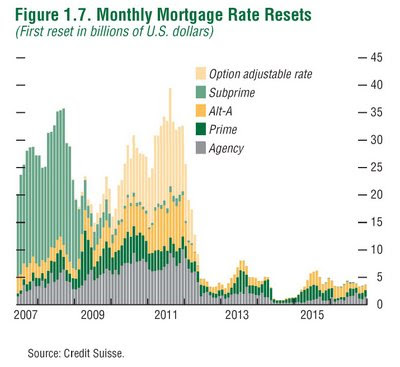
It isnt going to be pretty once those option ARM resets start to hit home, which, apparently could be a bigger problem than sub-prime.
Oh, Alt-A is going to be a little problem for them too. :eek::eek::eek:
Haven't heard anything from Mr Mortgage lately. Is he still around?0 -
We are in the dip.
See:
It isnt going to be pretty once those option ARM resets start to hit home, which, apparently could be a bigger problem than sub-prime.
Oh, Alt-A is going to be a little problem for them too. :eek::eek::eek:
Alt-A resets shouldn't be a huge problem right now as interest rates are so low.0 -
i rounded off the 12.9 billion to 13billion routed via AIG to GS. i had prev posted a visual to this. in the visual if you add up the amounts going to GS via the AIG bailout you will get 12.9 billion.Thats very basic and actually WRONG.
Firstly, if you even read a bit of the news you will see that Goldman did not need the TARP funds, they were thrust on them by the US government. There certainly weren't enough writedowns to require $10bn of additional capital.
December 08 was reported in 08/09 accounts as they have moved their financial year to be in line with other banks.
Where do you get the funding details from for the AIG bailout and what were they directly for?
also GS did apply for the TARP funds although the date is not known. and it wasnt a small amount it was 29% of their market capitalisation. in this link which is interactive please click on the letter G then click on GS on the left hand side or click on the red dot coinciding with 10billion and a small pop up chart will show that 10 billion bailout already paid out to GS amounted to 29% of their market capitalisation which was the 8th highest bailout from TARP funds.
also the following from wiki corroborates that figure of 12.9 billion in GS bailout and also the 10 billion TARP bailout on 28oct 2008.
http://en.wikipedia.org/wiki/Goldman_Sachs_Group_Inc.Involvement with the bailout of AIG
American International Group was bailed out by the US government in September 2008 after suffering a crisis in liquidity, whereby the Federal Reserve lent USD 85B (initially) to AIG to allow the firm to meet its collateral and cash obligations.
In the ensuing months, Goldman Sachs was the largest recipient of this money, channeled through counterparty contracts and collateral calls (USD 12.9B), followed by Soci!t! G!n!rale and Deutsche Bank (USD ~12B each), Barclays (USD 8.5B), Merrill Lynch (USD 6.8B), and other major US and international financial institutions.[41]
Due to the size and nature of the payout, there has been considerable controversy as to whether Goldman Sachs may have benefited materially from the bailout and if it may have been overpaid.[42] Furthermore, the New York State Attorney General Andrew Cuomo announced in March 2009 that he was investigating whether AIG's trading counterparties improperly received government money.[43] However, Goldman Sachs maintains that its exposure to AIG was "immaterial", and was covered by hedges (in the form of credit default swaps with other counterparties) and USD 7.5B of collateral.[44] The firm states that the cost of these hedges was over USD 100M.[45] However, because AIG was bailed out and not allowed to fail, these hedges did not pay out.
The relationship with, and bailout of AIG was controversial because the bailout was crafted by then-US Treasury Secretary Henry Paulson, ex-CEO of Goldman Sachs until 2006; people saw the potential for a conflict of interest between his past and present roles.
2008 Berkshire Hathaway Investment in Goldman Sachs
Goldman Sachs got help from Berkshire Hathaway, which bought $5 billion in Goldman's preferred stock, and got also warrants to buy another $5 billion in Goldman's common stock. [11] Goldman also received $10 billion of capital from the U.S. government in October 2008, under the Troubled Asset Relief Program.
.......bubblesmoney :hello:0 -
Alt-A Mortgages Next Risk for Housing Market as Defaults Surge
when these subprime masked as alt A reset now they will get higher rates not the low rates available to prime borrowers.Almost 16 percent of securitized Alt-A loans issued since January 2006 are at least 60 days late, data compiled by Bloomberg show. Defaults will accelerate next year and continue through 2011 as these loans hit their three- and five-year reset periods, according to RealtyTrac Inc., an Irvine, California-based foreclosure data provider
.............
About 3 million U.S. borrowers have Alt-A mortgages totaling $1 trillion, compared with $855 billion of subprime loans outstanding, according to Inside Mortgage Finance, a trade publication in Bethesda, Maryland. Of the Alt-A borrowers, 70 percent may have exaggerated their income, said David Olson, president of mortgage research firm Wholesale Access in Columbia, Maryland.
........
While subprime home loans describe a type of borrower --those with bad or limited credit histories -- Alt-A, or Alternative A- paper, are shorthand for a type of loan developed in the mid- 1980s.
`No Doc' Push
Many Alt-A loans go to borrowers with credit scores higher than subprime and lower than prime, and carried lower interest rates than subprime mortgages.
So-called no-doc or stated-income loans, for which borrowers didn't have to furnish pay stubs or tax returns to document their earnings, ..................................
``To grow, the market had to embrace more borrowers, and the obvious way to do that was to move down the credit scale,'' said Guy Cecala, publisher of Inside Mortgage Finance. ``Once the door was opened, it was abused.''
Exaggerated Income
By 2005, the credit score required for an Alt-A loan fell as low as 620, traditionally the definition of a subprime borrower
there are high defaults rates even for those whose mortgages have been crammed down or altered according to other websites
...............
About one-third of Alt-A loans are payment-option adjustable- rate mortgages, said Donlin of Loan Safe Solutions.
Option ARMs
A borrower with an option ARM can pay as low as 1 percent interest by deferring some of the money owned until the loan balance reaches a predetermined limit, usually 110 percent to 120 percent of the original mortgage amount. Then payments immediately rise. They also automatically shoot up after a set time period of up to five years.
The loans accounted for 8.9 percent of the almost $3 trillion in U.S. home loans made in 2006, according to an estimate by Inside Mortgage Finance.bubblesmoney :hello:0







This discussion has been closed.
Confirm your email address to Create Threads and Reply

Categories
- All Categories
- 354.6K Banking & Borrowing
- 254.5K Reduce Debt & Boost Income
- 455.5K Spending & Discounts
- 247.5K Work, Benefits & Business
- 604.4K Mortgages, Homes & Bills
- 178.6K Life & Family
- 262K Travel & Transport
- 1.5M Hobbies & Leisure
- 16.1K Discuss & Feedback
- 37.7K Read-Only Boards