Ready, steady… save!
You don’t need a chart to join in. Here are 2 ways to record your savings:
1. Cross it off
Pop a chart into your first post. Saved an amount? Cross it out! Read more »
£0.01 £0.02 £0.03
2. Write it down
Skip the chart and add updates to your first post. Read more »
“Another +£3 saved today. Go me!”
Use +£ before each new saving so it counts towards your total.
We’d like to remind Forumites to please avoid political debate on the Forum.
This is to keep it a safe and useful space for MoneySaving discussions. Threads that are – or become – political in nature may be removed in line with the Forum’s rules. Thank you for your understanding.
Buying a house with a crack in the wall, serious? (Picture)
Comments
-
Any more pictures of other aspects of the house? Is it detached, or is another one joined at the other end? Extreme bottom right - is that concrete drive, or....
Oh, to add to my post #11, there's also water penetration behind the gutter that's damaged the fascia/soffit and the mortar up there - and quite possibly damaged the main wall as well. It's not just a "clean the gutter" job up there!
You asked " Would I buy?" No, probably not, unless the price was quite exceptional, or the view stunning. It'd have to have some strong redeeming feature to be worth the hassle.
It's a detached 3 bedroom period property and the price was exceptional so if things check out it will be a great investment.0 -
That's bad. Real bad. Others have said to get a SE report but to be honest I wouldn't bother unless the house is cheap (as in auction cheap). Poor repairs in the past means you'll have to do the job properly and IMHO isn't worth the risk in case you discover further issues.
Walk away. No, I mean run away. And fast!
It was auction cheap, similar houses on the same street are valued at around 400K, and this property was on for 240K but I got it for 160K.0 -
-
Paypeanuts wrote: »There's your clue, then!
Yep looks like everyone else was scared of the crack too!
Get a structural engineer and work out if any work needed would cost up to the full value, don't forgot the full value will be lower than similar properties nearby.0 -
It's a bit of a gamble, as it sounds like you aren't that confident of your DIY diagnostic skills but, at that price, the odds are stacked in your favour. With those numbers your "would I buy?" changes to a yes, but only if I were ten years younger and two stone less unfit. Best of luck with it.0
-
It would turn me away from buying in i'm afraid, looks a big expensive job to me...0
-
other fish in the sea"enough is a feast"...old Buddist proverb0
-
Deleted_User wrote: »It would turn me away from buying in i'm afraid, looks a big expensive job to me...
Not all cracks are serious, many vertical stepped ones can result from settling and are just a cosmetic thing. So we thought we'd try our luck as if it is not serious its a great buy.0 -
It's not a crack. It's a cable. If you look closely you can see cable clips.
A crack doesn't behave that way. Cracks always take the path of least resistance, which is typically through the mortar bed. There are many cases where cracks can go through bricks, but typically through the centre of a brick. If you look at the brick that is 'cracked' on the very top course in the picture as well as the brick on the 5th course from the top, the 'crack' is only a half inch or so from the end of the brick. There is no way a brick would crack so close to the mortar. It would simply pull away from the mortar.
Also look at the bottom of the 'crack'. It suddenly stops about 3 courses above the grass. This is where the cable disappears in the house.
Additionally, if it was subsidence, the crack would typically be wider at the top than the bottom. This 'crack' is exactly the same width from top to bottom.Eat vegetables and fear no creditors, rather than eat duck and hide.0 -
It's not a crack. It's a cable. If you look closely you can see cable clips.
A crack doesn't behave that way. Cracks always take the path of least resistance, which is typically through the mortar bed. There are many cases where cracks can go through bricks, but typically through the centre of a brick. If you look at the brick that is 'cracked' on the very top course in the picture as well as the brick on the 5th course from the top, the 'crack' is only a half inch or so from the end of the brick. There is no way a brick would crack so close to the mortar. It would simply pull away from the mortar.
Also look at the bottom of the 'crack'. It suddenly stops about 3 courses above the grass. This is where the cable disappears in the house.
Additionally, if it was subsidence, the crack would typically be wider at the top than the bottom. This 'crack' is exactly the same width from top to bottom.
Are you referring to the bit of cable on the far upper left?
I've zoomed in on the original pic and it seems to move away from where the crack has been filled in...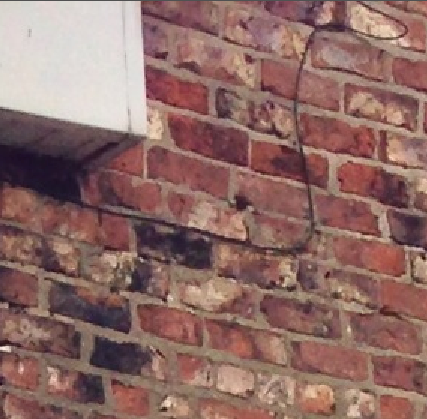 0






This discussion has been closed.
Categories
- All Categories
- 356K Banking & Borrowing
- 255K Reduce Debt & Boost Income
- 456.3K Spending & Discounts
- 248.5K Work, Benefits & Business
- 606.3K Mortgages, Homes & Bills
- 179.1K Life & Family
- 264.1K Travel & Transport
- 1.6M Hobbies & Leisure
- 16.2K Discuss & Feedback
- 37.7K Read-Only Boards