Ready, steady… save!
You don’t need a chart to join in. Here are 2 ways to record your savings:
1. Cross it off
Pop a chart into your first post. Saved an amount? Cross it out! Read more »
£0.01 £0.02 £0.03
2. Write it down
Skip the chart and add updates to your first post. Read more »
“Another +£3 saved today. Go me!”
Use +£ before each new saving so it counts towards your total.
We’d like to remind Forumites to please avoid political debate on the Forum.
This is to keep it a safe and useful space for MoneySaving discussions. Threads that are – or become – political in nature may be removed in line with the Forum’s rules. Thank you for your understanding.
How do I grout patio tiles

rca779
Posts: 462


 Forumite
I have just used my pressure washer on my patio and it has ripped out quite a lot of the grouting between the tiles.
What is the best way to replace this?
I have sandy coloured patio stones, so I want something that matches quite well?
Will any solution be strong enough to withstand the pressure washer in the future?
0
Comments
-
a lot of info here:
http://www.pavingexpert.com/jointing01.htm
cheapest is probably hand pointing using a cement mortar, but it takes time and is hard on your body and is quite difficult to make it look good, especially as it can stain the slabs.
http://www.pavingexpert.com/jointing03.htm
polymeric resin mortar is expensive, but get the right brand, and it will be easy and will withstand power washing on a patio.
http://www.pavingexpert.com/jointing12.htm
slightly off topic but also when power washing in future try to get a rotary head cleaner rather than using the lance alone.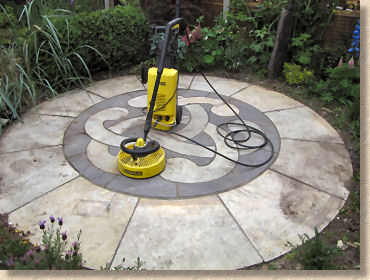
"All domestic-grade power washers feature a basic 'lance' which delivers a powerful jet of water which is then used to blast any surface staining or detritus. However, this jet poses a couple of problems when it comes to cleaning pavements. First of all, the water jet often 'etches' a cleaner area onto the paving, leaving those parts of the paving not directly bombarded by the jet looking slightly dirtier and making it possible to detect the path of the jet as it was played over the pavement surface. This can be seen in the photograph shown on the Power Washing page.
Secondly, and more importantly, a direct jet of water can (and does!) damage both the surface of the paving and will force out any jointing material that is in any way less than sound, intact and well-and-truly fixed in position.
Luckily, there is an attachment known as a Rotary Head Cleaner that attaches to the end of the lance and operates in such a manner that both of the potential problems mentioned above are minimised. The Rotary Head Cleaner achieves this by delivering the water over a wider area, and at a much shallower angle than is commonly used with a lance.
The Rotary Head Cleaner can be bought as a separate attachment, if not supplied as part of the kit, and fixes to the lance by means of the usual 'Twist-Lock' mechanism. An additional benefit is that the 'head' prevents the removed detritus being splashed all over adjacent walls, fences or planting."
http://www.pavingexpert.com/celtic_02.htm0
This discussion has been closed.
Categories
- All Categories
- 356K Banking & Borrowing
- 255K Reduce Debt & Boost Income
- 456.3K Spending & Discounts
- 248.5K Work, Benefits & Business
- 606.3K Mortgages, Homes & Bills
- 179.1K Life & Family
- 264.1K Travel & Transport
- 1.6M Hobbies & Leisure
- 16.2K Discuss & Feedback
- 37.7K Read-Only Boards