We’d like to remind Forumites to please avoid political debate on the Forum.
This is to keep it a safe and useful space for MoneySaving discussions. Threads that are – or become – political in nature may be removed in line with the Forum’s rules. Thank you for your understanding.
are pension withdrawals classed as "income"




I am interested to understand the gift from surplus income rules and wanted to ask if regular withdrawals - lets say 10k a month, for a couple of years - are regarded as income? If you can then gift most of this without it affecti9ng your lifestyle, does that qualify as gifts from surplus income?
Comments
-
Apart from the tax free lump sum any money you take from a pension is income - it will be taxed at source.
Mr Generous - Landlord for more than 10 years. Generous? - Possibly but sarcastic more likely.1 -
True but there is some suggestion that the whole of an UFPLS payment would qualify as income for the gifts out of surplus income IHT exemption.
1 -
Useful info:
especially:
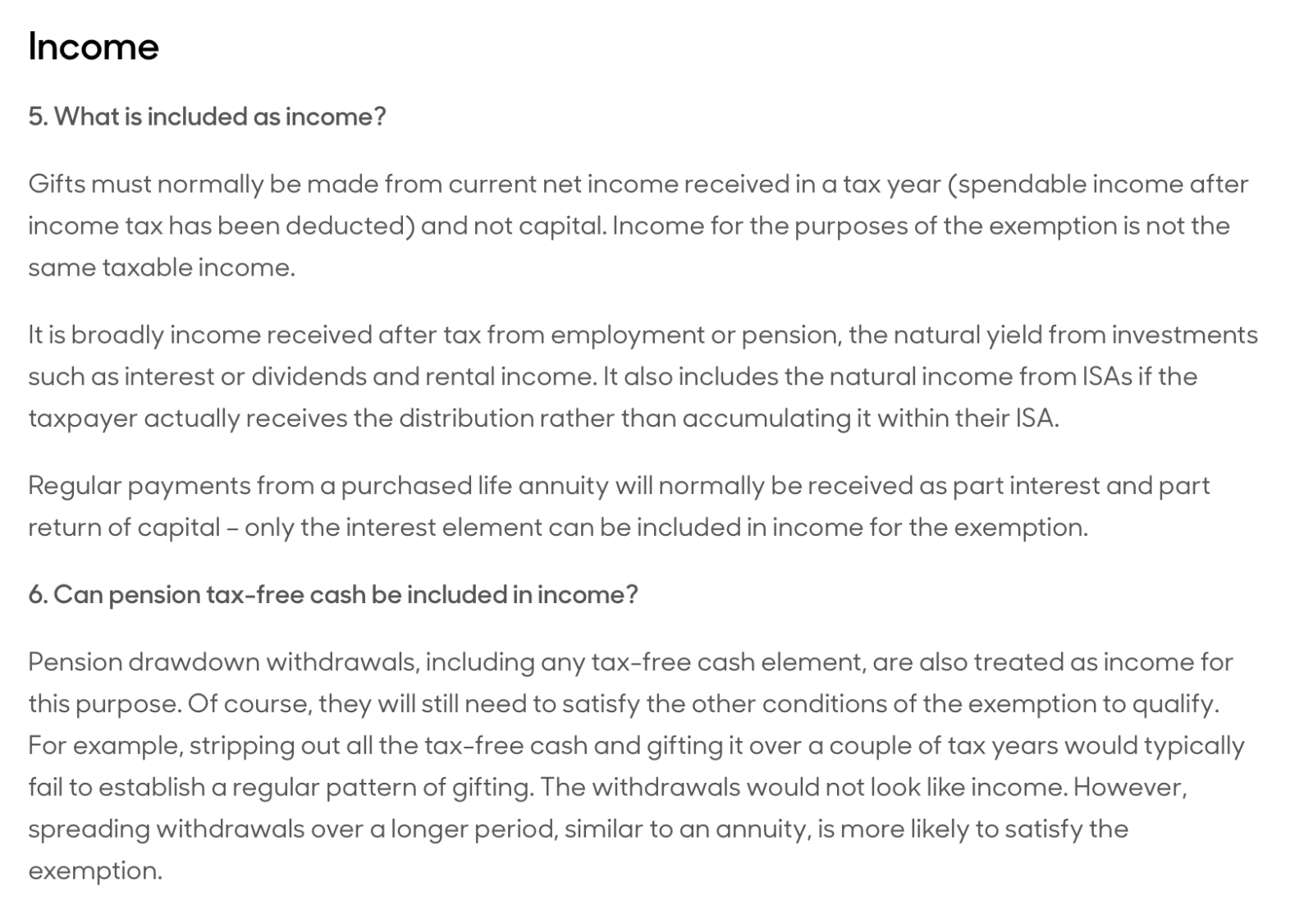
Be aware of the contrasting treatment of the capital element of a purchased life annuity (one bought from your 'own' money, as opposed to using money coming straight from a pension plan). See
especially:
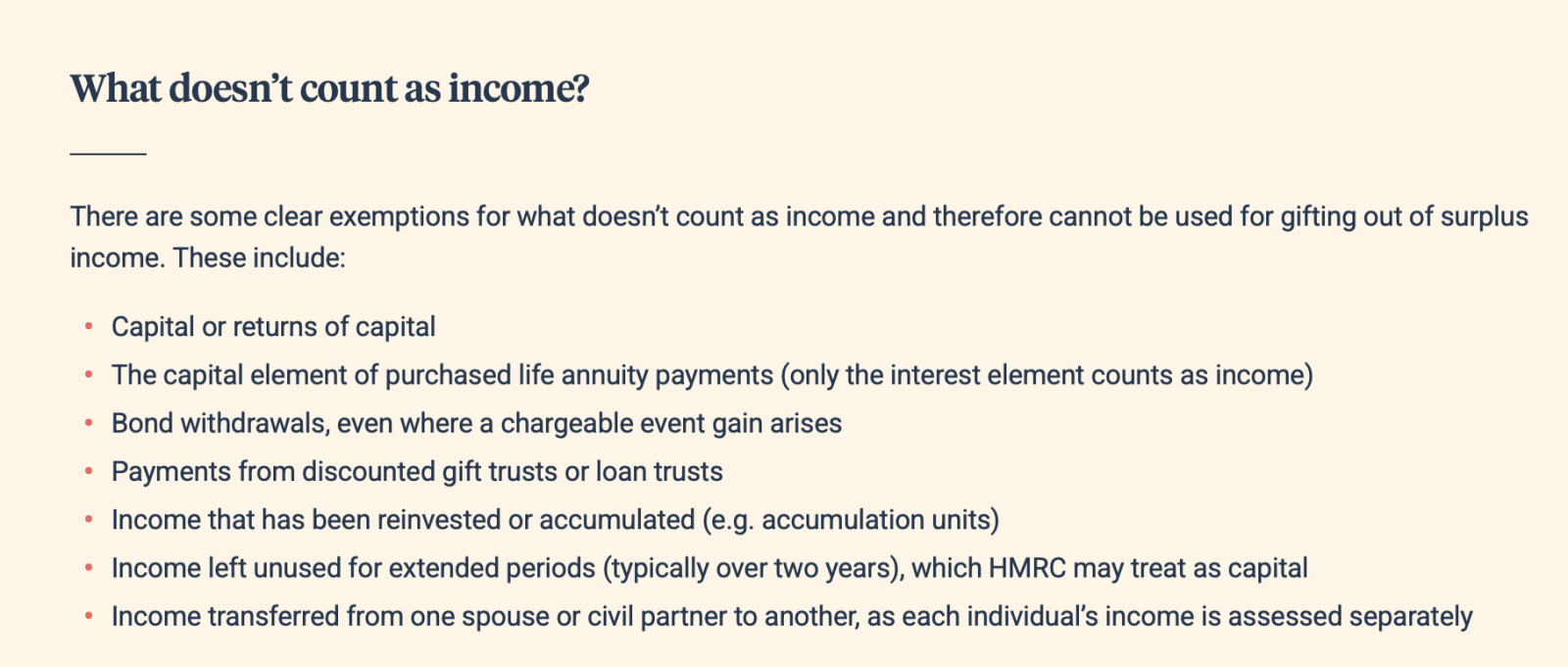 Googling on your question might have been both quicker and easier, if you're only after simple facts rather than opinions!1
 -
Regardless of what is and what isn't regarded as surplus income, you mention that you want to withdraw £10k a month. This is a high figure, which will result in a lot of income tax being paid. Even if only 75% of the withdrawal is taxable that's a lot of 40% tax being paid. If 100% of the withdrawal is taxable the percentage is even higher, especially since you will lose some of your personal allowance.
Of course it may make sense to withdraw such a high figure. Just thought I'd mention it since if you can reduce the figure and withdraw over more years the income tax paid will reduce.
2 -
I want to build this up in layers as it can become a bit unwieldy.
Scenario: a married couple have a pension pot of £3mio. If one of the partner passes away before age 75, I think this £3mio transfers wholly and IHT-free to the surviving partner. At this point the surviving partner can withdraw as much as they want and without any income tax?
Assuming yes, could they prepare a written agreement to agree a gifting strategy which is along these lines:
- they will withdraw £1mio each year and spread this equally over the 12 months.
- Since the living expenses of the surviving partner are only around £2k each month, can they set-up a direct debit for gifting the rest. Is this a clear case of gifting from surplus income (immediately outside estate).
Clearly, they could continue this - subject to their lifetime - and aggressively gift until they are below the IHT limit.
Can I get your thoughts on this please.
0 -
Can I get your thoughts on this please.
I think you're overestimating the amount of help a site like this can reliably provide - and of course nobody is insured for whatever observations they offer, especially when there is so little information on which to proceed.
Given the amount of cash in play, why not pay for some advice based on a full understanding of all relevant factors?
a married couple have a pension pot of £3mio. If one of the partner passes away before age 75, I think this £3mio transfers wholly and IHT-free to the surviving partner.
Personal pension pots are never 'shared' as you seem to be describing, so the whole £3m would belong to one or other party.
Googling on your question might have been both quicker and easier, if you're only after simple facts rather than opinions!1 -
Personal pension pots are never 'shared' as you seem to be describing, so the whole £3m would belong to one or other party.
Understood. If the £3mio pot belonged to the husband and he dies before age 75, it goes to the wife. She pays no IHT on it and no income tax upon withdrawals from this pension pot. Is that correct?
0 -
If the pension pot is £3m and you're drawing £1m per year to use as surplus income then I don't think that would be seen as sustainable.
Remember the saying: if it looks too good to be true it almost certainly is.1 -
A quick Google tells me that the withdrawals must be made within 2 years of the husband's death and the maximum amount allowed to withdraw is £1,073,100. This limit appears to be a total limit, not an annual limit.
1 -
Not necessarily. Depends how she accesses the cash.
Googling on your question might have been both quicker and easier, if you're only after simple facts rather than opinions!1







Confirm your email address to Create Threads and Reply

Categories
- All Categories
- 355.6K Banking & Borrowing
- 254.8K Reduce Debt & Boost Income
- 456.1K Spending & Discounts
- 248.2K Work, Benefits & Business
- 605.8K Mortgages, Homes & Bills
- 179K Life & Family
- 263.6K Travel & Transport
- 1.5M Hobbies & Leisure
- 16.1K Discuss & Feedback
- 37.7K Read-Only Boards