We’d like to remind Forumites to please avoid political debate on the Forum.
This is to keep it a safe and useful space for MoneySaving discussions. Threads that are – or become – political in nature may be removed in line with the Forum’s rules. Thank you for your understanding.
Any views on Tax Personal Allowance from April 2031?
Comments
-
The income tax system has many elements that make little sense, but which it is politically hard to see changing:
(1) 60% band - this looks like something that will just stay as it is in cash terms until it become so low relative to the minimum wage that something has to be change it. Reform before that time seems unlikely as no political party has an incentive to make a change which will be heavily criticised by some media.
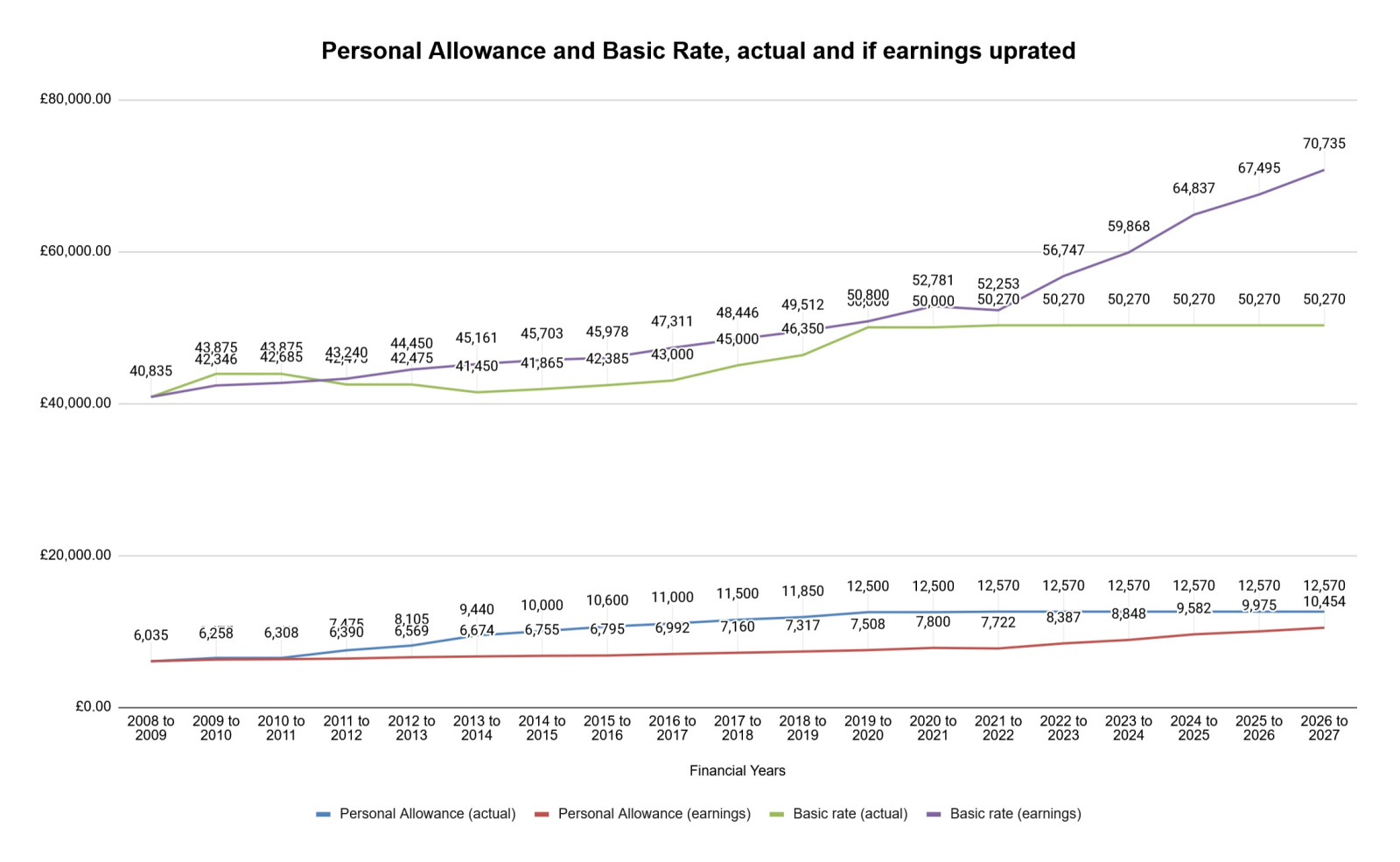
(2) Personal Allowance - although frozen since 2021, it is still comfortably higher than it would be had it simply been increased by earnings growth since 2008. So by historic standards it is fairly generous. So perhaps CPI uprating from 2031 is the best that might be hoped for.
(3) Higher rate tax threshold - whereas the Personal Allowance was increased significantly after 2010, the higher rate tax threshold even saw cuts in cash terms. This results in the higher rate threshold being far below the level it would have been had it been increased by earnings since 2010, and now only about twice the level of the full-time minimum wage. There will surely be pressure to index this from 2031 by at least CPI, but it is hard to see it going up by a higher percentage than the Personal Allowance.
In the background is employee National Insurance, and perhaps a desire to gradually phase it out by reducing the NI rate and increasing Income Tax take, either via Income Tax rates or thresholds.
At some point, wholesale reform could be on the cards. We only have the system we have today due to the legacy of various changes down the decades, rather than the system being designed for the needs of a modern UK. But, in practice that is hard and controversial and you struggle to end up taking significantly different amounts from anyone, so why bother with modernisation.
All the above makes any planning little more than guesswork. My plan is to draw up to higher rate tax every year, and leave everything above that untouched to age 75 (death might avoid tax).
 6
6 -
I think its impossible to have a new system that would
- Not have a load of winners and losers
- Not reduce the total tax burden - as the country is broke
- Not be politically dangerous for the side proposing it
- Not get destroyed by the media and vested interests who will find niche scenarios that make the new system look grossly unfair.
If no-one can even grasp the triple lock then a total tax change to a ‘fairer’ and ‘simpler’ system has no chance.
The only way it could work is if the country’s finances got into good ship with debt reducing, then a new tax system with a result that delivers somewhat less tax to the govt may have a chance.
3 -
I'll just note that we're due a general election before 2031. What happens with the Personal Allowance (and the tax bands, and lots of other things) could depend on the results.
Also between now and then we may be due a couple of Middle Eastern wars, possibly a war with Russia, subsequent energy crises etc. And of course the bursting of the AI bubble and the ensuing recession - or if you prefer, AI transforming productivity and ushering in an era of unprecedented economic growth.
It difficult to make predictions, especially about the future, but some of those events could have a bigger impact on what tax rates look like in 2031 than any election.
4 -
Bravo, and well said. Also trying to guess what might happen in 5 years time is just complete guess work.
4 -
Well, that's us told then isn't it.
3 -
If you look at the allowance in the 1990s to mid 2000's, it would have been under £10,000 in today's money.
Yes, a lot of people seem to forget (or are unaware of] how low the personal tax allowance was until the last couple of decades
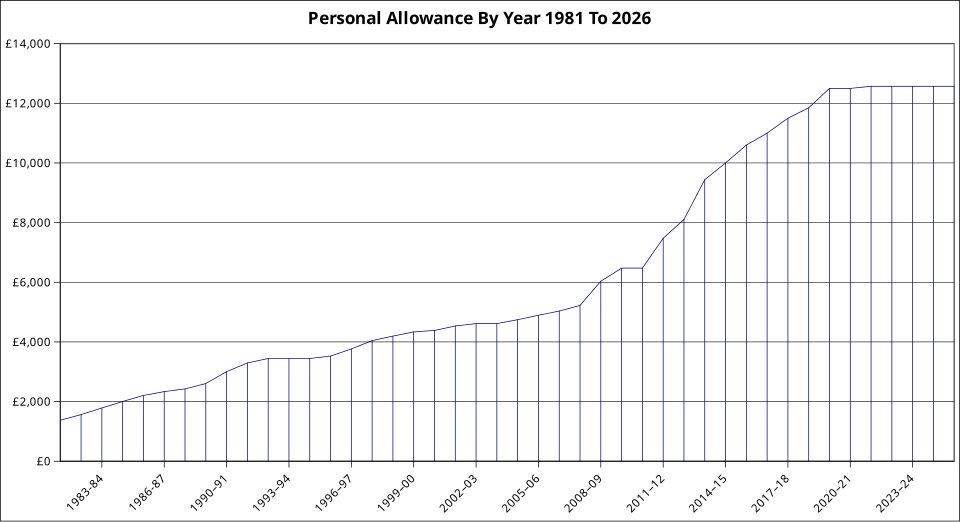
{Source: Wikipedia]
2 -
Yes, the main issue is the non indexation of the higher rate threshold, as above it'd be over £70k if it had kept up with earnings over the last couple of decades.
0 -
What is missing from this debate is that higher personal taxes on the general populace must be a natural consequence, to help defray the diminution in corporation tax receipts from erstwhile profitable UK companies following takeovers that burden them with crippling ( tax relieved) debt, or simply disappear as UK tax contributing entities entirely.
It is something I have been carefully following in retirement, especially in the context of UK corporate takeovers by foreign entities and private equity, hollowing out UK corporation tax receipts.
Obviously this is a process that has been underway over a number of decades, but really caught my attention with the Kraft takeover of Cadburys in 2010 resulting in corporation tax payments falling to zero pretty much immediately thereafter, not to mention job losses and PAYE receipts disappearing with some production moving to the Poland.
More recently I noted that the takeovers of Asda and Morrisons supermarkets following in close succession, has resulted in those companies who were regularly paying between one to two hundred million pounds of annual corporation tax, has seen that fall to zero post takeover - see below
Seems to me that without rapidly increasing ( rather than falling) corporation tax receipts contributing to the Exchequer, recourse has to be made the general population to fill the gaping hole in the nation's finances.
5 -
It's not a "debate", that would be political and not allowed here. It's speculation as to what might happen and how to react/plan for it. Which is exactly what this forum is for.
I think most everyone here accepts that rises in personal taxes are inevitable, so the question is how will they rise and how should that affect our retirement planning. A lot of people will have planned their retirement on the basis of being a basic rate taxpayer but now find they'll likely pay higher rate tax just due to inflation or even sub-inflation increases on their pension.
2 -
Yes I have noticed that planning to be basic rate tax payers in retirement seems to be an ever constant refrain here.
Always seemed an odd 'ambition' to me given one has no idea what inflation will do to the buying power of your basic rate income.
I have taken the opposite approach in aiming to get back to my pre retirement higher rate income via growing my capital base and growing the resulting income therefrom.
Having no DB pensions to fall back on at all, this seemed to be an entirely prudent approach to try and ensure inflation does not greatly impact on my choices of discretionary spending.
Scotland's multiple tax rates culminating in a top 48 % rate, is a sign to me of where England may well end up out of necessity, especially with corporate UK not pulling its weight in its tax contributions. The new 22%/42% rates may just be the start for English tax payers.
3












Confirm your email address to Create Threads and Reply

Categories
- All Categories
- 355.7K Banking & Borrowing
- 254.9K Reduce Debt & Boost Income
- 456.1K Spending & Discounts
- 248.2K Work, Benefits & Business
- 605.8K Mortgages, Homes & Bills
- 179K Life & Family
- 263.6K Travel & Transport
- 1.5M Hobbies & Leisure
- 16.1K Discuss & Feedback
- 37.7K Read-Only Boards