We’d like to remind Forumites to please avoid political debate on the Forum.
This is to keep it a safe and useful space for MoneySaving discussions. Threads that are – or become – political in nature may be removed in line with the Forum’s rules. Thank you for your understanding.
📨 Have you signed up to the Forum's new Email Digest yet? Get a selection of trending threads sent straight to your inbox daily, weekly or monthly!
Heirs' income tax on inherited SIPPs
Comments
-
But the SIPP is not part of the estate. That is why there is all that stuff about the PRs giving notices to the SIPP trustees telling them to withhold money and to pay the IHT.
I think there was originally some thought that the SIPP trustees would be liable for the IHT on the SIPP but it looks like that has changed.
I believe there are three different ways the IHT could be paid and that how or if you get income tax relief for the IHT paid will vary according to how you pay the SIPP related IHT but clearly I don't understand all this stuff since I was thinking that in some cases the IHT could be credited against income tax. So I'll shut up
except to say you might get more responses on the Pensions board. I am sure there was a thread or two on this subject on that board but I can't find them now.
0 -
Very helpful, UKTaxHelper and DRS1. Am I right in thinking we are still waiting for the final process/options for paying IHT/guidance to be published ahead of FY28?
0 -
The changes come in from April 2027.
There have been some draft regulations published for comments but I am not sure if they deal with anything more than the information exchange process.
In case it helps I found an Aberdeen note from May which has some helpful stuff at the end about how it could all work.
3 -
I like that Aberdeen note. While I'm aware of the updates in the pension newsletters and draft legislation I can't say I've even skimmed them properly so would be interesting to know if anything in that note has changed.
The general principle as I understand it (and that's all this is) is that inheritance tax due is proportioned between the non pension and pension assets of the deceased in accordance to their relative value (ignoring amounts being paid to a spouse which are exempt from IHT). Those proportioned IHT amounts are then usually deducted from those pension and non-pension assets. In terms of the pension assets this means the scheme pays the apportioned pension IHT and reduces the inherited pension value accordingly. And for the non-pension assets the executors pay the apportioned non-pension IHT to HMRC before administering the estate and distributing the assets (net of the apportioned non-pension IHT) to the estate beneficiaries.
However there is an option for the executors to pay the IHT in full from the non pension assets (rather than apportioned amounts from pension and non-pension being paid to HMRC) in which case the inherited pension isn't reduce in value by the apportioned IHT as the scheme has paid nothing to HMRC. In that case when the inherited pension is accessed, the first part of that inherited pension equal to the apportioned IHT that would have been paid, is treated as not subject to income tax by the beneficiary. This is because if it were treated as taxable it would penalise the beneficiaries relative to the scenario where inheritance tax was paid proportionately out of pension and non-pension assets.
If I was an executor I would be trying to work towards the apportioned IHT being paid from pension and non-pension assets method as the all IHT from the non-pension could get very messy (edit: although paying from the non-pension might depending on the circumstances have advantages too such as enabling probate to be applied for earlier). The latter would only be possible in any case if the pension beneficiary was also a beneficiary of the (non-pension) estate (edit: or if the pension beneficiary paid their share of the inheritance tax to the executor or paid HMRC themselves).
I came, I saw, I melted1 -
@aroominyork There are some new posts on this thread you may find interesting
Results of Government consultation re IHT on pension pots today - Page 5 — MoneySavingExpert Forum
1 -
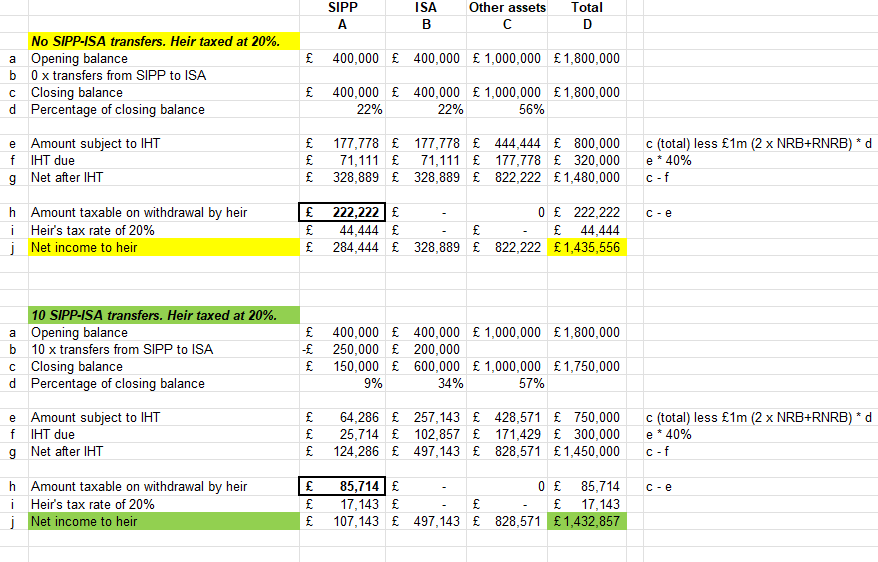
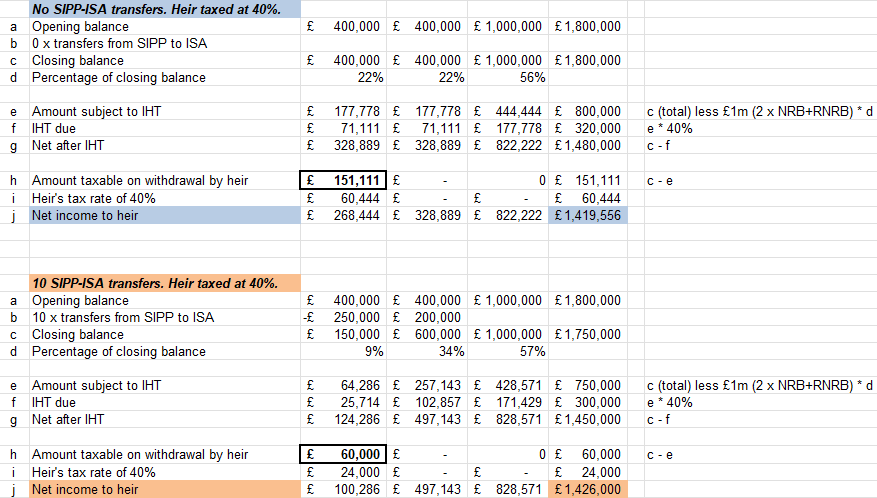
Really helpful - thanks. My instinct is to withdraw annually from our SIPPs up to basic tax rate limit and, if we have excess after spending, feed the ISA. But since inherited SIPPs are not going to be double-taxed, is that best? I have run 2 x 2 scenarios: moving or not moving £20k annually from SIPP to ISA (I am assuming for ten years), and the heir being taxed at 20% or 40% on withdrawals.
My key question is whether cell Ah – the amount of an inherited SIPP that is taxed (but not double taxed) on withdrawal by the heir – is arrived at correctly? I have boxed and bolded that cell.
If all this is correct, there is not a huge difference in whether or not to switch funds from SIPP to ISA. For 20% tax-paying heirs there is a small benefit in not switching; for 40% tax-paying heirs there is a small benefit in switching.
 0
-
AI sent me to section 567B of the Finance Act 2026:
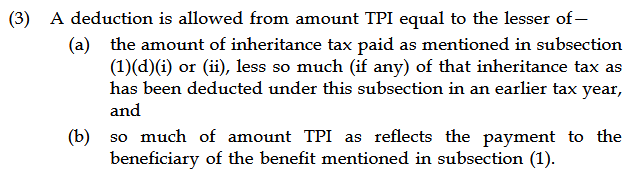
… which it interprets as essentially meaning the allowance against heirs' income tax is the amount of inheritance tax paid, not the amount on which tax was paid. That would mean, in my spreadsheet, cell Ah is the same as cell Ag. For example, in the yellow table after £71,111 tax is paid by the testator's SIPP withdrawals, £328,889 of heirs' withdrawals from the inherited SIPP would be subject to income tax. Is that how others understand it?
0 -
meaning the allowance against heirs' income tax is the amount of inheritance tax paid, not the amount on which tax was paid
Yes I think that is what @UKTaxHelper was saying on 25 August.
But having read that section, I have to admit there is a lot I don't understand.
0 -
Assume a SIPP has £1m subject to IHT. The balance is £600k. That £600k is then taxed at the beneficiary's marginal rate. If the beneficiary's marginal rate is 20%, they receive a net £480k from the estate; if it is 40% they receive a net £360k. How is that not double taxation?
PS I ran this calc through AI and it agreed with the £360k/£480k outcomes and then said, unprompted, "…this isn't double taxation of the same £400k. The £400k IHT reduces the pension first; Income Tax is then charged on the remaining £600k."
I don't buy that. If I start with £1m, the highest tax rate being applied is 40% and the outcome is under £600k, something has in effect been taxed twice… surely? And what has been taxed twice is the amount inherited after IHT is applied; after all, you could not apply income tax to IHT that is already in HMRC's account!
PPS HMRC's May 2026 technical note says: "If Inheritance Tax is paid in relation to death benefits, the portion of the benefits corresponding to the Inheritance Tax (and interest) paid does not count towards the beneficiary’s taxable income." So they seem to be accepting that 'not double taxing' simple means not levying income tax on the IHT already in HMRC's account.
0 -
If the beneficiary's marginal rate is 20%, they receive a net £480k from the estate; if it is 40% they receive a net £360k. How is that not double taxation?
Being a bit thick here but if the tax rate is twice as much (40% instead of 20%) then you pay twice as much tax but that is not the same as double taxation. Double taxation is where the same amount is subject to IHT and IT.
So in your example a SIPP with £1m and an IHT bill of £400k (it probably wouldn't actually be that much but let's ignore that) there is no double taxation because the £400k only goes out to pay the IHT. There is no IT charge on the £400k
But what if the beneficiary paid the £400k IHT? In order to do so the beneficiary draws an amount from the SIPP. If that amount is subject to IT at 20% then he needs to draw £500k to get £400k net (I know on £400k it would be more than 20%). That is where there is double taxation because he has suffered IT on the £400k.
The remaining £500k would be subject to IT and at say 20% that would mean a net receipt by the beneficiary of £400k instead of £480k in your scenario. I think the legislation is trying to get the beneficiary back to the £480k from the £400k (not trying to get them back to £800k (which I think is where they might be if there was no IHT)).
What I do not understand is whether the new section is saying that the beneficiary won't be charged IT on the withdrawal to pay the IHT or that the beneficiary gets a credit on the subsequent withdrawals from the remaining £500k. I think it is the latter but I am not confident about that
0





Confirm your email address to Create Threads and Reply

Categories
- All Categories
- 355.8K Banking & Borrowing
- 254.9K Reduce Debt & Boost Income
- 456.2K Spending & Discounts
- 248.3K Work, Benefits & Business
- 606K Mortgages, Homes & Bills
- 179K Life & Family
- 263.8K Travel & Transport
- 1.5M Hobbies & Leisure
- 16.2K Discuss & Feedback
- 37.7K Read-Only Boards