We’d like to remind Forumites to please avoid political debate on the Forum.
This is to keep it a safe and useful space for MoneySaving discussions. Threads that are – or become – political in nature may be removed in line with the Forum’s rules. Thank you for your understanding.
state pension - first part year
Comments
-
I think the whole problem for the part year lies not in the law itself for those reaching SPA under the new system, so on or after 6th April 2016, but the fact that HMRC has not updated its system to take account of the law as @pinnks said earlier. Their systems are still set up for those receiving the old state pension.
With regards to the 1/51 issue, HMRC manages to get the tax code correct so the simple answer to the pre-populated error would be to use that figure instead of the 52 times figure they’re using regardless. Doesn’t solve the 53 week tax year but it would be a start.0 -
The example in the HMRC page linked to, is, as snowman said, incorrect. The pension started on 4 January, which is a Sunday and payment received on Wednesday, 4 March, covering the period to 4 March. This means the person's payday is Wednesday and also means that the first part week is 4 days from Sunday 4 January to Wednesday 7 January.
After 7 January there are 12 full weeks ending on a Wednesday before 6 April, so the example should show £170/7x4, plus £170 x 12.
I think we should all bombard HMRC with "this guidance does not follow the legislation", or similar.
My experience of SA is that in the first year the part week was left off the pre-populated amount and when I challenged HMRC they didn't have a clue what I was talking about and told be to submit the return with the incorrect pre-populated amount, then call to amend it - eek. I did this but as a former member of that parish felt more than slightly uncomfortable. Since then the pre-populated figure has still been wrong in every year because it has been based on 52 weeks at the same rate, despite what the return guidance says.
All very poor!
1 -
Yes. I did the calculations earlier and agree with all of this
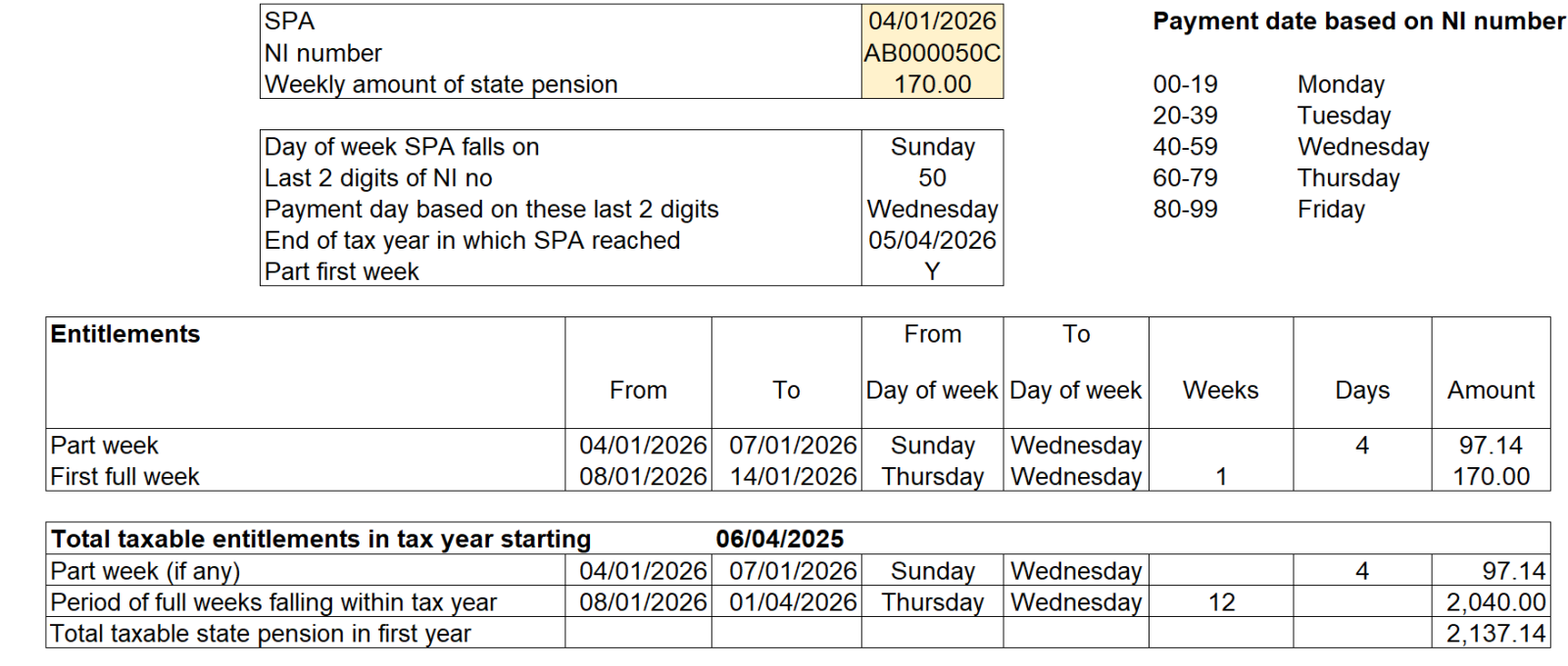
HMRC have taxable state pension of £2,210 it should be £2,137
Working through the LITRG example gives the following
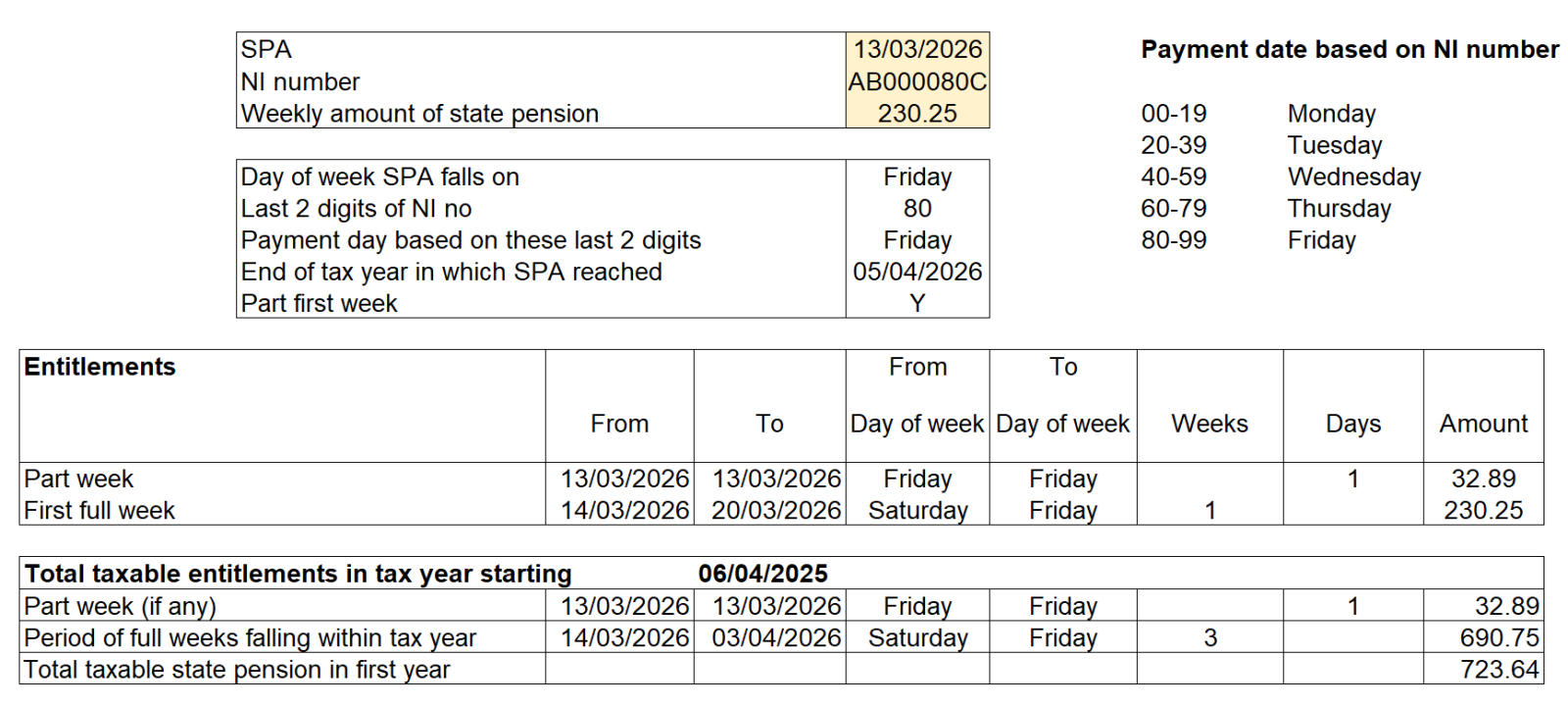
LITRG round down to 3 complete weeks which is the £690.75 taxable state pension figure they come up with. Arguably the 1 day should be included bringing it up to £723.64. What would definitely be wrong would be to round up to 4 weeks which is what HMRC would do it seems, giving a total taxable income of £921 (= 4 x 230.25). At a 40% tax rate that would result in an overpayment of tax of £79 (=(921 - 723.64) x 0.4).
I came, I saw, I melted3 -
If LITRG round down, that is wrong as they are simply omitting taxable income, which should not be advocated. The law is clear, you are taxable on the amount accruing due (part week and full weeks) during the the tax year.
An interesting point is that even when HMRC had their customer forum I could not get a proper answer from them on this. It seems the systems are still operating in a "pre-nSP" mode and staff don't have a clue what the law means, i.e. they have not bee trained on this issue.
1 -
It is clear that taxation is based on entitlement and not payments in the tax year.
My experience of SA is that in the first year the part week was left off
the pre-populated amount and when I challenged HMRC they didn't have a
clue what I was talking about and told be to submit the return with the
incorrect pre-populated amount, then call to amend it - eekOr in my case, SP began in August, and HMRC pre-populated with the whole year's entitlement! Not changeable on the site at that time either. It was some years ago, so I was able to speak to someone with a wait time in minutes rather than hours, and I think in the end I had to put the correct amount in a letter.
1 -
I have been doing a bit more reading on this and have to admit that my understanding of "accrual" in S578 ITEPA 2003 has been incorrect. Sorry about that.
If you look at the explanatory note to ITEPA 2003, it says in relation to what is now S578 that accrual is on a day-to-day basis across the tax year and not linked in any way to the fact that you are only ever entitled to receive your pension in weekly chunks. Oh well, we live and learn.
I have tried to work out what that means for being taxed and the best I can come up with is that 1/51 is a concessionary estimate that, year-on-year, gives a reasonable estimate of the correct taxable amount (erring, I think in favour of the taxpayer), given the complexities of when the annual increase applies in general and when it applies to each individual depending on their payday based on their NI number.
If anyone can sit down and put all of the variables into a spreadsheet to get a definitive answer I would love to see it but in the meantime I think I'll retreat to my cave and create pre-historic paintings therein.
2 -
Daily accrual
If they did it allowing for strict accrual on each day of the tax year (which is what I think you are suggesting) then this is what you would get in the HMRC example.
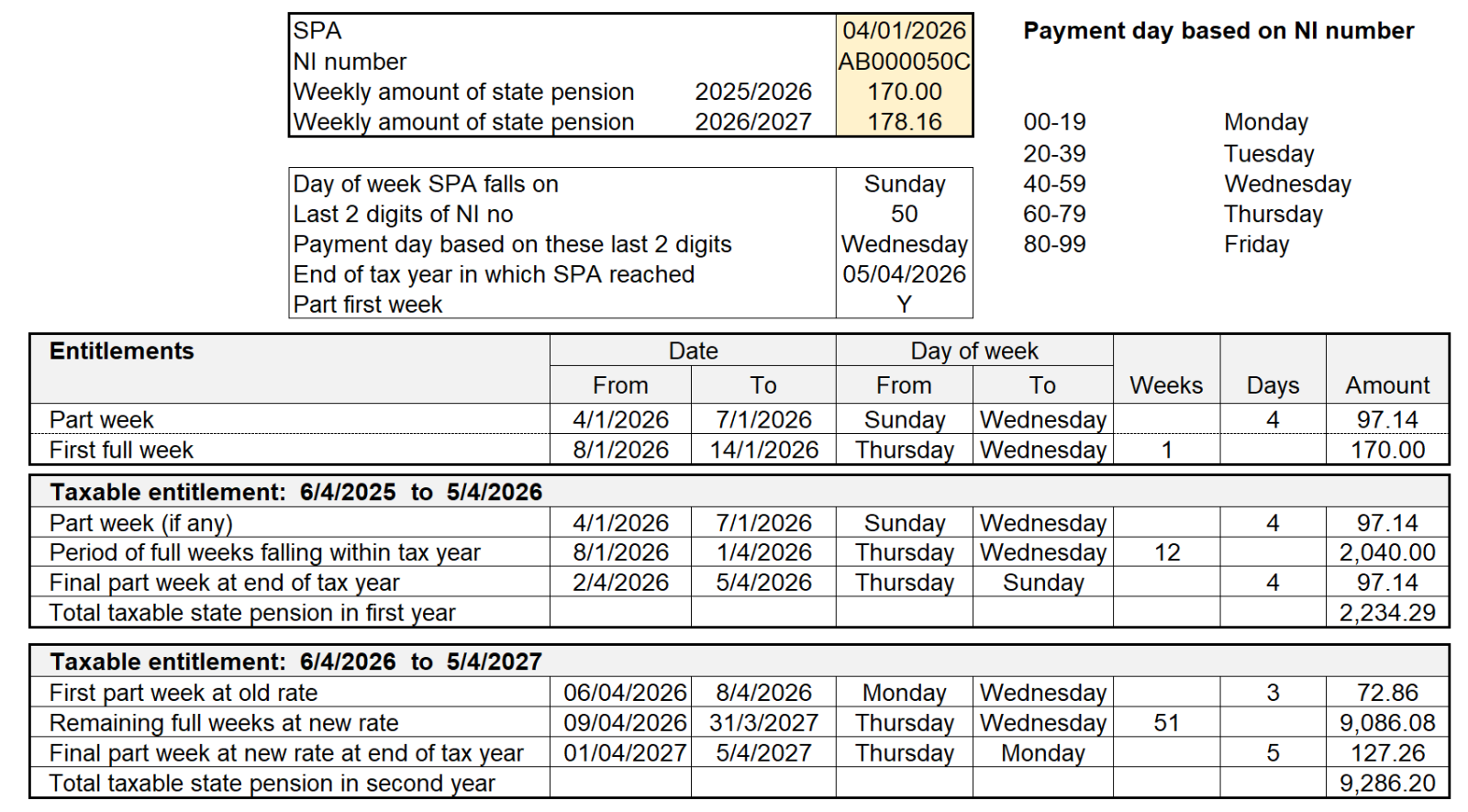
You can see that 2025/2026 splits into 3 periods and 2026/2027 splits into 3 periods also. I would suggest that this daily accrual is an overly legalistic interpretation (as opposed to a practical interpretation) of what should be happening, and in the absence of the taxpayer being given a P60 or taxable breakdown of their state pension would be completely impractical.
In any case the explanatory note (para 2322) 'this means that the charge is calculated on the amount accruing from day to day without regard to when the income is actually paid' is more about using accruing entitlement amounts rather than using the payment amounts and when they are paid. Day-to-day could be argued to be not saying it must be done to the exact day it is just an intensifier of the word accruing.
You are suggesting in the 2026/2027 year in this example HMRC use 51 weeks at the new rate and 1 week at the old rate as a concession to the taxpayer, but I would say that it is instead evidence that HMRC interpret the legislation differently. If they are making concessions they are not implementing legislation interpreted to mean do it to the exact day (if we accept that's what the legislation means) because through the concession they are not doing it to the exact day, instead they are using a taxable figure less than accrual to the exact day?
Weekly accrual
I would argue that HMRC are interpreting the legislation as follows. They look at an entitlement week and take that entitlement week as being in a tax year if the final date of that entitlement week is in that tax year. They can still argue that they are basing it on entitlement rather than payment because they don't differentiate between which of the 4 Wednesdays (or other day) in a 4 week cycle the payment is made.
This HMRC interpretation also means that the taxable amount in the second and subsequent tax years is the same for all taxpayers (at one week at the old rate and 51 weeks at the new) regardless of which payment day is allocated to the person. So two people with the same state pension and same SPA don't have different taxable amounts because of their NI number triggering a different payment day and no concession is required to achieve that equality. We won't mention the first year where there isn't equality! Perhaps more importantly it also means that what to fill in on a self assessment tax return can be made relatively easy as being 1 week at old rate and 51 weeks at new rate as in the self-assessment notes. Shame that HMRC prefill 52 weeks at the new rate rather than 51/1 and shame that they don't on the entitlement notification at the beginning of the new tax year say something like 'if you receive state pension until the end of the tax year your taxable state pension will be x (the 51/1 calculation).'
In terms of the 53 week years, which I've ignored in the previous paragraph, expecting the taxpayer to identify those years and fill in the self-assessment amount accordingly is not practicable and so a concession to use 52 (= 51 + 1) and not 53 (= 52 + 1) is reasonable if that is what HMRC do. And if those doing self-assessment use 52 weeks as per the notes it is not fair to those in simple assessment for HMRC to use 53 weeks because HMRC are doing the calculation. If HMRC supplied a taxable figure in the tax year entitlement letter then 53 weeks would arguably be the most ideal figure to use. Is that HMRC ignoring the law on how the state pension is taxed, I would suggest no, it's near enough correct as practicalities allow.
First part year
So getting back to the first part year, given the 51/1 approach in the second year; It is reasonable for HMRC to use weeks and first part week to the last assigned last weekday in the tax year (Wednesday in this example) or weeks to the last assigned weekday in the tax year. But it is not reasonable for HMRC to use weeks rounded up in at least some cases. If HMRC treat 53 week years as 52 weeks then of course that works in favour of the taxpayer and more than counterbalances the first part year rounding up effect over most retirements.
Of course the core of the issues is the complete lack of transparency from HMRC over many years on what they do and why and the clear errors such as prefilling 52 weeks new rate in self-assessment. And then there is the failure of HMRC to provide a P60 or P60 equivalent to those in receipt of state pension.
I came, I saw, I melted1 -
Thanks for this and your thoughts.
I agree that a P60 or similar would be useful but surely that would need to come from the DWP, as provider, and not HMRC? Unfortunately any time it’s been requested the DWP simply say we don’t deal with tax which of course they don’t but I’m sure it’s not beyond the realms of possibility just to say your total income for whatever tax year will be £xxx.xx and give that out with annual increase letters/initial award letter.
1 -
Yes you are right the notification would come from DWP; long post and I was getting tired by the end!
DWP do provide P60s for taxable benefits such as contributions based ESA, so they do deal with tax sometimes, so why can't they provide it for state pension also? Or as you say they could add it to the annual entitlement increase notice (and initial award) based on assumption of payment to the end of the tax year.
I came, I saw, I melted0 -
Good question! I hadn’t realised, or long since forgotten as I might have got one for Widowed Parents’ Allowance over 20 years ago, that a P60U is issued by the DWP. They don’t deal with the tax as all benefits are paid gross but they’re still able to provide details of what is taxable income.
So other than cost there seems no reason why it couldn’t be done.
1








Confirm your email address to Create Threads and Reply

Categories
- All Categories
- 355.6K Banking & Borrowing
- 254.8K Reduce Debt & Boost Income
- 456.1K Spending & Discounts
- 248.2K Work, Benefits & Business
- 605.7K Mortgages, Homes & Bills
- 179K Life & Family
- 263.5K Travel & Transport
- 1.5M Hobbies & Leisure
- 16.1K Discuss & Feedback
- 37.7K Read-Only Boards