We’d like to remind Forumites to please avoid political debate on the Forum.
This is to keep it a safe and useful space for MoneySaving discussions. Threads that are – or become – political in nature may be removed in line with the Forum’s rules. Thank you for your understanding.
SAL RSA Pension Scheme Wind-up




Today I received a letter giving first formal notice that as part of the buy-out process and wind up of assets for my deferred DB pension scheme with SAL.
My question is: how do I know they will meet all the liabilities, apart from a promise that ‘they will’? How can I check?
I was last able to request a quotation of my annual pension in 2023 and currently have no access to my pension online as they are being very slow to invite deferred members to access PIC online. I was told I would receive a registration letter in the post in Spring 2026, but nothing has been received. I’ve chased it but was told, not to worry and they will be sent out.
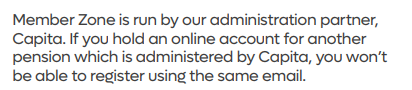
I was also very worried when I read that Capita will be the administrative partner of the Member Zone☹.
I have another deferred DB pension being currently administered Capita which has been heavily criticised for its slow response times and litany of errors. I’ve been on the PIC website, and it managed to read in the small print for members transitioning to PIC online, that if any members currently have other pension scheme being administered by Capita, they need to use a different email address for the one with PIC. I’m worried, it will all be a fiasco as I used the same email with RSA and my pension with Teachers Pensions.
In the appendix to letter under the heading Remaining assets, it states that money which had been set aside to secure all the benefits for members by purchasing individual annuities resulted in a surplus of assets of £20M (apparently due to the generous additional contributions made by the Principal Employer: RSA – SAL). I'm sure that is small amount in the grand scale of a pension scheme, but still I'm left wondering if I should do more due diligence.
RSA are going to pay it back to themselves. The notice states that under section 76 of the Pensions Act 1995, the Trustees are required to give members statutory notice to give members the opportunity to make representations to the Trustee.
“3) The requirements of this subsections are that
a) the liabilities of the scheme have been fully discharged.
b) where there is any power under the scheme, after the discharge of those liabilities, to distribute assets to any person other than the employer, the power has been exercised or decision has been made not to exercise it, and
c) notice has been given in accordance with prescribed requirements to the members of the scheme of the proposal to exercise the powers.
The trustee confirms that these requirements will be satisfied.”
I feel like I’ve been issued with an IOU, that has no date and no amount mentioned.
Any words of wisdom or reassurance, please.
Comments
-
My question is: how do I know they will meet all the liabilities, apart from a promise that ‘they will’? How can I check?
What's happening is entirely normal and once a buy out concludes, you have the reassurance of knowing that you are now covered by a guarantee that the Financial Services Compensation Scheme will meet 100% of the liabilities in the highly unlikely event that 'something nasty' happens to the buy out provider.
The trustees will have been through an unbelievably lengthy and nit-picking process to get to this point, with copious amounts of professional advice and support from their third party advisers such as actuaries, administrators and lawyers.
The benefit specification will have been checked and re-checked umpteen times, so the chances of it being wrong are extremely low - but it's the employer's problem further down the line if any members find something isn't exactly in line with the benefits promised under the original rules of the scheme. There will also be insurance cover in place to ensure that any such 'unexpected' liabilities are covered.
I was told I would receive a registration letter in the post in Spring 2026, but nothing has been received. I’ve chased it but was told, not to worry and they will be sent out.
Bit like a dentist telling you to relax…that exhortation not to worry tends to have the opposite effect! It's extremely common for delays to crop up at every stage and doesn't mean anything is wrong.
…if any members currently have other pension scheme being administered by Capita, they need to use a different email address for the one with PIC. I’m worried, it will all be a fiasco as I used the same email with RSA and my pension with Teachers Pensions.
I think you might have misinterpreted that. You need to use a different email when sending things to Capita in relation to different schemes. It's not one big amorphous organisation; there are individual teams dealing with different schemes, and the buy-out providers (who are major customers) will be keeping a very close eye on the team involved where any of 'their' schemes are involved. Having said that, I agree what you've quoted is ambiguous and it may be that you need to set up a new email address - hardly a massive issue since you can use a free internet based address and have it directed to the same inbox as all your other messages.
In the appendix to letter under the heading Remaining assets, it states that money which had been set aside to secure all the benefits for members by purchasing individual annuities resulted in a surplus of assets of £20M (apparently due to the generous additional contributions made by the Principal Employer: RSA – SAL). I'm sure that is small amount in the grand scale of a pension scheme, but still I'm left wondering if I should do more due diligence.
If benefits have been bought out in full, and there is nothing in the rules to say that the surplus must be applied for the benefit of members, what do you think you could or should do by way of 'due diligence'? The trustees have to send you statutory notices in relation to the use of the surplus and indicate that you have the right to contact the Pensions Regulator, and they've done that.
I've just checked online and there's a highly competent independent professional trustee (Law Debenture) in post alongside the other trustee board members. In short, nothing in your post suggests anything whatsoever is amiss. There's no point telling you not to worry, so I won't - but this is very much a positive move.
Googling on your question might have been both quicker and easier, if you're only after simple facts rather than opinions!1 -
If the trustees are going to refund surplus to the employer that sounds as if they are very near the end of the winding up.
Do you have a sob story to spin to the trustees as to why they should spend the surplus on you (and other deferred pensioners) instead of giving it back to the employer? Does the letter say the trustees have actually used some surplus monies to benefit members or pensioners and the £20m is what is left after they have done that?
Does the letter say how your benefits will be secured? Presumably they are being bought out with an insurance company (PIC?)? Do they say the insurance company will be writing to you? You could see having your benefits insured as a good thing - you are no longer reliant on how well the trustees invest the pension fund. I suppose you could search the web to see how financially sound the insurance company is.
But there are threads on here about insurance companies changing how certain things are done following a buy out. Early retirement factors is an example which comes to mind. So you may want to question that if the letter hasn't mentioned it.
1 -
Do you have a sob story to spin to the trustees as to why they should spend the surplus on you (and other deferred pensioners) instead of giving it back to the employer? Does the letter say the trustees have actually used some surplus monies to benefit members or pensioners and the £20m is what is left after they have done that?
£20m would be a fleabite on this massive scheme. It was a £6.5bn buy-in in 2023 with PIC. Working out how to apply a 'mere' £20m to benefit members in an equitable fashion (not just deferred but pensioners too need to be considered) would probably soak up a good chunk of the £20m in professional fees, and end up with a couple of extra pence per member!
It also depends on what the rules say - it's relatively rare for trustees to have the sole decision on what happens to a surplus, and in some cases the rules simply state it goes to the employer as of right.
Members will have had various letters at the time of the buy in, and since, to keep them updated. Whether they actually read them is, of course, another matter.
The Pensions Regulator will look at the process followed in relation to any surplus (to check that the rules have been followed), not change the outcome.
Edit - ditto the Pensions Ombudsman. This was a very high profile case which included a trip to the House of Commons Work and Pensions Committee:
You could see having your benefits insured as a good thing - you are no longer reliant on how well the trustees invest the pension fund.
Members of a DB scheme are not reliant on 'how well the trustees invest the pension fund'. The strength of the employer covenant (the sponsor's ability and willingness to pay) is what counts, since the employer is on the hook for the full cost of meeting the benefits.
Nothing remotely unreasonable about the surplus being refunded once all the employer's obligations have been met; the surplus simply means the employer paid in more money than necessary to meet the promised benefits.
I suppose you could search the web to see how financially sound the insurance company is.
As mentioned in my previous answer, it doesn't matter. A buy out is classed as a long term contract of insurance, so has 100% FSCS protection with no upper limit.
But there are threads on here about insurance companies changing how certain things are done following a buy out. Early retirement factors is an example which comes to mind. So you may want to question that if the letter hasn't mentioned it.
Unless the factors are cast in stone in the original rules (highly unlikely), then they'll be whatever factors apply at the time if a member applies for early retirement - exactly the same as the original scheme rules. I would expect members to receive individual policies in due course, and reading that should give the necessary information/confirmation.
I appreciate you mean to be helpful, but sometimes it might be better not to answer a question from a deeply worried poster when you've got no first hand experience of how something plays out in practice. Just relying on other posts on this forum (many of which may be a little short on facts and owe more to opinion than legislation!) isn't a guarantee of accuracy…
Googling on your question might have been both quicker and easier, if you're only after simple facts rather than opinions!1 -
Thank you for your responses @DRS1 @Marcon
Yes, maybe these buy out processes should come with the words 'Don't Panic' inscribed in large friendly letters on the front cover. I blame the necessary legalese in in the letter. It is easy for a layperson to misunderstand terms and processes.
Tied with this is the fact that this process is very slow. Hopefully, slow with good reason because they are getting it right and dotting the i's and crossing the t's.
Here is the vague time frame: 'The Trustee has also budgeted the costs of the Scheme through to its eventual wind-up and this information will enable the expected assets of the Scheme at winding up to be established. We expect this to happen during 2027'.
Being part of an employer's pension scheme run by elected trustees gave a sense of rights, voice and connection with other members. The newsletter was always very informative and detailed. I did read it. It was deficit of assets to liabilities that led to the Buy in and then Buy out to stop any shortfall occurring so I get why the Trustees have decided to go down this route.
I guess the point in posting is more to do with how to connect with other members and to share my concerns.
I'd just like to see something with my name on it and some figures, but I guess I will have to be patient. I'm not due this pension for a couple of years. I'm not considering taking it early at the moment. If I were due to retire this year, I might be a little more concerned about being caught in the middle of this process.
Thank you for posting the link to the ombudsman's response to Mr S and the Waterboard case. The letter states that the surplus £20M is to be refunded for 'corporate purposes'. I've read the Ombudsman's response and I understand a little better now the reason for the notice period. I note that Mr S was part of an action group of some members.
0






Confirm your email address to Create Threads and Reply

Categories
- All Categories
- 355.6K Banking & Borrowing
- 254.8K Reduce Debt & Boost Income
- 456.1K Spending & Discounts
- 248.2K Work, Benefits & Business
- 605.8K Mortgages, Homes & Bills
- 179K Life & Family
- 263.5K Travel & Transport
- 1.5M Hobbies & Leisure
- 16.1K Discuss & Feedback
- 37.7K Read-Only Boards