We’d like to remind Forumites to please avoid political debate on the Forum.
This is to keep it a safe and useful space for MoneySaving discussions. Threads that are – or become – political in nature may be removed in line with the Forum’s rules. Thank you for your understanding.
State Pension forecast only 33 full years retirement date 4 weeks off full year
Comments
-
I think that's an excellent way of looking at it. Diagrammatically and drawn roughly to scale it looks like this
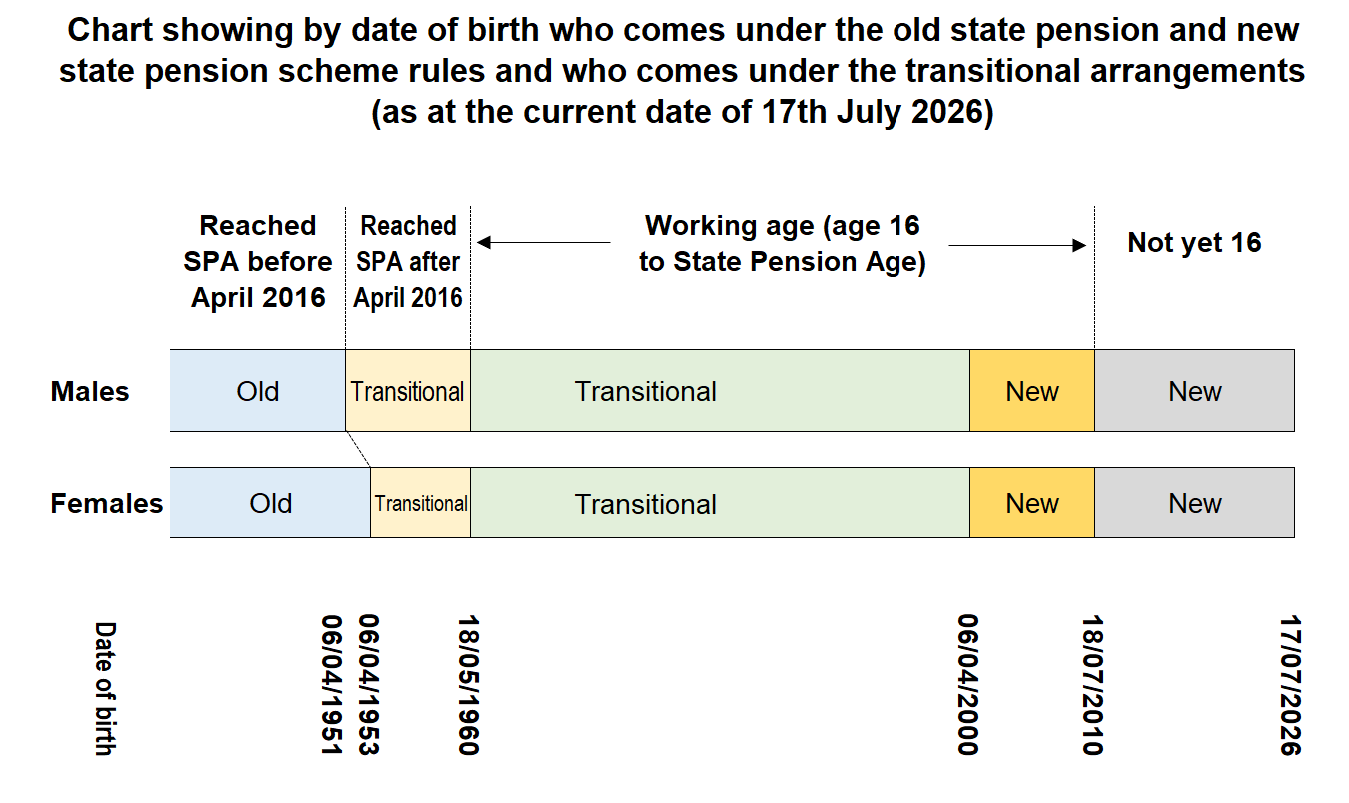
You can see that if we look at people who are currently working age the majority (the green shaded areas) come under the transitional arrangements, and so the requirement for 35 qualifying years exactly to get the full new state pension doesn't apply.
Of course there will be people like the OP who come under the transitional arrangements and just happen to need 35 years (rather than 34 or 36 or some other number or who can never reach the full new state pension amount). And some born in the years before 6/4/2000 may not achieve their first qualifying year until on or after the 2016/2017 tax year and so effectively come under the new rules rather than the transitional arrangements.
I came, I saw, I melted4 -
The way I look at it, why it's not necessarily 35 years, is that years prior to the change might have earned more or less than 1/35 of the New State Pension depending on contracting out vs SERPS.
0 -
Indeed, "number of years you need to reach a full state pension" is the wrong framing really, and makes things sound more complicated and less fair than they are. Pre- and post-2016 years are not the same; trying to add them together to get a total number of years contributions is combining apples with oranges.
The better way to think of it is: in 2016 everyone got a starting amount based loosely on how much they had already earned under the old system. How that starting amount was calculated was fairly complicated, which is a relic of the fact that the old state pension was fairly complicated, but it doesn't matter hugely - you had already built up an entitlement under the old system, which was different to the new system.
Then under the new system, each year's contributions get you an extra £6.89/week (at current prices), up to a maximum of £241.30/week.
There you are. No need to worry about whether it's 35, 30 or 40 years; your state pension is determined by (a) your starting amount and (b) the number of years you have contributed since 2016.
The rules don't fundamentally change for people who begin their working lives after 2016. It's just that their starting amount will be zero, as they made no contributions under the old system, so they will simply get £6.89/week* per year of contributions, up to a maximum of £241.30*, which corresponds to 35 years.
*Or whatever the numbers are in the future due to the triple lock, or whatever replaces it.
3







Confirm your email address to Create Threads and Reply

Categories
- All Categories
- 355.3K Banking & Borrowing
- 254.7K Reduce Debt & Boost Income
- 455.9K Spending & Discounts
- 247.9K Work, Benefits & Business
- 605.1K Mortgages, Homes & Bills
- 178.8K Life & Family
- 262.9K Travel & Transport
- 1.5M Hobbies & Leisure
- 16.1K Discuss & Feedback
- 37.7K Read-Only Boards