We’d like to remind Forumites to please avoid political debate on the Forum.
This is to keep it a safe and useful space for MoneySaving discussions. Threads that are – or become – political in nature may be removed in line with the Forum’s rules. Thank you for your understanding.
📨 Have you signed up to the Forum's new Email Digest yet? Get a selection of trending threads sent straight to your inbox daily, weekly or monthly!
State Pension forecast £1.5k above the 35yr New State Pension max?





My wife is in the process of applying for her state pension, after well over the max 35 years contributions. She'll be taking it at normal retirement age, which for her is 66.25 years old.
The forecast confirmed by the Gov't Gateway, paid monthly (I thought it was paid 4 weekly?) works out at just over £14k per year. But everywhere I search I'm told the 2026/2027 state pension tops out at £241.30 pw, or £12,547.60 pa for 35 years of contributions.
She's not retiring early, nothing is deferred, no disabilities or any special circumstances. She's just worked rather more than 35 years. Is this a mistake?
Comments
-
Was she contracted-in to SERPS /S2P prior to the 2016 changes?
It's entirely possible to have a state pension much larger than £241.30pw if she was.
N. Hampshire, he/him. Octopus Intelligent Go elec / Fuse gas / Vodafone BB / iD mobile. Kirk Hill Co-op member.Economy 7 cap explainer. Gas vs E7 vs peak elec heating costs, Ecoflow Stream, Best kettle :-)
2.72kWp PV facing SSW installed Jan 2012. 11 x 247w panels, 3.6kw inverter. 37 MWh generated, long-term average 2.6 Os.2 -
.Most of what you refer to, especially 35 years having any relevance, simply doesn't apply to your wife as she falls under transitional rules.
And you cannot have State Pension paid monthly. Weekly or 4 weekly are the options most people opt for.
0 -
The forecast confirmed by the Gov't Gateway, paid monthly (I thought it was paid 4 weekly?) works out at just over £14k per year. But everywhere I search I'm told the 2026/2027 state pension tops out at £241.30 pw, or £12,547.60 pa for 35 years of contributions.
State pension is indeed calculated on a weekly basis. By default it is paid 4 weekly, unless payment weekly or fortnightly is requested.
But everywhere I search I'm told the 2026/2027 state pension tops out at £241.30 pw, or £12,547.60 pa for 35 years of contributions.
Both the amount and the 35 year requirement only apply to those born from 2000. Your wife, in keeping with very many others, is under 'transitional arrangements'. From the sound of it she built up an entitlement to the Basic State Pension and also some 'Additional State Pension' (SERPS/State Second Pension) prior to 2016, when the New State Pension was introduced.
Googling on your question might have been both quicker and easier, if you're only after simple facts rather than opinions!1 -
Was she contracted-in to SERPS /S2P prior to the 2016 changes?
It's entirely possible to have a state pension much larger than £241.30pw if she was.
It's possible, I remember my company scheme was contracted out, then there was a fuss later about that maybe being a wrong move. SERPS additions did cross my mind, I'll ask her to check.
0 -
When the new state pension was introduced in 2016, they worked out for everyone a transitional amount which was equal to the greater of what they had earned to 2016 on the old system and what they would have earned under the new system up to 2016 (in the latter case with a technical adjustment for what was called contracting-out)
In your wife's case the transitional amount is likely to have been based on the old system. The old state pension was made up of two components, basic state pension plus additional state pension. If your wife had 30 (qualifying) years or close to 30 years of contributions up to 2016 the old scheme calculation would be something at or close to the full basic state pension plus her additional state pension (SERPS and S2P and graduated pension) earned to 2016.
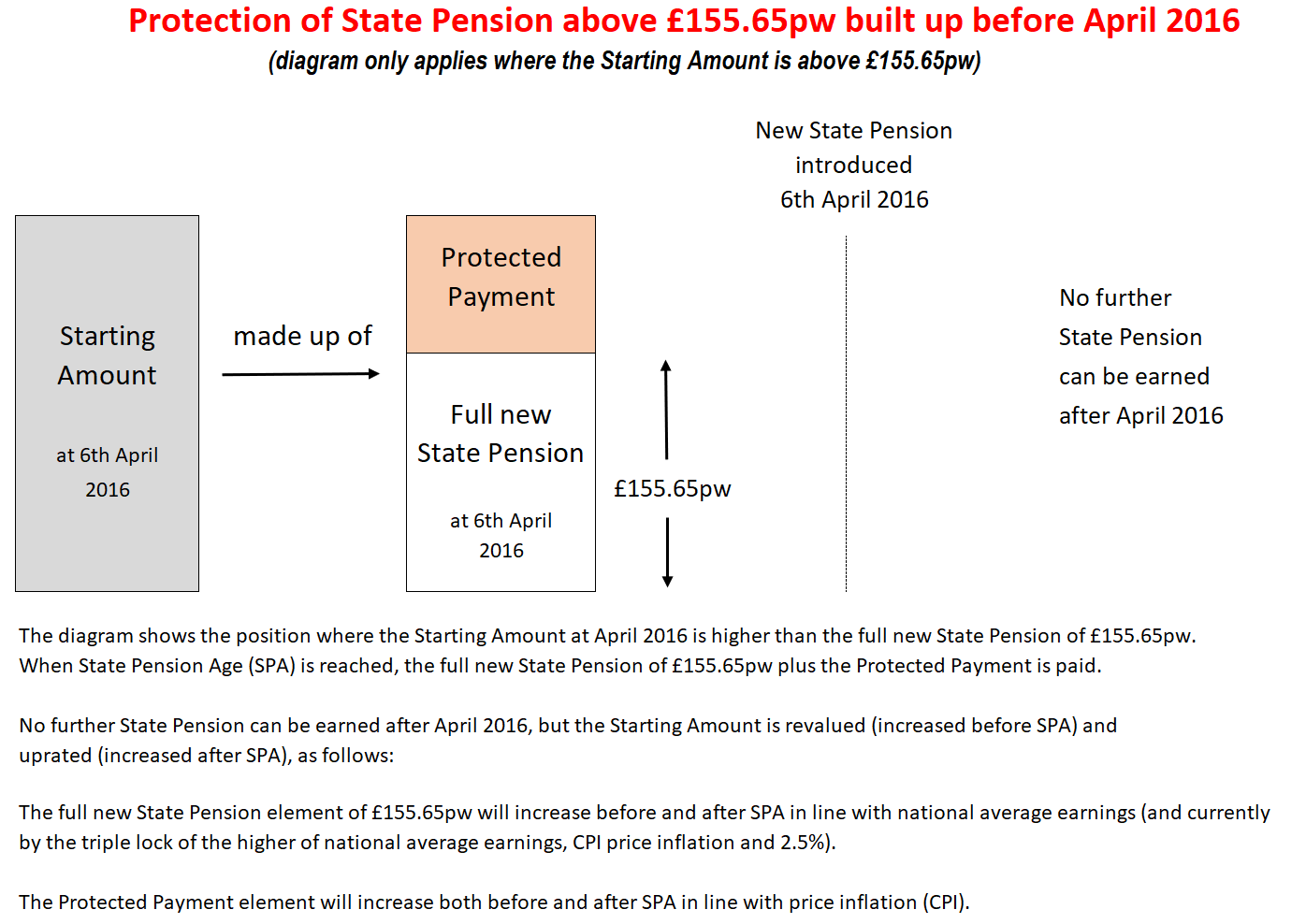
If that additional pension was high enough then the starting amount of the combined basic and additional pension to 2016, could have taken her starting amount of the old state scheme pension at 2016 above the amount of the new state pension (then £155.65pw). This is what seems to have happened here.
Under the transitional rules while your wife couldn't have then earned any further state pension post 2016, she would be entitled at State Pension Age to the full new state pension plus the additional amount by which her starting amount exceeded the full new state pension at 2016. That additional amount is called a protected payment and increases each year in line with CPI price inflation.
So it seems likely her £14k ish state pension is made up of the full new state pension £12,547.60pa (which increases currently in line with the triple lock) plus this protected payment (which increases in line with CPI price inflation).
The state pension is paid four weekly (although you can opt for weekly) so really it is only the four weekly amount that is relevant. The monthly and annual figures are just to help people who think of income in monthly or yearly terms.
The Protected Payment that your wife seems to be entitled to is mentioned briefly here in 3b
Diagrammatically the position looks like this (although the amounts are in 2016 terms)
 I came, I saw, I melted3
-
In your wife's case the transitional amount is likely to have been based on the old system. The old state pension was made up of two components, basic state pension plus additional state pension. If your wife had 30 (qualifying) years or close to 30 years of contributions up to 2016 the old scheme calculation would be something at or close to the full basic state pension plus her additional state pension (SERPS and S2P and graduated pension).
Thanks! Yes it seems highly likely that we have two state pensions being blended here. She started work in 1976, so by 2016 had clocked up 40 years, assuming no contracting-out, which is TBC, if she can find the paperwork.
Re the payment frequency, the gov site most certainly does quote a weekly and a monthly amount. Perhaps the latter is misleading, in that you can't (it sounds) actually get it monthly. After a lifetime of budgeting monthly, I wish you could do.
1 -
So her basic state pension component in the starting amount in 2016 terms would have been £119.30pw (the full basic state pension). So if her additional pension earned to 2016 was more than £36.35pw (in 2016 terms) that would have taken her starting amount above the full new state pension at 2016 of £155.65pw. A reasonably long work history on reasonable earnings and including a reasonably long period contracted-in to the additional state pension (it doesn't have to be all contracted-in) would create that scenario.
Yes the government system does state a monthly and annual amount but you can't be paid monthly.
I came, I saw, I melted1 -
assuming no contracting-out,
It is possible even for people who were contracted out at some point to have accrued a state pension higher than a full New State Pension.
Everything depends on the individual's own record at 6/4/16.
At 6/4/16, two calculations were done to establish the individual's starting amount of New State Pension.
It was the higher of
Old Rules
NI Qualifying Years (max 30)/30 x Full Basic State Pension + (Additional State Pension - Deduction for Contracting Out).
New Rules
{NI Qualifying Years (max 35)/35 x Full New State Pension} - Contracted Out Pension Equivalent.An individual might have more or fewer than 35 qualifying years at that date, might have been contracted out for all, none or some of the qualifying years, might have accrued some S2P from 6/4/2002 onwards even though contracted out……
Some people might have accrued more than a full NSP, some less, some the same amount.
In your wife's case, her calculations gave her a starting amount higher than a full NSP.
She will receive a pension comprising full NSP (which under current rules will increase each year under the triple lock arrangement) plus the protected payment which will increase each April by September CPI in the previous tax year.
https://assets.publishing.service.gov.uk/media/5a7a21fd40f0b66a2fc00201/single-tier-pension-fact-sheet.pdf
2 -
It's possible, I remember my company scheme was contracted out, then there was a fuss later about that maybe being a wrong move.
Normally if you were contracted out of SERPS, the NI contributions were rebated into a personal pension. At one point there was some anxiety that people were giving up guaranteed income, in return for a pension pot reliant on the financial markets. People were then encouraged to think again if they were doing the right thing by opting out, and eventually the arrangements were stopped for everybody. I tried at some point to work out if I was better off from opting out for about 25 years. It was difficult to calculate but as far as I could see it was a bit 50:50, although helped by the fact that the personal pension was quite aggressively invested and had grown a lot.
Re the payment frequency, the gov site most certainly does quote a weekly and a monthly amount. Perhaps the latter is misleading, in that you can't (it sounds) actually get it monthly. After a lifetime of budgeting monthly, I wish you could do.
Although to be more positive, one month of the year you get paid twice !
0 -
The monthly and annual amounts shown on pension forecasts are wholly notional amounts. The annual figure is the weekly amount divided by 7 and multiplied by 365.25 to take account of leap years - completely worthless in my view. The monthly amount is the annual figure divided by 12 and is equally worthless. The only one that matters is the weekly amount of a weekly benefit…
2







Confirm your email address to Create Threads and Reply

Categories
- All Categories
- 355.8K Banking & Borrowing
- 254.9K Reduce Debt & Boost Income
- 456.2K Spending & Discounts
- 248.3K Work, Benefits & Business
- 605.9K Mortgages, Homes & Bills
- 179K Life & Family
- 263.8K Travel & Transport
- 1.5M Hobbies & Leisure
- 16.2K Discuss & Feedback
- 37.7K Read-Only Boards