We’d like to remind Forumites to please avoid political debate on the Forum.
This is to keep it a safe and useful space for MoneySaving discussions. Threads that are – or become – political in nature may be removed in line with the Forum’s rules. Thank you for your understanding.
📨 Have you signed up to the Forum's new Email Digest yet? Get a selection of trending threads sent straight to your inbox daily, weekly or monthly!
Basic SIPP scenario - guidance needed rather than hard advice





Ok, so I am 59 and plan to retire next year when I hit 60.
I work and I am a higher rate tax payer and have a workplace pension starting at 60.
I have just inherited 100k and exploring options for making this work for my retirement.
A SIPP sounds like a good option on the face of it. So I would plough 60k into this and benefit from tax relief.
I understand that the first 20% tax relief is automatically added by my SIPP provider.
First question: i) Does this mean that my 60k is automatically increased to 72k to include the added 20% relief?
In my next tax return (26-27) I will claim 20% more tax relief on the 60k because I will still be in the higher tax bracket in this, my final year of full time employment.
Second question: ii) is that additional 20% simply refunded to my bank by HMRC?
So, I leave my SIPP to grow for a year or two. Hopefully.
At the age of 63 my fund has increased to let's be wild and optimistically say 90k.
I want to take 25% of this out of the SIPP tax free and leave the remaining 68k to continue to grow.
Presumably thereafter any further withdrawals will be at my marginal tax rate (and I would aim to remain in the lower tax bracket).
Third question: back to the beginning. iii) Might I also be able to invest the entire 100k inheritance into a SIPP? I ask this because in the past 3 years I have contributed about 5k per annum to my workplace pension scheme and I might have 'headroom' for more contributions under the SIPP rules.
Thank you in advance and apologies for a level of ignorance.
Comments
-
You would pay £48k and the pension company adds 25% so you end up with £60k in the pension (the £12k basic rate relief is 20% of the gross contribution).
There is no way for you to claim "20% more" relief in the way you describe. The gross contribution increases your basic rate band and your tax liability is calculated on the basis that you have a basic rate band of £97,700, not £37,700. Which might save you an extra 20%. But often it doesn't (it can be more or less).
There might not be any refund due, it depends what your overall Self Assessment calculation shows. But if there is a refund due then yes, it would normally go to your bank. It wouldn't be added to your pension.
If you actually paid £60k it would become £75k with the basic rate relief added.
The main issue with your post is you have given no indication that you can actually pay that much into a pension. Being a higher rate payer means very little, you could earn £40k and have loads of investment income or income from property, neither of which are relevant for how much you are allowed to contribute to a pension.
The earnings you expect to see on your 2026/27 P69 is a good starting point for understanding your options. And whether you have any company benefits reported on a P11D.
0 -
I work and I am a higher rate tax payer and have a workplace pension starting at 60.
To the nearest £1k, how much do you expect to earn (as shown in your P60) this tax year?
How much are you already planning to pay into your work pension this year? And how much is your employer paying into it?
First question: i) Does this mean that my 60k is automatically increased to 72k to include the added 20% relief?
It's £75k. Is your P60 going to say you earned at least £75k this tax year?
In my next tax return (26-27) I will claim 20% more tax relief on the 60k
That's not quite how it works. You'll tell HMRC that you've made a personal pension contribution of £72k, which will increase your basic-rate tax band by £72k (to £122270). Your income tax liability will be recalculated on that basis.
Second question: ii) is that additional 20% simply refunded to my bank by HMRC?
If you're due a refund of overpaid tax, yes that's how it normally works.
Third question: back to the beginning. iii) Might I also be able to invest the entire 100k inheritance into a SIPP?
Potentially, yes.
N. Hampshire, he/him. Octopus Intelligent Go elec / Fuse gas / Vodafone BB / iD mobile. Kirk Hill Co-op member.Economy 7 cap explainer. Gas vs E7 vs peak elec heating costs, Ecoflow Stream, Best kettle :-)
2.72kWp PV facing SSW installed Jan 2012. 11 x 247w panels, 3.6kw inverter. 37 MWh generated, long-term average 2.6 Os.1 -
There's a good basic guide to tax relief on pension contributions here:
Also worth reading: https://www.litrg.org.uk/pensions/paying-pensions/tax-relief-pension-contributions/pension-contributions-tax-relief-limits
I work and I am a higher rate tax payer and have a workplace pension starting at 60.
I have just inherited 100k and exploring options for making this work for my retirement.
If you can't pay all your inheritance into a SIPP, you could consider living on some of the inheritance and delay drawing your workplace pension. If it's a defined contribution scheme, then it'll go on growing. If it's a defined benefit scheme, does it increase because you are 'retiring late' assuming 60 is the scheme's Normal Retirement Age - and by how much?
Googling on your question might have been both quicker and easier, if you're only after simple facts rather than opinions!0 -
As above can you clarify the type of pension you are going to take at 60?
0 -
Starting from scratch and making the basic assumption that you will be paying basic rate tax on your retirement income (meaning that will be your marginal income tax rate). Also you do not already have large DC pension fund built up.
Your best course of action is to pay in enough to your workplace or private pension (SIPP or whatever) to bring you down to the higher rate threshold (£50270), or lower, in this tax year. You can pay in up to the total of your income if you wish (is this is over 60k you can use the carry-forward allowance from previous years). If this makes your take-home pay too small you can live off part of the inheritance.
From the inheritance put the maximum you can into some kind of ISA.
Repeat the above each year until you stop working, or you run the inheritance down to zero.
🐻 A little FIRE lights the cigar0 -
OP has said they are retiring next year.
Googling on your question might have been both quicker and easier, if you're only after simple facts rather than opinions!0 -
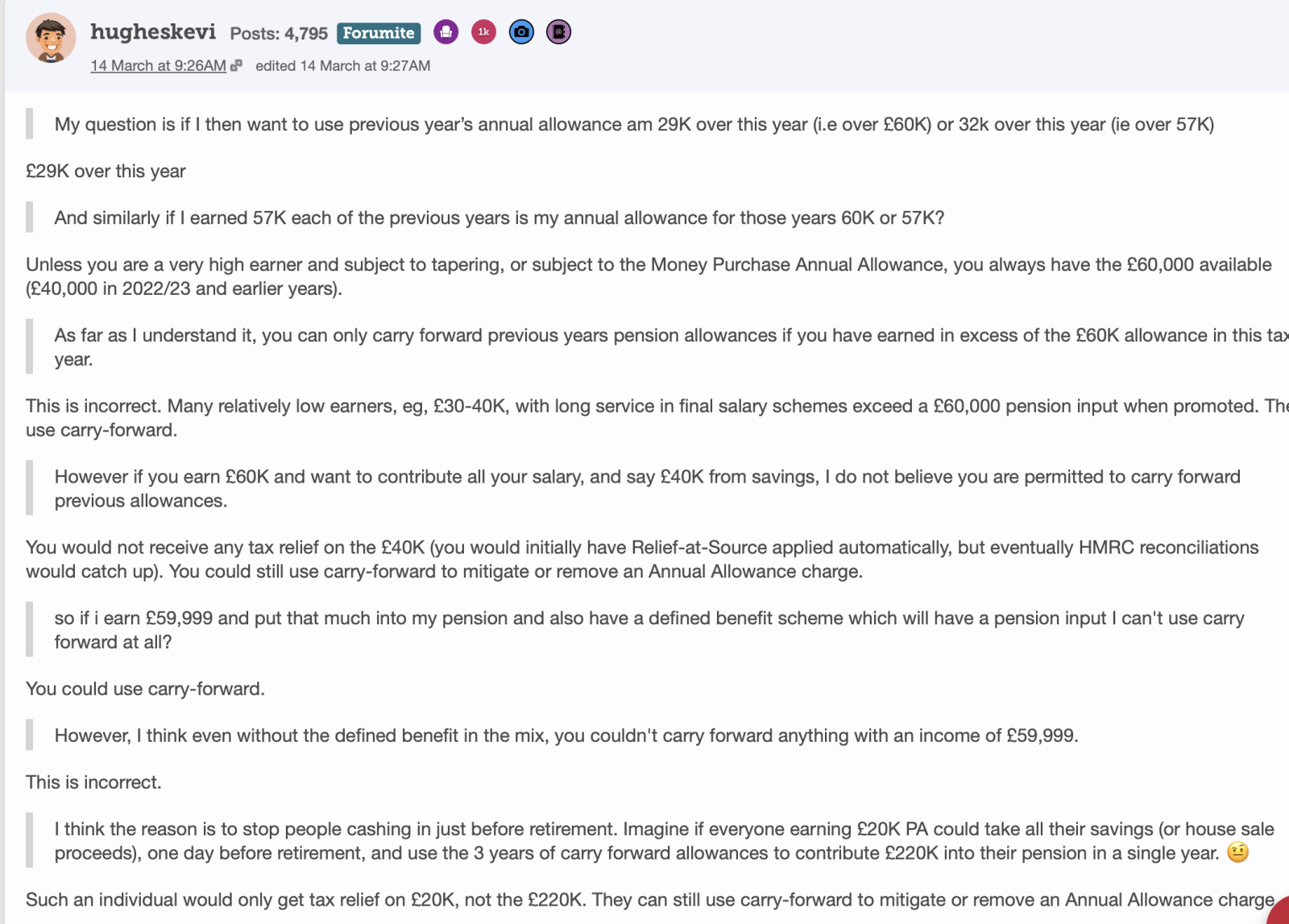
I was in two minds about posting a link to this thread given its complexity: https://forums.moneysavingexpert.com/discussion/6659623/annual-allowance-and-salary/p1
but the post from @hugheskevi correcting a number of misconceptions/misunderstandings about carry forward and earnings makes it worth doing so:
 Googling on your question might have been both quicker and easier, if you're only after simple facts rather than opinions!2





Confirm your email address to Create Threads and Reply

Categories
- All Categories
- 355.8K Banking & Borrowing
- 254.9K Reduce Debt & Boost Income
- 456.2K Spending & Discounts
- 248.3K Work, Benefits & Business
- 606K Mortgages, Homes & Bills
- 179K Life & Family
- 263.8K Travel & Transport
- 1.5M Hobbies & Leisure
- 16.2K Discuss & Feedback
- 37.7K Read-Only Boards