We’d like to remind Forumites to please avoid political debate on the Forum.
This is to keep it a safe and useful space for MoneySaving discussions. Threads that are – or become – political in nature may be removed in line with the Forum’s rules. Thank you for your understanding.
CT Clamps - some Qs.
Comments
-
Very close, thanks.
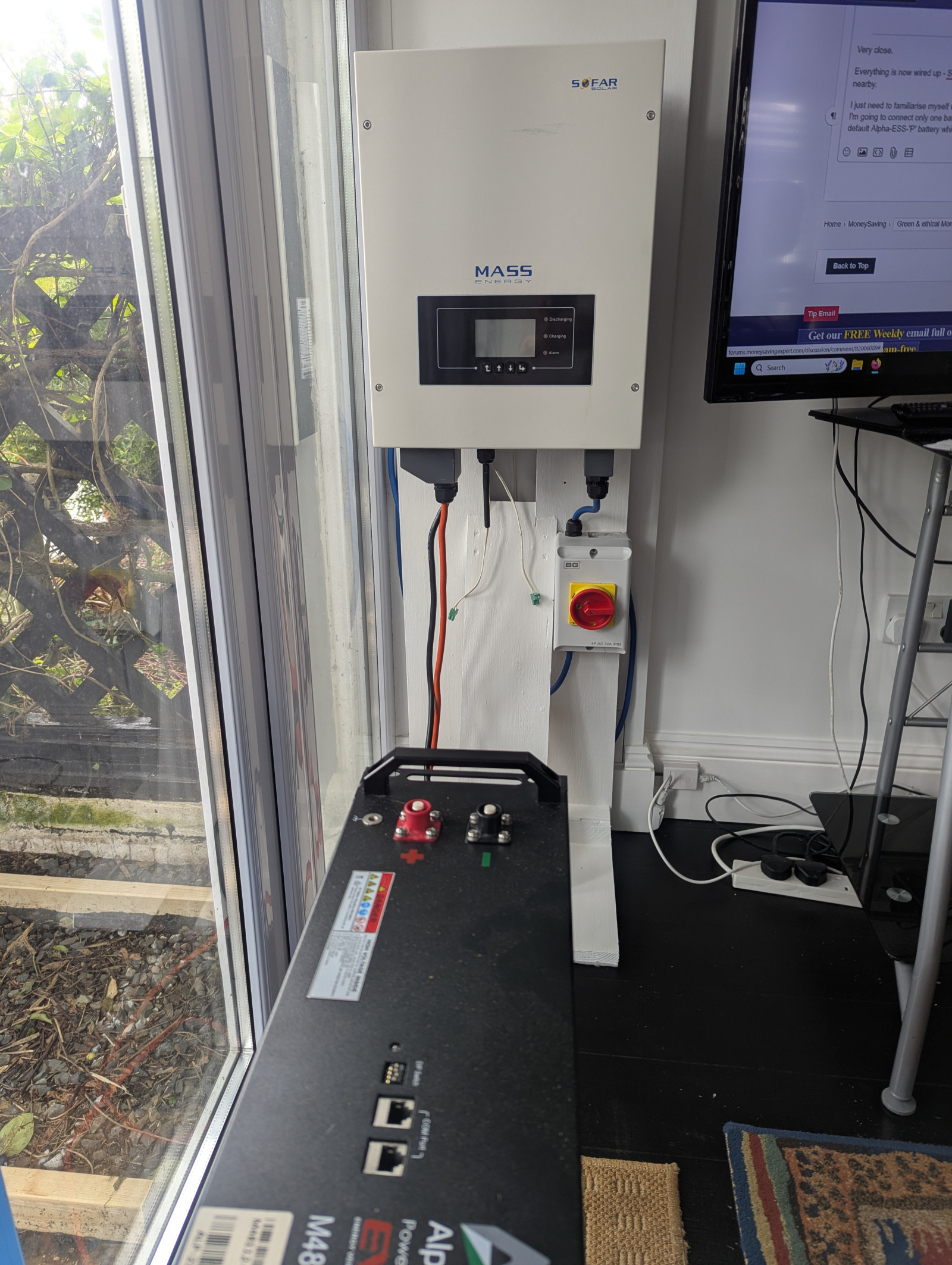
Everything is now wired up - Sofar to a 20A MCB in the main CU, both CTs in place, and one battery sitting nearby.
I just need to familiarise myself with the starting up process, beginning with the battery - the DIP switch settings. I'm going to connect only one battery first. Then it'll be to set up the Sofar. Still not sure whether to go for the default Alpha-ESS-'P' battery which is including in the software, or tweak it for the Parallel version I have.
 1
1 -
Hi,
My experience is that clip on CTs can buzz when not connected up - probably a spark gap or similar limiting the voltage so as to reduce the risk of electrocution.
Don't clip CTs onto wires until they are connected - if the internal protection fails (or they are cheap ones where it has been omitted) then lethal voltages can be present on the CT output.
2 -
Thank you doodling, every day's a school day!
N. Hampshire, he/him. Octopus Intelligent Go elec / Fuse gas / Vodafone BB / iD mobile. Kirk Hill Co-op member.Economy 7 cap explainer. Gas vs E7 vs peak elec heating costs, Ecoflow Stream, Best kettle :-)
2.72kWp PV facing SSW installed Jan 2012. 11 x 247w panels, 3.6kw inverter. 37 MWh generated, long-term average 2.6 Os.0 -
The trouble is one school day only gives a little knowledge...and we all should know that is a dangerous thing!
CTs have a transformer turns ratio to step down the current fron primary to secondary. Under no load conditions that results in a current step down but a big voltage step up. Aa an example a step down current ratio of 100 increases the voltage from the mains to 24,000V ( nominal figures) without a burden resistor.
For instrumentation purposes i.e. measurement, the CT output current is loaded by a burden resistor which reduces the voltage on the output terminals to a known value. ( ohms law)
That burden is essential to make the output voltage calibrated and safe.
Usually for the clip on split core types of CT used for solar etc. the burden resistor is built in rather than on the measuring device.
That makes the CT safe....unless damaged.
As posted before, if one is damaged just replace it !! I have edited my earlier post to respond - just replace if damaged.
1 -
Blimey!
Ok, I'm going to suggest that this is complete bar locks, certainly in the case of these CTs. Why? Because clearly there would be numerous fatalities and explosions taking place across the world if it were the case. And CTs would come emblazoned with lurid warning labels.
I did try an AC voltage reading at the time, tho' min scale on meter was 200V, and it read zero. I was expecting something, so zero was a surprise, but hey.
Edit: That reading could have been at a time of zero draw. The sun has come out this morn, and the CT clamp is buzzin' - I measured 51V across the plug. Pfft - that wouldn't hurt a f
0 -
Hi,
These clip on CTs are used in one of two ways, either as a voltage source or a current source. Those used as a voltage source have a burden resistor built in. Those used as a current source do not but should have some form of voltage limitation (e.g spark gap / zener diode pair / etc.). The current source approach is best in environments with long cabling / electrical noise.
In the current source case the voltage limitation is theoretically unnecessary (providing the CT is wired up before clipping it on) and you could imagine suppliers chasing cost omitting it. In both cases the winding on its own can generate lethal voltages so you are dependant on the components inside the CT to ensure safety - given the low cost of these devices I'm cautious as to how robust the safety measures actually are.
The OPs CT appears to be configured as a current source and I would speculate the buzzing is a spark gap limiting the voltage to a "safe" 50ish volts.
I would NOT advise anyone to clip a CT onto a cable unless the CT is connected to whatever device needs to monitor current.
1 -
I superglued the loose ferrite core, and the buzzing reduced by a huge margin. It also reduces/stops if I squeeze the sides of the body - I think it's clearly just physical vibration.
Anyhoo, once plugged in, it went silent.
0 -
Quite. Thanks for those additional comments.
I should add that my knowledge comment was not aimed at you ( or QrizB) but rather any readers that will pick up posts and then decide they have enough info to try things out without really knowing what they are doing, the risks etc.
1







Confirm your email address to Create Threads and Reply

Categories
- All Categories
- 355.7K Banking & Borrowing
- 254.9K Reduce Debt & Boost Income
- 456.1K Spending & Discounts
- 248.3K Work, Benefits & Business
- 605.8K Mortgages, Homes & Bills
- 179K Life & Family
- 263.6K Travel & Transport
- 1.5M Hobbies & Leisure
- 16.2K Discuss & Feedback
- 37.7K Read-Only Boards