We’d like to remind Forumites to please avoid political debate on the Forum.
This is to keep it a safe and useful space for MoneySaving discussions. Threads that are – or become – political in nature may be removed in line with the Forum’s rules. Thank you for your understanding.
📨 Have you signed up to the Forum's new Email Digest yet? Get a selection of trending threads sent straight to your inbox daily, weekly or monthly!
Buying an annuity, why does RPI get a better output that LPI?





As per the title question.
I've been going on all the annuity tools and calculators and find like for like quotes, RPI gets a better initial payment to customer than LPI.
LPI is apparently limited to a max 2.5% or maybe 5% and I just can't understand why RPI pays out more?
I must be missing something as I normally do.
Any views most appreciated?
Cheers Roger.
Comments
-
If RPI is 10%, then your RPI annuity increases by 10%. Your LPI annuity increases by 2.5%
0 -
Surely the reason you are taking an index-linked annuity is to guard against high inflation?
I've a public sector DB pension which has been in payment for 5 years and increases by September's inflation rate the following April. Only one of the increases in that time has been less than 2.5%. In 2023 it was 10.1%.
If you had been limited to 2.5% increases in each of these years you would have fallen a long way off the pace.
So the LPI quote is capping the insurance companies liability, at your expense.
0 -
I think you have misunderstood the question. But I'm not sure of the answer anyway.
2 -
Are you sure it was LPI (ie RPI capped at 2.5% or 5%) rather than fixed escalation of 2.5% or 5%?
0 -
Yes - I dived in and missed the point of the question as well - apologies. I'm currently asking copilot which agrees it happens, and gives an explanation for it, but I still don't understand it.
Apparently male 65, £100k no guarantee would give £3300-3600 on RPI and £2700-2900 on LPI as a starting price.
1 -
I don't like AI stuff on here - but here is copilot's attempt to explain it to me.
Why RPI is cheaper for insurers to provide than LPIThis is the part that feels counter‑intuitive until you see the mechanics.
1. RPI increases are hedgeable
Insurers hedge RPI annuities using index‑linked gilts.
- If RPI goes up, the gilts they hold also go up.
- Their liability and their assets move together.
- So the risk is hedgeable and predictable.
This means the insurer’s real risk on an RPI annuity is small.
2. LPI increases are not hedgeable
This is the killer.
LPI (0–2.5% or 0–5%) is not a real-world index.There is no LPI gilt market.There is no LPI swap market.There is no way to hedge the cap.
So the insurer is exposed to a nasty asymmetric risk:
- If inflation is low → they must still pay 0%–2.5%
- If inflation is high → they only pay up to the cap, but their hedging assets (RPI gilts) may rise more than their liability
- The mismatch creates unhedgeable volatility
Unhedgeable risk = expensive.
This is why LPI annuities have lower starting incomes.
2 -
What is the floor of the RPI annuity vs the floor for the LPI annuity? i.e. in a deflationary environment.
Even if an insurer finds an RPI annuity easier to hedge due to assets like an Index Linked Gilt I don't see why that would make the annuity rate higher. If anything I can certainly understand why they'd both be priced the same. With the LPI annuity rate the insurer could still own the same asset mix knowing their liability is covered and then would have an unknown upside i.e. profit should inflation run higher than the LPI cap.0 -
The LPI floor is zero.
There is no floor for an RPI annuity. If RPI is negative, your annuity goes down - stated in my annuity’s documents. There is no cap on any increase either.
I would have expected an LPI annuity to pay more thsn an RPI annuity for a given price because the average increase on the former is lower (assuming RPI stays positive).1 -
An uncapped RPI should result in a lower initial payment, unless they have very odd inflation assumptions. RPI however isnt necessarily uncapped and unfloored, have seen many policies which were RPI(0,5) so couldn't deflate and were also capped at 5%.
LPI is floored at 0% and can have a cap of 2.5% or 5%, its also can be based on RPI or CPI.
Hedging isnt my area of expertise but in Long term insurance, as Annuities fall under, you have the concept of Matching Adjustments which basically substantially lowers your capital requirements if you can demonstrate that your assets and liability cashflows are very well matched both normally and in stressed situations. One way of doing this is by using hedges or buying instruments like RPI gilts.
Certainly this can be a problem, its why general insurers who are on the receiving end of a Periodic Payment Order can't just go out and buy an annuity because the PPO payments must adjust inline with the ASHE (basically salary index) and life insurers havent worked out an investment strategy that would meet matching adjustments for this indexation.
Whilst I cannot tell you how they hedged CPI I can certainly say they have a large amount of annuities written on a CPI basis (and similarly things like RPI(0,5)), only a modest amount of longevity swaps but fully qualified for MA reductions worth several billion.
0 -
Just ran quotes on Hargreaves Lansdown
RPI Annuity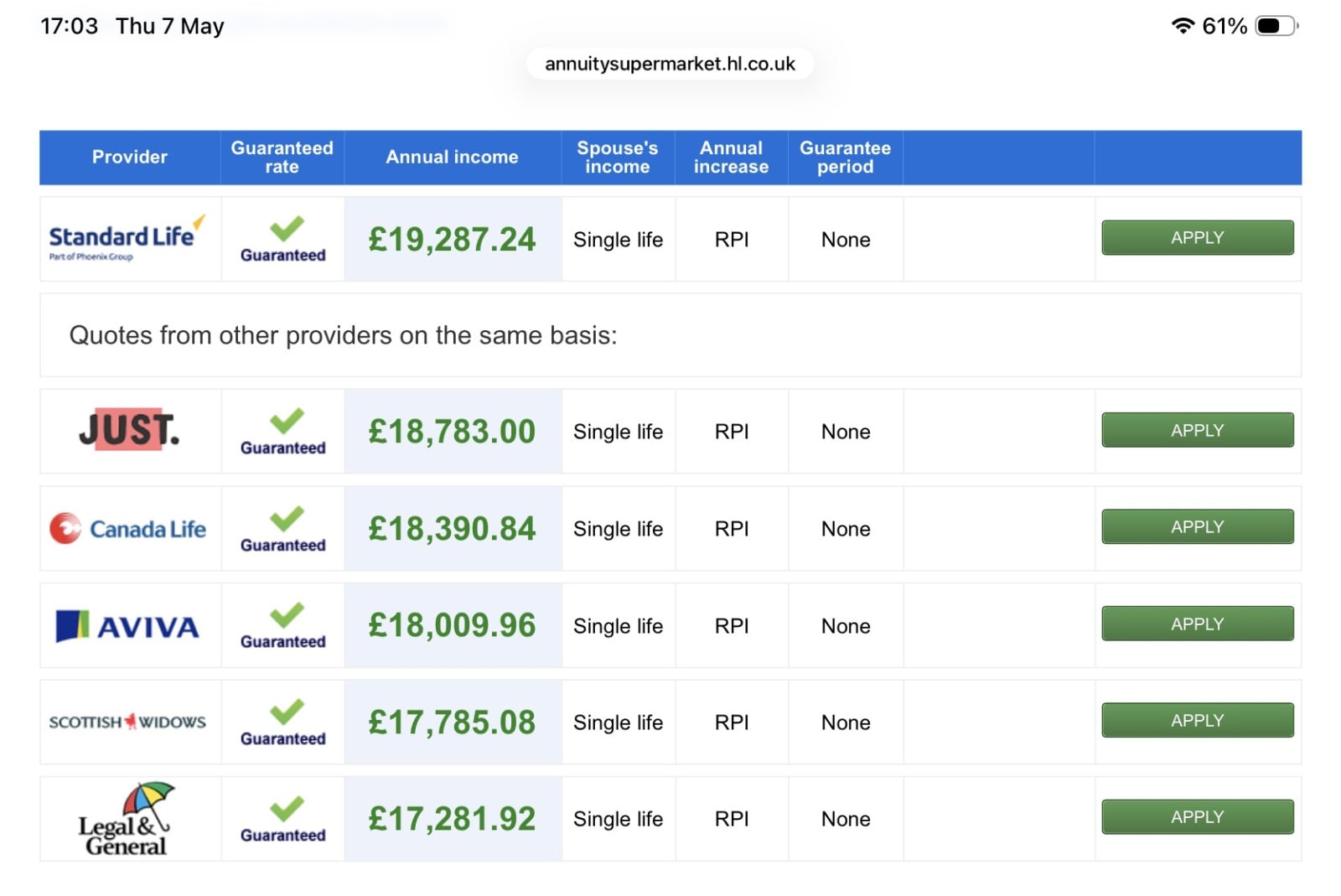
LPI Annuity
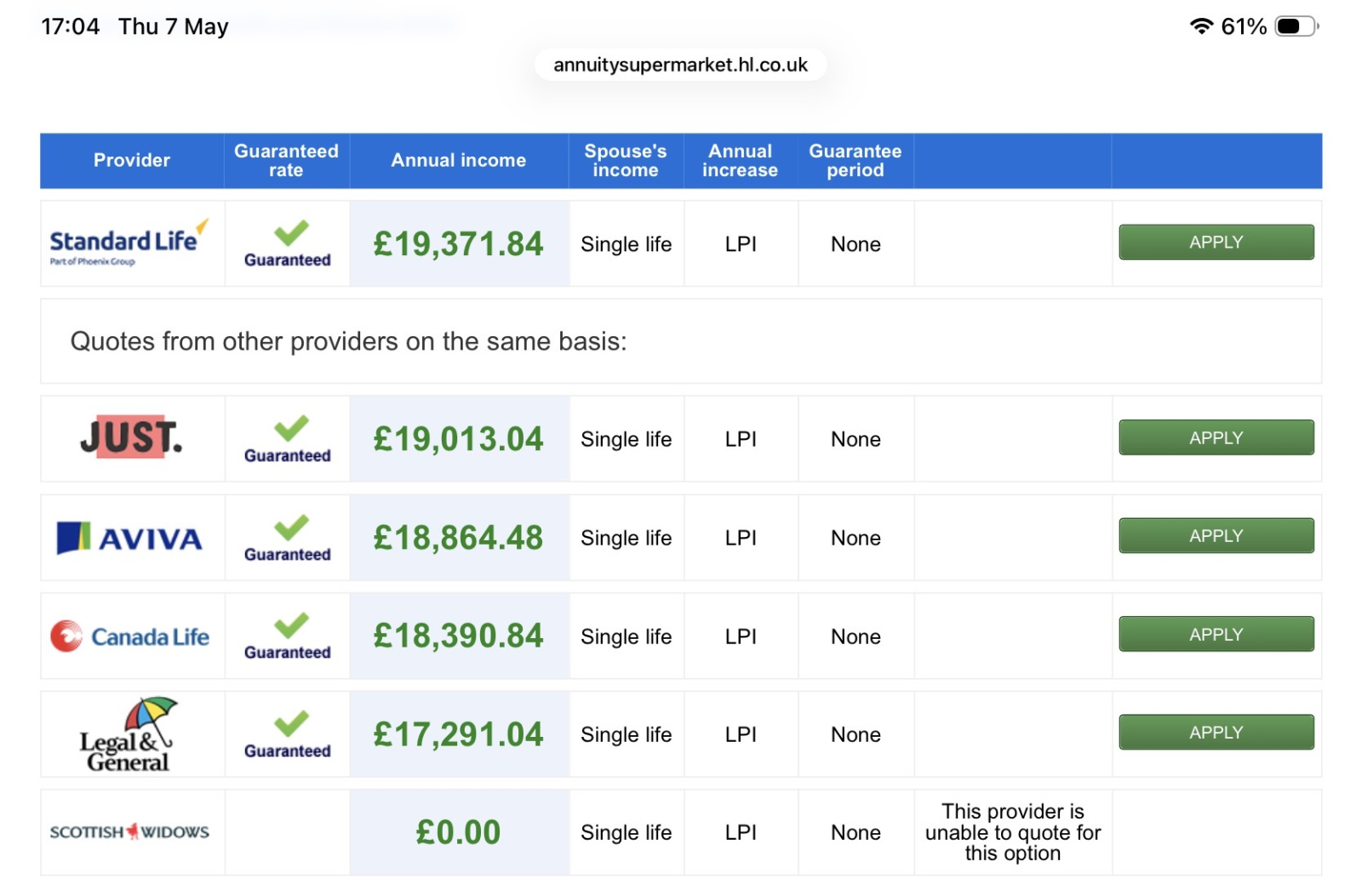
So the LPI annuity is slightly higher, as I suspected in my previous post.
Age 62, £370k purchase money, no health declarations.1









Confirm your email address to Create Threads and Reply

Categories
- All Categories
- 355.8K Banking & Borrowing
- 254.9K Reduce Debt & Boost Income
- 456.2K Spending & Discounts
- 248.3K Work, Benefits & Business
- 605.9K Mortgages, Homes & Bills
- 179K Life & Family
- 263.8K Travel & Transport
- 1.5M Hobbies & Leisure
- 16.2K Discuss & Feedback
- 37.7K Read-Only Boards