We’d like to remind Forumites to please avoid political debate on the Forum.
This is to keep it a safe and useful space for MoneySaving discussions. Threads that are – or become – political in nature may be removed in line with the Forum’s rules. Thank you for your understanding.
POPLA WIN! - Bridge PAM Edmund Halley Way Greenwich





Hello all,
The RK to a private hire vehicle received a PCN for unauthorised parking at Edmund Halley Way in Greenwich near the O2, next to the cable car station. This is typically an area where an Uber driver will wait for passengers to be picked up, as not too far (about 100 metres away) is the dedicated Uber pickup point.
The RK appealed, of course, without naming the driver, and of course, it got rejected.
So now I am at POPLA stage.
Any pointers as to what to focus on in my POPLA appeal?
Is the Ntk POFA compliant?
The NtK:
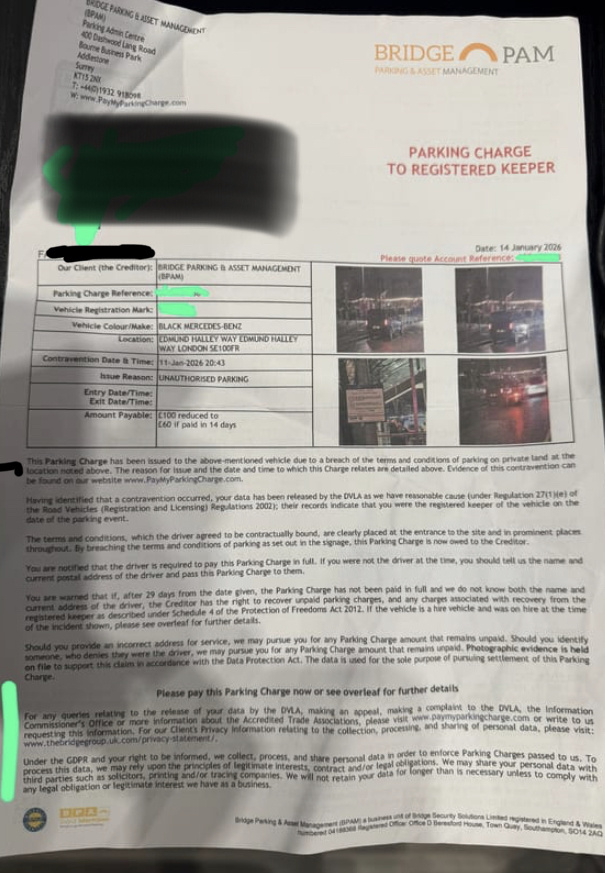

This is the appeal I sent:
__________

________________
They then asked me to identify the driver, which I refused to do.
They then sent me this rejection:


I will of course follow the advise on the newbie and i will post a draft of my POPLA appeal here, but just want to get some pointer for any specifics in my case.
Thank you in advance!
Comments
-
Your name is on your pic so I've redacted it above.It's somewhat similar to this one:
…in that the NTK fails to state a period of parking (at all, in this NTK of yours!).
That looks like a cash cow predatory, hidden CCTV site where the driver had no idea they were being filmed, which breaches the Surveillance Camera CoP and the DPA 2018.
The Code doesn't deal with this but the law does.
A driver cannot consent to being filmed if they don't see UKGDPR based warnings and they cannot have agreed to a parking charge there in the dark. There's no lit or legible signage.
You'd be guessing the terms even if you knew the site was covered by CCTV and 'managed', which the driver clearly didn't.
It looks like a normal road.
And where's the moving footage like the Council would be required to share? Literally nothing tells you whether a passenger was being dropped off/picked up nor does the NTK state how many seconds/minutes passed. Therefore there's no 'period of parking' so the requirements of Schedule 4 are not met.
PRIVATE 'PCN'? DON'T PAY BUT DON'T IGNORE IT (except N.Ireland).
CLICK at the top or bottom of any page where it says:
Home»Motoring»Parking Tickets Fines & Parking - read the NEWBIES THREAD1 -
Thank you! I have updated the original post with your redacted version.
Literally nothing tells you whether a passenger was being dropped off/picked up nor does the NTK state how many seconds/minutes passed. Therefore there's no 'period of parking' so the requirements of Schedule 4 arenot met.
On the NTK, on the evidence pictures itself, there's a timestamp, although very very difficult to see unless you have 20/20 vision or a magnifying glass. But when checking online, the evidence shows clearly the timestamp pictures. Does it change anything regarding this no 'period of parking' point?


 0
0 -
Nope.
Their case is hopeless (no judge would consider a contract was agreed, it's predatory filming and a deliberate trap zone) but your job is to convince the 'nice but dim' POPLA assessor, of your case:
- The period of parking has to be stated in a NTK. It is not.
- Two minutes in darkness isn't a fair or adequate consideration period to see a sign, read it and leave.
- The signs are prohibitive and I can see a red 'NO PARKING' sign there, which means there's no contract offered. No consideration.
PRIVATE 'PCN'? DON'T PAY BUT DON'T IGNORE IT (except N.Ireland).
CLICK at the top or bottom of any page where it says:
Home»Motoring»Parking Tickets Fines & Parking - read the NEWBIES THREAD1 -
What do you think of the POPLA draft?
Dear POPLA,
On the 14th January 2026, Bridge Parking & Asset Management (BPAM) issued a parking charge and it was posted to me (as keeper of the vehicle), highlighting that the above-mentioned vehicle had been in “breach of the terms and conditions” due to unauthorised parking.
As the registered keeper I wish to refute these charges and have this PCN cancelled on the following grounds:
1.The Notice to Keeper does not comply with Protection Of Freedoms Act 2012, schedule 4, paragraph 9, subparagraph 2 e and subparagraph 2 f and is therefore not POFA compliant.
2. The Notice to Keeper does not comply with Protection Of Freedoms Act 2012, schedule 4, paragraph 9, subparagraph 2 a and is therefore not POFA compliant; no keeper liability
3. No parking event occurred
4. No consideration period was given.
5. Forbidding sign, no contractual offer
6. The operator has not shown that the individual it is pursuing is in fact the driver who may have been potentially liable for the charge
7. Ineligible signage
8. Non-Compliance with the Surveillance Camera Code of Practice
9. No evidence of Landowner Authority - the operator is put to strict proof of full compliance with the BPA Code of Practice
Please see below for details
1)This Notice to Keeper (NTK) is not compliant with the Protection of Freedoms Act 2012 (POFA) due to not giving the warning required under schedule 4 paragraph 9 sub-paragraph 2f. Under schedule 4, paragraph 9 (2f) of the POFA, the notice must warn the keeper that if, after the period of 28 days beginning with the day after that on which the notice is given—
(i) the amount of the unpaid parking charges specified under paragraph (d) has not been paid in full, and
(ii) the creditor does not know both the name of the driver and a current address for service for the driver,
the creditor will (if all the applicable conditions under this Schedule are met) have the right to recover from the keeper so much of that amount as remains unpaid; An operator can only establish the right to recover any unpaid parking charges from the keeper of a vehicle if certain conditions are met as stated in paragraph 9. BPAM have failed to fulfil these conditions in the NTK issued.
Furthermore, the POFA 2012 Schedule 4 Paragraph9(2)(e) dictate that the NtK must “state that the creditor does not know both the name of the driver and a current address for service for the driver. This cannot be found in the NtK sent.
2) NtK fails to specify any “period of parking” as required by POFA 2012 paragraph9(2)(a) – No keeper liability
The Notice to Keeper (NTK) fails to comply with the strict requirements of Schedule 4 of the Protection of Freedoms Act 2012.
In particular:
- The NTK fails to specify any “period of parking” as required by paragraph9(2)(a)
- The operator relies on a single timestamp (from one of multiple images)
- The operator relies on images taken within 2 minutes. Since there is no seconds indication on the timestamp, the image may be within 62 seconds.
A short sequence of timestamps does not evidence a period of parking — it merely shows the vehicle was present momentarily. As a result, the NTK is non-compliant and keeper liability does not arise. Only the driver could be liable, and the operator has not identified the driver.
In the photo’s, it shows another car in front of the vehicle and a motorcycle filtering passed the vehicle which may indicate that there was traffic in front of the driver and the driver may be moving from the place but is unable to do so due to the traffic.
Furthermore, it is not enough time in darkness for a fair or adequate consideration period to see an unlit or ineligible sign, read it, and leave.
This is alone is fatal to the charge. Since there are numerous points that does not comply with POFA 2012, there keeper cannot be held liable for the charged. The NtK can only hold the driver liable. Since the driver is not identified, the charge must cancelled.
3) No parking event occurred — passenger set down is exempt activity.
The photos taken was purposely taken at an angle that the other side of the vehicle, where passengers can alight and be set down, was not able to be seen. Given that the vehicle is a private hire vehicle (PHV) with Transport for London (TfL), and the area is a dedicated area for Uber passengers to be picked up and dropped off, it is likely that the vehicle was there to pick up/drop off passengers. Stopping momentarily to pick up or drop off passengers does not constitute parking.
The MHCLG Statutory Code of Practice (which represents the Government’s position on what private parking operators should be held to) explicitly states that a “period of parking” does not include passenger pick up or set down, which is exempt activity. TfL guideline also gives exemptions for PHV to drop off or pick up passengers on single and double yellow and red lines. (PLEASE SEE XXXXX).
The vehicle was briefly stationary for some seconds where a passenger may have alighted. The exact period cannot be determined due to the lack of whole evidence. This is precisely the type of activity the Code exempts from enforcement. The operator has provided no evidence that the driver left the vehicle, that the vehicle was stationary for any meaningful period beyond the exempt activity, or that any act of parking, as distinct from a brief stop, occurred. A bare assertion that the vehicle was “unauthorised parking” is wholly insufficient. The operator is put to strict proof that a parking event, as opposed to an exempt set down, took place.
4) No consideration period was given.
No consideration period not observed. Even if POPLA were to find that a parking event occurred (which is denied), the duration of less than 2 minutes falls entirely within the mandatory consideration period required by the BPA Code of Practice. The Code requires operators to allow motorists sufficient time upon entering a site to locate signage, read and understand the terms, and decide whether to accept them or leave. No reasonable driver could be expected to do any of these things within the time. No contract could therefore have been formed, and no breach can arise. The charge must be cancelled on this ground alone.
5) The sign term was a prohibition, not a contractual offer.
The signage does not offer an invitation to park on certain terms. The terms are forbidding. POPLA must consider whether a contract was on offer, and it cannot have been, if parking is prohibited. The required basic elements of contract law are not met: no consideration (nothing of value) has been offered to the driver.
The signage at this site does not make any genuine contractual offer to park. Instead, the terms are forbidding in nature, stating what is not permitted rather than inviting drivers to park on certain terms. Such wording cannot form the basis of a legally binding contract.
For a contract to be formed under Contract law, there must be:
- An offer,
- Acceptance, and
- Consideration (something of value exchanged).
Here, no consideration is offered to the driver. The signage seeks to prohibit parking with ‘No parking’ sign, which is not a contractual offer but rather a unilateral prohibition. A driver cannot accept a “contract” that does not exist, and no payment or benefit is being offered in return for compliance.
This position is supported by case law:
- UKPC v Masterson: The court held that a prohibitive sign is incapable of forming a contract. The only possible cause of action would be trespass, which only the landowner – not a parking operator – has standing to pursue.
- PCM (UK) v Bull: The judge similarly ruled that where signage is forbidding in nature, no contract can be established. Instead, it amounts at most to a matter of trespass, which again only the landowner may enforce.
Accordingly, POPLA must find that no contract was capable of being formed in this case. The signage is prohibitive in nature, meaning any alleged contravention could only amount to trespass. Only the landowner has the legal standing to pursue matters of trespass, not BPAM. Therefore, BPAM has no lawful basis to enforce this charge.
6) The operator has not shown that the individual who it is pursuing is in fact liable for the charge.
In cases with a keeper appellant, yet no POFA 'keeper liability' to rely upon, POPLA must firstconsiderwhethertheyareconfidentthat the Assessor knows who the driver is, based on the evidence received. No presumption can be made about liability whatsoever. At no point have BPAM provided any proof as to the identity of the driver of the vehicle; nor have I provided them with the identity of the driver (nor do I intend to).
Where a charge is aimed only at a driverthen,ofcourse,nootherpartycanbetoldtopay.I am the appellant throughout (as I am entitled to be), and as there has been no admission regarding who was driving,and no evidence has been produced, it has been held by POPLA on numerous occasions, that a parking charge cannot be enforced against a keeper without a valid Notice to Keeper.
As the keeper of the vehicle, it is my right to choose not to name the driver, yet still not be lawfully held liable if an operator is not using or complying with Schedule 4. This applies regardless of when the first appeal was made because the fact remains I am only the keeper and ONLY Schedule 4 of the POFA (or evidence of who was driving) can cause a keeper appellant to be deemed to be the liable party.
The burden of proof rests with the Operator, because they cannot use the POFA in this case, to show that I have personally not complied with terms in place on the land and show that I am personally liable for their parking charge.
Furthermore, the vital matter of full compliance with the POFA 2012 was confirmed by parking law expert barrister, Henry Greenslade, the previous POPLA Lead Adjudicator, in 2015:
Understanding keeper liability - “There appears to be continuing misunderstanding about Schedule 4. Provided certain conditions are strictly complied with, it provides for recovery of unpaid parking charges from the keeper of the vehicle.
There is no ‘reasonable presumption’ in law that the registered keeper of a vehicle is the driver. Operators should never suggest anything of the sort.Further, a failure by the recipient of a notice issued under Schedule 4 to name the driver, does not of itself mean that the recipient has accepted that they were the driver at the material time. Unlike, for example, a Notice of Intended Prosecution where details of the driver of a vehicle must be supplied when requested by the police, pursuant to Section 172 of the Road Traffic Act 1988, a keeper sent a Schedule 4 notice has no legal obligation to name the driver. If {POFA 2012 Schedule 4 is} not complied with then keeper liability does not generally pass."
Therefore, no lawful right exists to pursue unpaid parking charges from myself as keeper of the vehicle, where an operator is NOT attempting to transfer the liability for the charge using the Protection of Freedoms Act 2012.
7) Ineligible sign – No contract form
I would contend that the signs (wording, position and clarity) fail to properly inform the driver of the terms and any consequences for breach. As such, the signs were not so prominent that they 'must' have been seen by the driver. A driver cannot read a small, unlit, ineligible signs whilst driving a motor vehicle as this is illegal under the Road Traffic Act 1988. If the driver was to read it, they would need to stop the car, and read it, which can be considered as causing an obstruction against the Road Traffic Act, or the driver will be driving without due care and attention which is another against the Road Traffic Act. Since equity cannot allow these types of offence to be put into a contract, the contract becomes null and void. Since this private land has public access, the Road Traffic Act are enforced on this land.
It is not reasonable or adequate that the driver would be able to read the sign whilst driving without driving ‘without attention and due care’ without stopping the car.
The Private Parking Sector Single Code of Practice (which came into force on 1 October 2024 and now applies to all BPA and IPC members including BPAM) requires that:
- Signage must be clear, prominent, legible, and unambiguous;
- Signage must be visible at the entrance and from parking spaces;
- The parking charge amount must be clearly displayed as one of the most prominent terms;
- Terms and conditions must be readable before the motorist decides to remain.
The signs are unlit, and small and difficult to read, insufficient to alert the motorist of the terms. I put the operator to strict proof that the signage was adequately illuminated and legible to a motorist arriving in darkness. Signs that may be readable in daylight do not necessarily meet the standard of being "clear, prominent and legible" after dark. I further put the operator to strict proof as to: the size of the lettering for the most onerous term (the parking charge itself); the number and positioning of signs; and whether the signs were visible and readable from the point at which a driver must decide whether to remain. Generic photographs or promotional images taken at different times or in different lighting conditions should not be accepted as evidence of the signage conditions on the evening in question.
8) Non-Compliance with the Surveillance Camera Code of Practice
BPAM operates ANPR surveillance cameras at this site. The use of ANPR constitutes surveillance under the Protection of Freedoms Act 2012, Part 2, Chapter 1. The Surveillance Camera Commissioner's Code of Practice sets out 12 guiding principles for the use of surveillance cameras, including requirements for proportionality, transparency, and clear signage informing individuals that surveillance is in operation and how their data will be processed. The evidence in this matter was obtained by an operative using a personal camera to photograph my vehicle. I contend that this constitutes intrusive surveillance and the processing of personal data within the meaning of the Data Protection Act 2018 and the UK GDPR. The photographs disclose angles and positioning which clearly demonstrate that the operative positioned themselves across the road and deliberately out of sight of motorists, rather than operating openly and transparently. This shows that the recording was carried out covertly, with the apparent intention of capturing images without the knowledge of drivers.
Such conduct is contrary to the principles set out in the ICO Code of Practice for Surveillance Cameras, which requires that surveillance must be overt, fair, proportionate, and carried out in a manner that is transparent to those affected. The deliberate concealment of the operative and the use of a body-worn camera to target vehicles in this manner cannot reasonably be described as fair or responsible parking management. Instead, it amounts to predatory behaviour designed to generate parking charges rather than to manage parking effectively.
No clear or prominent signage warned that personal cameras were in use, nor was there any information explaining that personal data was being captured for enforcement purposes. In the absence of transparency and lawful processing, the operator’s evidence has been obtained unfairly and in breach of statutory requirements. I submit that this approach amounts to entrapment rather than legitimate parking control. POPLA should therefore treat this evidence with considerable caution and afford it little or no weight.
I put the operator to strict proof that it complied with all relevant provisions of the Surveillance Camera Code of Practice and that adequate signage was displayed notifying motorists of the ANPR surveillance in accordance with the Code.
9) As this operator does not have proprietary interest in the land then I require that they produce an unredacted copy of the contract with the landowner.
The contract and any 'site agreement' or 'User Manual' setting out details including exemptions - such as any 'genuine customer' or 'genuine resident' exemptions or any site occupier's 'right of veto' charge cancellation rights - is key evidence to define what this operator is authorisedtodoandanycircumstanceswherethelandowner/firmsonsiteinfact have a right to cancellation of a charge. It cannot be assumed, just because an agent is contracted to merely put some signs up andissueParkingChargeNotices,thattheagentis alsoauthorisedtomakecontractswithalloranycategoryofvisitingdriversand/ortoenforce the charge in court in their own name (legal action regarding land use disputes generally being a matter for a landowner only).
Paragraph 7 of the BPA CoP defines the mandatory requirements and I put thisoperatorto strict proof of full compliance:
7.2 If the operator wishes to take legal action on any outstanding parking charges, they must ensure that they have the written authority of the landowner (or their appointed agent) prior to legal action being taken.
7.3The written authorisation must also set out:
a) the definition of the land on which you may operate, so that the boundaries of the land can be clearly defined
b) any conditions or restrictions on parking control and enforcement operations, including any restrictions on hours of operation
c) any conditions or restrictions on the types of vehicles that may, or may not, be subject to parking control and enforcement
d ) who has the responsibility for putting up and maintaining signs
e) the definition of the services provided by each party to the agreement
It cannot be assumed, just because an agent is contracted to merely put some signs up and issue Parking Charge Notices, that the agent is also authorised to make contracts with all or any category of visiting drivers and/or to enforce the charge in court in their own name (legal action regarding land use disputes generally being a matter for a landowner only).
Any contractual proof will have to fulfil what is required in the PPSCoP. The operator is required to provide clear and accurate information about parking restrictions and is prohibited from implying they have statutory enforcement powers, which was not the case here.
14.1. Where controlled land is being managed on behalf of a landowners), before a parking charge can be issued written confirmation must be obtained by the parking operator from the landowners) covering:
a) the identity of the landowners(s);
b) a boundary map of the land to be managed;
c) such byelaws as may apply to the land relating to the management of parking;
d) the permission granted to the parking operator by the landowners) and the duration of that permission
e) the parking terms and conditions that are to be applied by the parking operator, including as appropriate the duration of free parking permitted, parking tariffs, and specific permissions and exemptions, e.g. for staff, residents or those stopping for short periods such as taxi and minicab drivers, delivery drivers and couriers;
the means by which parking charges will be issued;
NOTE 1: For example, to the windscreen or through the post.
g) responsibility for obtaining relevant consents e.g. planning or advertising consents relating to signs
h) the obligations under which the parking operator is working, in compliance with this Code and as a member of an ATA;
i) notification of the documentation that the parking operator may be required to supply on request to authorised bodies detailing the relationship with the landowner; and
j) the parking operator's approach to the handling of appeals against parking charges.
NOTE 2: Where byelaws have been made, which prohibit the issuance of a parking charge, unless specific legal provision has been made to suspend them, they take precedence and therefore careful consideration must be given to ensuring that the parking management arrangements are consistent with them.
NOTE 3: Particular care is needed to establish appropriate contractual terms, including the application of parking terms and conditions, in respect of controlled land where leaseholders may have rights that cannot be qualified or overruled e.g. by imposing a requirement on the resident of an apartment block to display a permit to park in contravention of their rights under their lease, or to ensure that free parking periods do not breach planning consents.
I therefore request that POPLA uphold my appeal and cancel this PCN
Kind regards,
0 -
7. Ineligible signageYou mean illegible!
I haven't had time to look properly but remove the old BPA CoP para 7 quotes from your point about landowner authority. Instead quote only clause 14 and Appendix G from the Joint CoP.
PRIVATE 'PCN'? DON'T PAY BUT DON'T IGNORE IT (except N.Ireland).
CLICK at the top or bottom of any page where it says:
Home»Motoring»Parking Tickets Fines & Parking - read the NEWBIES THREAD0 -
Thank you, I have changed all "Ineligible" to "Illegible". Forgive my incompetence, I am clearly ineligible to be a proofreader 😆
I have some time to submit the POPLA appeal so no rush.Here is my updated point for point 9, landowner authority. Let me know if this and all the other points are good enough, please. Thank you!
9) As this operator does not have proprietary interest in the land then I require that they produce an unredacted copy of the contract with the landowner.
The contract and any 'site agreement' or 'User Manual' setting out details including exemptions - such as any 'genuine customer' or 'genuine resident' exemptions or any site occupier's 'right of veto' charge cancellation rights - is key evidence to define what this operator is authorised to do and any circumstances where the landowner/firms on site in fact have a right to cancellation of a charge. It cannot be assumed, just because an agent is contracted to merely put some signs up and issue Parking Charge Notices, that the agent is also authorised to make contracts with all or any category of visiting drivers and/or to enforce the charge in court in their own name (legal action regarding land use disputes generally being a matter for a landowner only).It cannot be assumed, just because an agent is contracted to merely put some signs up and issue Parking Charge Notices, that the agent is also authorised to make contracts with all or any category of visiting drivers and/or to enforce the charge in court in their own name (legal action regarding land use disputes generally being a matter for a landowner only).
Witness statements are not sound evidence of the above, often being pre-signed, generic documents not even identifying the case in hand or even the site rules. A witness statement might in some cases be accepted by POPLA but in this case I suggest it is unlikely to sufficiently evidence the definition of the services provided by each party to the agreement.
Nor would it define vital information such as charging days/times, any exemption clauses, grace periods (which I believe may be longer than the bare minimum times set out in the BPA CoP) and basic but crucial information such as the site boundary and any bays where enforcement applies/does not apply. Not forgetting evidence of the only restrictions which the landowner has authorised can give rise to a charge, as well as the date that the parking contract began, and when it runs to, or whether it runs in perpetuity, and of course, who the signatories are: name/job title/employer company, and whether they are authorised by the landowner to sign a binding legal agreement.
Any contractual proof will have to fulfil what is required in the PPSCoP. The operator is required to provide clear and accurate information about parking restrictions and is prohibited from implying they have statutory enforcement powers, which was not the case here.
14.1. Where controlled land is being managed on behalf of a landowners), before a parking charge can be issued written confirmation must be obtained by the parking operator from the landowners) covering:
a) the identity of the landowners(s);
b) a boundary map of the land to be managed;
c) such byelaws as may apply to the land relating to the management of parking;
d) the permission granted to the parking operator by the landowners) and the duration of that permission
e) the parking terms and conditions that are to be applied by the parking operator, including as appropriate the duration of free parking permitted, parking tariffs, and specific permissions and exemptions, e.g. for staff, residents or those stopping for short periods such as taxi and minicab drivers, delivery drivers and couriers;
the means by which parking charges will be issued;
NOTE 1: For example, to the windscreen or through the post.
g) responsibility for obtaining relevant consents e.g. planning or advertising consents relating to signs
h) the obligations under which the parking operator is working, in compliance with this Code and as a member of an ATA;
i) notification of the documentation that the parking operator may be required to supply on request to authorised bodies detailing the relationship with the landowner; and
j) the parking operator's approach to the handling of appeals against parking charges.NOTE 2: Where byelaws have been made, which prohibit the issuance of a parking charge, unless specific legal provision has been made to suspend them, they take precedence and therefore careful consideration must be given to ensuring that the parking management arrangements are consistent with them.
NOTE 3: Particular care is needed to establish appropriate contractual terms, including the application of parking terms and conditions, in respect of controlled land where leaseholders may have rights that cannot be qualified or overruled e.g. by imposing a requirement on the resident of an apartment block to display a permit to park in contravention of their rights under their lease, or to ensure that free parking periods do not breach planning consents.
Annex G of Joint CoP
G.1 Purpose
Where a parking operator is to manage parking on privately owned land, it is important that the parking operator and the landowner are both clear about the approach the parking operator intends to take, the terms and conditions they will apply, the regulatory constraints within which they are working, and the respective responsibilities of the landowner and the operator in respect of the management of the land.Hence, the purpose of this document is:
• to confirm that the landowner has appointed the operator to manage the land;
• to confirm that the landowner has been informed and has properly considered the This example does not cover the management of land governed by byelaws, where specific provision would need to be made to cover their extent and the legal remedies available for their enforcement. issues relating to management of the land when appointing the operator including all terms and conditions (e.g. restrictions, parking tariffs and parking charges, and exemptions) to be applied by the operator to third parties in managing the land;
• to confirm the identity of the landowner;
• to confirm that the landowner has been provided with a copy of the Code and is aware of the obligations of all parties under the Code; and
• to confirm that all provisions relating to the terms and conditions (including restrictions, parking tariffs and parking charges, and exemptions) to be applied by the operator to third parties in managing the land are complete and accurately and consistently cover the operator’s duties under the contract under which the operator is to manage the land.This document is not intended to create any new legal relationship between the landowner and the operator outside the contract under which the operator is to manage the land. This document may be disclosed on request (e.g. from those appealing against a parking charge) and will form part of the checks undertaken by the ATA when accrediting the operator. [NB – Landowners may wish to reserve the right to approve release].
0 -
I used to proofread legal documents for a major bank years ago, so I'm eligible!
😁
Remove the old blurb about witness statements not being enough, because POPLA think they are & it will annoy the Assessor, to the point of pushing back on that!
Instead:
Copy & adapt part of the version of POPLA Appeal 'landowner authority' point I wrote for someone about Horizon at Hove Tesco. Not the bit about 'extra signs' needed to communicate new regulations, just the bit concentrating on Clause 14 and Appendix G. It was something I wrote just a few months ago.
PRIVATE 'PCN'? DON'T PAY BUT DON'T IGNORE IT (except N.Ireland).
CLICK at the top or bottom of any page where it says:
Home»Motoring»Parking Tickets Fines & Parking - read the NEWBIES THREAD2 -
OKay noted; I assume this is the on you are referring to.
So here is my point 9:9) Landowner Authority
The operator has to comply with all requirements in the Joint Code. They must show that they have complied with the new Code regarding site-specific dates and details of landowner authority at this site.The following Joint Code Clauses apply:
ANNEX G: Sample landowner/operator notice, as well as clauses G1, G2 and G3 and clause 14 - 'Relationship with landowner' which says:
'Where controlled land is being managed on behalf of a landowner(s), before a parking charge can be issued written confirmation must be obtained by the parking operator from the landowner(s) covering:
a) the identity of the landowner(s)
b) a boundary map of the land to be managed;
c) such byelaws as may apply to the land relating to the management of parking;
d) the permission granted to the parking operator by the landowner(s) and the duration of that permission
e) the parking terms and conditions that are to be applied by the parking operator, including as appropriate the duration of free parking permitted, parking tariffs, and specific permissions and exemptions, e.g. for staff, residents or those stopping for short periods such as taxi and minicab drivers, delivery drivers and couriers;
f) the means by which parking charges will be issued;
g) responsibility for obtaining relevant consents e.g. planning or advertising consents relating to signs
h) the obligations under which the parking operator is working, in compliance with this Code and as a member of an ATA;
i) notification of the documentation that the parking operator may be required to supply on request to authorised bodies detailing the relationship with the landowner;
and j) the parking operator’s approach to the handling of appeals against parking charges.'I put BPAM to strict proof to show that they have Landowner authority that strictly complies with the Joint Code and Clause 14.
Please also confirm that all the other points are fine here.0 -
Yes I reckon it's all good to go.
PRIVATE 'PCN'? DON'T PAY BUT DON'T IGNORE IT (except N.Ireland).
CLICK at the top or bottom of any page where it says:
Home»Motoring»Parking Tickets Fines & Parking - read the NEWBIES THREAD1 -
Quick and easy! The operator has withdrawn the appeal at POPLA! Thank you all once again!
The operator has contacted us and told us that they have withdrawn your appeal.
5



Confirm your email address to Create Threads and Reply

Categories
- All Categories
- 354.5K Banking & Borrowing
- 254.4K Reduce Debt & Boost Income
- 455.4K Spending & Discounts
- 247.4K Work, Benefits & Business
- 604.2K Mortgages, Homes & Bills
- 178.5K Life & Family
- 261.7K Travel & Transport
- 1.5M Hobbies & Leisure
- 16.1K Discuss & Feedback
- 37.7K Read-Only Boards