We’d like to remind Forumites to please avoid political debate on the Forum.
This is to keep it a safe and useful space for MoneySaving discussions. Threads that are – or become – political in nature may be removed in line with the Forum’s rules. Thank you for your understanding.
Is RNRB tapering calculated before or after gifts to charity?




I asked ChatCPT whether gifts in wills to charity are taken into account for assessing the net estate for RNRB purposes. Say, including a late spouse’s allowance, you leave £2.7m of assets and gift £700k to charity. Does your estate receive all or none of the RNRB? I got two contradictory answers - see below - and was asked which I ‘prefer’. I prefer the correct one! Can someone please help?
Response 1.
Start with:
- Total assets
- Minus debts and liabilities
- Minus funeral expenses
- Minus any exemptions (including charitable gifts)
Charitable gifts are fully exempt from IHT, so they reduce the value of the estate before tapering is assessed.
Example
Estate worth: £2.1 million
Charitable gift: £150,000
Net estate after charity = £1.95 million
Because the net estate is now below £2 million, no RNRB taper applies, and the full RNRB can be claimed (subject to other conditions).
Response 2
The Residence Nil Rate Band (RNRB) in the UK is calculated before deducting gifts to charity.
You cannot reduce the estate below £2 million for taper purposes by leaving money to charity.
Example
If someone dies with:
- Estate: £2.2 million
- Charity gift: £250,000
For taper purposes:
- The estate is still treated as £2.2 million.
- Excess over £2m = £200,000
- RNRB reduced by £100,000
Even though the taxable estate after charity is below £2m, tapering still applies.
Comments
-
I’ve looked at this before when helping a relative with an estate close to the £2m mark, and the key point is that tapering is based on the value of the estate before charitable exemptions are deducted.
The legislation works off the “net value” for IHT purposes (after debts and liabilities), but before applying the charity exemption. So you can’t bring an estate below £2m for RNRB taper purposes simply by leaving part of it to charity.
In your £2.2m example with £200k to charity, HMRC would still look at £2.2m for tapering. The charity gift reduces the IHT bill, but it doesn’t restore RNRB lost to taper. I’ve seen this trip people up because the standard nil rate band works differently in practice.
Are you working from HMRC’s IHTM46000 manual, or just comparing general guidance summaries?
Regular forum reader & contributor
Interested in UK mobile networks, travel, and saving money
Opinions are my own1 -
I've just deleted my previous post and replaced it with this, which is a salutary lesson in how AI can argue against itself (if I understand correctly what I am about to quote…).
First I asked ChatCPT "These two responses are contradictory. Which one is correct?". It replied:
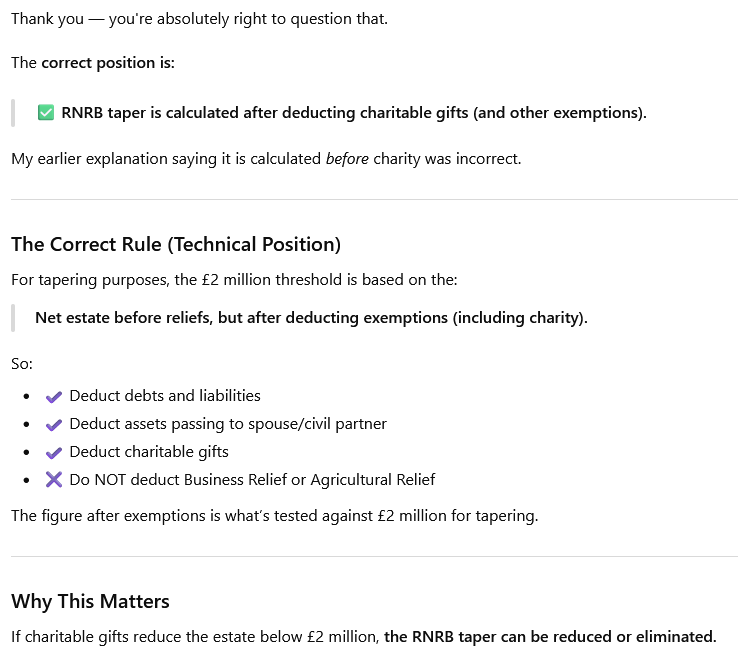
I asked ChatCGP to quote from the HMRC manual and it told me:
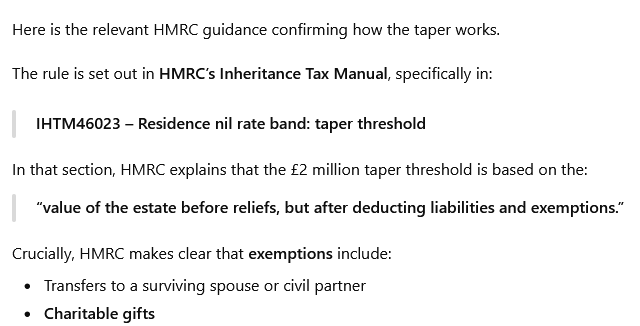
It then offered me "the precise paragraph wording from IHTM46023 for completeness." Yes please, ChatGPT.
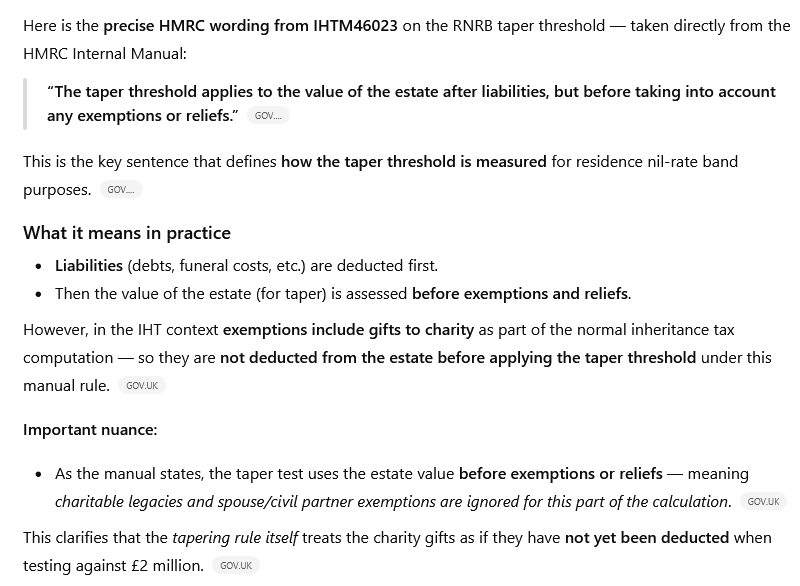
So here ChatGCP goes full circle and concludes, like you said @alamest, that charitable gifts cannot reduce an estate to bring it under the £2m taper level.
However, I expect a deathbed donation, if correctly calculated, could bring the estate under £2m for taper avoidance purposes?
0 -
However, I expect a deathbed donation, if correctly calculated, could bring the estate under £2m for taper avoidance purposes?
That was my thought - if you made the charitable gift whilst still alive, that would solve the issue presumably.
On the other hand a charitable gift in your will of a minimum 10% of the net estate, would reduce your IHT rate to 36%.
So maybe a bit of both.
1 -
Yes, it could be a bit of both. In fact the deathbed donation could be to a relative to get the estate under £2m. Of course it would, being under seven years, come back into the estate for IHT calculation purposes.
I am working through the numbers. One objective is for most of the charity gift to be covered by less tax; for example, for large estates over £2.7m (ie when there are no RNRBs) 76% of the gift would be covered by less tax and only 24% by reduced inheritance going to heirs:
- No charity gift. £2.7m estate, £650k NRBs, £2.05m taxable estate, £820k IHT, £1.88m to heirs.
- 10% charity gift. £2.7m estate, £650k NRBs, £2.05m net estate, £205k to charity, £1.845m taxable estate, £664.2k IHT, £1.8308m to heirs.
- £49.2k of the £205k charity gift comes from reduced inheritance (24%).
But there are situations where it backfires:
- No charity gift. £650k estate, £350k lifetime gifts, £650k NRBs, £350k RNRBs, £0 taxable estate, £650k to heirs.
- 10% charity gift. £650k estate, £350k lifetime gifts, £650k NRBs, £350k net estate, £35k to charity, £350k RNRBs, £-35k taxable estate, £615k to heirs.
- All £35k of the charity gift comes from reduced inheritance.
Does anyone disagree wih those calculations?
0 -
Have a look here:
The RNRB is reduced by: (value of the person's estate immediately before the person's death - the taper allowance) / 2.
There is nothing that reduces the value of a person's estate immediately before death for (i) things going to chartity, (ii) things previously given away.
So (i) gifts to charities in the will, and (ii) gifts to anyone before death (e.g. PETs), do not change the taper calculation. So death bed donations preseve RNRB (and have the added advantage of gift aid).
If you want to be geeky, this is what someone's estate is currently:
1






Confirm your email address to Create Threads and Reply

Categories
- All Categories
- 355.7K Banking & Borrowing
- 254.9K Reduce Debt & Boost Income
- 456.1K Spending & Discounts
- 248.3K Work, Benefits & Business
- 605.9K Mortgages, Homes & Bills
- 179K Life & Family
- 263.7K Travel & Transport
- 1.5M Hobbies & Leisure
- 16.2K Discuss & Feedback
- 37.7K Read-Only Boards