We’d like to remind Forumites to please avoid political debate on the Forum.
This is to keep it a safe and useful space for MoneySaving discussions. Threads that are – or become – political in nature may be removed in line with the Forum’s rules. Thank you for your understanding.
HL SIPP Track the market vs Expert Managed


Comments
-
Usually, most “expert managed” funds struggle to beat simple low-cost trackers over the long run, especially once fees are taken into account.
I’ve been with HL for a few years and stuck largely with trackers for that reason. The expert-managed option looks attractive in theory, but the higher ongoing charges make it a harder sell unless they genuinely outperform — which historically isn’t common.
That said, some people value the hands-off aspect and peace of mind, so it depends how involved you want to be.
I’ve also noticed a few cashback offers around recently for transferring out, so I’ve been looking at alternatives myself. I actually started an application with one provider but their system kept breaking, which was a bit off-putting.
Interested to hear if anyone’s had a long-term experience where the expert-managed route genuinely felt worth the extra cost.
1 -
I've been in income drawdown with HL for about 9 years now. The core of my portfolio has been about 5 managed equity income funds - all of these funds had a HL discount.
All of the funds have provided a good income yield as well as good growth, but 1 or 2 have really out performed the market. e.g BNY Mellon Global Income has averaged 2.9% annual income yield but has grown about 166% over 9 years. So much in fact that I had sell funds to rebalance my portfolio.
Overall very pleased with the performance, the only fund that was slightly disappointing was Troy Trojan Income which I switched out of about 12 months ago. Interesting that my brother-in-law, who is also with HL, opted for the low cost tracker approach but his portfolio hasn't performed anything like as well.
0 -
Here we go again.
It's perfectly possible for managed funds to lag, equal or beat their benchmark...if they have one. If you DIY with index tracking funds you should save on fees over a managed fund portfolio...doubly so if you avoid an IFA as well. I'm retired and I DIY with a equity heavy portfolio of mostly index trackers and I've averaged 12% annual return over the last decade. So make of that what you will. That's way beyond what I planned and my nest egg has more than tripled since I stopped working, so I'm very much in the DIY index camp.And so we beat on, boats against the current, borne back ceaselessly into the past.0 -
Not a straightforward comparison, but since 2016, HSBC FTSE All-world index fund (acc) has had growth of 235% (i.e., £1k became £3.35k)- selling 2.9% of the fund each year, led to £1k becoming £2.8k, i.e. growth of about 180%.Fermion said:I've been in income drawdown with HL for about 9 years now. The core of my portfolio has been about 5 managed equity income funds - all of these funds had a HL discount.
All of the funds have provided a good income yield as well as good growth, but 1 or 2 have really out performed the market. e.g BNY Mellon Global Income has averaged 2.9% annual income yield but has grown about 166% over 9 years. So much in fact that I had sell funds to rebalance my portfolio.
Overall very pleased with the performance, the only fund that was slightly disappointing was Troy Trojan Income which I switched out of about 12 months ago. Interesting that my brother-in-law, who is also with HL, opted for the low cost tracker approach but his portfolio hasn't performed anything like as well.
In other words, BNY Mellon Global Income has just about matched a global index over that time, but has provided income in a more convenient fashion.
The relative allocations to equities and fixed income have probably had a much larger effect on portfolio returns over the last 10 years than active/passive since equities have had such a good run in that time.1 -
Looking at their 'track the market' adventurous option compared to the FTSE All world index, it would appear to slightly underweight the US and overweight the UK. Assuming the 0.3% management cost is on top of the costs for the individual funds held then holding a single world index fund (e.g., HSBC FTSE All-world index fund) will be cheaper and is likely to perform similarly.sometime_soon said:As above. Obviously fees are much higher so just wondered what, if any, people’s experience has been and if they felt it had been worth it or not? ( Appreciate fund size and many other factors come in to play but as a simplistic experience!)
The expert managed fund has risen 40% since inception (March 2023) compared to about 53% for the HSBC index fund. Whether it will do better or worse in the future is impossible to say, but (given the large fee) probably not over the long term.
0 -
What do you mean by expert managed?sometime_soon said:As above. Obviously fees are much higher so just wondered what, if any, people’s experience has been and if they felt it had been worth it or not? ( Appreciate fund size and many other factors come in to play but as a simplistic experience!)
IFA, MPS, Fund house?
Would that management be underlying passive but management on the weightings?
Or is it full managed (funds and selection)?
What do you mean by track the market?
Passive funds with you making the weightings decisions?
Multi-asset funds making the weightings decisions?
Market cap or one of the many variatons possible?
Are you looking specifically at an HL own brand option or a different fund house?
HL platform plus HL own brand charges actually puts your total costs near full advice terrirtory (e.g. HL platform 0.45% + 0.3% OCF = 0.75%. IFA at 0.50%, platform at 0.15% and OCF 0.16% = 0.81%. (can be cheaper, can be more expensive depending on your instructions to the IFA. Indeed, the one I saw on Friday has a total 0.76%).
DIY is best when you achieve the same or a similar outcome without the costs. If you go DIY in any area of life, you usually do it to lower your costs. A good job and good DIY is a good outcome. Bad DIY, which can be bad decision-making or using higher cost options, is not a good outcome. It could range for sub-optimal and still getting away with it through to disastrous decisions.
Here is the performance of HL's Balanced version since launch vs a couple of IFA options and OEIC versions all using passives.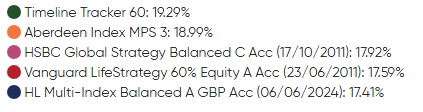
If we look at the period when US more or less switched from being best to worst: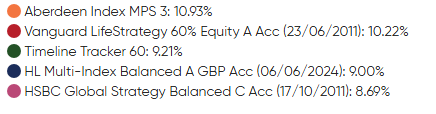
You see that one of the best options since 2011 (HSBC) is bottom now.
What is strange is that HL is bottom/near bottom in both periods. Upper has more of the period when US was best. Lower has more of the period when US was worst. So, a portfolio with a higher US weighting did better when the US was best but not as well when US underperformed. HL managed to be bottom or near bottom in both periods. (it is a short list, many fund houses and MPS have variants and HL could be better than some or many of those but I just selected from two of the popular IFA MPS and DIY Multi-asset funds).
If is worth noting that all of those are managed funds or managed portfolios. They all have underlying passive strategies (tracking the market), but the asset weightings, adjustments between them, and how they are rebalanced are management decisions.I am an Independent Financial Adviser (IFA). The comments I make are just my opinion and are for discussion purposes only. They are not financial advice and you should not treat them as such. If you feel an area discussed may be relevant to you, then please seek advice from an Independent Financial Adviser local to you.0 -
Thankyou for that. I am very new to this and probably should start with something easier like Quantum or Theoretical Physics before I move on to understanding this and investments! But joking aside it is a valuable forum and giving me a lot to research and learn .dunstonh said:
What do you mean by expert managed?sometime_soon said:As above. Obviously fees are much higher so just wondered what, if any, people’s experience has been and if they felt it had been worth it or not? ( Appreciate fund size and many other factors come in to play but as a simplistic experience!)
IFA, MPS, Fund house?
Would that management be underlying passive but management on the weightings?
Or is it full managed (funds and selection)?
What do you mean by track the market?
Passive funds with you making the weightings decisions?
Multi-asset funds making the weightings decisions?
Market cap or one of the many variatons possible?
Are you looking specifically at an HL own brand option or a different fund house?
HL platform plus HL own brand charges actually puts your total costs near full advice terrirtory (e.g. HL platform 0.45% + 0.3% OCF = 0.75%. IFA at 0.50%, platform at 0.15% and OCF 0.16% = 0.81%. (can be cheaper, can be more expensive depending on your instructions to the IFA. Indeed, the one I saw on Friday has a total 0.76%).
DIY is best when you achieve the same or a similar outcome without the costs. If you go DIY in any area of life, you usually do it to lower your costs. A good job and good DIY is a good outcome. Bad DIY, which can be bad decision-making or using higher cost options, is not a good outcome. It could range for sub-optimal and still getting away with it through to disastrous decisions.
Here is the performance of HL's Balanced version since launch vs a couple of IFA options and OEIC versions all using passives.
If we look at the period when US more or less switched from being best to worst:
You see that one of the best options since 2011 (HSBC) is bottom now.
What is strange is that HL is bottom/near bottom in both periods. Upper has more of the period when US was best. Lower has more of the period when US was worst. So, a portfolio with a higher US weighting did better when the US was best but not as well when US underperformed. HL managed to be bottom or near bottom in both periods. (it is a short list, many fund houses and MPS have variants and HL could be better than some or many of those but I just selected from two of the popular IFA MPS and DIY Multi-asset funds).
If is worth noting that all of those are managed funds or managed portfolios. They all have underlying passive strategies (tracking the market), but the asset weightings, adjustments between them, and how they are rebalanced are management decisions.0 -
I know that this is an ionic remark, but I think it's important to dispel any idea that investing and personal finances needs to be complicated. All you need is basic mathematics like percentages and some understanding of probability - there's no need for eigenfunctions or matrices. Just the mention of investing can intimidate many people and given the way pensions and ISAs are structured that isn't a good thing.sometime_soon said:
Thankyou for that. I am very new to this and probably should start with something easier like Quantum or Theoretical Physics before I move on to understanding this and investments! But joking aside it is a valuable forum and giving me a lot to research and learn .dunstonh said:
What do you mean by expert managed?sometime_soon said:As above. Obviously fees are much higher so just wondered what, if any, people’s experience has been and if they felt it had been worth it or not? ( Appreciate fund size and many other factors come in to play but as a simplistic experience!)
IFA, MPS, Fund house?
Would that management be underlying passive but management on the weightings?
Or is it full managed (funds and selection)?
What do you mean by track the market?
Passive funds with you making the weightings decisions?
Multi-asset funds making the weightings decisions?
Market cap or one of the many variatons possible?
Are you looking specifically at an HL own brand option or a different fund house?
HL platform plus HL own brand charges actually puts your total costs near full advice terrirtory (e.g. HL platform 0.45% + 0.3% OCF = 0.75%. IFA at 0.50%, platform at 0.15% and OCF 0.16% = 0.81%. (can be cheaper, can be more expensive depending on your instructions to the IFA. Indeed, the one I saw on Friday has a total 0.76%).
DIY is best when you achieve the same or a similar outcome without the costs. If you go DIY in any area of life, you usually do it to lower your costs. A good job and good DIY is a good outcome. Bad DIY, which can be bad decision-making or using higher cost options, is not a good outcome. It could range for sub-optimal and still getting away with it through to disastrous decisions.
Here is the performance of HL's Balanced version since launch vs a couple of IFA options and OEIC versions all using passives.
If we look at the period when US more or less switched from being best to worst:
You see that one of the best options since 2011 (HSBC) is bottom now.
What is strange is that HL is bottom/near bottom in both periods. Upper has more of the period when US was best. Lower has more of the period when US was worst. So, a portfolio with a higher US weighting did better when the US was best but not as well when US underperformed. HL managed to be bottom or near bottom in both periods. (it is a short list, many fund houses and MPS have variants and HL could be better than some or many of those but I just selected from two of the popular IFA MPS and DIY Multi-asset funds).
If is worth noting that all of those are managed funds or managed portfolios. They all have underlying passive strategies (tracking the market), but the asset weightings, adjustments between them, and how they are rebalanced are management decisions.And so we beat on, boats against the current, borne back ceaselessly into the past.0 -
You are absolutely right but it is something that really depends on your exposure to finance from a young age. For me and certainly many others, a non existent or very low income family and debt collectors being a way of life as children , just getting out of school with a job was a bonus and this reflects your caution and lack of knowledge for a long time. Education in these matters would benefit many but that’s a whole other discussion!! For now I try to learn more at a rather late stage.Bostonerimus1 said:
I know that this is an ionic remark, but I think it's important to dispel any idea that investing and personal finances needs to be complicated. All you need is basic mathematics like percentages and some understanding of probability - there's no need for eigenfunctions or matrices. Just the mention of investing can intimidate many people and given the way pensions and ISAs are structured that isn't a good thing.sometime_soon said:
Thankyou for that. I am very new to this and probably should start with something easier like Quantum or Theoretical Physics before I move on to understanding this and investments! But joking aside it is a valuable forum and giving me a lot to research and learn .dunstonh said:
What do you mean by expert managed?sometime_soon said:As above. Obviously fees are much higher so just wondered what, if any, people’s experience has been and if they felt it had been worth it or not? ( Appreciate fund size and many other factors come in to play but as a simplistic experience!)
IFA, MPS, Fund house?
Would that management be underlying passive but management on the weightings?
Or is it full managed (funds and selection)?
What do you mean by track the market?
Passive funds with you making the weightings decisions?
Multi-asset funds making the weightings decisions?
Market cap or one of the many variatons possible?
Are you looking specifically at an HL own brand option or a different fund house?
HL platform plus HL own brand charges actually puts your total costs near full advice terrirtory (e.g. HL platform 0.45% + 0.3% OCF = 0.75%. IFA at 0.50%, platform at 0.15% and OCF 0.16% = 0.81%. (can be cheaper, can be more expensive depending on your instructions to the IFA. Indeed, the one I saw on Friday has a total 0.76%).
DIY is best when you achieve the same or a similar outcome without the costs. If you go DIY in any area of life, you usually do it to lower your costs. A good job and good DIY is a good outcome. Bad DIY, which can be bad decision-making or using higher cost options, is not a good outcome. It could range for sub-optimal and still getting away with it through to disastrous decisions.
Here is the performance of HL's Balanced version since launch vs a couple of IFA options and OEIC versions all using passives.
If we look at the period when US more or less switched from being best to worst:
You see that one of the best options since 2011 (HSBC) is bottom now.
What is strange is that HL is bottom/near bottom in both periods. Upper has more of the period when US was best. Lower has more of the period when US was worst. So, a portfolio with a higher US weighting did better when the US was best but not as well when US underperformed. HL managed to be bottom or near bottom in both periods. (it is a short list, many fund houses and MPS have variants and HL could be better than some or many of those but I just selected from two of the popular IFA MPS and DIY Multi-asset funds).
If is worth noting that all of those are managed funds or managed portfolios. They all have underlying passive strategies (tracking the market), but the asset weightings, adjustments between them, and how they are rebalanced are management decisions.0 -
If you ask around, you will find a large majority of the public has a pitiful level of knowledge about personal finance, regardless of their background.sometime_soon said:
You are absolutely right but it is something that really depends on your exposure to finance from a young age. For me and certainly many others, a non existent or very low income family and debt collectors being a way of life as children , just getting out of school with a job was a bonus and this reflects your caution and lack of knowledge for a long time. Education in these matters would benefit many but that’s a whole other discussion!! For now I try to learn more at a rather late stage.Bostonerimus1 said:
I know that this is an ionic remark, but I think it's important to dispel any idea that investing and personal finances needs to be complicated. All you need is basic mathematics like percentages and some understanding of probability - there's no need for eigenfunctions or matrices. Just the mention of investing can intimidate many people and given the way pensions and ISAs are structured that isn't a good thing.sometime_soon said:
Thankyou for that. I am very new to this and probably should start with something easier like Quantum or Theoretical Physics before I move on to understanding this and investments! But joking aside it is a valuable forum and giving me a lot to research and learn .dunstonh said:
What do you mean by expert managed?sometime_soon said:As above. Obviously fees are much higher so just wondered what, if any, people’s experience has been and if they felt it had been worth it or not? ( Appreciate fund size and many other factors come in to play but as a simplistic experience!)
IFA, MPS, Fund house?
Would that management be underlying passive but management on the weightings?
Or is it full managed (funds and selection)?
What do you mean by track the market?
Passive funds with you making the weightings decisions?
Multi-asset funds making the weightings decisions?
Market cap or one of the many variatons possible?
Are you looking specifically at an HL own brand option or a different fund house?
HL platform plus HL own brand charges actually puts your total costs near full advice terrirtory (e.g. HL platform 0.45% + 0.3% OCF = 0.75%. IFA at 0.50%, platform at 0.15% and OCF 0.16% = 0.81%. (can be cheaper, can be more expensive depending on your instructions to the IFA. Indeed, the one I saw on Friday has a total 0.76%).
DIY is best when you achieve the same or a similar outcome without the costs. If you go DIY in any area of life, you usually do it to lower your costs. A good job and good DIY is a good outcome. Bad DIY, which can be bad decision-making or using higher cost options, is not a good outcome. It could range for sub-optimal and still getting away with it through to disastrous decisions.
Here is the performance of HL's Balanced version since launch vs a couple of IFA options and OEIC versions all using passives.
If we look at the period when US more or less switched from being best to worst:
You see that one of the best options since 2011 (HSBC) is bottom now.
What is strange is that HL is bottom/near bottom in both periods. Upper has more of the period when US was best. Lower has more of the period when US was worst. So, a portfolio with a higher US weighting did better when the US was best but not as well when US underperformed. HL managed to be bottom or near bottom in both periods. (it is a short list, many fund houses and MPS have variants and HL could be better than some or many of those but I just selected from two of the popular IFA MPS and DIY Multi-asset funds).
If is worth noting that all of those are managed funds or managed portfolios. They all have underlying passive strategies (tracking the market), but the asset weightings, adjustments between them, and how they are rebalanced are management decisions.
Of course if your parents are interested in it and give you a basic grounding, that is bound to be a big help.
However not sure how much income comes into it. We have posters on here earning £150K pa who are pretty clueless about savings, pensions, or even how much tax they are paying.
On the other hand sometimes having a poor background can make people very mindful of money when they grow up.1








Confirm your email address to Create Threads and Reply

Categories
- All Categories
- 354.5K Banking & Borrowing
- 254.4K Reduce Debt & Boost Income
- 455.4K Spending & Discounts
- 247.4K Work, Benefits & Business
- 604.2K Mortgages, Homes & Bills
- 178.5K Life & Family
- 261.7K Travel & Transport
- 1.5M Hobbies & Leisure
- 16.1K Discuss & Feedback
- 37.7K Read-Only Boards