We’d like to remind Forumites to please avoid political debate on the Forum.
This is to keep it a safe and useful space for MoneySaving discussions. Threads that are – or become – political in nature may be removed in line with the Forum’s rules. Thank you for your understanding.
📨 Have you signed up to the Forum's new Email Digest yet? Get a selection of trending threads sent straight to your inbox daily, weekly or monthly!
ILG pricing
Veloflyer
Posts: 361


 Forumite
Simply as an exercise to see how things work, I bought of £500 of Treasury Index linked 0.125% 22/03/26 today via Bell. Price on Bell currently shows 156.23
Put me right please - I assume that price continually rises - due to the IL bit continually being added on?
Coupon will be 0.125/100 x price at the time of coupon divided by 2.
Put me right please - I assume that price continually rises - due to the IL bit continually being added on?
Coupon will be 0.125/100 x price at the time of coupon divided by 2.
0
Comments
-
The (dirty) market price of ILGs will depend on demand from other investors
As this is very close to redemption it won't change much but it's likely to have an upward direction.
It's the longer dated ILGs that will be more volatile going up and down in (dirty) market price
If you don't ever sell it the market price doesn't matter anymore.
If you hold to redemption the government will pay you £100 x the Index Ratio (currently 1.57515 as there has been 57% inflation since it was issued in 2015) plus any coupons (£100 x 0.125% x the Index Ratio pa) along the way.
https://www.dividenddata.co.uk/gilts.py?ticker=TR26
https://www.dividenddata.co.uk/index-linked-gilts-prices-yields.py0 -
It's possible for the retail price index to fall, and it has in fact done so twice in recent months.
There are seasonal effects which contribute to this - e.g. Black Friday sales reducing prices in Nov compared to Oct; seasonal food prices, etc.
If the index falls below the value it had when you bought the gilt, the dirty price ( and redemption value, if it reaches maturity) may fall, because the index ratio (Current RPI divided by RPI at issue date) is smaller. That will combine with any gain/loss you make by buying at (clean price) below or above 100.
0 -
What’s the reasoning for buying ones that mature in 3 months?0
-
Technically I suppose it can make a quick small gain, and then reinvest. Buy at (clean) 99.22 and redeem at 100. Plus any inflation gain.
But dealing costs eat into that, and there are easier ways to get higher return in the short term.
It sounds like OP is just doing this to see how it all works.0 -
Correct to the latter. Testing theory basically - as well as the Bell website.af1963 said:Technically I suppose it can make a quick small gain, and then reinvest. Buy at (clean) 99.22 and redeem at 100. Plus any inflation gain.
But dealing costs eat into that, and there are easier ways to get higher return in the short term.
It sounds like OP is just doing this to see how it all works.
If the index falls below the value it had when you bought the gilt, the dirty price ( and redemption value, if it reaches maturity) may fall, because the index ratio (Current RPI divided by RPI at issue date) is smaller. That will combine with any gain/loss you make by buying at (clean price) below or above 100
Hmmm.... surely what matters for calculation of redemption is the RPI index ratio over the whole term of the gilt i.e. RPI at redemption/RPI at issue? I'd only perhaps make a loss if RPI at redemption is smaller than RPI when bought?1 -
The redemption price is always going to be £100 or £100 plus inflation if Index Linked.Veloflyer said:
Correct to the latter. Testing theory basically - as well as the Bell website. Both with the possibility of constructing a far more costly gilt ladder in the near future. I do intend to hold until redemption. Interesting that the redemption price could fall - not thought about that.af1963 said:Technically I suppose it can make a quick small gain, and then reinvest. Buy at (clean) 99.22 and redeem at 100. Plus any inflation gain.
But dealing costs eat into that, and there are easier ways to get higher return in the short term.
It sounds like OP is just doing this to see how it all works.
If you sell before redemption then the sale price could be less than you paid.
Gilt prices are typically higher when interest rates are low and lower when interest rates are expected to be higher: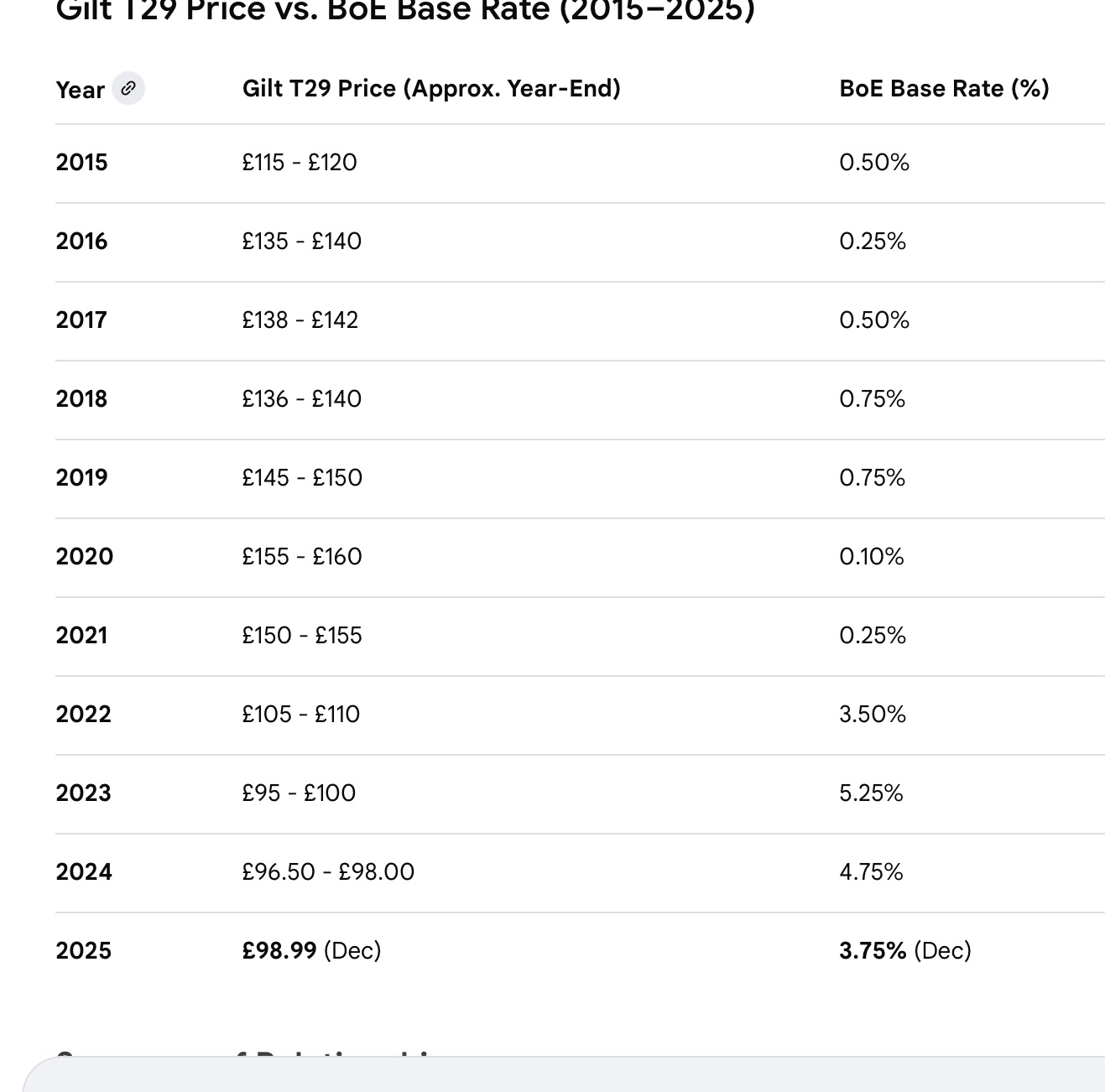
0 -
Strange, my Gilts have fallen today after the interest rate cut, in fact T34 has fallen 1.77% today.
They were up slightly a few days ago.0 -
Using illustrative (made-up !) RPI figures: If the gilt was issued when RPI was 100 , and you bought when RPI was 150, then it matured when RPI had fallen to 140 - then ignoring variations in the underlying clean price, you'd pay a higher index linked dirty price than you get back on maturity. But it should still buy you the same amount of goods.
Hmmm.... surely what matters for calculation of redemption is the RPI index ratio over the whole term of the gilt i.e. RPI at redemption/RPI at issue? I'd only perhaps make a loss if RPI at redemption is smaller than RPI when bought?
Any falls in RPI have historically been very small and very short term.0 -
Indexation is always 0 when the ILG is issued so the Index Ratio always starts at 1.0af1963 said:Using illustrative (made-up !) RPI figures: If the gilt was issued when RPI was 100 , and you bought when RPI was 150, then it matured when RPI had fallen to 140 - then ignoring variations in the underlying clean price, you'd pay a higher index linked dirty price than you get back on maturity. But it should still buy you the same amount of goods.
Any falls in RPI have historically been very small and very short term.
You can't really ignore variations in the clean price as it's a very important factor and in current market conditions means you might well have paid a price lower than £100 x current Index Ratio particularly on longer dated ILGs in which case even with 1920s style deflation reducing the Index Ratio you might still get back more than you paid.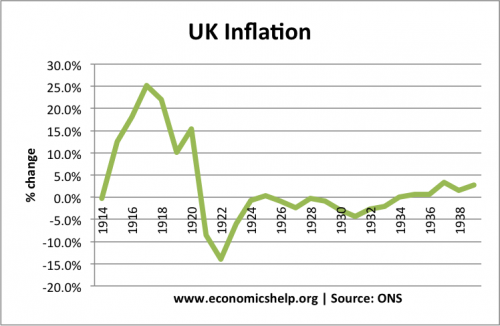
0 -
Yes - I think we are aligned. Thanks for clarifying. I also appreciate the further comments on clean price. Incidentally perhaps, I am not really looking to ILGs as wealth generation. I am far more interested in wealth preservation, with the eventual goal of using the withdrawals from a potential ILG ladder to fund basic needs in retirement - at least for the first few years.af1963 said:
Using illustrative (made-up !) RPI figures: If the gilt was issued when RPI was 100 , and you bought when RPI was 150, then it matured when RPI had fallen to 140 - then ignoring variations in the underlying clean price, you'd pay a higher index linked dirty price than you get back on maturity. But it should still buy you the same amount of goods.
Hmmm.... surely what matters for calculation of redemption is the RPI index ratio over the whole term of the gilt i.e. RPI at redemption/RPI at issue? I'd only perhaps make a loss if RPI at redemption is smaller than RPI when bought?
Any falls in RPI have historically been very small and very short term.1








Confirm your email address to Create Threads and Reply

Categories
- All Categories
- 355.8K Banking & Borrowing
- 254.9K Reduce Debt & Boost Income
- 456.2K Spending & Discounts
- 248.3K Work, Benefits & Business
- 606K Mortgages, Homes & Bills
- 179K Life & Family
- 263.8K Travel & Transport
- 1.5M Hobbies & Leisure
- 16.2K Discuss & Feedback
- 37.7K Read-Only Boards